Build Your Leadership On Your Strengths

So much of how we feel about going to work each day depends on our leaders. A great principal can make your day. A lousy one can kill your year. Many of us have had both and there are lessons to be learned from either. Let me give you two of mine.

My best principal ever knew all the teachers well. He was adept at noticing whether you were not yourself. If he saw that you were having an off day, he would often tell you to go to the nurse’s office and relax. He would teach your class. His leadership had so many benefits. The teachers felt that he not only cared, but he would take care of them. And the teachers were always willing to give back. If there was a shortage of a substitute one day, and he asked a teacher to cover an additional class, they would do so gladly. He also got to know the students on a different level from most principals I worked with, further showing his commitment and consistency.

On the other hand, I had a principal who was an egotistical misogynist. I, and almost everyone else, gave him the bare minimum. I was exhausted at the end of every day and brought my tension and anger home a lot. Too many of my dinner conversations began with, “You know what he did today?” It took me about a year before I appreciated how he was affecting all aspects of my life. Eventually, I began job hunting and found another position.

They both showed me important things about leadership – and how I did and didn’t want to lead. The first principal exuded empathy, an often-cited leadership quality. The second fell into the category of a leader who exemplified Power Over as his approach to leadership. What I hadn’t considered until I read Suzanne Degges-White’s article Are Ambiverts the Most Effective Leaders was a different way to determine your leadership mode.

Degges-White looks at introverts, extroverts, and ambiverts. We are familiar with the first two, but ambiverts, who embody both types, are less well known. And she says regardless of whether you are an introvert or an extrovert, you can become an ambivert. It is also important to recognize that no matter your type, you can be a good leader. “Effective leadership is based on healthy and productive relationships, not just personality types.” My two examples are evidence of that.

Taking a closer look at the strengths of each type of leader, Degges-White observes that introverts are good listeners, which means they think before jumping in to say something. They build relationships slowly and with care. They don’t seek the limelight, instead recognize the strengths others have. Extroverts are comfortable in a variety of settings. They tend to make decisions more quickly and pivot rapidly when needed. They are the ones who are seen as “natural” leaders.

So, what about ambiverts and their strengths? While they might like their alone time, they also enjoy being with others. They are comfortable with both individual projects and working on group ones. As leaders, they aren’t impulsive, but are open to trying new approaches. They are not afraid of taking risks, another often mentioned leadership quality.

The good news is that no matter if you see yourself as more of an introvert or an extrovert, you can become more of an ambivert. It only takes a few small steps to make you an ambivert. Fearful of risks? Take a few small ones. Do you dominate conversations? Make it a point to let others speak before you do. As you practice these steps, you will take on more and more qualities of ambivert.

As a leader, you always want to work from your strengths, but you can also get better. By stretching your natural personality type, you can become an ambivert – the most effective type of leader.

Avoiding Conflict – Makes It Worse

As School Librarians one part of our job is to have positive relations with all our colleagues, but this doesn’t mean you’re going to like everyone. There will always be people who rub you the wrong way or who you wish you could avoid. People with whom it’s hard to speak, who have opposing viewpoints and with whom there is always a sense of conflict. But avoiding them and the situation prevents any likelihood of having positive relations.

So how can we powerfully step into situations where we know there is going to be conflict? In her post, Uncovering 5 Hidden Stages of Conflict, Marlen Chisolm explores how to look at what is going on under the service because, she asserts, the conflict is not the problem. The avoidance is. To understand this better, Chisholm discusses all the ways avoidance comes into play:

  1. Inner Disturbance – You just feel “off” every time you are in contact with that person. You get the feeling they don’t like you. It may not be overt, but you can’t avoid that antipathy coming from them. It’s uncomfortable, so you avoid unnecessary conversations with them or being in proximity to them. 
  2. Justifying – It doesn’t seem reasonable to confront them about that sensation. What could you say, anyway? Do you suspect it’s some innate bias, and then wonder if you are being ultrasensitive. Yet letting it go on doesn’t change anything. People treat you as you train them to treat you. What you accept will continue. By excusing or letting it go, you avoid facing and discussing the situation.
  3. Seeing Them as Adversary – When you let the situation continue, you tense every time you interact with them. Chisolm says we frequently find ourselves viewing  them as the enemy. While that is a natural self-defense, it doesn’t deal with the problem or cause any changes. Again, you are avoiding and the conflict continues.
  4. Seeking Social Proof – The longer it goes on, the more you look for evidence as to whether you are the only target, or to see if the person is that way with others. Now you seek corroboration. You ask others if they are seeing/feeling the same thing you are. In addition to not solving the problem, you are creating divisions which can affect how your community functions.Word will get back to the person, or worse to administrators, as to your queries. Nothing about will make you look professional. Through your avoidance, the problem has gotten worse.
  5. Aggression – As you continue avoiding the issue, you become increasingly frustrated and angry. Now you run the risk of a real blow up. Whatever follows will be heated. You have become the initiator and have probably damaged your reputation. Hopefully, your explosion didn’t happen where others could see, although word will spread. Being able to work with this teacher will be incredibly difficult, if not impossible. By avoidance, you have now also harmed students who won’t get the learning experiences you normally create.

Avoidance may seem safe, but as Chisolm has shown, it’s the worst option possible. As soon as you get that “Inner Disturbance,” accept that it’s a wake-up call to act. Take time –not too long—to gather your thoughts. What is the outcome you want? Ask yourself, “Do you want it to work, or do you want to win? Because if you want to win, it won’t work.”

Be prepared to do active listening. Don’t try to rush in with counter-arguments. Arguments are power struggles. The Power you need to draw on is Power With which is finding common ground among different interests. What do you and that teacher have in common? Focus on that.

Don’t let micro aggressions or other perceived negative feelings coming from someone affect your ability to be a good leader. Leaders work well with others and are willing to take risks when needed. 

How To Tap Down Triggers

EDITOR’S NOTE – This blog about a specific and contained type of triggers. More serious, lasting triggers need a different kind of attention and help. Please get the support you need and deserve.

~~~~~~~~~

What is a trigger? A month ago, I wrote Look for Glimmers and Find Joy which discussed how Glimmers were the opposite of triggers. Both cause an unanticipated emotional reaction. The first is wonderfully positive. The second can cause us any number of negative effects including damaging our relationships and how people perceive us and our program.

Glimmers and triggers are opposite in one other way. You have to notice glimmers to appreciate them. Triggers slam into you without any invitation.

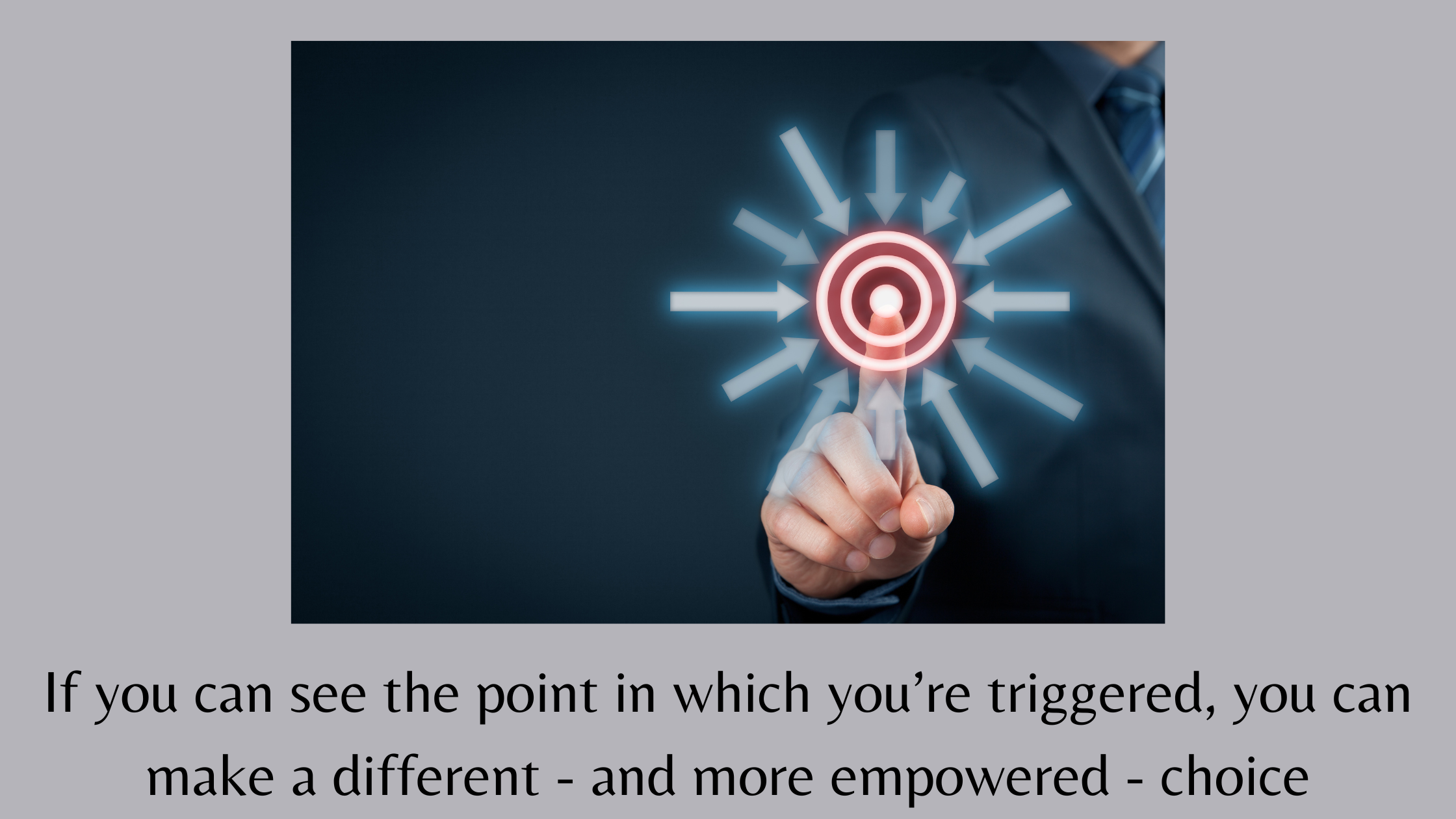
While triggers take you unaware, if you are going to deal with them, you need to recognize when you are having a trigger response. This isn’t easy when your emotions are taking over.

Andrea Mein DeWitt’s article, A Leader’s 3-Step Strategy to Being Less Emotional, Reactive, recommend you Name, Claim, and Reframe. This approach will give you skills to modify what could be a damaging response from you. Notice that she references “leaders.” Leaders can’t allow triggers to affect how they react in a given situation.

Here are her steps:

  1. Name – Look for the source of the trigger. (This is not like noticing glimmers, but in reverse.) She asks you to identify what is causing you to react rather than respond – an important distinction – and what specific emotion is in play. Also note what, if any, of your core values have been attacked. For example, book banning and malicious name-calling is on the rise leaving us emotionally exhausted. We are tired of explaining. When one more attack comes, particularly if it comes from what we thought was a friendly source, we can explode.
  2. Claim – Now that you know where your reaction came from, what can you do about it? De Witt wants you to identify the action(s) you can take to bring you back to your core values. Take your ego out and think what might have caused the person to say/do what then triggered your reaction. Then, look to what can you do to get the conversation back to the issue at stake. Rather than responding by saying “we are not…(insert charge)..” turn to the positive, reminding parents, teachers and administrators that,“libraries need to be a safe, welcoming space for all.” From there, you can better discuss what to do.
  3. Reframe – This helps you to move on positively from a stressful conversation. DeWitt says to ask yourself what you learned and what is now an opportunity to use your creativity. Which of the ideas you came up with will produce the best results and promote your Mission and Vision? Notice any new resources you can now use. As you reflect on what happened, you might decide to do a bulletin board or infographic identifying how libraries create a safe space. Perhaps mention the Mirrors, Windows, and Sliding Doors concept. Do something interactive such as having teachers/students anonymously post notes on the bulletin board saying how the library/librarian made them safe and welcome.

We are in the relationship business. With emotions running high and politics affecting libraries and librarians, we must do all we can to avoid being further sucked into the intensity of the triggers and stresses around us. Emotional Intelligence includes Managing Your Emotions for a reason. Leaders – and you are a leader – need to have all the tools possible to do it.

Small Talk Brings Big Results

Your success is built on the strength of the relationships you have as much as it is on the programs you run and the collections you create. If we don’t know how to build relationships, we will soon be out of business. So how do we develop these relationships? You start with small talk.

Small talk is like the way plants reproduce by dropping their seeds everywhere. Most of them won’t take root, but some will. And that’s the idea. Not every short conversation will start a relationship, but some will.  Sometimes, you will run into that person again, and you continue with small talk until one day you discover it’s become something bigger.

Consider every interaction as an opportunity. But use it as an opportunity to connect, not to push your message about librarians. When you have a follow up conversation, then the opening might occur. If it does, have your elevator speech ready (2-3 sentences that explain your mission for the library). Even better — have many variations depending on what would be most appropriate in the moment.

The post by Lisa A. Beach, The Art of Small Talk: How to Connect with Strangers and Acquaintances, is a helpful guide to developing your skill at purposeful small talk. Remember, all interactions are significant because no matter their length they will leave the other person with a positive or negative impression of you.

Beach recommends that you don’t divulge too many personal details too soon. Instead, you need to look and listen for clues that the other party is interested. What information have they offered? Why are they participating in this conversation? Do they appear to be welcoming the interchange?  She suggests you “find the magic in the moment.” Enjoy the conversation without worrying if it will go further.

To get better at small talk, Beach offers the following techniques:

  • The art of making small talk more meaningful – Get the other person to talk by asking open ended questions. Are they reading a book? Wearing a scarf or piece of jewelry you like? Have a picture on their desk of a pet or family member? All of these can be a place to start a conversation about something clearly important to them.
  • Overcoming shyness in social situations – If you are uncomfortable about initiating a conversation, remember the outcome you want which is better relationships throughout your school with students, teachers, and administrators. Since small talk has low stakes, this can be a great place to gain confidence. This way when you need speak, there’s already a connection to lean on. The more you engage in these – even when you’re nervous – the better your results will be over time.
  • Navigate graceful exits – Knowing how to get out of a conversation is as important as knowing how to start one. Some people have a lot of time on their hands and can talk forever. Beach has a three-step method. First, thank them for an interesting conversation, then indicate what you need to do, and close by wishing them well.  For part one, identify something they shared that you appreciated.  This has the added benefit of showing them you were listening. It may also give you a way to start your next conversation.

Small talk may not seem important, but these brief interactions will add up to something bigger – a relationship. As librarians, we want to be someone students, teachers, and administrators come to for our expertise. Becoming that kind of trusted resource takes time. When you start with small talk you create the opportunity for more significant conversations that lead to collaborations and new successes.

Vary Your Leadership Style

Just as people have a style of speaking and dressing, so too do they have a style of leadership. This might not be something you’ve thought about consciously, but you do have a way you lead When you become aware of it, you can use the one that best support your success in a given situation.

When I’ve spoken on leadership styles, I discuss that I lean into that of Native Americans who espouse Servant Leadership. As the term suggests, this style views the leader as working for the good of the people. For school librarians, focusing on helping others be successful is a natural part of what we do.

Whatever your style is, it probably comes so naturally to you, you don’t usually think of changing it, but there are times when servant leadership is not the best for managing a situation. As leaders we need to be aware of those occasions and know what style we need to draw on to be the most effective. In his blog post, “Are You Using the Most Appropriate Leadership Style? Paul Thornton says there are three basic styles: Directing Style, Discussing Style, and Delegating Style.

Thornton defines these as:

  • Directing Style – You tell people what to do.
  • Discussing Style – You collaborate with others asking for ideas and opinions.
  • Delegating Style – You give others an opportunity to demonstrate their skills and abilities.

He then speaks with leaders in different fields (fire fighter, professor, hockey coach, minister) to explain how they use these three style in action. It’s a fascinating read to see how they each use these styles to bring out the best results for a given situation. Consider their responses along with mine to see where you use them.

  • Directing Style – This is a good one for emergency situations. You also use it when you give students directions as you begin a project with them or start a class at the elementary level. It’s the style you use when you set goals. It is also useful when there is no place for discussion.
  • Discussing Style – This is how you collaborate with teachers or learn where students are in a process. You want to make sure you hear them. Know what they are trying to achieve. It’s how you are careful not to override them. Long ago when a teacher wanted her entire science class to research the same scientist, I suggested she would get bored reading all the same information. From there together we went onto a more meaningful project. When you’re working with students, you help them discover what they are seeking rather controlling what they find. It’s the style that is essential to making the library a safe, welcoming space for all. This style can also be very effective with administrators allowing you to build a relationship with your principal. Learn what their priorities and goals are, then find positive things to share that reflect how your work supports this such as a great project students did. Spotlight both the teacher and the students for the project.
  • Delegating Style – Beth McGinnis-Cavanaugh, a professor of engineering and physical sciences, says, “Delegating requires students to take charge of their learning and performance. This approach teaches students how to advocate for themselves, ask for help, communicate, seek needed resources and work independently.” We need to give students choice and voice so they discover their own strengths and recognize they can overcome challenges. You might also use Delegating Style when working with teachers with whom you have built a solid collaborative relationship. Having them select from different resources as to where students will be “directed” to begin or creating the Essential Question for the project is empowering.

Most of you are probably using all three styles without thinking about it. However, as leaders we are most effective when we do things consciously. Consider the situation and choose the leadership style you need.

Managing Emotions During Difficult Conversations

I recently gave a talk at my state’s School Librarian conference on managing difficult conversations. It doesn’t take much for a situation to get out of hand when intense emotions become involved. Our emotions are powerful forces, and if we’re not conscientious, they can work against us.

When we are having a difficult conversation, our emotions can reduce our ability to think logically, hear what the other person is saying, and manage the discussion. Since a negative outcome can hurt a relationship we worked hard to build, it’s critical that we keep our emotions out of these talks.

LaRae Quy recognizes the difficulty in managing your emotions and offers these four tips in her blog post, How to Have Hard Conversations Without Emotions Taking Over:

  1. Repeat the statement as a question – Take the statement that is creating a rise in emotion for you and reframe it as a question. You give yourself time to think as well as a chance to hear why the other person made the choice. For example, a teacher is using your desk while they are in the library. After you bring it their attention, and they say, “It’s the most convenient space available,’’ you can respond with, “Do you need a convenient space in the library?”  This does two things. You put a pause before you next speak and have turned your attention outward onto the teacher with an opportunity to hear what they need rather than venting your anger at your space being violated.
  2. Speak in soothing tones – This doesn’t mean a sweet, artificial tone, but rather speaking calmly. People can hear the tightness when anger creeps in. Consciously using a reassuring timber has the benefit of calming your emotions and that of the other party as well. Quy recommends noticing your tone of voice when you are stressed and working on calming it down. In regular conversations practice using different tones to convey your meaning. As you become more aware of how you use your tone of voice you will become better at it.
  3. Employ active listening – This works in all situations. People need to know you hear them – and see them. Be observant of body language and the many non-verbal ways the other person is communicating.  It helps you recognize what they are saying and develops your empathy. Quy explains that “Empathy is the ability to recognize, understand and share the thoughts and feelings of another person.” When we use this skill, relationships develop deeper connections, even during more difficult moments.
  4. Gather significant information – If you are initiating one of these conversations, you have time to find out more about the person and what might be happening outside of the circumstances that created the difficult situation.  You may discover there was a reason for whatever triggered their behavior. This is especially true for students, whose Emotional Intelligence is still developing. Student behavior is often triggered by issues out of your control – or your purview. If you are seeing something that concerns you, speak to teachers and seek out the guidance counselor to learn what you can.

Difficult conversations are going to happen. If we cannot avoid them, we have to know how to manage them. The more you learn about managing hard conversations, the better you become at building and maintaining relationships.  And as we know – we are in the relationship business..

Do You Know How To Read the Room?

Reading the room is a useful skill that is related to our ability to build and maintain strong relationships. It can mean knowing your audience when you make a presentation or understanding the person you are having a conversation with. In his post, Axios Finish Line: Read the Room, Jim VanderHei presents seven hacks to help you get better at this essential reading skill.

  1. Back to School – By this, VanderHei is referring to “fine tuning your situational EQ” and being a student of observing and listening to people in whatever setting you’re in. Notice the body language and tone of voice of the person (or people) you are talking to, as well as what and how they are expressing themselves. Are they relaxed or tense? Can you sense what they are feeling? Is the emotion very strong?
  2. Case the Room – Know who is there and who is listening to you. You don’t speak to teachers and students the same way, nor do you bring them the same information. The better you know who you’re speaking to, the better you can give them what they are looking for. You may find you change what you say when you know more about your audience.
  3. Shift Your Eyes – Whether in a group or with one person, train yourself to really look at people. Be aware of them and what they are saying and not saying. Don’t focusing inward. This is not the time to wonder about your dinner plans. Use what you are learning about them to make a connection. Practice at every opportunity.
  4. Watch Faces – Thanks to Zoom, many of us have gotten better at this. Whether online or in person, watch the actions and reactions of the people in front of you. Who seems to be paying attention? Who isn’t? If you are leading the meeting, you can ask questions of individuals to bring people back. But don’t start with those not paying attention. You’re not trying to call them out; you’re trying to get them involved.
  5. Let ’em Talk – Give space for others to speak. Be mindful of whether you are dominating the conversation. As VanderHei says, “if you are doing most of the talking, you are losing.” This is true even if you are the presenter. You need to involve your audience so they know their questions will be heard and answered. (This is my biggest challenge and one I continue to work on.)
  6. Diffuse Tension – In the daily interchange, don’t let conversations get heated. You are getting into a power struggle, and even if you win—you lose because you will have had a negative effect on the relationship. An effective cool-down sentence is “I appreciate your perspective on this.” You can add that you will think about what they’ve said and hope they will do the same and come back to talking about it later.
  7. Take Notes – VanderHei suggests you do this literally by jotting down your observations both during and when the meeting is over. It helps you stay focused as well as recall what happened. He also recommends taking mental notes while the interaction is occurring. This will aid you when you record what you “read” and make you better at doing it. He concludes by saying, “Think of the room like a book. Read the words – and between the lines.”

One of the most important times to read a room is when you are giving a presentation. Whether a faculty meeting or a conference, this can be a great way to increase your leadership visibility. To be effective, you’ll not only want to know your topic and what questions it will answer, but you need to be aware of your audience. This means knowing who is there to see you, why they might have come, as well as who you know – and who you don’t.

Reading the room is a powerful skill for leaders to master. It will help you avoid tension and misunderstandings because you will have taken the time to see and understand where your audience is and what they might need from you. When you consider your audience, you’ll look for and find ways to connect with the people you are talking to. And by doing this you will help them retain the ideas, techniques, and concepts you are bringing.

Questions Can Power Your Leadership

Good questions are more important than good answers. Sounds contradictory – we’re praised and lauded for the right answers. But answers only show you have mastered a body of knowledge; you know what is already known. Far more important is the ability to generate new questions which show the depth of your interest and involvement. It is the questions that lead to new knowledge.

Because of this, questions can strengthen your leadership. In Fred Ende’s post, 4 Questions to Make Leading and Learning More Effective, it is clear where this can be a valuable tool that also improves your relationships. Here are his questions, and why they work.

  1. What’s on your mind? – This gives you or the person you’re talking to a chance to reflect, which allows us to slow down. Far too often we have so much happening, we don’t take time to focus on what our concerns and goals are. We gain a lot when we ask it of others. To be considered as valuable and indispensable to someone, we need to be able to meet their needs and wants. Knowing the curriculum and the aims of the principal, we can help teachers attain these. Ask this of a teacher, and you are likely to find new ways to collaborate and connect.
  2. Why do you think this is urgent or important? – Ende says this is a great follow-up question because, “it builds the connection between the ‘what’ and ‘why.’ This also helps you understand where they are. You can then move forward on helping them address the need. It is the question beyond the Eisenhower Matrix which asks you to identify what things are urgent and which are important. Based on the response you receive, you can better decide what needs to be done next and have a better understanding of what is causing your teachers pressure.
  3. What do we think would happen if …?How you finish the question obviously depends on the first two answers. It encourages deeper thought about the issue. Ende says to note what is more important than the question is the word “we.”  After letting the other person share, you have now introduced yourself into the discussion. You are now showing your interest and support while quietly collaborating.
  4. How can I help? – With this last question, you have moved center stage. You have moved from “you” to “we” to “I.” This is where the gold is. You started by asking a simple, engaging question, and now because you have listened, you are positioned to respond to their need. One you might not have been aware of. It’s possible the person has no idea how you can help, but asking the question is an important start. You may have some suggestions you can share if they are open to it. Thus, the collaboration begins and you are becoming invaluable to the teacher.

You are not always asked for help. Many times teachers and administrators don’t know all we can do for them. These four questions open a vital dialogue and reinforce the premise that people don’t care what you know until they know you care. Where you build relationships, you create opportunities for leadership. Take the lead by asking questions and grow into the answer.

The Art of Listening

Last year, Libraries Unlimited released my book The Art of Communication: A Librarian’s Guide for Successful Leadership, Collaboration, and Advocacy. Despite my understanding of the subject overall, my great weakness is the art of listening. As an extrovert and one who talks a lot, all too often I forget to practice active listening.  And it’s in the listening that relationships are forged.

Both introverts and extroverts need to cultivate this important skill. Our students, teachers, administrators, and parents will value us if can meet their needs and wants.  Only by listening can we identify and understand these needs and wants.

To help us increase our ability to listen, David Lembi proposes 4 bad habits to drop and 3 skills to build in Leadership-Level Listening: The Quiet Superpower. As you read them, consider which bad habits have been impeding you and which skills you need to work on.

BAD HABITS

  1. Listening with a Goal in Mind – The object is to listen to what the other person is saying not on what you want to do. If you are waiting to jump in and offer your expertise, you will likely miss important information. Lembi says to “make understanding your only conversational goal.”
  2. Multi-tasking – This one is probably the most common. If you are doing something else like deleting unneeded emails, you are not listening to the person talking to you. And they are aware of it. Even if you are not physically doing something, you may have so much on your to-do list that you let your mind wander.  The lack of focus in your eyes lets the speaker know you are not paying attention.
  3. Judging – Deciding what the other person is saying is accurate, relevant, or important means you are not listening to all they are saying nor are you able to understand that individual’s point of view. Wait. You will have time to assess their message before you need to respond.
  4. Preparing Your Response This is a habit I can easily fall into.  During the conversation, are you searching for the best way to frame your response. If so, you are longer listening.   To build relationships, people need to know you care and want to hear what they have to say. You don’t need to have every conversation end with a collaborative unit.  Your objective is to build the relationship.

3 SKILLS TO BUILD

  1. Engagement – Do you feel the connection between the two of you when you are talking?  That’s the engagement needed which creates the trust necessary to build a relationship. Lebni suggests we do whatever it takes to stay present and go “all in” on listening.
  2. Attunement – This is the next level. When you are attuned to the other person, you see things from their point of view.  It leans on your Social and Emotional abilities. You can sense their pain, frustration, and whatever emotions are at the root of what they are saying. Lembi says it’s akin to how musicians tune into each other to “synchronize rhythms and harmonize pitch.” It also allows you to be aware of the speaker’s nonverbal messages.
  3. Respect – You need to show that you believe in the value of the other person’s opinion – regardless of whether or not you agree or what else you might know. You never want to convey that you think their opinion can’t have merit. Instead, bring a sense of curiosity as to how they arrived at their conclusion or about what they are looking to learn.  If you are going to want them to value you, you must show you value them.

As a further help, Lembi suggests these 2 types of questions to use:

  1. Clarifying Questions – These help you make sure you have the details correctly. Lembi notes these also help you remember what was said more clearly.
  2. Diagnostic Questions – How, What, and Why questions deepen the conversation. They not only show you have been listening but also indicate you consider the other person’s ideas important and valuable.

Communication does not exist without listening.  As the old riddle ask, “If a tree falls in the forest and no one is there to hear it, does it make a sound.”  Make sure you hear all conversations you are engaged in. It’s vital to your relationship building skills and the continued success of your program..

Building Resilience

Life has been throwing a lot at us for the past years. We got through the pandemic only to be faced, in America, with being the target of groups determined to censor books and demonize librarians all in the name of a political agenda. And that’s on top of the usual heavy demands of our job. We need to cultivate the talent of resilience if we are to survive.

According to the American Psychological Association, “Resilience is the process and outcome of successfully adapting to difficult or challenging life experiences, especially through mental, emotional, and behavioral flexibility and adjustment to external and internal demands.” The definition is an excellent description of the experiences librarians have been facing. How can you “successfully adapt” to it is the challenge.

Elena Aguilar provides the answer in her blog post, The Resilient Educator/ What Does a Resilient Educator Do? While there are just three tips, there are several steps as you work through them.

  • 1.      A Resilient Educator Reflects – With so much requiring your attention, it is natural to dive in and do what you seen needs to get done. Despite the pressure to get going, you will accomplish more if you build in a pause to reflect (see also my blog on the importance of taking time to review). What are you trying to achieve? Is this really the problem or is it a symptom? Aguilar recommends checking in with your Core Values. This is more likely to build your confidence in your actions. To make reflection work even better, do it regularly. Another of Aguilar’s tips is to put space for reflection in your calendar. Make this a priority. If there are others in your school you enjoy working with, consider holding a monthly meeting with colleagues for everyone to take this time.
  • A Resilient Educator Sets BoundariesWe need to know when enough is enough. Unless you know when to say, “no”, you will inevitably say “yes” to that proverbial straw. Just adding to your workload doesn’t create resilience – it’s more likely a step toward burnout. You need to know, set, and stick to your boundaries. What things are your hard/fast “no?” How do you preserve that time for self-care and/or family time? Just because we can doesn’t mean we have to be the one to do it. Aguilar rightly says, “Boundaries preserve our energy.”
  • A Resilient Educator Is Clear on What Matters Most – This is where your regular Reflection gets put into action. Using the Eisenhour Matrix, make what is “urgent and important” a priority. Recognizing what is “important but not immediately urgent” keeps you from overlooking that need. Being clear and not compromising on your hard/fast “no’s” prevent burnout. Remember your Core Values and your Mission and Vision. Is there a way to turn a challenge into an opportunity? If used properly, challenges allow you to think in new ways about your situation, what you are doing, and how you can do it differently.

Far too many librarians and teachers are burning out and leaving the profession. What is happening in your life might lead you that way, but taking time to reflect might offer insight into a better way to manage what you need to deal with. Finding a way to develop the resilience to stay and thrive is the target that will allow you to grow and thrive in your position for the long run.