Stop Getting In Your Way

How many times have you felt overworked, overwhelmed and unsuccessful? For many of us this happens often. We have so much to do and there’s so much left undone. But what if… we were part of the problem? We know that our thoughts are powerful, but if they’re sabotaging you, then they need to change.

In her article for SmartBrief, Amber Johnson write about , “The 10 mental traps that sabotage your success.” After working with business leaders she discovered how we get in our own way, and sabotage our success. She writes, “We’re seeing obstacles when an overpass has already been created. Often, it’s our thinking that is actively creating the obstacles.” Her ten traps (and my suggestions) are:

  1. Avoidance – The talk with the teacher who keeps “forgetting” to show when their class is scheduled is not going to be easy, so you put it off. It keeps happening, making you more frustrated. Planning the PD for teachers you promised your principal will take lot of work. You put it off, and as the date approaches your stress level increases. These become missed opportunities and bigger problems. Do the hard one first.
  2.  Making everything about us – Johnson refers to taking “other people’s moods, decisions or feedback personally when it often has nothing to do with us at all.” Just because teachers are having a gripe session, doesn’t mean they are complaining about you and/or the library specifically.
  3. Perfectionism paralysis – Between Avoidance and Making Everything About You, this is an easy trap to fall into. Johnson recommends asking yourself: “What am I not starting because I’m waiting for the perfect moment? What do I keep tweaking instead of seeking feedback?” The good plan you do today beats the perfect plan you’ll never start.
  4. Catastrophic thinking – A never ending loop of thinking of all the possible problems and ways things can go wrong can stop us as much as perfectionism. We are so afraid of what might happen, we do nothing. Instead, try to end the loop by thinking of a positive possible result and the importance of getting there.
  5. Comparison trap – Are you measuring yourself based on what another librarian is doing? Or what your predecessor did? How about the perfect video you saw online. This is another thought process that will keep you from seeing what you’re doing well. Gauge your success by your learning and growth, not by looking at others.  Besides, you are probably doing somethings better than that other librarian.
  6. All-or-nothing mindset – This one is pulls in parts of  #3 and #4, it results in #1. If we can’t do it completely, we don’t do it all. Johnson suggests looking at what can happen no matter what. She suggests you ask, “What partial solutions would still be beneficial? What’s worth trying because we’ll learn along the way?”
  7. Ruminating on past mistakes –You made a bad mistake in the past. It was embarrassing. But you learned from it. Remember “FAIL” can stand for First Attempt in Learning.” Don’t let it keep you for trying it again or trying new things.
  8. Assuming we know what others think – The body language you think is about you could be about something else entirely. (See #2). Your hesitancy in talking or working with this person adds to your stress, self-sabotaging thoughts, and keeps you from being the leader you need to be,
  9. Staying in our comfort zone – This is one I talk about often. If you stay in your comfort zone you aren’t growing. And if you aren’t growing, you are dying. You and your program must be seen as a dynamic force that is integral to your school community’s needs and wants.
  10. “The way we’ve always done it” thinking– Back to #9. Yes, it’s easier to go with the tried and true. If our industry had done that, we would still have card catalogs and use only Dewey for cataloging. We need to lead the way. Keep up with what’s happening in our field – and what is happening in teachers’ and administrators’ fields. Know what the kids are interested in and you’ll find new ways to grow and lead.

Being a school librarian can and often is exhausting. But its also exhilarating. We touch so many lives over the years. When we look at where our thoughts stop us —even lie to us—we can push past the self-sabotage and be the Leader they need.

Slow and Mindful is More Powerful Than You’d Think

You know it’s important that your school community sees your contribution as invaluable. To continue to bring value to your school, are you always looking for what you can develop next?. Maybe you heard about some great programs other school librarians have developed. What about maker spaces, gentrification. There are a lot of choices. But where are you going to find time to add the research and development necessary in your jam-packed day?

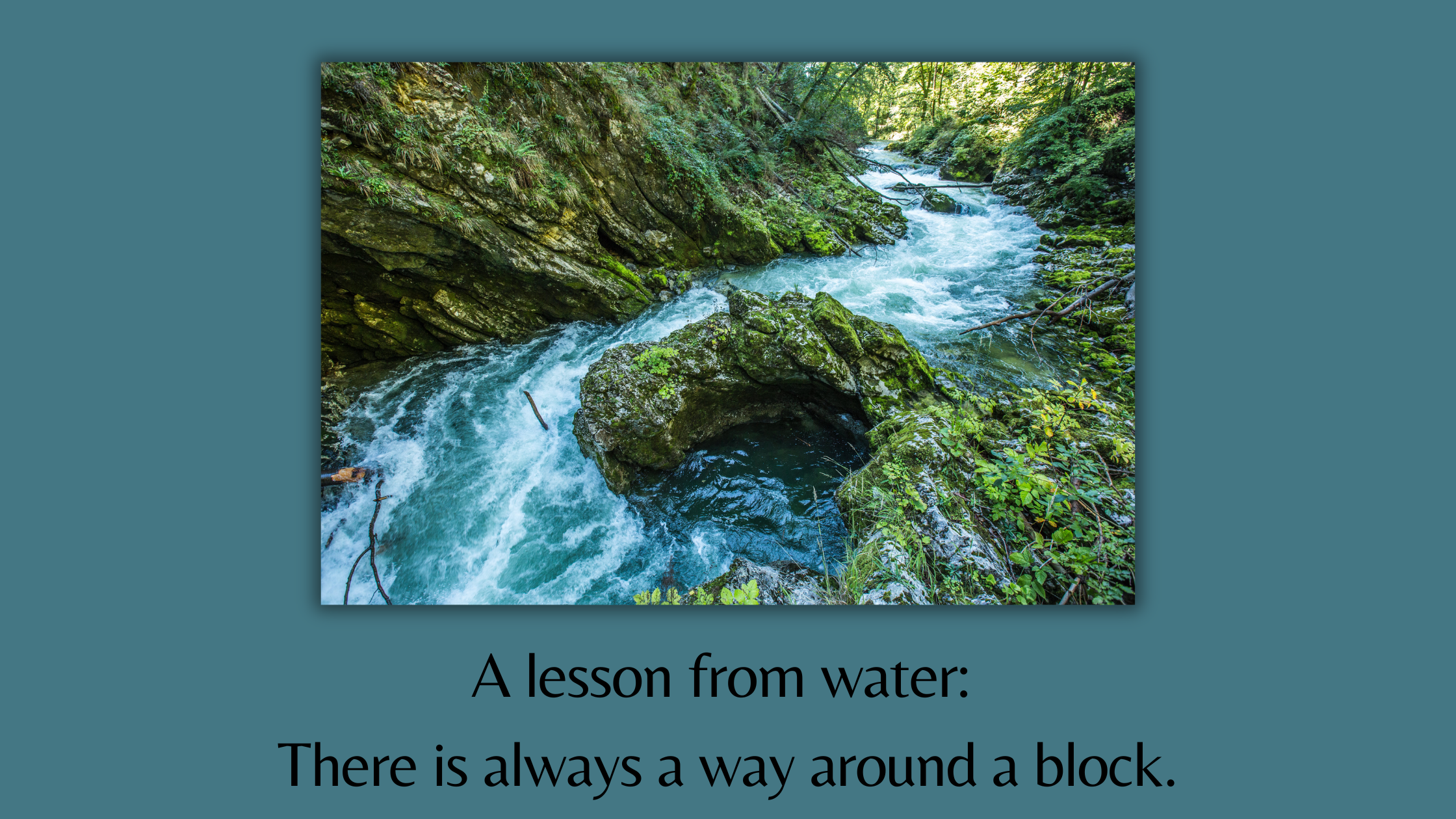
Good news. You don’t need to get overwhelmed by a large-scale project. You can take a much easier approach, and Julie Winkle Giulioni tells you how. The title of her blog article, Water Always Finds a Way – And So Do Good Leaders gives away the secret. It’s not about working hard to move big obstacles out of our path. Forward motion followed by consistency will make the impact you want/

The All-Or-Nothing Trap – We have all read about these leaders who came on the scene, scrapped whatever was in place, and rebuilt this incredible business from the ground up. Giuliani says that way lies paralysis. You figure you can’t do that, so you do nothing. Slow isn’t the opposite of bold. Methodical steps get you where you want to go, usually with less stress and frequently with more connections and support made along way.

The Approach I Thought Was “All Wet” – Giulioni recalls a manager she thought didn’t have enough drive. Instead, the manager “spent time engaging in conversations, building relationships, [and]shifting perspectives.” Sound familiar? We’re in a relationship business. Consider how those activities fit in our inserting the library into the daily needs of our teachers and administrators.

Reflecting on the manager’s actions, Giulioni realized the success achieved was much like what she had observed on a trip to the Costa Rican rainforest. Although it was the giant waterfall that captured attention, it was the rivulets that carved the terrain. It did so “over millions of years. working around barriers, exploiting soft spots and carving deeper wherever it found opportunity. Persistent. Patient. Purposeful. And, as a result, powerful.”

To be powerful, take these three lessons from water:

  • Bypass the boulder – Boulders don’t move easily, but “there’s almost always a crevice nearby to start working your way through.” Is your principal ever going to listen to your goals for the library? Maybe not But working with teachers who are enthusiastic about what you are doing, and what the kids are learning will bring it to their attention, particularly when they hear about it from others then come in to observe a lesson. Is it a teacher who feels their class is too important to “waste it” on library time? Move around that teacher and work with those who are enthusiastic the benefits.
  • Start small – It only needs to be one teacher with whom you start. It won’t overwhelm you, will lower the stakes on success as well as give you the early success that will keep you inspired to continue. If you can, within this project, find something the principal is interested in and send any brief articles that would capture their attention. Aim for once a week but not on a schedule.
  • Measure momentum, not magnitude – The water keeps flowing, and you need to do the same. Slowly, but continually keep going. Little by little your “flowing water” will create the changes you are working for. As Giulioni says, “Consistent, purposeful action compounds over time in ways that single bold gestures rarely do.”

I know it’s hard to keep going between the demands of the job and the outside forces adding stress. But we can’t afford to do nothing. That way leads to librarians being removed from their positions and too much is at stake to our communities. You can be a bold leader without making constant giant changes. Just be like water: Persistent. Patient Purposeful.

Lower the Stakes for Greater Success

The title sounds like an oxymoron. All the science tells us that positive thoughts and big, clear goals are what we need for success. But what if some of the things we’re striving for are a little too much? Then we “fail” and starting again or moving forward becomes harder. Especially if teachers or our administrator knew what we were trying to achieve. Always reaching high not only creates stress but long term it can lead to burn out, neither of which is helpful when we need and want to keep going.  We need to be careful not to doom our future by overreaching our capabilities.

In her article “How to Win by Lowering the Stakes” for Psychology Today, Chitra Ragavan illustrates why and how lower stakes can allow us to reach bigger goals. She contrasts the mindset and results of Olympic Figure Skaters Ilia Malinin and Alysa Liu to make her points. For our uses, I will build some examples that align with our community’s needs.

Defensive Pessimism vs. Strategic Optimism – Ragavan explains, Defensive Pessimism is a psychological technique that has you lowering expectations to reduce pressure on achieving the desired outcome. This is what Liu did and it lead to her gold medal. By contrast, Strategic Optimism is when you set the bar on high and reject all negative thoughts which is part of doomed Malinin in his long program. When you launch a big project, such as school-wide reading club focusing on multiple genres to engage the entire student body, a Defensive Pessimist expects only one or two teachers to buy in. When three sign up – you’ve beaten the goal! On the other hand, a Strategic Optimist might create a presentation and flyers for a faculty meeting with a sign-up sheet ready to hand out and be disappointed and frustrated when only three teachers buy in.

Lowering the Stakes – To put lowering the stakes into action for your reading club project, you might start by seeking out teachers who love reading and already make good use of you and the library. Then, use the first year as a pilot project. Any participation is a win. Have a celebration at completion to build support and excitement for the next year.  It could take several years and need changes, but you would get there with less pressure and more pride. And others would see the growth over time. Ragavan says, “You can be physically and technically at your peak. But in the end, self-confidence and the ability to psychologically lower the table stakes in high-stress environments are the real advantages.” This approach takes the best aspects of both ends and makes your goals less stressful, yet still achievable.

And finally, what doesn’t work is Redemption Competition – This would be striving harder, setting the bar even higher to redeem yourself at a future moment or with the next goal. The likelihood that this will increase your stress—and probability of failure—are high and probably not worth it. In addition, the attitude of needing to “prove” yourself, adds to the chances of a public defeat. Instead, use a setback as an opportunity to learn and then set a goal like a Defensive Pessimist,

Lowering the stakes, lowers your stress. We all know it’s more than high enough these days.  You can successfully reach your desired outcome by relying on your ability and self-confidence. You know what you bring to the school community. Far too many schools don’t have school librarians. We can’t afford to lose any of us, either for being unable to show our value or because we are totally burned out. The kids and teachers need us. Look for ways to lower your expectations and hit even bigger goals.