Don’t Interrupt Your Leadership

On occasion, we are all guilty of interrupting, but if it is something you do often, then chances are you are undermining your relationships, which can hurt your effectiveness. Related to interrupting is when we find ourselves not really listening, and instead, waiting for the other person to take a breath or a break so that we can speak. Once again, relationships pay the price, as does our success.

When we do this, the message we’re sending is that we don’t consider what they’ve said to be important – or as important as what we want to say. It is both disrespectful and annoying. The frustration felt by the receiver puts a negative tone on the conversation, even if we are friends. If it’s a colleague, we’ve lost the opportunity for connection, and perhaps done longer-term damage to the relationship.

If this is a habit of yours, Madeleine Homan Blanchard reviews some reasons you are a habitual interrupter, and how to stop doing it in her article Trying to Stop Interrupting Others? Ask Madeleine. She lists triggers which you will recognize and then ways of getting past them.

Triggers:

Just excited – You are bubbling over with enthusiasm. Blanchard says this is forgivable. And no one is always excited, so chances are this only happens occasionally. With any luck, the other person is equally excited.

Getting a word in edge-wise – This is common if you grew up in a talkative environment or work in a fast-paced one, this Blanchard refers to it as a forgivable survival skill, but awareness becomes key to doing things differently.

In my own head – This is for those who have a tendency to tune out during conversation. It can be uncomfortable at best, insulting at worst. If this is something you do often, Blanchard recommends taking notes to keep you present.

Shutting people down – This is unforgivable. You have negated what the other person has said. Regardless of the reason, you have revealed an unhelpful and potentially harmful attitude that will, if not corrected, likely result in long-term issues that cannot be fixed.

 8 Changes to Make:

  1. Notice the behavior and the impact it has on others. Read body language. Listen to tone of voice. These will tell you a lot.
  2. Decide that the behavior is making enough of a negative impact on your effectiveness with others that it is worth making the effort to change. When you see the results of your interrupting, you will need to choose to do what it takes to change.
  3. Pay attention to what is happening when you engage in the behavior. As opposed to #1 which is external, this is internal. Recognize your trigger.
  4. Practice what you might do the next time a spark presents itself in a safe environment. Once you notice your triggers, you need to learn to do things differently. This can be anything from putting your hand over your mouth, managing your energy and thoughts by using a notebook, or doing something with your hands. Even doodling can keep you present.
  5. Share your quest to change your behavior with your colleagues. Getting support is a good idea. Blanchard notes it should only be from trusted colleagues. If the issue is having a chance to speak at a meeting, she suggests asking the leader to ensure everyone is heard.
  6. Experiment. This is an ingrained habit you are changing. It’s going to take time to break a habit and find what works for you. You will make mistakes.
  7. Keep track of your progress and what you did when you were successful. Recognize what worked and what didn’t. Celebrate your successes. Both of these will help you continue to make progress.
  8. Before long, you will notice you have made a change. Blanchard warns not to let your guard down. Habits are not easy to break. Be kind to yourself when you slip up then go back to doing what works. You have come a long way.

I would add that a key motivators for making this change is noticing how you feel when you are interrupted. What comes up for you when someone isn’t listening to you? You certainly don’t look forward to talking with them again. You can also take time to observe how others react when they are interrupted. Seeing the results can drive home the importance of changing this habit. Listening is a leadership quality. Interrupting is the opposite of it. This is one habit you can’t afford to have.

How – And When – To Say No

You already have a full schedule. You are always a hairbreadth away from overwhelm. And now you have been asked to do something else. What do you do? Can you just say no?

What if the request is coming from your principal? What if it’s a teacher you are good friends with? My guess is you say, “yes,” and then you try to make it work. Maybe you stay late – and cut out some of your self-care. Yes, it cuts into family and personal time, but you had no choice. Right?

There is always a choice. It’s how you manage it that makes the difference. Something that frequently worked for me, especially with teachers, was asking, “Can we do this differently?” Then I would come up with alternate solutions. It could be anything from changing the date or time that was requested to sending a cart of books and emailing websites if my schedule was booked.

When it came to my principals, I, of course, couldn’t say no—not exactly. Instead, I would let them know that I’d be happy to accommodate them and ask for their advice regarding how to handle the shifts I would need to make to meet their requests. This lets them know that you can agree, but gets their buy-in or support for the things that will have to be dropped or changed.

There was a time I was asked by the secretary to close the library to accommodate a meeting of the athletic directors in our league could meet. I agreed and said I would contact the previously scheduled teachers to tell them they couldn’t come because of this meeting. A teacher complained to the principal. The secretary called me back “to apologize for her mistake.” She said the request was that I close a portion of the library to allow the meeting to happen. This had a double benefit. Not only had I completely acceded to my principal’s request, I also had demonstrated how connected I was to the teachers and curriculum.

As a leader, you may get requests from your state (or even national association) to take on a task. Do you want to do it? How much of your valuable time will it take? When this occurs, pause before responding and do your best to make your decision out of your purpose, priorities, and passion. If it doesn’t match up with these, say no.

In Saying No Is Better Than Saying Nothing, Shari Harley had advice for those times when “no” is the answer you want to give. She recognizes that saying no is hard. She says people often practice avoidance, ignoring the request or saying you will get back on that—and not doing it. That shows a lack of integrity and honesty in your dealings with people, something that hurts relationships.

Harley offers three options. Before exercising one of these, the first step is thanking the person for asking and saying you will give them your response in a set period of time (not too long in the future). Make sure you get back to them after you determine what your answer will be. Then you answer with one of these options:

Option One is to turn down the request but suggest someone else who might be able to do the task. Within the school, this option is rarely open to you. However, when it’s a district request or one on the state/national level, you should be able to recommend a qualified person who could do it.

Option Two is to agree but negotiate a different time. It gives you the opportunity to ask important questions such as by when does this actually have to be done. It enables you to prioritize your time in completing this new task. It may be possible to do an introductory piece and then complete the project at a later date. For example, if the teacher wants to bring in a class two days in a row, perhaps you can go to the class and do an opening to get students started and thinking, and then have them come in a day or so later to actually get to work. (Debrief them on their thinking process to begin the class.)

Option Three is to turn down the request but offer what you might be able to do instead. Ask if that would work. If not, see if you can find some substitution, but don’t change your no into a yes. You have thought the request through. You know it won’t work for you. Don’t push yourself into becoming overwhelmed.

Harley concludes with “keep your commitments.”  Whatever you said you would do, do it. You want people to trust you. Your word must have meaning.

Knowing how and when to say no is a test of your leadership. Don’t answer too quickly – and always follow through.

Giving Effective Feedback

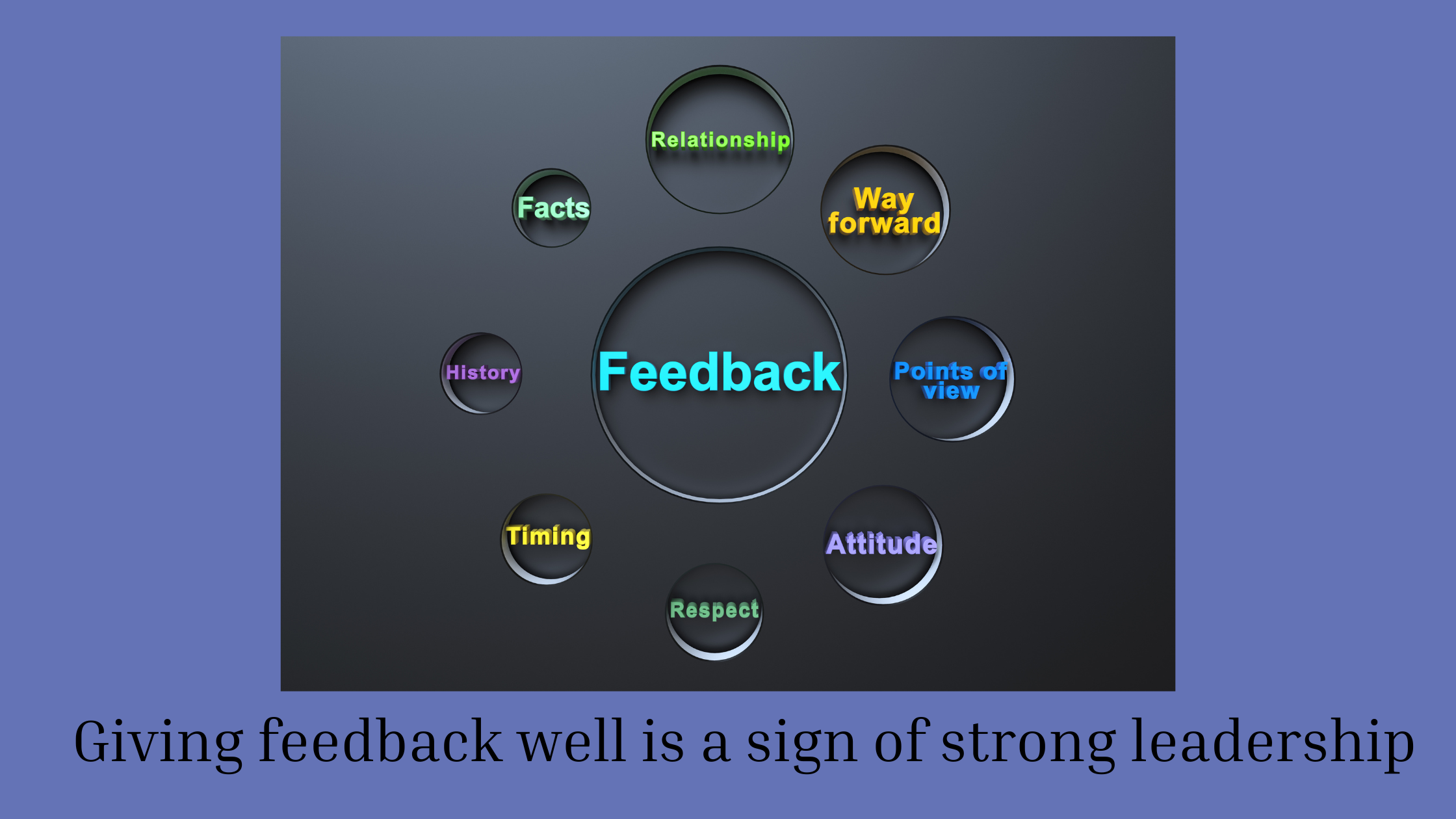
Two weeks ago, I blogged on When Feedback Hurts. We have all experienced those painful moments (they can be the hardest to forget, unfortunately). As a leader, we recognize that receiving feedback is important if we are to grow, but we also need to consider how we give feedback to others.

We may not always be aware of all the instances we give feedback. It is worthwhile to notice the comments and criticism we offer. A teacher is late bringing in his class. You note the lateness, and unbeknown to you, he is thinking you don’t understand what is involved in getting this group organized and ready to go to the library. With this negative feedback, will he be as willing to schedule his class in the future? Will he be open to collaboration?

The IT department has not responded to your request to address an issue. You are justifiably frustrated and send an email, copying the principal, saying the delay is affecting student learning. Do you think the IT department will be more or less responsive to your next request?

You give feedback to students all the time. Perhaps a group is supposed to be working on a project and is obviously more interested in socializing. You tell them it’s time they settled down and got back to work. Are they now more or less engaged?

It’s not that these issues shouldn’t or can’t be addressed, but words count and so does the delivery. Consider these alternate approaches:

  • If you said to the teacher, “Let me get them started. You can probably use a breather after getting the kids here today,” the teacher will feel taken care of, not criticized. You’ve let him know you’re aware of the challenges he faces. And he’s more likely to start the process of getting his class organized earlier so they’re not late in the future.
  • If you sent the IT department a message (not including the principal) and said, “Help! I really need you. I appreciate how very busy you are, but I hope you can make this a priority,” their response is likely to be far different from that annoyed email where they were embarrassed in front of a superior. And you’ve shown you understand their workload.
  • If you said to the students, “Now that you have completed the preliminaries, where are you planning to go next?” Because they need to respond, they are more likely to focus on the task and start working.

While it’s important to let people know you’ve noticed them doing something that doesn’t work, there are ways to move from that information toward something that is helpful to you, them, and the relationship you want to have with them going forward.

Be SpecificThis allows people to be focused. You can tell the teacher in advance what the class will be doing, which can support them all to arrive prepared. The IT department will appreciate as much specificity as possible. Telling them it’s important to you, doesn’t make it important to them. Let them know how their work will have an impact. Your next question with students should direct them on how to start.

Be Timely –The more immediacy you bring to giving the feedback the better it will be. The teacher knows he is late. The IT department is buried in requests for tickets and doesn’t usually think yours is special. The kids are going to have fun until you show them there is fun in the task. Once you’ve pointed out the situation, move on.

Be Prescriptive – What can they do to improve and how can you help? Once the class is going, ask the teacher if he could use a brief reminder early in the day about the impending visit. Ask the IT department how they determine priorities and if there’s anything they need from you in the future, since your request affects so many students. Tell the students you are looking forward to seeing whatever it is they are to do next (a reminder here to be specific).

Be Encouraging – Let the teacher know you recognize the challenge of getting kids to the library as scheduled and are glad to help. Assure the IT department you are aware of their workload and appreciate all they do. Tell students the project is challenging, and you are looking forward to seeing their creative solutions. And the second part of this is to recognize changes. When the teacher arrives on time, say you appreciate what it took to get this done. Thank the IT Department every time they are responsive. (This is the time to copy the principal.) And, if possible, make a positive specific comment to the students when you see what they have accomplished at the end of the period.

So often (maybe even more often) it’s the little things that count. Leadership is not just huge projects with big outcomes. It’s what you do every day to encourage, support and work with the people around you.

Fielding Tough Questions

We live in a confrontational, polarized world. Tough questions—and charges—are a part of it. If you are a leader, chances are someone is going to challenge you. It happens to every president, CEO, director and head coach. Even if you don’t think of yourself as a leader, people know you lead the library. If someone has an issue related to the library, you are going to be challenged. What you do next defines you as a leader.

A story I have told before occurred when I took a new position in a school and a teacher came storming into the library and started haranguing my clerk. I came over immediately, indicating if there was a problem, the responsibility was mine, not the clerk’s. It was in the early days of automation, and the practice had been to use teachers’ social security numbers for their barcodes. The teacher was opposed to this. I listened to what she said and apologized for not being aware of the policy. It was my library, and I was responsible. I told her would return all her books, issue a new barcode for her, and re-check out the books to her. At the end of the school year, we changed all teacher barcodes.

What worked when I was challenged? I listened without getting defensive or arguing that I wasn’t the one who put the practice in place. I came up with a satisfactory solution. The result – she became one of my strongest library advocates.

The tough questions are getting tougher, the challenges louder and more fierce. To help us be prepared, Allison Shapira has some answers for you When a Tough Question Puts You on the Spot. Here are her four points.

  1. Prepare in Advance–You can expect to have questions and accusations directed at you for books in your collection and displays in your library. Don’t be caught off guard. Be familiar with the Library Bill of Rights and be able to quote key sections. (You might keep a copy on hand). Have a Selection and Reconsideration Policy in place. This ALA toolkit will get you started if you don’t have one yet.
  2. Pause and Breathe–Being confronted is scary. Your body goes into fight, freeze, flight response. While it is trying to protect you, the process shuts off your cerebral cortex–the part of you that thinks. Allow yourself a moment to respond and get your (hopefully) pre-planned response into action.
  3. Express Sympathy and Honesty–This is what I did with that teacher. When a parent comes to you with a challenge, acknowledge their awareness and their concern. Explain how you don’t seek to override their decisions for their child. Once things have stopped escalating, explain that other parents have the right for their children to have access to those subjects.
  4. Acknowledge the Uncertainty–This is often at the root of challenges and frustrations, rather than true animosity. A teacher is angry and wants to know why the material they requested for inclusion in the library last year is still unavailable. A principal wants more data on the impact of your Makerspace and you hadn’t thought of that before. Be honest about your lack of knowledge, assure them you will look into the matter when possible, and give them a date by which you’ll have an answer.

In some of these confrontations, you need to take a stand and that can be difficult. Shapira recommends you use this PREP framework:

  • Point: State one main point.
  • Reason: Provide a reason behind it.
  • Example: Give an example that supports your point.
  • Point: Before you start rambling, re-state your main point.

You will have to face tough questions and never know when. As with any other aspect of leadership, planning is key. Knowing what you will say when it happens will put you in the best position to handle the challenge and help you trust yourself in difficult, emotional situations.

Communication Channels

Every conversation is an opportunity, yet many are wasted or don’t use the best channel for a particular communication. With our limited time, we can’t afford not to use these interactions to get the maximum possible benefit.

In looking at these different channels, keep in mind that the underlying purpose of any conversation is building relationships. When we get to know people better and allow them get to know us, ties are forged, and future advocacy developed. As a leader, particularly in these times, you need all the supporters you can get.

Joel Garfinkle focuses on 5 of The Most Effective Communication Channels at Work. Each offers a different opportunity. The challenge is to know which one to choose for a specific purpose and what you can accomplish.

In Person – This gives you the best opportunity to learn more about the other person. You have a host of non-verbal cues, including body language and even appearance, to help you understand and communicate. In Person is the perfect channel to meet with your principal or other administrator (as long as your principal knows the meeting is happening).

Summer is the ideal time for this meeting when your principal is less harried, and there is less likelihood of interruption. This meeting is especially important if you have a new principal. Your past achievements don’t count.

This is the time to learn their vision, what they want to achieve, and a perception of libraries and librarians. Share your mission and vision and spin it to show how you and the library can support their goals. Use your knowledge of body language to recognize when it’s time to bring the meeting to an end. It’s best if you can do this before the principal does. Change channels and follow up with an email — or a handwritten note—thanking them for their time and highlighting one important take-away.

Video Communication – We have all become Zoomers. Within the school setting this isn’t used as much as now that we’re back to in person classes, but it offers some interesting possibilities.

If you are fortunate enough to have several librarians in your district, a Zoom meeting can help in unifying how you deal with similar challenges. While not the same as in person, it does help you to get to know your colleagues better and build those relationships. You lose some ability to read body language and eye contact isn’t as clear, but it’s a good start. Consider this channel for reaching out to the public librarian.

Phone – These are best for shorter, more direct conversations. Garfinkle recommends you check at the start to be sure this is a good time to talk. The phone is best used for setting up an in-person meeting or reporting in on something. Be specific, clear, and quick. Stay focused on your purpose. You might want to have notes to keep you on track. Follow up with a confirming email. Without any visuals to guide you, listen for verbal cues to hear if the person sounds rushed or background noise that hints at distractions.

Voice Mail – Sometimes this is the only option. You called and the person didn’t pick up. Be prepared to leave a succinct and clear message. Identify yourself and, if necessary, give your preferred call back number. Repeat that at the end of the message – slowly. Keep your message focused on the reason for the cal. Garfinkle advises if you are not prepared to capsulize the reason for your call, hang up. Get your thoughts together then try again. Smiling as you talk will help you sound upbeat and increase the chances of being called back. Your tone is your most important signal in this method.

Email – Although Garfinkle likes this channel the least, it continues to have its place as long as you are aware of potential pitfalls. The first rule is to keep it brief. People are busy and often don’t read all the way to the bottom. They are also often checking on their phones and so are reading on a small screen.

The next rule is to proofread, particularly if it’s an important communication. Spelling errors have a negative impact on you and your message. Also check to be sure your language is clear and is unlikely to be misconstrued. Obviously, this is not the place for sarcasm and emojis aren’t appropriate in the work environment. All you have are your words in this form of communication – no tone, no inflection. Clarity is key.

Before hitting “send,” make sure you haven’t included people who shouldn’t get this message in the “To” section. A “reply all” can get you in trouble. We work so fast, it’s easy to make these mistakes. If it matters, take time to get it right.

Knowing the best channel for initiating conversations is an important leadership skill. Don’t waste or miss your opportunities to reach out and build those vital relationships.

Quiet Your Inner Critic

Of all the people with whom we communicate with each day, the one we speak to the most is ourselves. And all too often we are not kind. We say to ourselves things we would never say to anyone else. And we certainly wouldn’t be saying it so often. Yet, each day the barrage continues, and it takes a toll.

A result of this negative self-talk is a decrease in our ability to believe in ourselves. When something new comes up, we step back, sure if we take on this challenge, we will mess it up. Our inner critic blocks our path to leadership, adds to our stress, and it leads to feelings of overwhelm and burnout.

But how can we turn off, or at least turn down, the critic that lives inside us? It’s not as if we seek it out. It speaks up almost without us being aware of it. And there is the core of the answer. Being aware of your self-critic is the first step.

In a recent article on Edutopia, Kailyn Fullerton presents the following  7 Ways to Identify and Overcome Self-Criticism:

  1. Understand the negativity bias -Fullerton explains it’s natural. All animals are hard-wired to identify threats, humans included. Unfortunately, we do this even when the situation isn’t dire and as such, look for – and find – all the things going wrong at any given moment. By being aware of this bias, we can notice when it’s not serving us, when it’s not true, and even when others are doing it by having their focus solely on what they think is wrong.  
  2. Monitor your inner voice –What are those negative phrases that play in a loop in your head? Fullerton says these self-critical statements often repeat themselves and suggests identifying your “top ten.”  The “shoulda,” “coulda,” “woulda”s” are always up there, along with “I always,” and  “I never.” Absolutes in a statement are usually a warning. Putting this negative self talk to a “truth test” will help remind you see where the critic is lying.
  3. Set realistic expectations – Having high expectations isn’t a problem as long as you accept the learning and growing process that goes with it. Otherwise, you give your inner critic a space for those negative phrases (back to Monitor Your Inner Voice). Remember, too, that depending on the importance of the task, excellent and “good enough” can be sufficient. Learning takes time, and you can’t rush it.
  4. Create realistic goals – Don’t set yourself up for failure. Is what you want to do likely to happen given all the interruptions you face or do you need more time? Don’t forget the “A” in a SMART goal. If it’s not reasonably achievable, don’t make it goal however much you want to get it. Find a way to break it into something smaller. You can also try the W-O-O-P (Wish-Outcome-Obstacles-Plan) method for creating goals recommended by Fullerton which allows you to acknowledge the things that will get in your way and how to manage them..
  5. Find the helpers – Who can you turn to? Rather than beating yourself up or venting too often and sounding negative, look for supporters. Let those you have a good relationship with knew you are trying to find a solution to some challenges. If you don’t have a mentor, look for one or turn to library-related social media. Someone has already experienced this and will be glad to offer advice and support.
  6. Give yourself a break – If you criticize yourself, you can also be kind. Create a practice of self-compassion. Tell yourself supportive things. My favorite reminder is, “I have done tough stuff before and faced difficult challenges, I will do so again”. The advice is old but true, “Speak to yourself the way you would speak to someone else.” Acknowledge how difficult something is, recognize that this is part of the process, part of being human, and then say something kind to yourself. “I am taking on a big goal. I knew this would be hard but worth it. I am learning and getting closer to my goal every day.” It’s a worthwhile shift and you’ll feel your emotions and energy lift.
  7. Look for the good – Mute that inner critic by loading up with self-congratulatory thoughts.  This counteracts the negativity bias. Do it just for yourself. Make note of your successes. Savor compliments you get. Keep track of them. Create a Success Journal (this is the action that works for me). It’s so easy to overlook what went well. Moments of joy and positivity can make a difference.

Your inner critic is not going to become silent. Note that the title of the article was “Quiet Your Inner Critic” not eliminate it. As Fullerton says, your inner critic is natural and, sadly, well developed. Notice it, release it, find supportive truths, and be kind to yourself and others.

In the Heat of the Moment

We are all stressed. And we are dealing with people who are stressed. The combination can lead to sudden eruptions of temper. Words spill out. More are exchanged, and you are left with the fallout. It’s not pretty, and it can have long-term consequences.

How do you feel after one of these verbal explosions? Exhausted? Still simmering? Annoyed with yourself? Are you re-thinking what the other person said? What you said or should have said?

We are in the relationship business. Having a professional relationship with everyone in the building is a job requirement for school librarians. We can’t afford to lose our temper in the heat of the moment. We need to quickly defuse the heat whether it’s ours or theirs.

It’s important to anticipate these outbursts and possibly more important to know how to deal with the consequences. Knowing these confrontations are bound to occur, have a plan for dealing with it to lessen occurrences and/or any damage it does to relationships.

The Leadership Freak’s blog post offers sage advice, giving 7 Proactive Responses to Hot Emotions. The title refers to the focus of the post: reactions are too often an out-of-control response to a situation. As he says in his list of “7 Dangers of Reacting, “The more you react, the more your thinking congeals,” and “The more you react, the more negative consequences you experience.”

The “5 Emotions that Switch on Reaction-mode” according to the Leadership Freak are ones we experience frequently. The first he mentions is Stress, and, as noted we are living with high stress. Discouragement is another emotion he identifies. So many librarians are feeling frustrated about schedules that keep them from doing their job as librarians. It’s no wonder that things boil over.

To deal with these situations, Leadership Freak suggests “7 Powerful Proactive Responses to Hot Emotions.”

  • Gratitude – Thank the person for bringing the issue to your attention. When you do this, focus on the message the other person is sending, not the manner of delivery.
  • Acknowledgement –  Recognizes the other person’s feelings. There are two of you (or more) in this moment. Notice what is happening for them.
  • Space – A time-tested technique for any relationship, personal or professional. It’s counting to ten or the parent classic, “Go to your room, I am too angry to deal with you now.” In the work setting “Give me some time to think about this” achieves the same aim.

If you respond offensively or defensively when someone’s hostility is directed at you, you set off an escalating confrontation. You will need to invest time and effort to restore the relationship to where it was previously. If others were present to hear it you may have some repairs to do there as well.

The scenario is somewhat different when you are the one who starts the conflict. It maybe you were asked to do one more thing and just exploded. Whatever triggered your reaction is not as important as what you do after. That step is crucial.

As soon as possible, apologize, another of Leadership Freak’s proactive responses. It’s best to do so without adding reasons. Start with, “I’m sorry. There is no excuse for my behavior.” Justification is a natural way to remove some of the blame (and shame), but you will get the relationship back on track much faster if you take full responsibility.

And remember, what is true in the work world is also true in your personal life. These outbursts will happen. Be pro-active to de-escalate them rapidly. The more clearly we can communicate, the less stress we’ll have in our relationships and our lives.

Powerful Words – Powerful Results

Our word choices – whether speaking or writing—impact how we are perceived, and the results we get. When we write, we take time to search for and edit out weak words, those which don’t say what we want or which muddle the clarity of our message. In conversation, it’s important to choose words that convey surety and confidence.

This is vital is when writing your Mission and Vison statements. When I give presentations on the subject, I often point out how a simple word choice or change can make the statements more powerful. We eliminate words like “will” and “plan to” and put the statements in the present tense. Even a Vision statement you don’t see as entirely possible to achieve (or at least not for a while) gains strength from being written in the present tense. Let’s look at the difference the right words can make:

Compare:

The Mission of the Blank School Media Center Program helps in creating lifelong learners with critical thinking skills and an appreciation of literature with enriching opportunities for all students to gain the self-confidence necessary to successfully learn in an information-rich world.

With

The Blank School Media Center Program creates lifelong learners possessing critical thinking skills and an appreciation of literature by collaboratively providing opportunities for all students to gain the self-confidence necessary to successfully learn in an information-rich world.

“Help” is weak, while “Enriching” is vague in the first example. They aren’t wrong, but they are supplementary. When writing something so concise, and something we want to have an impact, we can’t afford to be supplementary.

Changing a Vision statement into the present tense immediately adds force.

Compare:

The School Library Media Program will be a user-centered environment where up-to-date resources and technology and a responsive staff empower students and teachers to achieve their academic and personal goals.

With

The School Library Media Program is a user-centered environment where up-to-date resources and technology and a responsive staff empower students and teachers to achieve their academic and personal goals.

In our conversations, the subtleties communicated in our word choices can make a huge difference in how our messages are received. Saying, “I believe that purchasing books by diverse authors will make a positive difference in our students’ sense of belonging,” does not convey the same message as “I know that purchasing books by diverse authors will make a positive difference in our students’ sense of belonging,” “Believe” does not convey the same strength of conviction as “know.” Being aware of words that weaken or soften your impact can improve your proposals and have you better positioned to be accepted and approved.

In his article The Love for Confidence and Conviction, Bob Decker points out how “soft word” choices communicate the degree of confidence you have in your ideas, regardless of how much confidence you actually have. He recommends you eliminate the following terms:

  • Maybe
  • Possibly
  • I think
  • Just
  • I hope
  • Potentially

because they suggest you aren’t certain about what you’re saying. Each conveys hesitancy and a lack of conviction which does not support your success.

It is an odd fact of life that as receivers of information, we recognize these indicators of uncertainty and lack of confidence, yet as senders, we are frequently unaware of the implications of our word choices. To improve the power of your communication, both written and oral, tune into how others express themselves. Listen to the words your principal uses in proposing an initiative or plan. Did you hear confidence or uncertainty? Observe how others respond. Then take the time to notice your own language choices and speak (and write) from the passion and enthusiasm of your work.

Always Leading

Leadership should not be something you turn on and off and it’s more than something you do. It’s a mindset and a way of being. When you see yourself as a leader, you carry your leadership qualities and skill set into all situations and regardless of the type of administrator you work for.

By being aware of what your administrator(s) want and need, and responding as a leader, you sharpen your leadership skills. Other people respond to your actions by seeing you as a leader. The more naturally you assume the role, the more you own this identification. Your colleagues and administrators come to view you as one of the building leaders and respond positively to your suggestions and proposals.

Managing or leading up can be critical in a building or school district where administrators change frequently or the one in place is inept. Jenn David-Lang and Donna Spangler explain why and “How to Manage Up in a School Setting.”  They identify six different administrators and what skills you want to employ:

  • Brand new – Get in early and be regarded as a helper as the administrator becoming acclimated. Learn their goals and show how your work supports this.
  • Hands-off or distracted – Take the reins and run. They won’t notice it, but the teachers will, and many will be grateful.
  • Micromanager – Sending detailed reports shows you know how to do your job – and how they like to do theirs.
  • Inexperienced with teaching and learning – Infographics are a good source of help. You want to present information as succinctly as possible so they can absorb it and see the connection.
  • Know-it-all – Show that you’re aware of their knowledge. Introduce ideas with phrases like, “As you know…”
  • Indecisive – Present options (but not too many) and offer rankings along with reasons or evidence for choices.

David-Lang and Spangler expand on dealing with these six types of administrators with their “AAHH” strategy.

Ask – You need information to prevent missteps. Ask questions to learn their vision, what they see as success, and gain a sense of who they are. You also want to know what issues the administrator is focused on and any background information on it.

Adjust – Change tactics depending on which of the type of supervisor you are dealing with. What worked for a previous administrator, might not work for your new one. For example, if you were a micromanager, presenting a plan of action and having a written agreement on who will do what (and probably by when) works well. With a hands-off administrator, you can be more general in your plan and stay focused on presenting the successful end result.

Head or Heart – Some administrators want just the facts. They love data. Others respond better to the emotion behind a project. Micromanagers and Know-it-alls tend to be the former. The others can fall into either category, so it helps to identify early how they react to information and present it in a way that facilitates their hearing you.

Hands – When you make a proposal, you need to support it with an action plan. All types of administrators need to know they can count on you to deliver—and make them look good.

Get to know your administrators and their style. Present yourself and your work in the best light by giving them what they need, the way they can you it best. When you do, you are better able to lead everywhere.

You Aren’t Listening

Did you ever have someone call you out because you weren’t listening to them? Have you ever said that to anyone? You can’t have a successful communication if one party isn’t listening. We know this and recognize the importance of active listening, yet all too often our conversations go astray as we or the other party tune out.

We (or the person we’re talking to) tune out when our thoughts go elsewhere. We also tune out when we are trying to make our point and override what the other person is saying.  This typically happens if we have decided we are not being heard. In the process, we block what is being said to us in an attempt to reinforce our perspective.

The result is the communication doesn’t work. Whatever the purpose of the conversation, it isn’t achieved. Worse, we may need to repair any damage we have done to a relationship we are building if we have left the other person angry or annoyed.   

Ronald Williamson and Barbara R. Blackburn identify three conditions needed by an effective communicator in their blog post, Leadership: Listening to Others in Volatile Times. The three requirements are:

  • Focus – Keep the conversation focused on the speaker, even if you’ve gone to them for something. Either they need the help or they have what you need.
  • Openness – Be willing to listen. Don’t make up your mind before hearing what the person has to say.
  • Willingness – This is the tough one. You need to be prepared to change your mind or your actions based on what the other person says.  You cannot get here without being focused and open.

Knowing these three conditions doesn’t mean we put them into practice.  There are barriers we construct that keep us from being successful at active listening. Williamson and Blackburn list these five. If you notice these barriers coming up you need to return to practicing the three requirements.

  1. Indifference – For some reason, we think the speaker or their issue is not important.  They may be someone who always has an opinion, and we are tired of dealing with them. It could be a student who regularly brings up something that interferes with the direction you are taking the lesson.  The other party will eventually notice from body language, incorrect answers or other slips that you were not listening.
  2. Assumptions – This happens when we judge other people and categorize them based on our implicit biases.  Although getting to know them can change these perceptions, tuning someone out based on these assumptions hampers building relationship and affects how we are perceived in turn. You are missing an opportunity to connect and get to know someone who could be a true ally if given the chance.
  3. Distractions – Our days are filled with them. You hear your phone vibrate and stop listening to the speaker. Other people in the library have part of your attention, or the project you were managing before this conversation is still on your mind. In these instances, you are out of the conversation and have gone somewhere else. Allowing yourself to be distracted telegraphs the message that the other party and their issue isn’t important.  
  4. Hurrying – The other barriers – in addition to our overloaded schedules – frequently has us trying to hurry a conversation, not allowing the other person the time they need or deserve. Who has time?  We are like the White Rabbit in Alice in Wonderland. If you find yourself thinking, “get to the point,” you aren’t listening and you may miss an important piece of information. You’ve definitely missed a chance to connect.
  5. Information Overload – As librarians we are often guilty of doing this to others.  They come in with a question. We find the answer and keep going with related information and more detail than the person asked for or needed.  Given the likelihood of distractions and hurrying, less is more. When approaching your principal with a proposal, don’t give all the details. Hit the major bullet points and let the other person know you have more information if they need or want.

In conclusion, Williamson and Blackburn list 10 behaviors to promote active listening, many of which I’ve written about before:

  1. Make eye contact.
  2. Use positive body language.
  3. Restate or affirm what the other person is saying
  4. Ask clarifying questions to help you understand.
  5. Wait to share your comments until they finish.
  6. Pause and allow silence if appropriate.
  7. Be fully present and avoid distractions.
  8. Keep an open mind.
  9. React to the content, not the person.
  10. If you take note, explain why, so they don’t think you are ignoring them.

Leaders must be good listeners to be successful communicators. Check in with yourself if your mind wanders and get back to focus, openness, and willingness. Soon, you’ll be actively listening to and engaged with the person speaking with you.