Make Your Library Invaluable

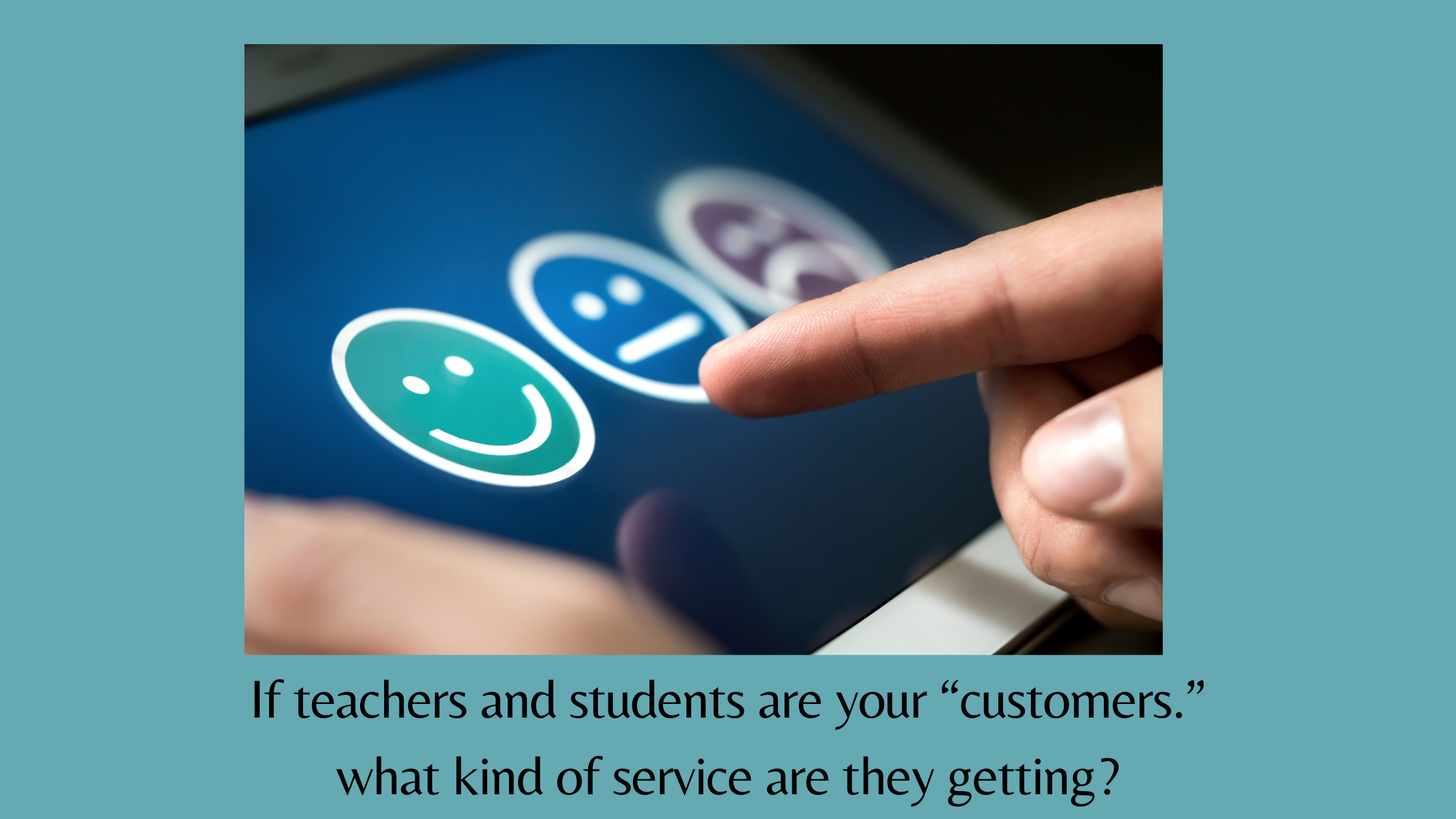
Do you see your teachers as colleagues or customers? What about students? Did those questions have you considering something you haven’t?

Whether or not you see them that way, teachers and students play dual roles in your library and in its success because teachers are both colleagues and customers and students are both patrons and customers. they are your customers as well as your colleagues and students.

Recognizing this duality may how you approach them and help them see your library seen as the invaluable resource it is. When you are dealing with customers, you want to give them the best service possible, meet their needs, and ensure they keep coming back. And you want them to give you great reviews to others who are interested in coming by.

In her SmartBrief article, The leadership blind spot that’s quietly killing revenue, Jeannie Walters states that “Many leaders think customer experience is someone else’s job.” It’s not – it’s ours. And unlike customer relations, it is proactive. It is what you think about before there is a problem, not what you do after there’s an issue.

She recommends businesses make three shifts to movie to a customer service approach. I’ve revised them to show how we can adapt this for our work.

  1. They define what success looks like for the customer, not just the organization – There are numerous data points which you and the teachers you support are expected to reach, but teaching is more than that. Before you start collaborating, think about the different results the teacher looking for from this learning experience. Is it only the grade that will make the student feel successful? Or is there something to be learned from the process. Also, is this a project special to the teacher or connected to state mandated benchmark. Knowing this, having a good relationship with the teacher, will help you support them. Listen carefully and ask questions so that you can shape the project and bring them the satisfaction of having attained their goals.
  2. They make the customer’s voice a leadership-level input – What the teacher or student tells you will reveal what they most need and where you can help. Even if you think you know a lot about the topic or lesson, try not to talk so much. (A tough one for me.) We need to hear what our “customers” are looking for. Ask questions from the teacher before going into action. Have a class discussion to elicit where students are with the assignment. Do they hate it before it starts? How can you shift it? Where can it be connected to students life experiences? And show them (teachers and students) that there answers are important by following through and incorporating what they tell you.
  3. They treat consistency as a competitive advantage – One good project followed by poor or mediocre ones doesn’t build a good relationship. You want to create a situation where good is repeated or improved on. At the end of the project, consider doing a mini survey. This will give you an opportunity to learn what your customers like best about the project, what did they wished had gone better, and where they might have struggled or felt successful during the project. Go a step further and score yourself, keeping track of the feedback, good and bad.

Before you put this into action, be proactive yourself. What could you learn from this approach? How could it help you grow as a leader? As Ranganathan says in his fifth law of library sciences, “Libraries are growing organisms.” So are leaders. Grow a little each day and your “customers” will not only come back for more—they’ll tell everyone (including administrators!) about what you bring to the school.

Presenting… You!

School is out for the summer, but school librarians (and teachers) don’t just work ten months of the year. Summer is time for rejuvenating, updating lessons, and other plans to prepare yourself for the start of school in the fall. In addition to those projects, whether you are an experienced librarian, new on the job, or starting in a new school or grade level, this is a good time to look for ways to use the time to address how your community sees you.

We develop opinions about others based on the behaviors others exhibit. While you are making these assessments, your colleagues, students, and administrators are doing the same thing for you. In her SmartBrielf article, Hidden behaviors that shape how colleagues and managers see you, Anne-Maartje Oud addresses seven ways we are unknowingly sending a message about who we are and what we care about. Here are her seven, along with my usual comments on how these play out in our education world.

  1. Are you present? – Whether it’s a professional development session or a faculty meeting, have you already decided it’s really meant just for the teachers? If you are tuned out, your colleagues (and principal) are likely to notice. Even if you are correct as to the intended audience, listen for upcoming changes being planned. Learn what is important to the faculty and consider ways to support them. This is how you get ahead of what teachers will need and what your principal is looking for.
  2. What is your body language? Do you fidget? Check your watch to see how much longer this meeting/conversation/presentation will last? You are telling others you aren’t interested in what is being said. This can have an especially negative impact in a one-on-one discussion. Rather than show impatience, if you are pressed for time, tell them, and ask to speak with them as soon as possible in the future. Oud says to maintain a “steady eye contact and …pause without filling the silence.” Also, “small signals, like nodding while someone explains something, encourages people to keep sharing their thoughts.”
  3. How do you treat others? – Gossip is, unfortunately, a major form of communication in schools. Don’t engage in it. Mostly, it’s biased and especially damaging toward the administration. When a negative comment about a teacher is repeated, not only can it alienate the teacher, but if you are found to be the one saying it, it will also show you aren’t trustworthy. You have heard the expression, “Little pitchers, big ears.” Students are also listening. You don’t want them repeating what you said about a teacher, student or administrator. –Always assume someone is listening.
  4. Are you all about work? And only about work? You need to diversify your time. Yes, you are very busy. On the other hand, we are about relationship building. Do you eat lunch with teachers? You might not be able to do it every day but try to do it occasionally. It creates a bond. (But remember #3 – no gossiping when you do.)
  5. Are you consistent? – Do you keep your word? When you tell someone you will send them a copy of a document you got at a conference or forward them resource links to help them with a project, do you get it to them quickly or do they need to ask for it? Unfortunately, they probably won’t, and they will lose trust in what you say. A relationship building opportunity hays been lost.
  6. Do you ask questions? – To ask meaningful questions, you need to be listening. We know how important this is when we work with students. It’s just as important when dealing with our colleagues. Showing you are focused on what they are saying builds connections and strengthens the relationship. And you may learn something you missed or discover a new place where you can offer support..
  7. How do you deal with feedback? – Sure we want the positive feedback. Negative feedback is hard to hear, but we aren’t going to improve without it. I always liked asking teachers what I could have done better. You probably did well, but we all need to grow. Remember Ranganathan’s quote, “The library is a growing organism.” If we are not growing, we are dying.

You probably do some of these behaviors better than others. Summer is the perfect time to work on where you feel weaker by practicing with friends and family. And consider where and when, come the fall, you want to be able to be stronger at presenting yourself to your colleagues, students and administrators. Present yourself as the leader you are!

Get A Little Help From Your Friends

I am back from my annual refresher. To be more exact, I had my usual exhilarating time at the ALA Conference held this year in Chicago. The programs were motivating, informative, and a sparking reflection of the impact libraries make every day. As good as the sessions were, my favorite part is getting to see my school library friends from around the country and the never ending opportunity to make new friends.

The Beatles had it right when they wrote that we get by with a little help from our friends (although they were talking about drugs). Your colleagues, near and far, are one of your best resources when you are struggling with a problem, need to get information fast, or want to talk with someone who understands your commitment and challenges.  Especially if you are the only librarian in your school (or schools). The PLN (Professional or Personal Learning Network) you create and continue to grow is always there for you.

Kristin Hendrix has a similar view in her article, Why you need to stop networking and start building community.” Although she is speaking to the business world, there is much that applies to our education community. One of her points is to recognize that “We Have More Help Than We Realize” and recommends we should “Engage Well.”  Then, once you know what you need, “Be Intentional About the Ask.”

For “Engage Well,” Hendrix says it’s important to know the strengths of the different people in your PLN. You may have some who have expertise in AI. Others are working at the level to which you have recently reached. Which ones are great at creating displays using Canva or are always up on the latest tech tools? Hopefully, you have a store of those in you PLN who can reach out to with a question or problem you have.

To “Be Intentional About the Ask,” think carefully about what you really want to know. It’s so easy to give too much surrounding story. Instead, identify your purpose, why it’s important to you, and what you most hope to receive. This will keep the conversation focused and honor both of your time

Hendrix also provides five prompts to keep you on track when finding these professional friends. I’m listing her first four and adding one of my own:

CONNECT – This is how you grow your PLN. Identify the people most likely to provide the various types of help and advice you need or are likely to need. Conversely, be available to those who need your areas of expertise.

PEOPLE –  Who are the people you want to talk to? One way to identify them and their strengths is by belonging to social media platforms related to libraries. Comment on Substack posts, follow a chain on Reddit, or join a Facebook group or other social media directed to librarians. (The School Librarian’s Workshop Facebook group is, of course, my recommendation.) Read their posts and respond. Eventually some may become friends, not just colleagues.

ACTIVATE – Time for a plan. Who do you want to approach with your concern? Is the more than one person or are you asking the PLN as a group? Are there parts to your plan that require different members of your PLN. Think about who the right people would  be to approach and reach out. Email if you have that contact information, a DM if this is someone you don’t know well. Be professional and personable.

FEEDBACK – Ask a question that’s as clear and focused as possible so you get feedback you can use. Vague questions get vague responses, which can be frustrating both for you and the person you’re talking to. Prepare in advance (part of ACTIVATE) so that this time strengthens this professional relationship.

Hendrix’s fifth prompt is Negotiate, but for us, I would change that to GRATITUDE. Let those who helped you know how much you appreciate their support. Tell them what you learned, how you applied it and, if possible, what the results were.

And be ready to give back by supporting others. You never realize how much you’ve learned until someone comes to you because they see you as an expert in the field.

Remember redwood trees grow tall even though their roots are shallow. They survive the strong winds by entwining their roots with other redwoods. Our community of librarians lets us all grow and thrive. With a little help from your friends, you’ll continue to grow as a leader.