Building Resilience

Life has been throwing a lot at us for the past years. We got through the pandemic only to be faced, in America, with being the target of groups determined to censor books and demonize librarians all in the name of a political agenda. And that’s on top of the usual heavy demands of our job. We need to cultivate the talent of resilience if we are to survive.

According to the American Psychological Association, “Resilience is the process and outcome of successfully adapting to difficult or challenging life experiences, especially through mental, emotional, and behavioral flexibility and adjustment to external and internal demands.” The definition is an excellent description of the experiences librarians have been facing. How can you “successfully adapt” to it is the challenge.

Elena Aguilar provides the answer in her blog post, The Resilient Educator/ What Does a Resilient Educator Do? While there are just three tips, there are several steps as you work through them.

  • 1.      A Resilient Educator Reflects – With so much requiring your attention, it is natural to dive in and do what you seen needs to get done. Despite the pressure to get going, you will accomplish more if you build in a pause to reflect (see also my blog on the importance of taking time to review). What are you trying to achieve? Is this really the problem or is it a symptom? Aguilar recommends checking in with your Core Values. This is more likely to build your confidence in your actions. To make reflection work even better, do it regularly. Another of Aguilar’s tips is to put space for reflection in your calendar. Make this a priority. If there are others in your school you enjoy working with, consider holding a monthly meeting with colleagues for everyone to take this time.
  • A Resilient Educator Sets Boundaries – We need to know when enough is enough. Unless you know when to say, “no”, you will inevitably say “yes” to that proverbial straw. Just adding to your workload doesn’t create resilience – it’s more likely a step toward burnout. You need to know, set, and stick to your boundaries. What things are your hard/fast “no?” How do you preserve that time for self-care and/or family time? Just because we can doesn’t mean we have to be the one to do it. Aguilar rightly says, “Boundaries preserve our energy.”
  • A Resilient Educator Is Clear on What Matters Most – This is where your regular Reflection gets put into action. Using the Eisenhour Matrix, make what is “urgent and important” a priority. Recognizing what is “important but not immediately urgent” keeps you from overlooking that need. Being clear and not compromising on your hard/fast “no’s” prevent burnout. Remember your Core Values and your Mission and Vision. Is there a way to turn a challenge into an opportunity? If used properly, challenges allow you to think in new ways about your situation, what you are doing, and how you can do it differently.

Far too many librarians and teachers are burning out and leaving the profession. What is happening in your life might lead you that way, but taking time to reflect might offer insight into a better way to manage what you need to deal with. Finding a way to develop the resilience to stay and thrive is the target that will allow you to grow and thrive in your position for the long run.

Start By Reviewing

The new school year is underway. Believe it or not – this can be a good time to review. Ask yourself, what do you want to achieve by the end? How will you get there? Which of your leadership skills will aid you in the journey?  What do you still need to learn? This is also a good time to ask what threats, such as the existing attacks on school librarians, can work against you? What conditions exist in your school, district, or on the state and national level can you use or learn into to take your leadership to a larger level?

To answer these questions, consider doing a personal environmental scan. While I usually prefer a S.O.A.R. analysis (Strengths, Opportunities, Aspirations, Results) because it keeps us from focusing on the negatives, in this case doing a S.W.O.T. analysis (Strengths, Weaknesses, Opportunities, Threats) can serve you better. You have leadership skills that are working for you. You also have difficulties in some areas, places where you need and want to grow. By taking a close and unemotional look at these, you can create a plan to guide you through the year.

With your scan in mind, Jay Sidhu’s blog post, Essential Lessons for Leaders provides a review of what you know while offering the following concepts and ideas for moving forward:

  • Leadership Qualities – Although you know many of them, Sidhu starts with the reminder that a leader must have a Vision, Mission, and Strategic Plan to achieve goals. His recommendation is that a leader must master their internal and external environment. Your S.W.O.A.T. analysis helped with that. He then adds the need to be “passionate about continual improvement,” which I hope you do as a lifelong learner.
  • Building Alliances – For us, this translates into advocacy which rests on continually building and maintaining relationships. Listening is key to achieving this along with awareness of the goals of others in your school and district. To successfully build a relationship ,you need to prove yourself important to the other person’s well-being and success. What do you teachers feel they need? What do they want? How are you or can you meet those needs and wants? Ask this question about students and administrators as well.
  • Learning to Be a Leader – Sidhu states a leader is a continuous learner. This not only means keeping up with the newest changes in technology, it also means understanding curriculum needs, district goals, and growing and developing as an individual. Use role models and mentors to help you. Identify leaders you admire, in the world or in librarianship. Reflect on what they do and how they are that caused you to admire them. Do you manifest any of those qualities? Can you work on acquiring the ones you don’t have? Risk learning by doing. Step out of your comfort zone and take on a bigger job in your state or national organization and ask someone who has done it to mentor you.
  • Knowing What It Takes – Sidhu brings us back to the beginning by wrapping his post up with a reminder to be clear about your Vision and Mission. As Yogi Berra famously said, “If you don’t know where you are going, you will wind up someplace else.” Review both.  Missions in particular change over time as our roles change and expand. Keep your Vision and Mission in a prominent place so you—and others – see it every day.

I keep in mind the AASL Vision, “Every school librarian a leader; Every learner has a school librarian.”  Our students, teachers, and administrators need us to be leaders – and learners. Take this time as your school year starts to get clear on your vision, discover what you need to learn, and understand how you will be a leader.

Ending a Conversation

Our conversations are an essential component of building and maintaining relationships. Navigating them can be complicated. Last week I blogged on how to start a difficult conversation. This week, let’s discuss how to successfully end one.

We all know someone who goes on and on. Sometimes, the conversation is fun, but we don’t have unlimited time. What should you do? You have tasks to attend to. Whether it’s a student, teacher, or (yikes!) administrator you’re speaking with, cutting them off can cause hurt and damage the relationship. How can you bring the conversation to an end without impairing it? John Millen has some options in his blog post, 5 Best Ways to End a Conversation:

  1. The Time-Conscious Approach – Millen’s favorite phrase for this is, “I want to be mindful of your time” and then continue by asking them what else needs discussing at this point.” By doing this, you are making it about the other person, showing your awareness of their needs, and guiding them into identifying the key points so that you are able to end the conversation while also having the information you need.
  2. The Grateful Farewell – Look for a point in the conversation where you can say, “Thank you for what you said. You have given me something to think about.” It’s complimentary and true regardless of what you think of the other person’s ideas. At the same time, you have signaled strongly that you are exiting the conversation, while showing gratitude – something that strengthens relationships.
  3. Non-verbal Cues – We all instinctively recognize them. Millen suggests slowing your speech to indicate you are about to or want to end the conversation. This is much like our recognizing the notes that typically end a musical piece. Be cautious, however, of excess body movements which will make the speaker sense you are bored, a pointed look at your watch or phone, crossing your arms, tapping your foot. These cause discomfort and push the other person away.
  4. End on a Positive Note –A specific compliment is always well-received. Millen suggests, “I’ve really enjoyed our conversation. Your insights are really helpful.” And, if necessary, you can add, “Let’s continue this conversation at a future time.” In a few words, you have not only achieved your primary goal of ending the conversation, but you have paved the way to further build the relationship.
  5. Practice Empathy – This is a reminder to treat other people the way we want to be treated. You might be the one who is going on too long, particularly when you are passionate about the topic. Consider the difference between someone saying to you, “We need to wrap this up, I have something that’s waiting for me,” as compared with them using one of the four other possible endings. And always thank them for their time and attention.

Every interaction we have either builds or detracts from our relationship with the speaker. The fewer mistakes we make in our communication, the stronger our relationships are and the more our constituents will continue to seek us out for help and support as well as be open to when we ask for assistance.  Add the skill of graciously ending conversations to leadership tool box. It’s one more way to enhance the perception of you as a leader.

Starting Difficult Conversations

It seems as though difficult conversations are everywhere these days. Some we get pulled into – such as issues surrounding gender, sexuality, and racism. Some we must start when these issues affect collection selection, censorship, book banning, and who decides what information students have access to. But because we are in the relationship business, and every relationship – from personal to professional – has to manage through tough conversations at some time, we must know how to handle these situations when they happen.

Sometimes our actions or words put a colleague in the position of coming to us with a sensitive topic, and sometimes we’re the ones who need to take a stand. Nate Regier, the CEO and founding owner of Next Element Consulting, a global leadership firm dedicated to bringing compassion into the workplace, discusses how to Initiate Difficult Conversations With These 4 Steps. He quotes an EDI leader for a company as saying, “We just need better ways to talk to each other right now.”  As the political climate keeps amplifying both our differences and our emotional responses, this has become more critical than ever.

Regier’ four step approach involves using “Compassionate Accountability” which he says is more than altruism or empathy. It’s rather “struggling together in a spirit of dignity.” An important factor is accountability for behavior “without repeating the cycle of violence.”

  1. Own and express your feelings without blaming – Blaming words include “disrespected,” “left out,” and “attacked.” They imply that you blame the person who did whatever triggered your feelings. It’s hard to think of what you can say in response without using those words.  First take a moment to recognize what you are feeling. Accept the emotion and say, “When I hear something like that, I feel as though I don’t matter or that I am not seen as equal to others.” As Regier says, owning your feelings without blaming them on someone else’s behavior doesn’t condone the behavior or end the conversation. Quite the opposite. It can be what starts a healthy discussion.
  2. Use discomfort as your ally – When you have expressed a biased comment to someone, and realized it after the conversation was over, there is a tendency to duck your head and try to forget it happened. But it did happen, and someone was likely hurt. Integrity means you need to own it and say something. I had a volunteer model this many years ago after using a slur against Jews. At the time, I said nothing. She left after her morning shift, but returned in the afternoon, embarrassed and apologetic. I admired her tremendously for taking the first step by acknowledging what she had said.
  3. Mind the gap; own your part – Regier says, “Conflict is any gap between what we want and what we are experiencing.” In the fraction of the moment after my volunteer said what she did, I wanted to let her know how her comment made me feel. I recognized there was no ill intent, but I was hurt. Fortunately, when she returned, we could have that discussion because she had owned her part. She faced her discomfort and our relationship was better for her actions.
  4. Awareness is necessary but not sufficient to change behavior – Awareness is an important step, but the communication that follows is even more key when it comes to doing things differently. The experience with my volunteer was been a lesson to me.  I have my own innate biases.  I work hard to identify them and shut them down before I say something, but I make mistakes. When I have done so (or know that I have done so), I immediately apologize.

Regier concludes by saying, “Compassionate Accountability is a skill that translates beyond any particular conflict or dimension of diversity. By owning and expressing our feelings without blame, minding our part in the communication gap, leveraging discomfort to move forward, and being aware enough to close the knowing/doing gap is how conflict can become transformational.”

Whether someone is coming to us or we need to initiate a difficult discussion, it is important to stay open and listen to what is being said and how someone may be hurt so that the relationship can be strengthened. It takes a great deal of time and mindful effort to eliminate our inherent, unconscious biases, but we can acknowledge and own them. Recognizing and expressing our error and vulnerability adds to our integrity as leaders – and human beings.

The Power of Telling Stories

We’re librarians – we love stories. Elementary librarians tell them to kids all the time. When I was a high school librarian, I often used Patricia Polacco’s picture book Pink and Say to connect students emotionally to the Civil War before beginning a research project on the topic. Ask a group of librarians for their favorite book and you’ll be in for a spirited conversation.

But there is danger in stories, too. The stories we heard told by people of certain beliefs, along with the stories we tell ourselves, can lock us into a rigid way of thinking unless we are exposed to newer ones that reveal what we hadn’t seen. Whether the readers are children or adults, stories can help us understand a world bigger than ourselves, bring out our empathy and broaden our perspective and understanding.

What is it about them? Why do they impact us so deeply?

The answer is emotion. Stories touch the deepest places inside us—for good or ill—and help make us who we are. I frequently remind school librarians that while data is great, it needs emotions to send that information home. A powerful story can break through an idealized belief.

As leaders, the emotions we create and develop in the people we support make a difference in our ability to grow – and protect – our programs. In Scott Van Voorhis post Looking to Leave a Mark? Memorable Leaders Don’t Just Spout Statistics, They Tell Stories he discusses how if you want people to hear and remember your message — tell a story. How does this help? Here’s some data (funny, right?) about story:

  • Measuring Memory – A research study conducted by Thomas Graeber (Harvard Business School), Christopher Roth (University of Cologne), and Florian Zimmermann (University of Bonn) revealed differences in how long we retained different types of information on beliefs. They found that a story’s effect faded by about one third within a single day. A statistic faded by 73% in one day. The reason why stories last longer in our memories is that they usually have “distinctive details or context” which help us remember them. Being abstract, statistics and numbers give our memories less to cling to. Van Voorhis says these are also more likely to get jammed by other irrelevant information. So much for your beautiful charts and infographics.
  • A Story That People Will Remember – To be effective, a story needs a strong relationship to the data you want to present. If you are trying to get additional funds for books, focus on a subject of interest to your audience. Talk about something outrageous in it. Having the book with you helps. Some examples from my past life as a high school librarian in the late 1980’s: A book that said Harvard was only for males. A book that said the Conquistadores brought civilization to the “natives.” A biology book that didn’t include DNA. All three together created a story that showed students, teachers, and administrators the importance of updating a collection and how our knowledge and presentation of a subject grows and changes.
  • Beware Extreme Stories – While I hope none of us will be guilty of this, it is wise to be aware of this caveat which Van Voorhis uses to conclude his post. As he showed, stories by their nature are more easily remembered. We are attracted to them, and because of that conspiracists, among others, use them freely to send their message. They raise stakes, create drama and conflict where there may be none. Too many of you have been at the receiving end of these extreme stories. Hopefully you can change that narrative with empowering and truthful stories.

The bottom line is a good story has more power than any piece of data no matter how artfully that date might be presented. Start telling you stories. Share them widely and encourage others to do so, too. We are natural storytellers. Let’s use this talent to support our leadership and our schools and send our message of why libraries are valuable to everyone.

I Hear You

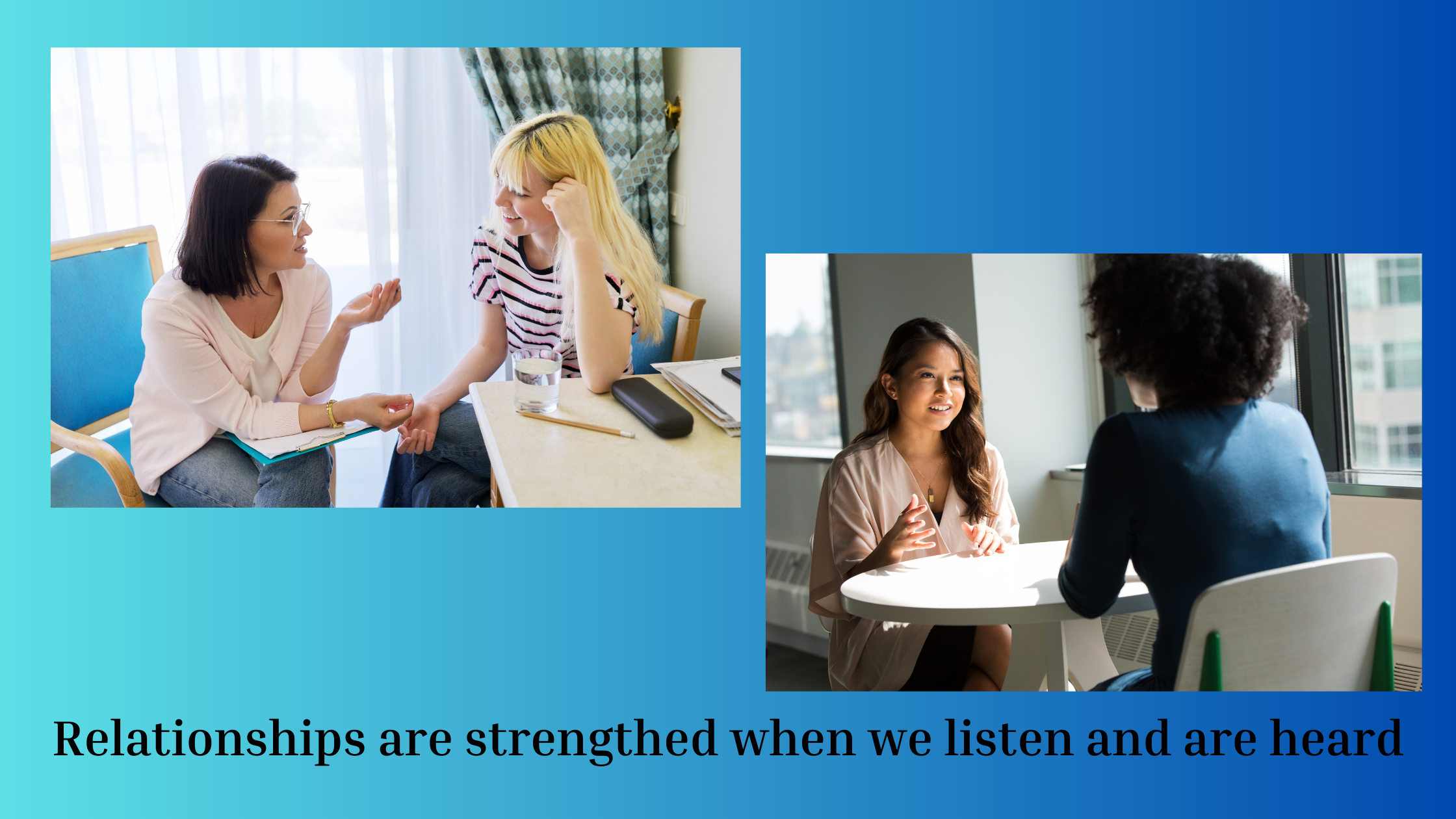
We know the importance of building relationships. While you can start making the necessary connections by emailing websites or apps that might interest teachers, the action that results in collaboration or cooperation doesn’t truly begin without face-to-face conversations. How we handle these in person interactions can speed or derail the process.

Just as a bad wi-fi connection can interfere with hearing what people are saying on a Zoom call, the way you respond to the teachers can prevent you from hearing them – and prevent them from reaching out to you in the future. You may think you are offering help and support, but that is not what is being communicated. What can go awry and how can you prevent it?

In my book The Art of Communication, I discuss the importance not only of active listening, but being aware of the non-verbal signals you are sending when you speak with someone. Similarly, in his blog post, How to Make People Feel Heard, David Burkus recommends four ways to improve your connections and relationships. He starts with active listening then offers three other usable skills.

  1. Model Active Listening – We know how important this is, but in the moment some of us, me included, get so caught up in wanting to respond, we plunge ahead. So much for active listening. Nodding and gesturing helps, but make sure your gestures aren’t expressing “Hurry up and finish, I have something to say.” Remember, our body language speaks volumes. What can help is summarizing what you think you heard them say. Give them the space to point out any parts you may have misheard or misunderstood. This ensures any further response doesn’t include false assumptions.
  • Praise the Contribution –Burkus says, even if you disagree, let them know you appreciate their willingness to share the information or their opinion with you. Identify any points which you agree with. By showing you respect what they said, you open the way for them to take in your response. It also alleviates any tension that may be building up. This is especially powerful when the interaction occurs at a meeting, and we have an audience. Our interactions with the speaker, usually unconscious, show others how you treat people. You could be inadvertently preventing other relationships from building.
  • Challenge Assumptions, Not Ideas – In these contentious times, it’s so easy to speak out against the ideas being stated. Instead, Burkus recommends you focus on the assumptions that underlie them. This way, you are more likely to discover the thinking process that lead them to develop their ideas. You can ask questions about the assumptions. If you can, point out where there is additional information that conflicts with those assumptions, but keep it factual and as emotion free as possible. Identify any areas where you have common ground, such as, “we all want our students to be successful.”
  • Questions Before Advice – Just as we want our students to feel safe in the library, our relationships with teachers depend on how safe they feel with us. Asking questions to determine where they want to go shows we want to go on this journey with them. They might not be asking for advice. Once you know what they are looking for, then you can offer support. I once had a teacher who wanted her entire ninth grade class to research Galileo. Rather than say, “Are you kidding me?” I asked what she wanted by having the focus be on Galileo. Her response that she wanted them to see the scientific method in action led me to suggest the possibility of having them choose from a list of scientists to report on how scientists’ work showed the importance of the scientific method. Once she knew I was listening to and understanding her goals, she was willing to diversify the assignment and used Galileo as a model when she introduced the assignment.

These same rules apply when we’re building our relationships with students. We need to pay close attention to discover what they are saying if we want to truly respond to their request and make them feel safe and welcome. Be sure that the student who you thought asked for help in finding out about euthanasia wasn’t looking for information about youth in Asia.

Our leadership is always about relationships. We need to continually learn how to build and maintain them. It’s a skill that requires lifelong learning – with lifelong benefits.

Be More Effective

According to Merriam Webster, effective means “producing a decided, decisive, or desired effect.” A second meaning for the word is “ready for service or action.” You obviously want to get certain tasks done during the course of the day, but are you doing this effectively? And if not… why not?

When you sit down at your desk, are you completely ready for action? Or do you start by straightening things up, putting off the moment when you begin? Even after you have begun, there are so many things that can and do pull you off track. It’s no wonder that by the time you finish for the day, it’s frequently later than you had planned, and you are often feeling battered and thoroughly exhausted.

In his blog post, These Three Questions Help Our Effectiveness, John Keyser quotes David Emerald’s 3 Vital Questions: Transforming Workplace Drama, observing how the approach is simple, helpful, and insightful. The responses to these questions require reflection which Keyser guides you through. As usual, even though this post is intended for business leaders, you are leaders, and it does apply to all of us.

Here are the questions and the process for responding to them (italics are based on Keyser’s emphasis):

  1. Where is my focus? – Take time to notice where your thoughts are going and if they are pulling you off track. Ask yourself: Am I focused on where it should be? Am I listening to what my teachers really want/need? Have I heard what the student was really looking for? Do I communicate my appreciation for what they do? Do I let teachers know I am grateful when they take a chance and work with me? When I am helping others, am I focused on doing my best so they do a great job? Do I do it all with kindness or am I abrupt and thinking about getting back to a task? In the process, am I giving feedback in positive ways that can be heard? You won’t be able to do all of these at once (or immediately) but keeping them in mind will help.
  2. How are my relationships? – Keyser says, “Relationships matter greatly” and this is no surprise to us. I have repeatedly stated we are in the relationship business. If we aren’t building relationships, we will be out of business. To do this, Keyser recommends one-on-one conversations. Every interaction, planned or spontaneous, is an opportunity for starting or building a relationship.
  3. What steps/actions am I taking? We cannot ignore the truth that everything we do has an impact. The smallest step in relationship-building leads to more steps. The clearer your focus, the better your results. To-do lists and priorities are recommended as always as a way to see your progress and know that you are moving in the right direction. Keyser recommends you have only three items on your to-list, and these should be the ones that will produce the most significant outcomes. (In other words, don’t just pick the easy ones.) Be hones with yourself – what will move you toward your most desired result.

You probably won’t go through these three every day. However, if you do this at the beginning of the work week and then review them again at the end, you’ll see the results as well as where you want to do things different. The process and practice of self-reflection and self-evaluation is good to develop and will lead to great effectiveness.

The Truth About Multi-tasking

Last week, I shared with you about the real problem of decision fatigue and having too many choices. This is what leads many of us to spend our day multi-tasking. But there’s a downside to this skill – it doesn’t work. Studies show that we cannot successfully do many things at the same time. Yes, your brain is constantly chattering at you when you have a lot on your plate, and you have multiple thoughts in your head at any given time, but the simple fact is multi-tasking doesn’t help us to do the job we want.

I was a confirmed multi-tasker. I was proud that I could respond to a few emails, get back to working on a project, and open some junk mail while I was taking a call. But it was costing me. Almost every time I multi-tasked, I didn’t produce my best work. I hit send in my email – and realized too late that I had made typos, or worse, I sent it to the wrong person. Other times, I didn’t fully read an email I received and didn’t follow through properly. Projects were completed, but not as well as they could be. Everything got slightly short changed.

Multi-tasking didn’t and doesn’t work.

So how do you get through it all? Naphtali Hoff advises Instead of Multitasking, Go All in on Your Tasks. We need to be single-task focused. He offers the following 8 steps to take:

  1. Make a to-do list and/or block out times – Take note of your priorities and then set time to do them. One at a time. You don’t need to act on your biggest priority first (especially if you don’t have the time until later), but know what you are going to do and when. And then only do this thing.
  2. Break down large projects or tasks into chunks – Because we frequently look at how much needs to be done – and frequently get overwhelmed – this one is important to repeat. Get clear on the steps, and then do each step completely before moving on to the next. It’s the old story, “How do you eat an elephant? One bite at a time.” As each step is taken, success doesn’t seem impossible.
  3. Work in time blocks – Hoff says to work for 25 minutes and then take a 5 minute break. This works great if you can keep your breaks to five minutes (To be honest, I’m not always good at that). Working for short, dedicated periods of time helps our brains to not “panic” that we have to stay focused indefinitely. Like breaking things into chunks, breaking down time this way works, too. It is also easy to stay focused on one thing if you know it’s for a shorter period of time.
  4. Remove distractions – Hoff has several recommendations, including shutting off your phone (so hard!), keeping your desk neat, and closing open computer tabs. Do what you can to keep your focus on the single task you are trying to accomplish.  
  5. Set unrealistic personal deadlines – This one is a little more controversial and won’t work for everyone. Hoff believes that if you give yourself a shorter deadline, you’re more likely to stay focused and be more productive. Try it (and let me know if it works!) For example, tell yourself you’ll get something that normally takes you an hour done in half an hour, then push yourself to do it. For some, that deadline and pressure will be motivating.
  6. Write it down – Most of the time, when we suddenly remember we need to do something while we’re in the midst of another project, we attend to it. Then when we get back to the original task, we waste time reviewing to find out where we are. Instead, keep a notepad nearby, make note of what needs to be done next (or later), then get right back to what you are doing during this time block knowing that you won’t forget and can take care of the other project later.
  7. Follow your energy – When do you do your best work? First thing in the morning? After answering emails? Maybe you’re an evening person. Use that time for the work that needs your clearest focus and schedule other tasks for other times.
  8. Enjoy the sensation – It’s that inner delight when you cross something off your to-do list. The more you do, the more energized you are. Take the time to feel good about what you’ve done and you’ll have more energy to tackle whatever comes next.

Being a leader puts a lot on your plate. So does running a school library. You will do better at both if you follow as many of these steps as possible and stop multi-tasking and instead, keep your focus to a single task at a time. By doing this, you’ll be amazed at how many tasks you actually get done and how well you’re able to do them.

Combatting Decision – and Leadership – Fatigue

Most people aren’t aware of how many decisions they make over the course of the day. Starting with what to wear, what to have for breakfast and continuing from there, is it any wonder that by the end of the week (if not sooner) we’re unable to make a clear choice? This is known as Decision Fatigue – the mental exhaustion that results from the toll all our decisions take on our thoughts and resulting in the difficulty, or even inability, to make more decisions.

The most notable cure for Decision Fatigue is the Eisenhower Decision Matrix (also known as the Urgent-Important Matrix) which recommends identifying which of the decisions you need to make are urgent and which are important. Some are both, some neither, and some one or the other. The big takeaway that is not always mentioned is that once you make a firm decision, you are able to relax because all the other possibilities are not churning through your brain.

Personally, I was recently in such a state. I had a significant interruption in my personal life, and I was about to work on a fall class for which I was scheduled where there were some tech issues that were concerning me. My program leader, hearing of my personal issue, offered to replace me. My first thought was to reject the offer because this is work I love. But on examining urgent and important, it became clear that I needed to accept it. I did, and it’s amazing how much calmer I am as a result.

Decision fatigue is endemic in leadership, and you are a leader so you need tools that can help you when this happens. In addition to the Eisenhower Matrix, Art Petty offers seven other ideas for managing this in his blog post Leadership Fatigue Is a Thing –Make Time to Recharge offers seven other ideas for getting past it.

  1. Center on your purpose as a leader – He asks how do you want to be remembered? What impact do you want to make? And what help do others need from you? My recommendation is focus on your Mission statement. It will help you decide what’s urgent and /or important.
  2. Adjust your attitude through Beginner’s Mind thinking – When you are a beginner, all is possible – but that can’t last. Petty recommends “suspending judgment and seeking first to understand.” He finds this leads to a deeper level of calm and the opportunity for new discoveries.
  3. Treat the workplace as a living laboratory and start experimenting – As with the above, this brings freshness into your day. It will spark the enthusiasm that disappeared when your decision fatigue took over. Try a new approach. Look for a new way of doing something. And consider asking, who else can handle this task (which is part of the Eisenhower Decision Matrix)?
  4. Commit to creating value at every encounter – How you can impact, improve in some way, what the other person is experiencing? A quick suggestion to a teacher or well-chosen words of encouragement to a student can bring a positive response from them which, in turn, gives you a lift. It restores that enthusiasm. Petty (and I) recommend you keep track of these encounters.
  5. Get physical to rejuvenate the mind and body – It’s amazing how physical activity supports our success. For me, walking outside restores my whole being. I take time to breathe deeply which helps me have a positive mindset. Add meditation if that speaks to you All this helps in erasing the drain of decision fatigue.
  6. Reinvent your career without resigning – Look at interesting possibilities that capture your attention and passion within our world. If you belong to AASL or another national library organization, you might consider doing occasional blog posts for them. This practice can help you identify the important things in your life, promote your leadership skills, increase the presence of your library and give you a sense of satisfaction. Maybe you could join a school committee or drop one that’s draining, boring, and/or accomplishing nothing.
  7. Do something completely different – What fills you up outside of your work. I have many friends who are quilters in addition to being library leaders. Do you like to draw? Have you considered writing a book? What possibility engages your mind and passion? Once you add it you will have something else bringing enthusiasm into your life.

Recognize when decision fatigue is making your work – and therefore personal – life draining, exhausting, and lacking the feeling that first made you love what you do. Decision Fatigue will happen. When you know how it affects you, you can learn how to deal with it so you can continue make a difference in the lives others – and decide what to make for dinner.

Stories Carry Your Message

We are constantly being told that data is important. It is.

We are told that decisions are made on data. They are. And they aren’t.

Studies have shown that we make 80% of our decisions using our emotions. We then use the remaining 20% to justify our decisions with logic. Businesses who want us to purchase their products know this and use it in commercials. You may buy a car because of its safety features, but no matter what you tell yourself, the reason you chose that brand has more to do with how you respond to it emotionally.

For years, we have had high-quality data showing the importance of school librarians to student learning. I applaud the researchers, many of whom are my friends. But districts are still not hiring librarians and claim it’s because we have been replaced by technology and are not necessary. Why is our message not getting through?

Perhaps it’s because we have too much data and not enough emotion. We have loads of stories about our students – and teachers – who have found success, learned, and grew because of the library. We need to tell our stories and tell them often.

Even if you are doing annual or and quarterly reports, start telling “snippets.” When a student has a great experience or breakthrough, send a quick email to your principal. One or more may strike a chord in your administrator. They might even include it in one of their reports to their superior. Make the story emotional – not only what was learned, but what was experienced.

Scott Van Voorhis says if you are Looking to Leave a Mark? Memorable Leaders Don’t Just Spout Statistics, They Tell Stories. He quotes research (Look! More data!) by Thomas Graeber that showed stories stick to our minds better than anything. Humans have always been telling stories. Our cave-dwelling ancestors told stories then illustrated them on the cave wall. Stories are how we communicate as human beings.

We have a lot of stories. Stories of triumphs and failures. Which should you tell and when? According to Graeber, if you want people to remember something for more than a day, “building a unique story around it is essential.”

Consider first the message you want to send. It’s best if it connects to your Mission. What happened in your library with a student that best illustrates the idea? Tell the story and then incorporate relevant data. Later, use the story as part of the requests you make.

For example, if you want to include more diversity in your collection, talk about how excited a student was to see themselves in a book. Perhaps one that was written by someone from his culture. Then point to the diversity audit you have conducted showing how few books represent all your students. You can then refer back to this story when you request funds for or order more diverse books.

While “eye-catching statistics” may work in business and help them move to immediate action, this is rarely an option in education. Statistics mixed with story can give you the longer lasting impact you want. For example, statistics on the difference between the performance of college freshmen who had a high school librarian and those who didn’t is powerful but coupled with stories from your school’s alumni—it’s lasting and shows the long-term benefit of the work you do.

I always use stories in my presentations and in my books (and frequently here in this blog). They strike emotional chords that readers and participants respond to. They form a connection between you and them. Data gets forgotten; stories get remembered. As librarians, we are not only good at telling stories, we understand the impact they make. Add this to your Leadership qualities and start telling them.