When Being Right Is Wrong

two sidesIn the past few days I have gotten e-mails from two librarians from different states with very different responsibilities but a similar challenge. Each is now coping with big challenges with their superiors stemming from the administrators’ strong belief that they are right. What should you do in a situation like this?  Cave in?  Accept an incorrect assessment?  Ignore being disrespected? Definitely not.  But it’s obvious that insisting on being right is not going to lead to the outcome you want.

In the first case, the librarian worked with one department in a large educational consortium. A relatively new administrator instituted procedures that worked against what the librarian was trying to accomplish and seemed unaware of the dynamics in coordinating practices and interests of the different members of this department.  A job performance review highlighted this disparate view and hinted at the administrator’s correct perception that the librarian disliked her. In the other case, an elementary librarian was copied on an email to a teacher (and hadn’t read it), telling her to bring her class to the library as part of schedule changes caused by testing.  The administrator had sent it without checking to see if any classes were already in the library, and the librarian felt disrespected.Relationship over ego

Having heard the details of what occurred, there is no question that both of the librarians are right—and therein lies the problem. We are in a relationship business, and in relationships, unlike with tasks, being committed to being right can create trouble.  When a librarian is critical of a directive or approach taken by an administrator, he or she invariably reacts negatively deciding, correctly, that the librarian is not a team player and is possibly a threat to what the administrator is trying to achieve—rightly or wrongly.

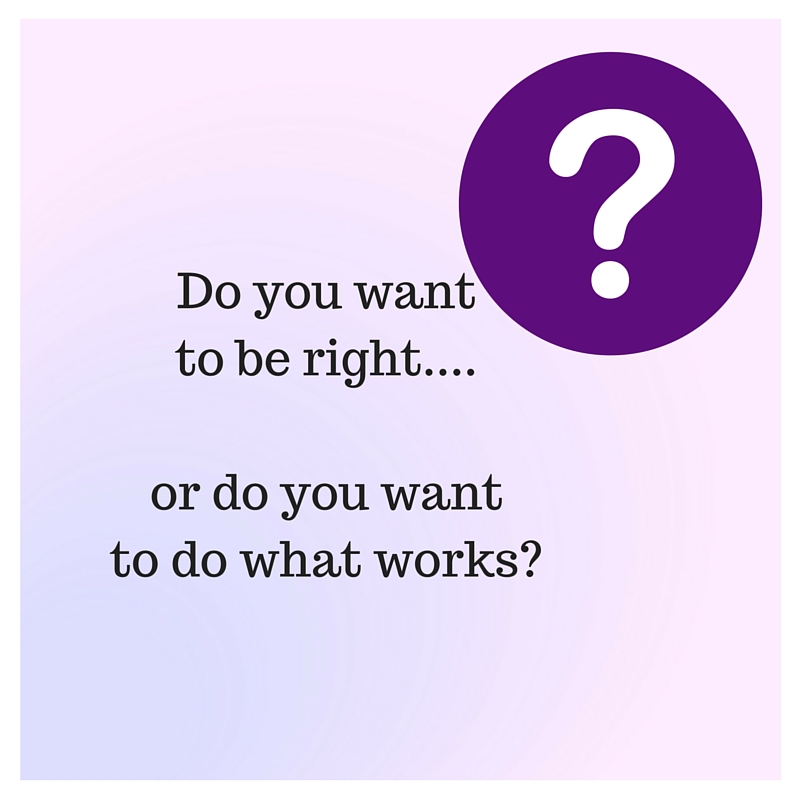
Consider this, “Do you want to right, or do you want to make it work?”  Because, if you focus on being right, it most certainly won’t work.  As I noted earlier, we are in a relationship business and maintaining your position will destroy not build relationships.

Here’s an example of how this works.  You are a middle or high school librarian and a teacher schedules his class for an upcoming research project.  You work on the lesson, find websites and apps, pull relevant print material and are fully prepared but the class doesn’t show.  You are angry with the teacher—and rightly so.  Do you go to the teacher and let him see you are furious? If you do, what will the results be?  Your ultimate goal is to reach the students.  Being right will prevent you from achieving this – and harm your working relationship with this teacher.
right or what worksIf you go to the teacher instead and say “I probably should have sent you a reminder, but your class was scheduled to come to the library.  Do you want to reschedule or should we cancel the project?”  The teacher will likely be contrite and the two of you can come up with a workable revision. You also have not alienated the teacher who will be glad to work with you in the future.

Letting go of being right is not easy.  It’s natural to guard our territory—and our emotions.  However, we are also big picture people.  When dealing with a situation where you know you are right, step back before you speak or email in response.  Consider whether being right will get you where you want to go.  Remember, “Do you want to be right, or do you want it to work?”


Shush?

stereotypeThe classic stereotype of a librarian is a plain female with hair in a bun and wearing a dowdy dress who shushes anyone speaking above a whisper.  This dated view of librarians is still very much with us, to a great extent because, sadly, it still occurs in many places.  Should libraries be silent?  Do you like it quiet?  Do your students?  I associate a hushed library environment with those large libraries with vast expanses of books visible on multi-levels with aging researchers buried over huge tomes.  Certainly not the picture of a modern school (or public library).

A 21st century library is a bee-hive of collaborative activity, with students moving seamlessly from electronic to print resources using multiple devices to access them.  True, not every library approaches this level, but it should be what we are aiming to achieve.  Students are comfortable learning from each other and sharing what they know.  In fact – they love it. It’s how they develop skills in video games and discover new tricks and apps on their smartphones.what society thinks

They are accustomed to a world of continuous information feeds whether audio or text. We need to capitalize on that inclination to learn by teaching them how to become global citizens, creating content, and building knowledge which they share in a participatory culture.  And that means, silent libraries are part of the past (or exist only in research libraries).

I am not advocating for a loud, out-of-control environment.  You should be able to be heard if you raise your voice just above normal speaking level. That’s a safety issue.  I am also not talking about a library where kids are horsing around.  On the other hand, all talk does not need to be work-related. Some socialization is acceptable and even important if they are to move from casual conversation to exploring their ideas, interests, and academic pursuits.

My libraries, both elementary and high school, were always a hubbub of activity – and the busy sounds – and energy – it entails.  A visiting superintendent was so impressed to see how engaged students were and how crowded the library was.  This was during lunch period (we were on block scheduling and managed a one-hour lunch for all 1,500 students simultaneously).  It was not a quiet place.  But learning was happening everywhere.

busy library 3Many of you already have this level of activity – and “noise” in your library.  Kids love coming there.  You have made your library the warm, friendly, environment that encourages questions, accepts diverse ideas and opinions, and promotes the desire to learn.

Elementary librarians are more inclined to keep noise levels down.  I suspect it’s caused by the fear that students would quickly become unruly and hard to rein in.  The answer is to change the culture of the library with their cooperation.

Students need to be a part of setting the rules and guidelines.  Talk about the difference between noise in the classroom and noise in the library.  What is good noise?  When does it become too much? What needs to be done if students become too loud?  I have found it best to talk to those students individually or the small group causing the disturbance rather than loudly addressing everyone.

Consider couching these guidelines under the heading of Respect.  Respect for yourself, respect for others, and respect for the library.  If at all possible provide a quiet area (much like trains today with their quiet cars) for those who need more silence to get work done.  Most often it’s the teachers who need it.

What do you think is the optimum level of noise vs. silence?  Is your library too quiet?  Too noisy?  What do your students think?   What do you want to change?  And what help do you need to get to this new level?

Reach Your Prime Audience – Back To School Night Suggestions

back-to-schoolThe parents who show up for Back-To- School Night and Parent Conferences are the ones who tend to be most directly involved in their children’s learning.  They are the ones who will fight for what their kids need. Too many librarians spend these events alone in the library catching up on work. You want them to recognize your contribution to student success in school and for their futures in college and beyond.  Once you do, they will do everything in their power to ensure your program thrives. Don’t miss out on reaching your prime audience.

To bring them in, have a sign or signs where parents check in and/or post them on the walls.  At the elementary level they may have little free time to wander so have a table set up at the main school entry with information for them.  Check with your principal to see if you can be there instead of in your library.  This gives you a chance to meet and greet them.Parents-orientation

In preparing material, consider what parents want most from the school library.  At the lower levels they want their children to learn to love reading.  So have a hand-out with the heading “A Book for Every Child—Every Child a Reader.”  Highlight any reading programs originating from the library.  Have a brief annotated bibliography and give links to your website where they can find more suggested titles.  If you can’t do that, list the URL for ALSCs Notable Books.

Are you looking for volunteers? Have a sign-up sheet, but just don’t have lines for their names and contact information.   What will parents get as a result of volunteering?  Seeing their child while they work in the library?  Learning more about the library program?  Access to borrowing material they can use at home with their children?  Helping the library be a welcoming environment for all students?  Put that first–then the lines for signing up.

At upper levels where parents move from class to class to meet teachers, they may have more room in the schedule to actually drop by the library. Again in preparing, think about what they want for their children.  This the time when they begin worrying about college, so spotlight how the library program prepares students.

A flyer or a running program entitled “What Students Don’t Know about Research” lets you showcase the information literacy skills you incorporate into students’ learning experiences.  Link to articles on the topic, such as this one from Huffington Post and point out why students in your school don’t need to wait until college to learn the skills.  Have your computers open to the databases you available and have a hand-out with the passwords for accessing them at home.  (Your students should have it, but the parents are probably unaware of it.)

library resourcesAt all grade levels, have your Mission Statement prominently displayed and include it on all handouts—and the Volunteer Sign-up Sheet.  Let parents know they can always contact you via school email.  If you have them, inform parents about LibGuides you created just for them and how they can see projects their children have done on your website.

The more parents learn about the value of today’s school library program, the more they will fight to keep it.  Don’t let your best potential advocates walk out the door without discovering what you do for their kids.

Reach Out – Find Your Larger Community

libraries transform learning
From ALA – click image for article

More and more of you recognize that no matter how busy you are in the library, the vital advocacy work that has administrators supporting your program happens outside it. While showing your own tech skills is a critical part of demonstrating how libraries have transformed over time, you still need to add a personal touch to make a true impact.

You know—or should know—your own town or city best.  Start thinking about ways you can reach beyond the educational community to send the message about how school librarians transform learning, boost student achievement, and prepare students for college, career, and lifelong learning in a constantly changing world.

In a world where so much communication is asynchronous, being with someone in person, in real-time adds much more meaning.  What this means, is that you have to get out of your library – and it’s on your own time. Up until now, your outreach for the most part is only directed to the school community including parents.  But you need to communicate with the much larger community.  They are voters and their attitudes toward school libraries is likely to be far more dated and entrenched than those of parents.facetime

Start by reaching out to your natural partners. Visit the public library. Introduce yourself to the children’s or YA librarian depending on the grade level of your school. Checking in advance with your principal to insure it is OK to do so, invite him or her to come to your library.  At the elementary level, you can work together on a story time with one or more classes.  At the middle and high school levels, you can get a cooperative English teacher to bring a class to the library and have your guest discuss upcoming programs at the public library.

Offer to promote public library programs in your library – and on your website.  See if the children’s or YA librarian is open to have you share student work in a display case or bulletin board at the public library.  This will reach community library users who don’t have children in the schools.

If you are a high school librarian, consider connecting with librarians in any college in your area.  An after school visit from a college librarian discussing college-level research with students (and possibly parents) will draw interest.  Try to get coverage from local press or cable TV station. High schools with TV stations can report on it as well.

special eventSome communities have a special day with various merchants contributing money and/or merchandise and food to bring out people.  The high school football field is often one of the venues for the day. Other places with a town green use that.  See if you can have a booth or table for the day.  Have flyers to hand out.  Display work by students and pictures you have taken showing library activity.  If possible, have students spend some time at the book talking with passers-by about what they love to do in the library.

Alternatively, or in addition, consider inviting community members into your library for special events.  Read Across America is a time when you can invite local officials to come and read to students. (Prepare them well –and prepare your students.)  Guests from Kiwanis or Rotary can talk to high school students about what they want to see and hear from those seeking part-time or summer work.

Your school library is part of a larger community that you need to be a part of. Get creative and have fun with these audiences you’ll find new resources and connections for your indispensable program.

How Large is Your PLN?

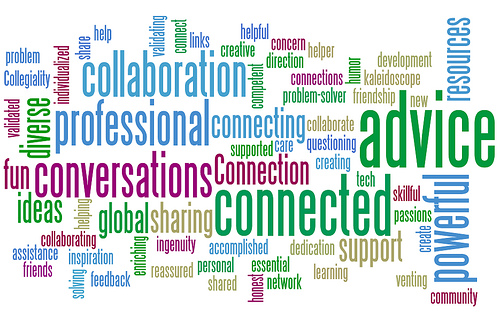
pln wordleYour PLN.

This acronym has two versions and both are important.  PLN can be either a Professional Learning Network or a Personal Learning Network. While it may seem to have arisen along with social networks, the concept has been in use long before the Internet, although the term didn’t exist.

Connecting with colleagues to seek their advice or help on a professional issue has always existed. At first it was within an office or school.  I can remember reaching out to a school librarian when I was planning to automate my library in 1993.  The telephone was my link.  I had already begun building a large Professional Learning Network by becoming an active member first in my state’s school library association and soon after in AASL.

Social networks have made extended these connections. Numerous library associations have Facebook pages.  National and state organizations also have listservs, and, of course, there’s LM_NET which has been a vital listserv for many school librarians who know how to manage the large amount of email messages.  Have a problem? A question? Just put it out on one or more of these and advice and help from experience practitioners will soon help you resolve it.

Sometimes you aren’t looking for anything, but a post gives you an idea.  I was just on the NYLA/SSL Facebook page and there was an illustration of Barbara Stripling’s inquiry model.  I will be teaching a course in the fall which will discuss inquiry-based learning.  I asked the person who posted, if she would send it to me for this purpose. She did, and I will be using it with attribution to her and Barbara Stripling.pln types

Members of Google+ TL Chat share what they are doing with software and other resources you may not have heard of.  Just click on the post and find out more. If necessary, post a question.  Twitter and LinkedIn groups offer other sources of information to grow your PLN.

Personal Learning Networks are a mix.  The greatest number of people in my personal learning network are fellow librarians who are also my friends.  I know them well even if I only see many of them at conferences.  We are always available for each other.  They are my friends on Facebook so I am always keeping up with their lives—professional and personal.

In person and online, we can get involved in discussions about issues arising in the profession.  Occasionally this leads to developing a project together or creating a workshop or presentation for a conference.  We know each other well enough to make drawing on each other’s specific area of expertise a natural part of the collaboration.

The remainder of the people in my Personal Learning Network are non-librarian friends.  Recently, I became interested in yoga for people with limited mobility.  I am a good librarian and researcher.  I could have spent time investigating this on my own.  Instead, I reached out to a friend who has been attending yoga classes for years.  She loved exploring this.  Soon she was sending me information about programs on television and chair yoga classes at a local Y and through the local park service.

yogaBecause she had a yoga PLN, she was able to let me know which had good teachers and the pros and cons of each option.  She also sent me illustrated directions for doing chair yoga at home. I now have a number of options without expending much of my own time.

Knowledge and information keep expanding at a rapid pace. You can’t do it all by yourself. Remember this is a two-way street.  Often you are able to respond to someone else’s query.  You are continually getting and giving in our participatory culture. Being a school librarian today requires you to keep up with the constantly changing technology landscape. PLNs – both professional and personal, are the way you can do it without feeling lost.  How big is your PLN?  How are you going to make it bigger?