Giving Effective Feedback

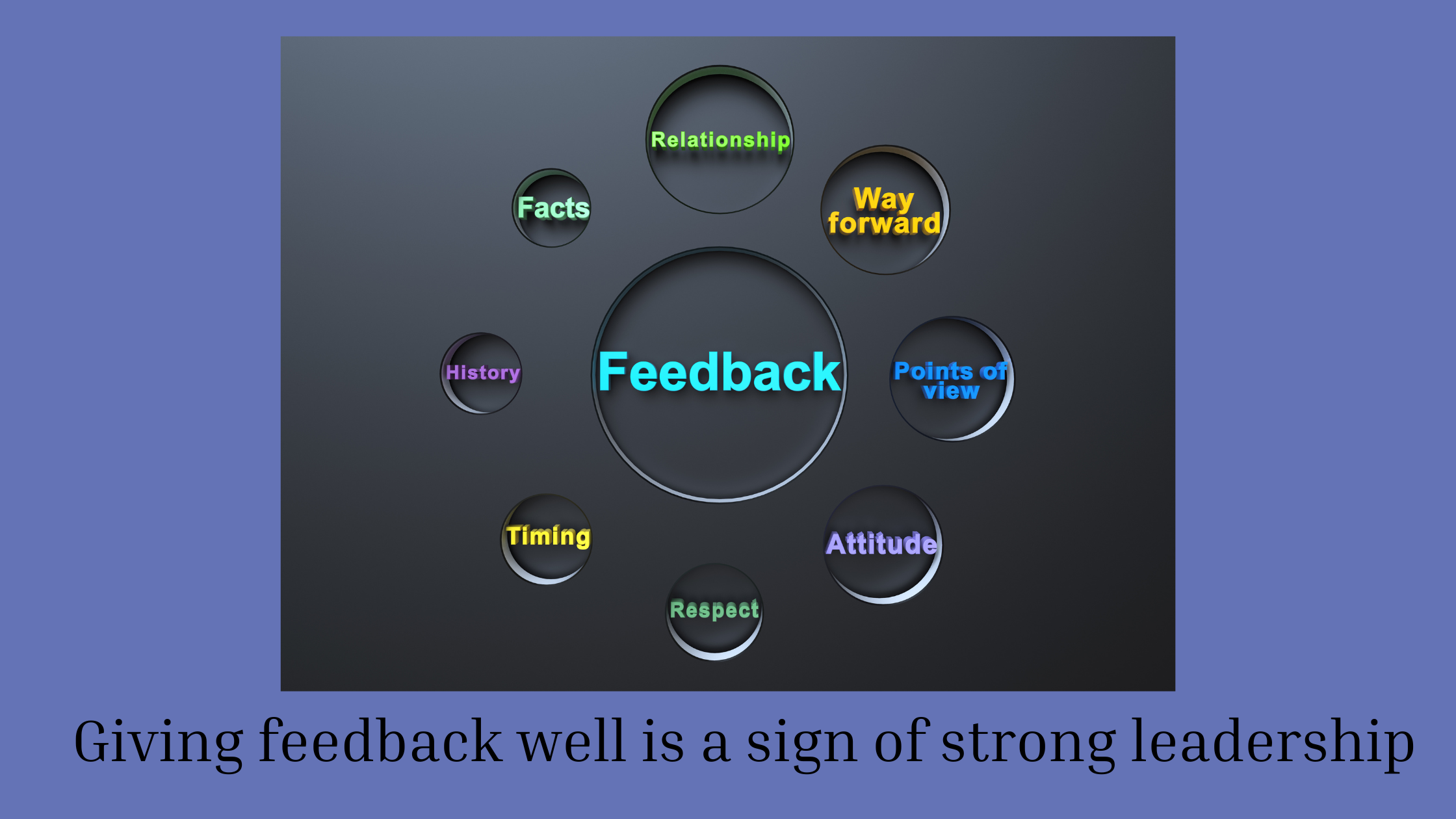
Two weeks ago, I blogged on When Feedback Hurts. We have all experienced those painful moments (they can be the hardest to forget, unfortunately). As a leader, we recognize that receiving feedback is important if we are to grow, but we also need to consider how we give feedback to others.

We may not always be aware of all the instances we give feedback. It is worthwhile to notice the comments and criticism we offer. A teacher is late bringing in his class. You note the lateness, and unbeknown to you, he is thinking you don’t understand what is involved in getting this group organized and ready to go to the library. With this negative feedback, will he be as willing to schedule his class in the future? Will he be open to collaboration?

The IT department has not responded to your request to address an issue. You are justifiably frustrated and send an email, copying the principal, saying the delay is affecting student learning. Do you think the IT department will be more or less responsive to your next request?

You give feedback to students all the time. Perhaps a group is supposed to be working on a project and is obviously more interested in socializing. You tell them it’s time they settled down and got back to work. Are they now more or less engaged?

It’s not that these issues shouldn’t or can’t be addressed, but words count and so does the delivery. Consider these alternate approaches:

  • If you said to the teacher, “Let me get them started. You can probably use a breather after getting the kids here today,” the teacher will feel taken care of, not criticized. You’ve let him know you’re aware of the challenges he faces. And he’s more likely to start the process of getting his class organized earlier so they’re not late in the future.
  • If you sent the IT department a message (not including the principal) and said, “Help! I really need you. I appreciate how very busy you are, but I hope you can make this a priority,” their response is likely to be far different from that annoyed email where they were embarrassed in front of a superior. And you’ve shown you understand their workload.
  • If you said to the students, “Now that you have completed the preliminaries, where are you planning to go next?” Because they need to respond, they are more likely to focus on the task and start working.

While it’s important to let people know you’ve noticed them doing something that doesn’t work, there are ways to move from that information toward something that is helpful to you, them, and the relationship you want to have with them going forward.

Be SpecificThis allows people to be focused. You can tell the teacher in advance what the class will be doing, which can support them all to arrive prepared. The IT department will appreciate as much specificity as possible. Telling them it’s important to you, doesn’t make it important to them. Let them know how their work will have an impact. Your next question with students should direct them on how to start.

Be Timely –The more immediacy you bring to giving the feedback the better it will be. The teacher knows he is late. The IT department is buried in requests for tickets and doesn’t usually think yours is special. The kids are going to have fun until you show them there is fun in the task. Once you’ve pointed out the situation, move on.

Be Prescriptive – What can they do to improve and how can you help? Once the class is going, ask the teacher if he could use a brief reminder early in the day about the impending visit. Ask the IT department how they determine priorities and if there’s anything they need from you in the future, since your request affects so many students. Tell the students you are looking forward to seeing whatever it is they are to do next (a reminder here to be specific).

Be Encouraging – Let the teacher know you recognize the challenge of getting kids to the library as scheduled and are glad to help. Assure the IT department you are aware of their workload and appreciate all they do. Tell students the project is challenging, and you are looking forward to seeing their creative solutions. And the second part of this is to recognize changes. When the teacher arrives on time, say you appreciate what it took to get this done. Thank the IT Department every time they are responsive. (This is the time to copy the principal.) And, if possible, make a positive specific comment to the students when you see what they have accomplished at the end of the period.

So often (maybe even more often) it’s the little things that count. Leadership is not just huge projects with big outcomes. It’s what you do every day to encourage, support and work with the people around you.

Fielding Tough Questions

We live in a confrontational, polarized world. Tough questions—and charges—are a part of it. If you are a leader, chances are someone is going to challenge you. It happens to every president, CEO, director and head coach. Even if you don’t think of yourself as a leader, people know you lead the library. If someone has an issue related to the library, you are going to be challenged. What you do next defines you as a leader.

A story I have told before occurred when I took a new position in a school and a teacher came storming into the library and started haranguing my clerk. I came over immediately, indicating if there was a problem, the responsibility was mine, not the clerk’s. It was in the early days of automation, and the practice had been to use teachers’ social security numbers for their barcodes. The teacher was opposed to this. I listened to what she said and apologized for not being aware of the policy. It was my library, and I was responsible. I told her would return all her books, issue a new barcode for her, and re-check out the books to her. At the end of the school year, we changed all teacher barcodes.

What worked when I was challenged? I listened without getting defensive or arguing that I wasn’t the one who put the practice in place. I came up with a satisfactory solution. The result – she became one of my strongest library advocates.

The tough questions are getting tougher, the challenges louder and more fierce. To help us be prepared, Allison Shapira has some answers for you When a Tough Question Puts You on the Spot. Here are her four points.

  1. Prepare in Advance–You can expect to have questions and accusations directed at you for books in your collection and displays in your library. Don’t be caught off guard. Be familiar with the Library Bill of Rights and be able to quote key sections. (You might keep a copy on hand). Have a Selection and Reconsideration Policy in place. This ALA toolkit will get you started if you don’t have one yet.
  2. Pause and Breathe–Being confronted is scary. Your body goes into fight, freeze, flight response. While it is trying to protect you, the process shuts off your cerebral cortex–the part of you that thinks. Allow yourself a moment to respond and get your (hopefully) pre-planned response into action.
  3. Express Sympathy and Honesty–This is what I did with that teacher. When a parent comes to you with a challenge, acknowledge their awareness and their concern. Explain how you don’t seek to override their decisions for their child. Once things have stopped escalating, explain that other parents have the right for their children to have access to those subjects.
  4. Acknowledge the Uncertainty–This is often at the root of challenges and frustrations, rather than true animosity. A teacher is angry and wants to know why the material they requested for inclusion in the library last year is still unavailable. A principal wants more data on the impact of your Makerspace and you hadn’t thought of that before. Be honest about your lack of knowledge, assure them you will look into the matter when possible, and give them a date by which you’ll have an answer.

In some of these confrontations, you need to take a stand and that can be difficult. Shapira recommends you use this PREP framework:

  • Point: State one main point.
  • Reason: Provide a reason behind it.
  • Example: Give an example that supports your point.
  • Point: Before you start rambling, re-state your main point.

You will have to face tough questions and never know when. As with any other aspect of leadership, planning is key. Knowing what you will say when it happens will put you in the best position to handle the challenge and help you trust yourself in difficult, emotional situations.

Leadership Power

Making your Vision for your library a reality requires two things: leadership and power. Power has many faces. Some comes from a person’s title, like principal or superintendent, but at its core (and by definition), power is having or making people do what you want them to do. The best kind of power happens when the person with power inspires – rather than forces – people to follow.

The strongest and most effective leaders don’t only have power, they are visionaries. Your Vision Statement is just a dream unless you keep it in mind and work toward it, however slowly. In addition, you can’t accomplish your vision on your own. You must make connections with others who help bring it with you to fruition.

As an example, look at this Vision Statement, “The Blank School Library Program is the center of collaborative learning, producing creative students who have an appreciation of literature, critical thinking skills, and a respect for others and self, and who are prepared to make a contribution to the world.” It is uplifting, as all Vision Statements need to be. At the same time, the importance of others being a part of it to make it a reality is embedded in the statement with phrases including: “collaborative learning,” “appreciation of literature” and “critical thinking skills.”

Bringing your vision to life requires you to work with teachers at all levels and in all subjects, as well as creating the safe environment that welcomes all, allowing them to produce their best work. To achieve that, you need to be clear on where you are going and have a positive mindset about getting there. Alaina Love in her post, Do You Have the Kind of Power That Really Matters? guides you with these five questions to ask yourself.

  1. What is the over-arching purpose I am here to achieve? The word “purpose” provides the answer. It is your Mission Statement. Your Mission Statement is what grounds you and keeps you focused on what is truly important so that you don’t get distracted –or not for long—by tasks that don’t further your purpose.
  2. What are the outcomes I am hoping to manifest today? A prioritized to-do list has you working towards that over-arching purpose in manageable steps. The pleasure we feel at being able to cross off these tasks keeps us motivated to continue in our always busy world. Love recommends keeping track of your successes as a reminder of what you are achieving. Seeing progress is an incredible motivator.
  3. How do I need to show up for others to get these results? For librarians, this means listening to the people in our community and learning what teachers are doing – and struggling with. When your library is a safe welcoming environment, they are more likely to share their worries and stresses. Offering your help and doing the heavy lifting brings them back. They will see you and the library as a vital resource toward their success.
  4. What needs to shift in the environment I create to allow others to be more successful? Your first thought may be to look at the physical arrangement of furniture in your library. That’s one place but go further. You can invite teachers to put their student projects on display highlighting the success of many. You might also assess if you can make it easier for teachers to talk with you and/or schedule their classes into the library. Is there a place in your library where you can talk privately? Environment is about more than how a place looks. It’s about how it feels when you’re there.
  5. Where do I need to demonstrate more authenticity in my interactions and communications? Establish yourself as someone who can be trusted. Be comfortable sharing what you know – and what you don’t. In addition, be open to feedback, valuable part of leadership. is tough but necessary. After a project is completed, be willing to seek the truth from the people you worked with. Ask, “What do you think worked best?” “Where did you feel most supported?” “What could I have done better?” “How could I have helped you more?” “What changes would you like to see if we repeat this project?”  Asking may make your feel vulnerable, but you will have built trust. And trust is the foundation of relationships.

You want to be the kind of leader who stays in your power and impacts others positively. With your Mission Statement and Vision to guide you, you can work continuously and successfully to make your Vision a reality because others will want to be a part of what you’re creating.

Become Confident

Leaders are confident. Confidence is the outward manifestation of your trust in yourself. It is an essential ingredient for leadership. When you trust yourself, people trust you. When they do, they will follow and work with you. That doesn’t mean you believe you are always right. You can question your original decision and/or get feedback from others. But you are still confident and recognized as such.

You need confidence when you propose a new program. You need confidence to deal with students who are acting out. You need confidence when you make changes to the facilities in the library. You need confidence to face challenges to your collection. You need confidence to grow. And if you are not growing, you are dying.

But how do you develop confidence?  The Indeed Editorial Team gives some helpful recommendations in Building Self-Confidence: 10 Ways to Boost Your Confidence.

  1. Attend professional development training – The more you know, the more confident you will feel. Going to your state’s school library conference is an important investment in yourself. In addition to the specific knowledge you gain, you also develop a vocabulary that shows you are informed about the topic. The added benefit of attending PD sessions is the connections you make. Building relationships with other librarians is as important as building relationships with people in your building. They are potential mentors, people with whom you can safely vent, and sources of advice and experience.
  2. Learn new skills – Similar to the first, but this can also refer to choosing a specific course or topic. For example, you may feel you could use more help with time management. Or you want to learn more coding so that you can make recommendations to students and teachers. Searching online for some training in this area will make you feel more knowledgeable and therefore more confident.
  3. Dress for success – This outward step has an important impact on your inner self-assurance. Your dress affects your attitude and mindset. Think of elementary kids on picture day. When they are dressed up, they behave much better. When considering this, make sure your clothing does not restrict you from being able to do your job comfortably. If your day requires you to sit on the floor or a low chair, keep that in mind. The way you are dressed transmits a silent subconscious message to others while potentially empowering you.
  4. Leave your comfort zone – Almost everything on this list asks you to take this step. It is key to professional growth. Giving your first presentation is scary. Getting through it is an enormous confidence boost. The Indeed Editorial Team also notes that doing something like a presentation can open the door to new opportunities. Someone in the audience might note something that suggests a new direction. Confidence lies outside of your comfort zone.
  5. Emulate confident peers – Look for role models. Who do you know who appears confident? How do they do it? The authors of the article suggest observing how these people interact with others and incorporating some of their strategies.
  6. Set goals for yourself – As with #2, start with something you want to learn or do and set small goals on your path to achieving it. Each goal you reach builds your confidence and keeps you going.
  7. Focus on your strengths – There are things you already do well. Can you do them better or can you use these skills more? Don’t look for perfection. Keep your focus on improvement Indeed recommends keeping a list of your achievements. (I keep a journal of what I accomplish each day.)
  8. Learn from your mistakes – Mistakes are a good thing – even though they don’t feel that way in the moment. They are part of growing. Mistakes give you information on what’s not working so you can do things differently. Use this information to move forward.
  9. Eliminate negative language – Notice how you treat yourself. We tend to be our own harshest critics. Change that mindset and look to what your accomplishments are and the goals you are working toward. Keeping that journal will help.
  10. Ask questions – Questions are another important part of the growth process. Pretending you understood everything someone said keeps you uninformed. Everything around us is changing at a faster rate than ever. One way to stay on top of what you need to know is by asking questions.

The Indeed Editorial Team had 3 final tips:

  • Take your time,
  • Be persistent, and
  • Keep developing your mindset.

I would add to that: Keep growing; Recognize the value you bring, and Build your PLN. With practice and awareness, confidence is there for you.

Creating an Advisory Council

In this day of libraries receiving regular disputes about books in their collection (and ALA has some great resources should this happen to you), it’s important to have advocates for the library who can support you through this process and any other challenges your program may face. One of the best ways to do this is to create and develop an Advisory Council.

When you’re planning, try to make your council as diverse as possible without becoming unwieldy by limiting your board to between 5 and 8 members. First, consider other librarians. You can invite the local public librarian and a college librarian, if there is one in your area, are other potential members. If you are at the elementary level invite a middle school librarian. Middle school librarians should look to high school, and high school librarians invite the middle school librarian.

Next, consider inviting one or two teachers from different subject areas, STEM teachers especially. If you are at the high school level, consider adding a student representative. Reach out to the community as well. Invite parents and local business owners. Inform your administrators, inviting them if they are interested. (And keep administrators in the loop no matter what).

As you develop your plan, start by creating your ask. What will be the purpose of the Advisory Council? How do you see the potential contribution of the members?  What will the commitment entail? Before or after school? Evening? Zoom or in-person? Know what you are asking people to do.

Also consider what members will need to know about the library to be effective. This includes an explanation of the Code of Ethics and the 6 Common Beliefs in the National School Library Standards. Add whatever else you believe necessary, depending on the members, and be sure to have these resources available to the members.

At the first meeting, welcome and thank the members for volunteering their time. After brief introductions, review the purpose of the council. Ask what they know and think about the school library. As succinctly as possible, review what you determined members need to know and encourage questions to ensure their understanding.

As a group, develop what the goals of the Council should be. You might want to focus on the diversity of the collection, reviewing the collection development policy, or what changes are needed to ensure the library is welcoming to all. Although you are leading what the possibilities are, be open to their suggestions.

Alaina Love’s post How to Lead a New Team to Success offers a direction for how to continue.

  1. Listen before leading – Don’t plunge into the tasks. While you want something to show for the first meeting, allow time to hear from the members. You asked them to be on the Council for a reason, but they may have more to offer than you knew. Be open to discovery.
  2. Share – Set up a Google doc or other method where Council members can report so every one can keep up with what is being done. After the first meeting, for example, you may have them comment on any goals that were discussed. Also, the doc can have a place to post any questions they have that have arisen since the meeting. Be sure they know everyone can respond to someone else’s posts.
  3. Seek insight –Discover what drives your members. Why did they agree to be a part of the Council?  What do they hope to give? What do they hope to gain? What have libraries meant to them. Knowing them as people, beyond their titles, will make them more connected to the team.
  4. Evaluate and align – The more you learn about the members the better you are at assigning tasks. We all have strengths and weaknesses. You do as well, and the Council is meant to help you do better at leading the library program. By knowing what members like to do and are good at, you not only get the best results but also increase their commitment to it.
  5. Review – Leaders inspire and inspect. Over time, notice how things are going and assess whether members have been offered the opportunity to give their best. Should you make changes in who is responsible for different tasks, be sure to frame it in the context of feeling they could give more in the new assignment.
  6. Query, acknowledge, celebrate – Get their input as to how they feel things are going. Instead of asking “how are we doing?” ask, “What can we be doing better?” And celebrate Council’s achievements and those of individual members. Even if you meet virtually, try for an in-person celebration. People stay more invested and active when they are acknowledged.
  7. Look outward – Council members don’t stay forever and new blood will always be needed to keep the council strong. Encourage outgoing members to recommend their replacement. Be sure to welcome new members and get them up to speed.

Creating and sustaining an Advisory Council takes work, but the benefits to your program and how you are perceived make it worth it. Bringing in diverse perspectives will give you the direction you need to ensure the library is a safe, welcoming space to all and continues to be an invaluable asset to the school.

Moments in Leadership

Leadership is a journey. You start small and grow as you go. And, no matter how much you grow, the journey doesn’t end. It’s a lifelong pursuit. For librarians, leadership is not an option. AASL’s Vision puts it succinctly, “Every school librarian is a leader; every learner has a school librarian.” 

We cannot forget that until every librarian is a leader, not every learner will have a school librarian. Too many non-leader librarians have seen their positions and libraries disappear. Yes, leaders have been eliminated, but it’s those who haven’t stepped out lead who have been the most likely to have lost their jobs.

We do face a challenge, because librarians don’t have a title, such as principal or superintendent, that implies leadership. We are the ones who define and develop what our leadership is and what it means. Fortunately, we have colleagues who have marked the path. Develop your PLN. Use social media to connect to library leaders. Observe how leaders in your state association assert their leadership and take the profession (and their library) forward. Seek out someone you admire and ask if they would be your mentor.

Mark your own leadership path. Art Petty delineates 3 Big Moments That Can Define Your Leadership Career.

The Moment You Decide to Lead – Making this active decision is key. You must decide, then pursue. Petty recommends some self-reflection questions including, “Am I motivated to help others?”  He follows that with “Am I willing to put their needs ahead of mine?” Think about the ways in which your work supports the goals of students, teachers, and administrators and make that your priority as you craft your goals. By becoming and being a leader, you are positioned to give students and teachers the information and resources they need for success.

The Moment You Decide the Type of Leader You Aspire to Become – Petty writes: Deciding to invest yourself in the work of leadership is essential. Defining the leader you aspire to become is priceless. There are many models of leadership and not all of them work for school librarians. A style known as “servant leadership” works best for librarians. This style focuses primarily on the growth and well-being of people and the communities to which they belon is the style most frequently showed by library leaders. They are empathetic and active listeners; leaders who empower others.

A variation is collaborative leadership. Here the leader enrolls others and works with them. They value the skills and expertise of their colleagues as they take their library program and students forward. Servant and/or collaborative leaders in our state and national associations make our profession and value known to an increasingly larger audience.

The Moment(s) When You Make a Stand – In the current book-banning climate, there have been several school library leaders who have taken public stands in the face of hostility and even personal danger. It takes courage to stand up for your core values and professional ethics. While there are reasons some are afraid or have reasons for not doing so, these Warrior Librarians are to be admired. Hopefully, their courage will encourage others to do the same.

Making a stand is not always as earth-shaking as those situations. Sometimes, it’s showing up at a Board of Education meeting and talking about the importance to students and teachers of school libraries. It could be making an argument to your principal about the use of your time.

Your leadership journey will have many “moments.”  No matter when, you need to become more active in our profession. The first step will require you to get out of your comfort zone. Subsequent steps will hopefully be a little easier (although stretching yourself will always be part of the process). First, step up to leadership at your state level. From there look to serve on the national level. If you serve on an AASL Committee, look for a leadership position. Be ready to be part of ALA. The same is true for other professional associations/

What type of leader are you or do you want to be? How are you making that happen? The journey never ends.

Me? An Author

If on seeing the title, your first thought was, “No way!” you should know that it is absolutely possible. And being an author gives you a unique way to be noticed in your school and district. It certainly makes your presence known, and being published in any format makes you seen as a leader. Like all things dealing with leadership, it takes moving out of your comfort zone.

I have been writing since 1977, and, as with my job as a librarian, I fell into it. I took a post-grad course to earn a supervisor’s certificate. For the final paper in the course, two of us created volunteer manuals. Our fellow students said we needed to publish it. I had no idea where to begin, and neither did the other student, Ruth Toor. Fortuitously, one of my library volunteers, a college professor, suggested contacting her publisher.

Figuring we had nothing to lose, I did so. The man who became our first editor suggested we enlarge our idea – by a lot—and model it on a Teacher’s Almanac his company had done. This was far more work than we had considered, but we decided to try it. It was a definite step out of our comfort zone, but we signed the contract.

To write the book, we met on weekends and developed an outline of the chapters from September through June, along with a sample chapter. It came back loaded with corrections. Panicked, I questioned our editor if he still wanted the book. He eased our mind by saying, “we only correct good writing.”

We buckled down, adjusting our different styles and drawing on our individual skills to produce the final manuscript. In 1979, The Elementary School Librarian’s Almanac was published. You can still get a used copy online, but I wouldn’t recommend it. It’s more than a little dated.

Shortly thereafter, our publisher suggested we do a monthly newsletter to be called The School Librarian’s Workshop, whose title lives on in my Facebook group. Over the years, Ruth and I changed publishers several times but continued writing. The books led to presentations at state and national conferences, and our reputation grew. Ruth passed away a number of years ago, but I continue to write. My newest book, The Art of Communication: A Librarian’s Guide for Successful Leadership, Collaboration, and Advocacy, was recently published by Libraries Unlimited.

Since I started, I have seen many librarians make the same journey into authorship, and you can too. And unlike Ruth and me, you have formats other than print books to get started. For example, you can submit a blog for Knowledge Quest, the journal of AASL. Your administration will be impressed that you have published on the national level.

As with everything, the hardest part is getting started. In How to Grow a Reputation as a Thought Leader, Becky Robinson recommends five ways for people to get started writing:

  1. Identify the content you want to share – You have knowledge, skills and experience. Don’t assume everyone has the same. Start with what has been a big success and what you like to do. Have you had great bulletin boards or other displays?  Have you been able to reach formerly reluctant teachers and now collaborate with them?  You have probably been more successful than you give yourself credit for and there are inexperienced librarians who would benefit from your results.
  2. Figure out what content you have and create a content catalog – Robinson suggests checking out slide decks from presentation you have given. If you have a website, you may have posted content that can be used. Did or do you write articles for the school newsletter? All this is content you have ready to put together.
  3. Create a content calendar – This usually refers to when and what you want to post on social media platforms and your webpage, but it can also help you to look forward towards what a publication might need. Look at your content and see if there are topics where you are particularly strong. In September, they are looking for New Year ideas. In March or April, they may be interested in information on how to wrap the school year up so the fall starts strong. Identify themes and any times of the year when they are most appropriate. Some themes are good all year such as leadership, advocacy, and collaboration. Robinson suggests that you, “think about the stories you tell again and again. What are the questions you always get asked? What are the frameworks you share?” That will help you build content.
  4. Flex to repurpose your content – A presentation for teachers can become an article with the presentation used as graphics. Several short pieces on the same topic can be merged into a longer one. A long one can be broken into shorter ones.
  5. Bundle it up – When you look at the work you’ve done, you may discover you have a book almost ready to go. As a librarian, you are familiar with the non-fiction publishers in our field. Contact their acquisition editor and see if they are interested. If they aren’t, try another publisher. Ask around your PLN to see who may have recommendations.

Your years as a reader have likely made you a very strong writer. Your experience as a librarian likely means you have something to share. Look for what you’d like to give back to our community, where you’ve learned and grown, and you may discover some exciting publishing possibilities.

Working Together

To be truly successful as school librarians, we need to collaborate with our colleagues. Yet, because we have full schedules and so do teachers, many of us have found this an insurmountable challenge. It’s easy to fall into existing patterns and not go beyond what we have always done.

Collaboration needs us to extend beyond regular projects or limited to what has been previously done. Our students need it and our programs are better because of it. And doing so is part of our national standards. Collaborate is the fourth of the Shared Foundations in AASL’s National School Library Standards for Learners, School Libraries and Librarians. How School Librarians are to implement it is best shown in the framework on pages 84-85 of the Standards. Here you find:

Key Commitment: Work effectively with others to broaden perspectives and work toward common goals.”

Under

School Library Domains and Alignments: A. Think

The school library facilitates opportunities to integrate collaborative and shared learning by

  1. Partnering with other educators to scaffold learning and organize learner groups to broaden and deepen understanding.”

As a leader, grounded in your Vision and Mission, it’s part of your job to look for ways to connect with as many teachers as possible for the benefit of your students and the teachers. Finding the time won’t be easy, but you need to make the outreach a priority. Ken Blanchard in Playing Well with Others presents reasons why it is worth your extra effort.

When getting started at building relationships forming the basis for collaboration, I recommend reaching out to those with whom you already share a bond. But, as Blanchard points out, you can’t stop there. Playing well with others means finding places to form a connection. Those with different viewpoints are the very ones who can help us grow. In the process, you can form the start of a relationship leading to collaboration.

Blanchard discusses four benefits of working with others:

Learning–When we work with others, we learn: about them, ourselves, new ways to create. Like Blanchard, I have written a number of books with a co-author. We had some knowledge in common, but each of us had areas where we knew more than the other. Our combined strengths led to a better book and to me learning more than I expected during a venture where I was sharing what I knew.

Skill BuildingOne of the most vital skills in creating relationships is listening. You have to truly listen – and not just wait for your chance to talk—when you are working collaboratively. Related to Learning, there will always be skills where your partner is stronger and their knowledge will help you grow. Acknowledging what you each bring to the partnership strengthens it and leads to future collaboration.

Productivity—An obvious benefit. When work is divided, the load is lessened. While it seems at first that building relationships and creating collaboration increases in your work, ultimately you will be more productive and successful when you collaborate.

Networking Creating a network of teachers who understand and support the library is vital for your ongoing success. In addition, collaboration can extend to working with other librarians in your district (if you have them), public librarian, or a librarian at a local college. The larger your PLN, the more you grow, and the more you have to offer your teachers and students.

It’s simpler to work by yourself. You know what needs to be done. You have your own style and approach for doing it. Working with others seems be a way to slow things down. But as the saying goes, “To go fast, go alone. To go far go with others.” Thinking about this, realistically, how many teachers can you target for a collaborative project before the holiday break? Even one is a start. How many can you target from January to the end of the school year? What you learn from the first will help you reach the new ones with whom you plan to work.

The Power of Partnership

Getting teachers to collaborate with you can be a challenge. At the elementary level, you are their prep period, and they are perfectly happy to let you work with their students however you choose. At the high school level, you may never see them. And if they do come into the library, they know what they want and look to you for assistance, not collaboration. They don’t always see how your vision supports their goals.

If there is to be a change, chances are good that you must be the one to initiate it. It will take time and multiple steps to achieve your goal, but it will be worth it to everyone—especially the students. As you develop these partnerships, keep in mind your Mission and Vision. Look toward the relationships you have already built and focus on those who are most likely to be open to an overture from you. New relationships take longer but are just as worthwhile.

How you approach your teachers to begin the process is critical to your eventual success. Jim Knight offers Seven Principles for True Partnership. Although written to address to the business world, they are powerful reminders for us as well.

Equality – Although you are the one doing the initial heavy lifting, both parties must feel heard. No matter the teacher or what you see you bring to the project, it’s important that we “recognize the value and dignity of others.” This means listening without interrupting and correcting, which will likely cause them to withdraw. Be sure you show you recognize and value their interest in their students’ learning and the part they play in the success of your collaboration.

Choice – Rather than trying to find ways to impose your plan, look for ways to incorporate their ideas into the process as well as the final design. A partnership means there are contributions from both sides. Identify what you see as good ideas in what they proposed. Rather than thinking of it as selling your idea, approach it as how can you create something good together. It will be stronger for having input from both sides.

Voice – Give them room to react to your ideas. As with creating Equality, listen attentively. Make sure they know you hear and value their ideas. Sometimes a teacher’s idea of resources, essential questions, and other components seem off base. This may be a matter of newness, not ignorance. Are they concerned the scope is too large? Do they think it will be more work than they can handle? Pay attention to what they are saying and any other silent communication that suggests some resistance. If you spot that, ask about it. Don’t override any issues they have.

Dialogue – Knight talks about recognizing the other’s strengths. This is one of the best ways to build a partnership and collaboration. Each of you has something unique to bring to the project. Dialogue is a back-and-forth process where both sides want to be heard and understood. How can you leverage this?

Reflection – Look inwardly to see how you behave and react as the partnership develops. We tend to jump in and fix things rather than allow the other person to find their way and learn. Telling someone what they should do doesn’t work unless they have asked for advice. Make certain that each step in the process strengthens the partnership you’re working to build because you want this to last beyond the one project.

Praxis – As Knight uses it, this is about the learning that occurs while a project is happening. Plans rarely go exactly as designed. Both of you need to be prepared to make changes and adjustments. Mistakes and successes will happen. Learn from both. And do this in partnership so that you each feel supported.

Reciprocity – Each partnership is an opportunity to learn and grow. Go into this collaboration knowing that you are likely to learn as much (or more) from them as they will from you. That is one of the gifts of partnership – it speeds our learning because we do it together. What have you learned from each other? Be sure to share how you benefitted from the other person. Hopefully, you will hear what they learned from you.

Librarians and teachers have days that are filled with tasks and deadlines. Both have goals that are difficult to achieve alone. Building and nurturing collaborations take time, but the benefits to students and to our own lives are worth it. With whom will you partner?

The Core of Librarianship – Ethics, Courage, and Planning

In the United States, you can’t escape news of the nation-wide movement to ban library books. Almost daily, social media, television, and newspapers have stories about books being removed from library shelves and legislation that could mean jail time for librarians. You want the library to be a safe place for all, and now it doesn’t even feel safe for you. All this is happening and you’ve barely had time to get your library program going in the new school year.

How do you manage within this turmoil?  What choices should you be making? 

My recommendation is to anchor yourself and use the resources available from the American Library Association (ALA) as well as the American Association of School Librarians (AASL). Start by reviewing ALA’s Code of Ethics. Number 7 and the newly added number 9 are of particular importance at this time.

Number 7 reads: “We distinguish between our personal convictions and professional duties and do not allow our personal beliefs to interfere with fair representation of the aims of our institutions or the provision of access to their information resources.”

Number 9 states: “We affirm the inherent dignity and rights of every person. We work to recognize and dismantle systemic and individual biases; to confront inequity and oppression; to enhance diversity and inclusion; and to advance racial and social justice in our libraries, communities, profession, and associations through awareness, advocacy, education, collaboration, services, and allocation of resources and spaces.”

Those are powerful and often difficult principles to maintain. Number 7 is the basis for the idea that a library should have something in it to offend everyone, including the librarian who purchased it. Number 9 flies in the face of the restrictions and bannings centered on LGBTQ+ themes and the history of racial injustice in the United States.

The Library Bill of Rights adds another dimension by listing eight statements that should be part of library policies. It defines what libraries must do – and not do – to provide equitable services to all. They further delineate what is in the Code of Ethics.

Additionally, school librarians can also look to our Common Beliefs as given in the AASL Standards Framework for Learners. The fifth Common Belief is “Intellectual Freedom is every learner’s right.” The explanatory sentence states: “Learners have the freedom to speak and hear what others have to say rather than allowing others to control their access to ideas and information….” These statements represent the core purpose of librarianship. They are what guide what we purchase, how we arrange our facility and resources, and the displays we create. It is who we are.

This is where courage comes into the picture. You don’t have to do any of it. If you choose not to buy a book because you don’t approve of the author’s viewpoint, you won’t be drummed out of the profession. These documents carry no legal weight. No one even needs to know how you made your choices. It is up to you to decide how deeply you are committed to the ethics of our profession. You are the one who must make choices based on what could be the personal cost of that decision.

 Everyone has different things at stake. I, and other librarians, won’t fault you even as we hope you are willing to hold these ethics. Sometimes you figure out ways to bend them in order to do the best you can. Holding them can be impossible in some situations, but the workarounds are better than nothing.

No matter where you live, whether it’s a liberal or conservative community, challenges are now almost inevitable. You need to be prepared for them, or you will not be able to respond in a way to get the best possible results for your students, teachers, and yourself. As always, planning is required.

Build your plan around your resources and your allies What resources do you have on hand? You should have a board approved selection and reconsideration policy. If not board approved, the one you have been using is a good start. Even better, work with the ALA Selection and Reconsideration Policy Toolkit for Public, School, & Academic Libraries.

Be familiar with the ALA Challenge Support page. It gives you all the go-to information you need as soon as soon as you hear about a challenge. Also know what help your state association provides.

Look for allies among your teachers, administration, and community. Well before a challenge arrives, let people know how you make your book selections. Share the Code of Ethics and Library Bill of Rights. Discuss the library as being a safe place for all. If – and probably when—you are faced with a challenge, these are the ones who will show up for you and come to Board meetings as needed.

It has never been easy to uphold the ethics of our profession, but it has become much harder in the past year. The issue is not going away. Understand our ethics, be as courageous as you can, reach out for help and support when you need it, and plan so you are prepared.