The Getting Is In The Giving

This is the season both for giving and receiving. When we stop to consider, there are so many ways to give, and each one brings a reward. Finding ways to give to those in your community brings returns many times over in the value placed on you and your library program. When you think about how you contribute, most of us focus on the roles the library offers to students and teachers. While that is vital, the underlying perspective others have about you and the library comes from the one-on-one ways in which you give.

In his article for Rolling Stones, The Courage to Give in a Take-First Economy, Chris Schembra observes that our fast-paced, reactionary world has caused leaders to become short-term thinkers rather than long term visionaries. This does not serve us in building the connections and relationships we need to demonstrate how much we are worth to teachers, students, and administrators. To reverse the trend of fast responses, Schembra proposes five steps for those in the business world which apply to us in education as well. Here they are with my usual additions to make it more relevant to how we interact with our community.

  1. Pause – One of the bracelets I wear on my wrist and see frequently, reminds me to breathe. We move so frequently on auto-pilot, we don’t take time to think. As Schembra says, “This is why the pause is no longer a luxury; it’s a discipline.” He refers to it as “micro-courage” (and courage is on another bracelet I wear). We need the time to consider what the individual we are responding to needs, how fast, and what is the best way to give it to them. We also need to pause to better form our response rather than reacting quickly.
  2. Ask Better Questions – Be sure you and they know what is really being asked and required. A teacher or student may ask for something they think will answer their need. If you listen for the purpose of the request, you can ascertain whether something else will provide a better solution. When you do this, you are tuning into them, seeing them as an individual, not a problem to solve. Scherma says, “…extraordinary leaders aren’t interesting. They’re interested.”
  3. Collective Momentum – This is a reminder that we all do better when we do it together. We are not in competition. When we strive for connection and collaboration, we discover the truth of Mudita, “a Buddhist principle, means taking genuine joy in the success of others.” When you help someone, it brings an inner smile to you both and joy in seeing how happy the other person is. A specific complement can also do the same.
  4. Generosity in Action – We don’t admire the takers. We admire the givers. When your report to your principal promotes a teacher’s learning project with students, the principal becomes aware of the connections you create. They are also likely to let the teacher know about it which supports the possibility of future collaborations. Generosity can also be as small as having coffee and snacks available in your office for teachers when they need a break. And if they come to you for that break, don’t ask questions until they are willing to share. Sometimes they desperately need that quiet moment, a pause in the pressures of the day.
  5. Appreciation – Scherma notes, and it has been my experience as well, that, “A sincere, specific thank you, in my experience, increases engagement.” Taking time in a world that rushes from one thing to the next to stop and offer a meaningful acknowledgement goes a long way. And, if you’re so inclined, consider dropping off a handwritten thank you note to a teacher or principal. You can even do thank you notes to students for how well they helped someone or contributed to a lesson. It feels so good to receive one and it is long remembered.

In his Final Thoughts – Scherma concludes, “Givers build deeper customer loyalty.” When we build customer loyalty in our world, we build trust and ever-increasing connections and relationships with our students, teachers, principals, and even parents. As a result, the library thrives and is regarded as invaluable. Giving (along with last week’s gratitude) is a vaulable feel-good tool in our leadership arsenal.

Do You Know How To Read the Room?

Reading the room is a useful skill that is related to our ability to build and maintain strong relationships. It can mean knowing your audience when you make a presentation or understanding the person you are having a conversation with. In his post, Axios Finish Line: Read the Room, Jim VanderHei presents seven hacks to help you get better at this essential reading skill.

  1. Back to School – By this, VanderHei is referring to “fine tuning your situational EQ” and being a student of observing and listening to people in whatever setting you’re in. Notice the body language and tone of voice of the person (or people) you are talking to, as well as what and how they are expressing themselves. Are they relaxed or tense? Can you sense what they are feeling? Is the emotion very strong?
  2. Case the Room – Know who is there and who is listening to you. You don’t speak to teachers and students the same way, nor do you bring them the same information. The better you know who you’re speaking to, the better you can give them what they are looking for. You may find you change what you say when you know more about your audience.
  3. Shift Your Eyes – Whether in a group or with one person, train yourself to really look at people. Be aware of them and what they are saying and not saying. Don’t focusing inward. This is not the time to wonder about your dinner plans. Use what you are learning about them to make a connection. Practice at every opportunity.
  4. Watch Faces – Thanks to Zoom, many of us have gotten better at this. Whether online or in person, watch the actions and reactions of the people in front of you. Who seems to be paying attention? Who isn’t? If you are leading the meeting, you can ask questions of individuals to bring people back. But don’t start with those not paying attention. You’re not trying to call them out; you’re trying to get them involved.
  5. Let ’em Talk – Give space for others to speak. Be mindful of whether you are dominating the conversation. As VanderHei says, “if you are doing most of the talking, you are losing.” This is true even if you are the presenter. You need to involve your audience so they know their questions will be heard and answered. (This is my biggest challenge and one I continue to work on.)
  6. Diffuse Tension – In the daily interchange, don’t let conversations get heated. You are getting into a power struggle, and even if you win—you lose because you will have had a negative effect on the relationship. An effective cool-down sentence is “I appreciate your perspective on this.” You can add that you will think about what they’ve said and hope they will do the same and come back to talking about it later.
  7. Take Notes – VanderHei suggests you do this literally by jotting down your observations both during and when the meeting is over. It helps you stay focused as well as recall what happened. He also recommends taking mental notes while the interaction is occurring. This will aid you when you record what you “read” and make you better at doing it. He concludes by saying, “Think of the room like a book. Read the words – and between the lines.”

One of the most important times to read a room is when you are giving a presentation. Whether a faculty meeting or a conference, this can be a great way to increase your leadership visibility. To be effective, you’ll not only want to know your topic and what questions it will answer, but you need to be aware of your audience. This means knowing who is there to see you, why they might have come, as well as who you know – and who you don’t.

Reading the room is a powerful skill for leaders to master. It will help you avoid tension and misunderstandings because you will have taken the time to see and understand where your audience is and what they might need from you. When you consider your audience, you’ll look for and find ways to connect with the people you are talking to. And by doing this you will help them retain the ideas, techniques, and concepts you are bringing.

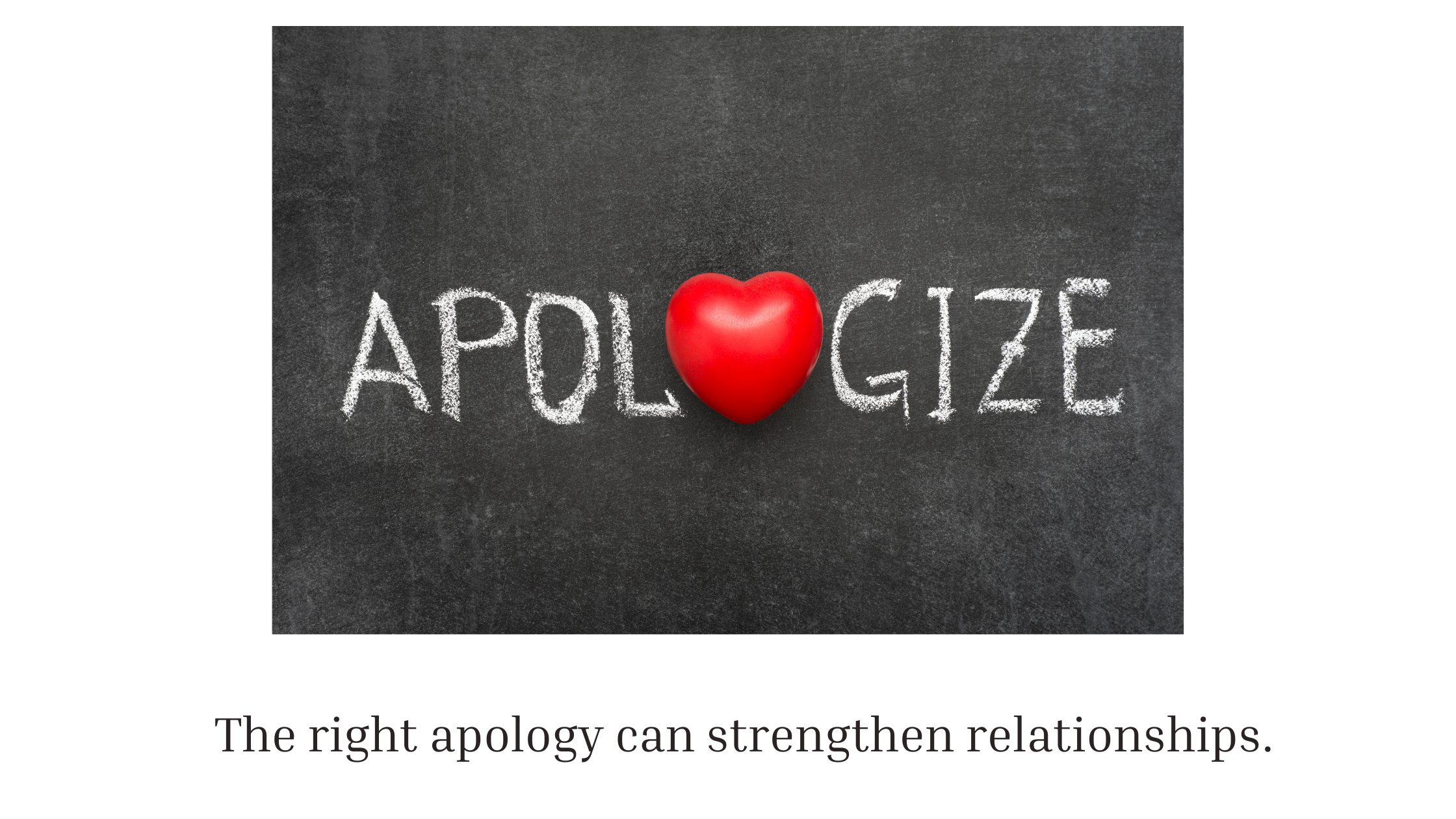
The Power of Apology

I’m sorry. Two short words (OK—one is a contraction.), yet they carry so many different meanings. Sometimes they aren’t enough or hardly matter. Other times, they carry a heavy weight. What you say, when you say it, whether you choose to say it, and how you say it can affect your relationships and your leadership and, therefore, your success.

The offhand “sorry” comes when you accidentally bump into someone while walking or your cart hits theirs in the supermarket. You make that quick apology. The other person says, “it’s OK.” or says nothing at all. Not saying “excuse me” or “sorry” makes you rude, but in the larger scheme of things, it doesn’t matter that much.

An apology carries a deeper import if your mind wanders in a conversation, and you didn’t hear what the other party was saying. It’s embarrassing, but you both will get past that quickly as long as you don’t drift off repeatedly. Avoiding the “sorry” can cause a bump in a relationship if you try to fake it and get caught.

Apologies become more significant when you have made a big mistake, such as forgetting a meeting, failing to follow-through on something you promised you would do, or saying something that revealed your implicit bias. Do you acknowledge your error? Try to minimize it? Hope it won’t be noticed? What should a leader do?

Niki Jorgensen discusses The Emotionally Intelligent Way to Apologize for a Mistake at Work. She says to be effective you need to choose your words and the correct time to make an apology. Your body language when making it also contributes to its effectiveness.

Jorgensen describes two things you should consider before making an apology:

Is an apology necessary? How to Decide – Don’t automatically rush into a long apology before taking the time to stop and think. How significant was your mistake? If you always apologize profusely, this detracts from what you say when your error was significant.

Observe the body language of the other person. Are they upset? That may provide an indication of the seriousness of your error and the impact it may have on your relationship. This is particularly true when what you said revealed your implicit bias. You need to apologize as soon as you become aware of your mistake. We all have these biases. What is important is that we recognize them when they appear and acknowledge them.

How to apologize professionally Jorgensen says to “evaluate the reasons behind the incident, the impacts on others and ways to prevent similar mistakes moving forward.” Apologizing in private is important and is more likely to  allow an open interchange. Avoid the temptation to get it all out quickly.

Apologizing is usually uncomfortable, but you also need to show you are listening to the other person’s response – and watching their body language. While you may be the one apologizing, it is an important opportunity to listen more than talk. When you acknowledge and take responsibility for your mistake, you strengthen the bonds of trust necessary in building and deepening a relationship.

To be recognized as a leader you must have integrity. Embarrassing as it can be, apologies made – or not made – reveal the person and leader you are. Take the time to acknowledge the error, whether big or small, and give the situation and person the right apology.

Fight The Fear Factor

The past two weeks my blogs have centered on you getting in front of an audience. As a leader, this will be necessary to get your face and your program out there. Yet many school librarians shy away from doing this other than with the smallest possible group. They know the value but find a host of reasons not to step into the limelight. The most obvious reason is fear.

Fear holds us back, and we can’t afford to let that happen.

Public speaking is a fear more common than death. Also known as “stage fright,” it is one of the most common fears. The phrase refers to performers, but it is, in essence, what we are all doing when we step in front of a group. Actors get past it or they wouldn’t have careers. You need to do the same because if you hide your light under a bucket, you will not be seen. If you are not seen, you will not be valued. And if you are not valued, you and your position are likely to be eliminated.

Terri Klass has sound advice on How to Stop Fear from Paralyzing Your Leadership. In presenting her five recommendations, she notes this fear can pop up at any point of your career, especially as the audiences get larger or feel more important. Each time you step onto a larger stage, there is the chance it might emerge. With these steps in mind, hopefully, you will be able to conquer it when it does.

  1. Name the Fear – Klass encourages you to identify the physical responses you are having. Can you recognize what is causing it? Notice and name your reactions (rapid heart, sweaty palms), and what they go with (not being sure you have the answer, wondering if anyone will listen to you, etc.) Recognizing that this is fear “talking” is an important first step.
  2. Share the Fear with a Trusted Advisor – Talking out the fear puts it into perspective. A fellow librarian or a friend (or both) makes a good listening ear. As you speak about the fear you just named, you are better able to see how inaccurate your fears are. If you don’t have someone to share it with, talk to yourself. Out loud. It’s hearing it that makes you aware of how much of the scenario you imagined is improbable and just some chemical reactions in your body.
  3. Try on a New Perspective – Klass has an imaginative idea here – think of someone who inspires you, and imagine them guiding you through this fear. How would they approach this situation? What attitude would they present? What would they say to you to encourage you? Can’t think of a person – Klass suggests you think of an animal. Imagine embodying the power of a wolf, the majesty of lion. It’s the perspective change that will help you manage the fear.
  4. Give It a Meaningful Good-bye – Look that fear in the eye and let it know you are done with it. Klass suggests writing down your good-bye and putting it away somewhere or speaking it into a mirror. Rather than putting away that fear, you can also burn it. There is a kind of satisfaction in seeing it go up in smoke. Gone forever.
  5. Commit to the New and Inspiring Leader – What are you going to do going forward? How do you want to be? Look at the presentation you made after having conquered your fear. How did it go? Remind yourself of this the next time you move onto a larger stage. Talk to yourself as you would to a friend who is beginning to shine more brightly.

I can remember reading Frank Herbert’s Dune shortly after it was published. A line from it has stuck with me forever, “Fear is the little death…. I will face my fear. I will permit it to pass over me and through me.” Each time we step out of our comfort zones, fear will be waiting. Don’t let it keep you from being the leader you were meant to be.

Are You Being Defensive?

Last week I wrote about the importance of listening. Somtimes listening is most significant when what’s being said is not something you want to hear.

Whether it’s intended as criticism or feedback, how do you respond when someone says something negative about you? Most of us immediately rise to the defensive, although some go on the offensive. Neither is the best course of action. The word “immediately” is the cue. Anytime we react without thinking, we are apt to make a mistake. Responding from our emotional first reaction is in gear is likely to produce a damaging result.

Whether it’s an administrator, teacher, student, or parent who made the comment, as a leader you want to be seen as someone who respects what others say. It doesn’t mean you agree with them, but you also don’t want to attack them. A defensive response is an attack, as its purpose is to invalidate what the other party said. And a relationship damaged by defensiveness can be hard to repair.

Lolly Daskol shares How the Best Leaders Overcome Their Own Defense Mechanisms. These five ideas, coupled with my comments, can keep you from reacting in the moment,

  • Cultivate self-awareness–Use your Emotional Intelligence (EI) to prepare you for these situations. No one likes to be criticized, but it happens to us all. Daskol suggests you recognize what your triggers are and how you are likely to react. Whether the comments came in a one-on-one or where others were present, your response will affect how people see you as a leader.
  • Make room for acceptance–One of the best tools a leader can have is the ability to pause. Settle yourself mentally. Take stock of your feelings. Daskol says to accept them without judgement in order to respond in a way that will move you forward with this person and continue to build on your relationship.
  • Hold yourself accountable–You may not have liked what you heard, but was it true? It may have been presented in a way that was hard to hear but listen for the message. While the method of delivery may have caused your trigger response, there is likely a kernel of truth in what is being said. Leaders take responsibility for their actions and learn from their successes as well as their setbacks.

Thank the party for calling your attention to a potential problem. Your open way of handling the criticism may even lead to developing or deepening a relationship. After, Daskol recommends you reflect on how you handled the situation. Did you respond reasonably? Remember, you can’t control how others think or behave, but you can control yourself.

  • Break the code–Rising to your own defense is natural. It’s a survival skill that animals as well as humans have learned. However, we are not fighting for our lives here, and the ingrained behavior doesn’t serve us in this instance. It takes work to change an automatic response, but it can be done. Starting with becoming more self-aware of how you react in these situations will help in resisting that immediate response and allow you to behave in a productive way.
  • Lead from within–Every time you avoid a deep-rooted response and substitute a thoughtful one, you grow as a leader. In addition to self-awareness, EI requires self-management. Leaders need to continually build their EI. It makes others see them as trustworthy and empathetic to their needs.

None of us will never like being criticized, and a voice in our heads will always rise to our defense. The object is not to let the criticism derail you. By moderating your response, hearing what the other person is saying, and responding appropriately, you will continue to be seen as the leader you are and want to be.

Leading Today, Tomorrow and Beyond

Success feels good – it feels great. You worked hard to get there. Unfortunately, if you get too comfortable with what you have achieved, you risk to sliding backwards.

Remember Blockbuster? Xerox? Blackberry? Sears? They were all leaders in the field for a significant period and are nowhere today. These giants, and many others along with them, didn’t see the change coming and didn’t adjust and move forward. You don’t want your library to suffer a similar fate.

As lifelong learners we must keep our leadership focused on the future or our libraries will be rooted in the past. “We have always done it that way” leads to stagnation. Policies, procedures, and programs must be reviewed regularly and be open to change and new ideas.  Equity, SEL and other current issues need to be thoroughly integrated into the library program. What else is happening? How can you predict where you need to go?

One way is to think laterally. Expand your reading beyond library and education issues by looking at what is happening in business and technology. Consider how new developments and concerns in those areas might impact libraries and schools. From this you may find unique inspiration to bring into your school.

In How to Keep Learning as a Leader, David Burkus presents four ways in which you can be ready for what may be coming next.

  1. Linger on Failure – Take the time to notice what you learned, achieved and will do differently as a result of setbacks. Accept your failures as part of your process – and proof that you’re growing as a leader.. Failure is feedback when you know how to use it. It isn’t comfortable to review your mistakes, but this is not about being comfortable. It’s about growing and learning.
  2. Stay Curious – Listen, read, view, and keep learning. A random conversation can give you a new idea. Watching television or seeing a movie can start an unanticipated thought process. You just need to be open to the possibility.  Burkus talks about listening to experts in different fields. The wider your scan of the environment, the greater your opportunity to discover something new. It doesn’t have to be a deep dive into these subjects, unless you uncover a treasure you want pursue.
  3. Experiment – Put your new idea into practice. If it only stays in your head, tomorrow will have arrived before you are ready for it. Yes, you will fail sometimes (see #1) but the trying is worth it! Burkus suggests creating a decision journal and log what you decided to do. What was your intended outcome? Did it work? Can you tweak it? The journal can give you a record of your thinking and how productive it is.
  4. Cultivate Conflicts -This is the scariest step. It doesn’t mean instigating them but it does mean developing your awareness of them. We live in highly polarized time. While you don’t want to engage, listening can lead to amazing opportunities. The more you know about how others around you think and why they do, the better able you are to anticipate resistance to different ideas and projects. Knowing where pushback is likely to arise, you can plan. You might make modifications, provide background information, or include others in the planning process, which always a good idea.

In the words of Fleetwood Mac, “Don’t stop thinking about tomorrow/ Don’t stop, it’ll soon be here…Yesterday’s gone.” Be staying curious, learning from setbacks, trying new things, and listening to those around you, you’ll be ready for tomorrow and continue to grow and thrive as a leader.

Take My Advice

We all are guilty of giving unsolicited advice. Most often, we don’t even realize we’re doing it. Unfortunately, instead of building relationships, giving advice when it’s not asked for tends to cause resistance. In offering help, we don’t stop to learn if the other person needs or wants assistance. In rushing in with our solution, it may seem to the other person that we are minimizing the problem. In ither case, the other person pulls away and an opportunity to truly be of help is gone.

 What makes us think we always have an answer? We certainly don’t have solutions for all our problems. Often, the best help we can give someone is just to listen. Whether they want to vent their anger or release too many thoughts swirling in their heads, offering a solution cuts off their process. By short-circuiting what they were saying, you may very well have prevented them from finding their own solution. When someone is angry, fearful about a situation, or any other highly emotional state, they are not thinking cognitively. Through the process of expelling it all, reason has a chance to return. The thoughts stop swirling, and the rational mind deals with what has upset them.

When someone comes to you with a problem, you have an important role to play—without offering help. They needed someone with whom to share all of it, and they trusted you to be that person. By using your active listening skills, you help them while deepening the relationship. Instead of speaking, use your body language to show you are focused on what they are saying. Nod your head. Let your facial expression mirror supportive feelings. If there is a pause, you can restate something they just said to show you are listening – and to find out if you missed a point.

PsychCentral cautions “It’s Time to Stop Giving Unsolicited Advice“. The simplest way to do this is to ask if advice is wanted. You can try any of these questions suggested by PsychCentral:

Are you open to suggestions? This clears the path for your response. “Suggestions” is a better word than “advice.”  The latter says you know more and can be taken as a criticism. The former is just some ideas you offer that can be taken or not.

I’ve been through something similar. Can I tell you about what worked for me? Without imposing, you are establishing a bond of a mutual experience. Recognize that means you will have to share that experience. That interchange puts the communication on an even more personal level. It evokes shared trust and leads to deepening the relationship.

Is there anything I can do to help? Be prepared for a no or a yes. It is a generous offer. If the other person takes you up on it, you are obligated to follow through. The commitment may take time and effort on your part. If no further help is required or requested, you have shown your willingness and concern.

If you find that you regularly give unsolicited advice, PsychCentral offers you some advice in the form of questions to ask yourself, including the following:

  • Why do I want to offer advice right now?
  • Is there something else that I can do that would be more helpful?
  • Is there someone more qualified who could advise this person?
  • Can I let them decide or figure this out on their own?
  • What else can I do to reduce my anxiety or discomfort?
  • Can I accept that my ideas aren’t the only good ideas?
  • How can I be supportive without giving unsolicited advice?
  • Can I focus on listening and understanding instead of fixing and instructing? Would this be supportive and respectful?

Unsolicited advice is a two-edged sword. You have only the best intentions when you are the one offering it, but that may not be how it’s received. Think about times when someone has offered you unsolicited advice By recognizing what receiving it feels like, you will be better able to restrain your impulse in the future. And if they are looking for advice, hear the other person out — completely—so you understand the situation before you give your response.

And that’s my advice to you. LOL 🙂

Reach for Your Leadership Vision

I often write and speak on the importance of knowing your Mission and Vision. Missions focus on what you do. It’s your purpose or your “perspiration.” Visions are your “inspirations” and “aspirations.” They are where you would love to have happen. Both grow from your core values, your philosophy. And you can’t reach your school library Vision unless you have one for yourself as a leader. Without that self-Vision, it is difficult to step out of your comfort zone and the take risks leadership requires.

In Think Deeply About the Leader You Aspire to Be, Art Petty suggests you “mine for early influences and marry them to future aspirations to develop a clear picture of your desired leadership self.” Connecting what you’ve seen and done with what you want can guide you in constructing your leadership Vision using the following four steps:

  1. Start by exploring your leadership inspirations – Look inwardly and widely. Consider the values you hold. What are you passionate about? Who are the people you admire in librarianship and elsewhere? Why do you admire them? Petty suggests you look at the behavior of those people. If they had a direct contact in your life, how did they reach out to you? I became active in school librarianship and began writing because of the people who reached out. Their trust and belief encouraged me to leave my comfort zone.
  2. Spend time reflecting on your best self – Think of those moments when you were proud of something you did as a leader. You may have put together a difficult project or you gave a workshop for teachers, and they were all engaged and participating. Consider what you did to make those instances happen. What aspects of yourself as a person did you draw on? Think of the values that motivated your behavior and/or achievement. Look to the moments when you were proud of yourself and your behavior. It may have been how you connected a reluctant reader to the perfect book. Perhaps you turned a confrontation into the start of a relationship.
  3. Your Leadership AspirationsImagine this was your last year at your current position. You’re either moving on or retiring. What would you hope your students would say about their library experience? How about teachers and administrators? Take time to think about the legacy you want to leave, the impact you want to have, as a librarian and a leader and from that, pull out the pieces you want to include in your Leadership Vision.
  4. What’s most important to you as a leader? Petty recommends answering the following questions:
  • What do I care most about doing and achieving as a leader?
  • How will I guide, teach, and coach?
  • How will I support creating great results through others?
  • How do I want to affect those I come in contact with along the way?

My Leadership Vision is “School Librarians are recognized everywhere as vital leaders.” I know it will never be universal, but I always work to be a force for change. It inspires all I do.

Taking the time to see yourself as a leader and the impact your leadership will have on your library can inspire and should inspire you. Reach high and fearlessly create your own leadership Vision.  

The Centrality of Trust

image from Wavetop via Canva

Trust is the foundation of relationships. And we are in the relationship business. It is through relationship we build the collaboration with teachers – and administrators – which engages students in meaningful learning. Building trust requires trusting yourself and the willingness to trust others.

We have had many successful experiences that began with us not knowing everything necessary to do a task. In those cases we either get the information through our research or from the knowledge of our colleagues either locally or in social media. We may not know the answer – but we can find it. This builds our trust in ourselves

Trusting others is somewhat more difficult, but relationships are a two-way street. Most people have had an occasion where someone violated their trust. To build a relationship, you have to give trust even before it is accepted. This is not about sharing your deepest, darkest secrets. It’s letting people know who you are as a person and following through on what you say, which makes it safe for them to share themselves with you.

In How Successful Leaders Build Trust with Their People Lolly Daskal discusses “trust-inducing behaviors” which build relationships.  You probably exhibit many if not most, of these, but it is helpful to be aware of what you are creating. Work on any you find challenging. Many of them weave together. Here is her list of eleven behaviors:

  1. Being accessible – Of course you are… except for when you are feeling rushed and harried. You can’t always just drop everything, but you can ask when you can get back to someone. Being honest about where you are, combined with being available when you say you will be, builds trust.
  2. Being confident – It’s not arrogance. It’s being efficacious. When you are confident, teachers and students know they can count on you to help them. People come to you for what you know or what you can do to support them. Be willing to show them they’re right to trust you for this.
  3. Being credible – We build credibility when we are willing to share both our mistakes and our successes. Acknowledging our goofs, large and small, along with our wins lets people see we are human. Admitting we are wrong doesn’t make us less in the eyes of others. It makes usmore worthy of trust.
  4. Being honest – There are times when we might want to skirt an unpleasant truth but telling hard truths builds trust. People know when you’re avoiding saying something. Instead, pause to choose your words and give honest feedback.
  5. Being supportive – Others make mistakes, too. If theirs has a direct effect on you, it might be hard not to jump on them for it. Go for “being honest,” and acknowledge it happens to us all (“being credible”). Look for the lesson you both get. If they are sharing something that doesn’t have to do with you, be prepared to listen (“being accessible”). If they ask, you can help them find a solution or fix. Your support will build trust.
  6. Being dependable – Keep your word. When you make a commitment, see it through. You build trust when you can be counted on to do what you say.
  7. Being consistent –We are known by our actions. Our actions must match our words. Students – and teachers – need to know how you will react. If you allow them to behave one way on a given day and then rebuke them for it on another, they will not trust you.
  8. Being open – Listen to others. Show by your actions that you see and care about them. Give them the space to give you honest feedback. When people know you listen, their trust will grow.
  9. Being empathetic – Everyone is dealing with something. We try to put it aside when we get to school, but it is there, and sometimes it is significant. Despite what they are showing on the surface, be attuned to the body language and behavior of others. It will help in your dealings with them, and when you’re “being open” and “being supportive”, they will share as needed, further building trust.
  10. Being appreciative – Acknowledge the success of others. In collaborative projects, give them the limelight. Emails or, even better, hand-written notes brighten someone’s day. They also realize you see them.
  11. Lead from within – Take trust very seriously. When you display the previous ten behaviors, people feel safe in having a relationship with you because you are trustworthy. This allows you to be an effective leader.

Good leadership begins with trust. Leadership is not something you take on when you want to get a project done. Leading is how you interact with people every day. By acting in the ways listed, people recognize you are a leader and someone they can trust.

Reviewing Leadership Skills

No matter how well you know a subject, it never hurts to review and sharpen your skills. This is true with leadership as well. And like re-reading a favorite book, when you go back, you’ll probably find something you didn’t notice the first time and you may even find something new to enjoy.

An unexpected source of leadership information comes from American physicist Richard Feynman who was also a popular teacher at the California Institute of Technology. There he taught eight classes which have become well known and play a strong role in the tenets of leadership.  In Richard Feynman’s Lessons for Life (And Leaders) John Baldoni calls out the core of these classes and adds his own comments. I’ve added applications to librarians.

  1. Work hard – Baldoni says, “discipline is essential to mastering your craft.” I would add to remember to work smarter rather than harder. Know what is important. Before diving into a project, ask will it advance your Mission? What return are you going to get for your investment of time?  Does it need to be done now?  Can/should you get help? Answering these questions will enable you to work hard and smarter.
  2. What others think of you is none of your business – Don’t let opinion and hearsay distract you. Instead, keep in mind it is vital that others see you as important to their success. They must value the help and resources you provide. Don’t become preoccupied by those who steadfastly resist every attempt you make to collaborate with them. Focus on strengthening the connections you already have. 
  3. It’s OK not to have all the answersLeaders don’t know it all. But as the saying goes, “the librarian knows where to find it.”  It is more important how you bring the answer.  Make sure you empower those who want to answer questions, especially since most people feel foolish for not knowing. If you make the teacher feel like a co-discoverer for raising the question, you pave the way for improved relationships and collaboration.
  4. Experiment, fail, learn and repeat No one is successful all the time. We can’t let the fear of failure makes us hesitant to experiment.   We have an opportunity to model this for teachers and students and offer others a valuable lesson. They will become more confident in their own process when they see ours.  
  5. Knowledge comes from experience Lessons come from success and failure. How you react to and learn from a failure is a measure of your leadership and future success. You will show others the kind of leader you are when you accept that your project/experiment didn’t work and, rather than hiding from it, take the lessons you learned and use them to go forward. 
  6. Imagination is importantGood leaders create a safe place for others to think big. Creating a climate of “wondering” is essential to what the library provides to all its users and makes it safe for them to consider the possibilities. Allowing your imagination loose is necessary in creating a Vision for your library. This is your chance to think big!  Think outside the box – or imagine that there isn’t any box at all.
  7. Do what interests you the most – In this Baldoni is urging us to set goals that inspire us. Although you need to do your job, you can play to your interests. We are fortunate in that our job requires many skills and roles.  Where is the heart of your passion? Are you a techie? Is reading where your heart is? While you won’t ignore the range of responsibilities you have, you can put emphasis on what you care about and enlist others in the aspects of the job you like less. Volunteers are hard to come by, but if you are specific about your needs, you might find some.
  8. Stay curious – Curiosity keeps our imagination engaged. This is a place where libraries and librarians excel. We are role models for lifelong learning and what is curiosity but the beginning of learning something new. Being curious is good advice when it  comes to building the relationships which are necessary for our success.  Be curious about others.  Letting them know you are interested in them as people gets communication going.  Collaboration can then follow.

These eight life lessons may all be things you knew but are they things you’ve practiced? If there is one that inspires you today or if one is feels new and exciting, then I hope you’ll put it into practice to strengthen your leadership skills. The best lessons never get old and always deserve a good re-read.