ON LIBRARIES: Always have a plan

chart your courseThe school year has begun.  Everything is new again. Where do you want to be when it ends? Have you given it any thought?  Now is the time to chart your course.

I have written and taught about strategic planning, feeling very strongly that every library program needs to have a direction for the future.  But strategic planning is normally for a two to three year timeline.  If you haven’t gotten that far, make a plan for this one year.  It will give you the confidence to create bolder and longer term ones.

Start by looking at your Mission Statement.  Every library program should have one that declares its purpose in a compelling way.  If you don’t have one, time to get it written.  I did a blog on it one year ago that briefly explains how to craft the statement.  It doesn’t have to be perfect.  You can always tweak it later.  Check websites of other school librarians to see if they have a Mission Statement.  Borrow wording you like and make it suit your library.  The statement needs to promote the unique purpose of the library program.mission statement

Once you have your Mission, identify any part you haven’t achieved yet.  For example, perhaps mention teacher collaborations yet very few teachers are collaborating with you. Or if you refer to tech resources, what would you most like to add to your collection?  Is your book budget far too small—or non-existent – for you to build the lifelong readers you stated as part of your purpose?  Do you think an author visit would promote reading? What else is lacking?

Now comes the challenge.  How can you achieve this one change in the course of the school year?  If teacher collaboration is your target, identify the teacher(s) most likely to work with you. You really can start with just one teacher to discover what works and what doesn’t.  Remember, you need to have a relationship first before you are likely to win that teacher over.

Figure out what curricular unit would be the best fit for a mini-research project. Look for one occurring early in the school year so you can build from that. Speak to the teacher, stressing what you are willing and able to do.  You don’t want to add to the teacher’s workload. Do your homework first and have a list of helpful resource ready for you share with the teacher.  Offer ideas for a culminating unit in which students demonstrate critical thinking and create new knowledge.

For tech issues and increasing money for book purchases, you need to identify a source of funding. Can you get a grant from the local education foundation?  Will the parent association give you money from a book fair? Are there other sources in your community?  Look into DonorsChoose,org as a possible source.

Before you apply for any outside funding, develop a rationale for your plan.  Know what you want to do as a follow-up. Speak with your principal. Discuss your Mission and why you want to work on developing this aspect of it. If you are prepared, you should be able to get approval without much if any difficulty.

will it be easyLeaders plan and always have a plan.  While you will focus on one thing for this school year, have a list of everything you want to do to strengthen the library program and make your Mission Statement a reality for everyone in the school.  Then you start working on achieving your Vision.

You never know when an opportunity will arise and you have a chance to do something but have to move quickly. I have known of librarians who are informed there is suddenly a specified amount of money available but it must be spent within a short time frame.  I had it happen and called a vendor I trusted, set up a meeting and gave the rep a big order.

I also used to make it a practice to see my Superintendent of Schools over the summer.  Depending on how your district works, you probably would do this only with your principal.  In that quiet time of the year, I would discuss where I wanted to take the library next and why and how it might affect the budget.  We would negotiate for the funds I wanted for a given project.  I would agree to take money from one part of my budget and she would acquiesce in getting me additional funds to make it happen.

What was most telling is that she once said to me, “I have the feeling that if I go one step with you, you have nine others waiting.” She was right.  I needed those other possibilities.  In case my first idea was shot down, I would bring up the next. She also said to me on another occasion that she learned the easiest way to deal with requests was to say no.  Almost everyone would take that for an answer and go away.  But those like me, who came back with an alternative were listened to.  She could see we were committed to getting something done.plan

So what’s your plan?  What do you want to see happen by school’s end?  What else?  What else?  Dream, plan, and work.  Create a mission, build relationships, and grow your program. You can make it happen.


ON LIBRARIES: Leaders Empower Others

    leadership direction         The word “empowerment” has been coming up often. The AASL guidelines for school library programs has the title Empowering Students. “Empower” has become one of the buzz words used in business and education.  As with many overused terms, frequency blurs meaning. It is a very strong word and should be thoroughly understood so you know what it is you are expected to do.

Merriam Webster defines it as “to give power to (someone)” or “to give official authority or legal power to (someone).” Obviously we use the first meaning most often, but even so, what power are we giving students?  Through our inquiry-based lessons they develop the power to learn on their own, follow their passions, knowing they have become skilled users and producers of information.

But there is a more subtle meaning of empower. When we empower someone we make them more confident, in control of their life, and able to believe in and trust their abilities. That is a huge responsibility. Yet if you follow your students over their several years in your building, you see that is exactly what you do.super heroes

The AASL Guidelines were published in 2009 and the use of “empowering” in the title was new in the world of education.  Although it didn’t discuss why the word was chosen, it was on target.  We need to embrace the concept of empowerment.

As a leader you need to take on the challenge of empowering others.  Recognize how and when to empower your stakeholders. When you bring relevant aspects of your expertise to them, they become more confident in what they are doing and, whether or not they acknowledge what you have done, they are aware that they have grown as a result.

Students, of course, are your first stakeholders, and you know how you empower them.  You do so with every inquiry based lesson, every time you expand their range of leisure reading, or guide them in their searches for their assignments or personal interest.  Tune into how you are building their confidence and trust in their own abilities to learn on their own.

Your teachers are the next group you need to empower.  To do so, analyze where they are unsure of themselves and need some help. Because of rapid changes, teachers are usually not nearly as capable as you are at integrating tech resource.  They are unaware of the vast range of them and the new ones that keep sprouting up.  One librarian I know of, sends teachers information on one tech resource each week, offering to help them see how it can be used in their curriculum units.  Knowing that you are there to hold their hand as they learn how to use it, makes the prospect less intimidating and builds their confidence.

help upSome teachers are not well versed in crafting units with Essential Questions (EQs) and Enduring Understandings (EUs).  As you work with them, having built a relationship so they trust you, suggest possibilities to use in a learning experience.  The more the two of you work together, the greater the teacher’s confidence grows in writing the EQs and EUs on their own.

Finally, the importance of inquiry-based learning is being touted as important in student learning.  Too often the implication is it can be accomplished solely in the classroom. Considering it has students select the direction of what they want to learn about a topic and invariably requires research, it can’t really be limited to the classroom. But you can point out how you structure an inquiry-based unit.  Working with you is safe as you do not evaluate teachers so they are willing to ask questions and learn as they go.

The strong relationships and growing history of collaboration or cooperation you have built with teachers are the foundations on which you empower them.  In an era when many eyes are on classroom teachers, judging and evaluating what they do – and usually negatively, you give them the confidence and the vocabulary to show they are valuable.  And you are therefore valuable to them.

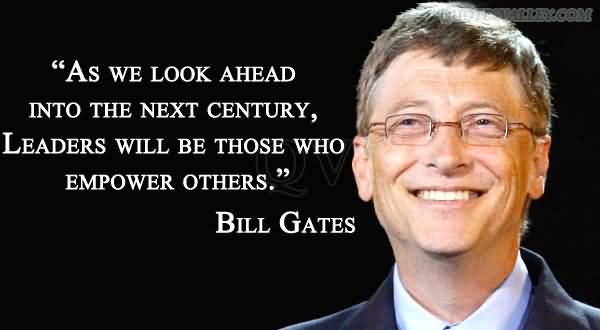
Your next step is empowering administrators.  While many work hard to keep up with changes in technology and what is happening in their buildings, too often they are even more overworked than you and the teachers.  When you inform them of projects teachers have done with you, always spotlighting the teacher, and students learning and reactions, you give them a deeper understanding of how collaboration (or cooperation) is impacting both faculty and students. With this knowledge, the administrator gets to know more details of what is happening in the building that could be obtained from the few classroom observations.  The added benefit is that it promotes your program.Bill Gates

Parents are another group of stakeholders you can empower. They are aware of the dangers their children might get into in cyberspace but lack the knowledge to know how to prepare them and keep an eye of their child’s digital footprint.  If you give a presentation to parents on keeping kids safe in cyberspace and/or posting helpful information for parents on your website, you empower them.  Even keeping them informed about projects classes are doing is a form of empowerment as it makes them feel closer to their children’s day.

Who are you empowering?  How are you doing it? What help do you need? Remember – your peers and mentors are here to empower you!

ON LIBRARIES – Weeding and Leading

weedingI recently realized these two topics are related when I discovered how many librarians are reluctant to weed, and the many issues that arise when they do. Perhaps you’ll feel better about the process when you realize weeding gives you several ways to promote your program. As you make your collection more relevant and less burdened by past choices, you show your program’s (and your) relevance.

The Issue of Weeding

I first encountered weeding back in the 1980s when I took over a high school library from a librarian who feared administrative reaction if she threw books out.  After all they were bought with hard-earned taxpayer money.  I had no such qualms.

Among the treasures I found on my shelves was a book called Percy Goes to Yale, the sue bartoncomplete Sue Barton series starting with Sue Barton Student Nurse which I had read twenty plus years before in high school.  Other treasures included a 300+ page book on homeroom guidance, a science book with a chapter on the Piltdown Man, first “discovered” in 1912 and proved a hoax in 1949, and a guide for young ladies called What’s Your PQ? about how girls should keep their intellect and skills hidden so as not to seem superior to their dates.

Weeding needs to be a continuous process to keep collections current. Having books on the shelf just for the sake of having them is a disservice to students. Worrying about keeping a certain number so you have 20 books per student or whatever formula you are following means nothing if the books aren’t helpful.

While librarians are still be eliminated, in other places the positions have been restored.  The newly hired librarians are faced with books that haven’t circulated in years and nothing current.  This is one place leadership shows up.  If you put books you have weeded onto a cart and either show the howlers to your principal or take a picture of them and share it, you will show how you mean to take charge of your library.  Tie it into your view of what a 21st century program should be and use it to show your leadership.

You can also use weeding as a means of building advocates for the library program by inviting volunteers to assist you.  If you don’t have library volunteers, with the principal’s approval, see if the PTA will work with you to sponsor a Weeding Saturday.  Have carts and criteria ready along with snacks and drinks.

Choosing What to Weed

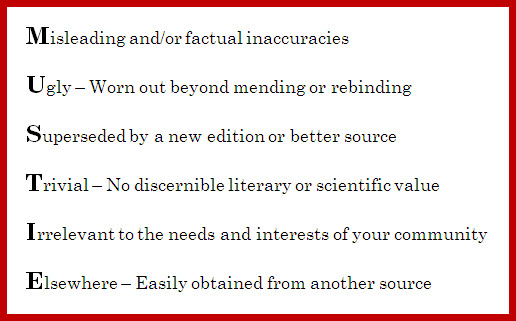
mustieFor criteria, many librarians use the CREW and MUSTIE method created by Belinda Boon and presented in full in The CREW Method; Expanded Guidelines for Collection Evaluation and Weeding for Small and Medium-Sized Public Libraries (Austin, Texas: The Texas State Library, 1995). In it she explains the two acronyms. CREW stands for Continuous Review, Evaluation, and Weeding while MUSTIE helps you decide what to throw out:

  • M- Misleading—factually inaccurate
  • U- Ugly –worn beyond mending or rebinding
  • S- Superseded—by a new edition or a much better book on the subject
  • T- Trivial—of no discernible literary or scientific merit
  • I- Irrelevant to the needs and interests of the library’s community
  • E- Elsewhere—the material is easily available from another library.

My personal favorite resource on weeding is Less is More: A Practical Guide to Weeding School Library Collections by Donna J. Baumbach and Linda L. Miller (Chicago: ALA, 2006). While now 10 years old, it is still incredibly helpful.

library girl - weeding
The FRESH approach of Library Girl

Library Girl offers the acronym FRESH.  The image at the left explains her measures and if you click on image (or her name at the beginning of this sentence), you’ll read her article on the subject.

When your volunteers arrive, explain the criteria to them and let them begin.  Be sure they know you will review each item because once in a while, they pull a classic that really should be kept.  Keep track of the total number of books to discard and photograph everyone hard at work as well as the results of their labor – the piles of books and the uncluttered shelves.

Part two of the weeding process brings up what can be a thorny issue.  What do you do with the discards? Before you begin, find out what the district’s policy is.  Assuming you have the right to dispose of them as you wish, think twice before you send them to Africa, to a school lacking in books, or to classroom collections.  I know it’s hard for most of us to throw books out.  And tossing what were expensive reference sets seems wrong but why would you burden another collection with books that aren’t valuable.

Before you choose one of those options, I urge you to read an article by Gail Dickinson in the April/May 2005 issue of Library Media Connection. In addition to explaining the weeding process succinctly, going through all relevant steps –and discussing MUSTY (which I like even better than MUSTIE) she makes an analogy between milk in your refrigerator that is past the sale date and has curdled and books that are outdated and contain misinformation.

Weeding Shows Leadership

One more story from my past.  I was working with a group of volunteers on a community service project doing some cleanup in an inner city school.  One team worked on the playground, another in the cafeteria/ gym/auditorium, and I headed up those who wanted to clean up the library.

There hadn’t been a librarian in several years and the library had been rearranged to meet teacher needs, so there was no Dewey order and no card catalog. The shelves however were packed.  I gave my team guidelines and in a few hours we had an enormous pile of books to discard. One was about family life in the 1950s complete with a picture of the family watching a tiny black and white television.

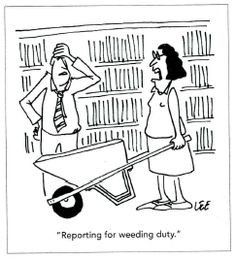
weeding dutyThe volunteers were very pleased with how the library looked and so was the principal.  He was very impressed and told me if I had been his librarian, he would never have eliminated the position. He had no idea of who I was other than a librarian. He didn’t know about the books I had written or what I was doing in AASL.  He just saw results.  And that is why weeding is tied to leadership.

How often are you weeding?  Do you get help?  What “howlers” have you found?


ON LIBRARIES: A Matter of Time

white rabbitWith the start of the school year, the demands on your time just increased exponentially. By the end of the first week some of you feel you are already a month behind. To prevent yourself from spending the year in a constant state of overwhelm, you need to develop time management techniques that work for you, allowing you to get your work done and still be able to be with family and friends.  In other words, have a life outside of school.

Leaders know how to manage their time. They have to.  Last October I blogged about the stories we tell ourselves as to why we can’t be leaders. The first one was you didn’t have time.  As you take on more tasks and responsibilities, you can quickly find yourself buried in tasks.  Even with good time management, you can get swamped.  You just need to know how to minimize those times when you are in work and some techniques for getting your life back in order.

You almost undoubtedly have days when you feel you will never get done.  Mostly, it’s a matter of finding out what organizational techniques work best for you.  Then you must become sufficiently disciplined to use them.

No one has more than twenty-four hours in a day.  Realistically you need time to sleep, eat, and be with family and friends.  That leaves a limited number of hours to get everything done.  Yet if you look around, you will see that some people do it very well and others are constantly floundering. time management

The truth that you know, but hate to face, is you are probably wasting a great deal of time. It’s getting easier and easier to do so with lures such as Candy Crush or other Facebook games, checking email, or looking at posts on your social media of choice. Procrastination has always been with us, and it seems we have more ways to avoid what we don’t feel like doing.

Take an honest inventory of your habits.  Make of list of how you spend (squander?) time.  What tasks do you avoid doing for as long as possible? This is not meant for you to blame yourself for these habits.  Even the most organized people need downtime. You can’t shift from one task to a dissimilar one without a brief break of some type.  The brain doesn’t work that way.  The difficulty is not to turn that brief break into an extended waste of time.

Make another list of your daily routines and your “regular” ones.  Which ones require a deep focus and which are “no-brainers?”  It is important to be recognize that all tasks are not equal in how much concentration they need. You should know what time of day you are best suited for the ones that involve the most attention, so that to the extent possible you can deal with them at the optimum time for you.

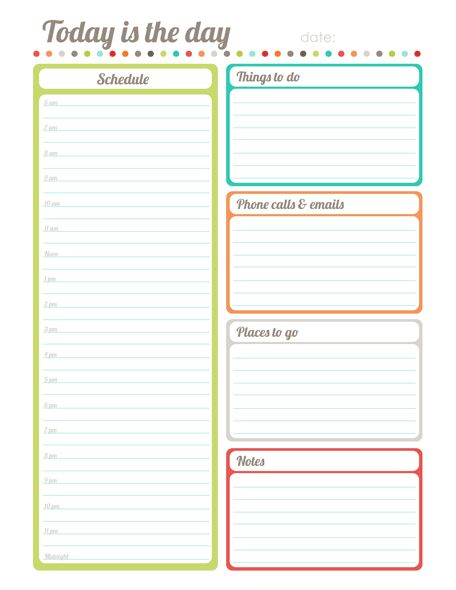
daily plannerThink about how you spend your average work week. I sometimes characterize many librarians as living with a fire extinguisher and duct tape as their prime tools.  They are spending much of their time putting out fires or patching up problems.  That’s draining.  For the most part it is caused by not having a Mission and Vision (which I hope you have since I have blogged about it previously), and setting goals for attaining desired objectives.  As the great philosopher, Yogi Berra, is reputed to have said, “If you don’t know where you are going, you will wind up someplace else.”

Stay focused and be productive by finding a way to have a to-do list that works for you.  Some highly obsessive, motivated people can have one for the day with a list of all tasks prioritized.  They consider completing it a mark of their success.

The nature of your job makes it unlikely that you can do that.  Your day can be very unpredictable.  Consider a weekly to-do list.  I have one that is for two or three days.  I have a column on the right where I list the different categories of my tasks.  For you it could be “back room” for tasks such as cataloging, ordering books, etc, “administration” for doing reports, and “teaching” for getting materials for a class.  You would be the one to best set the categories.

I put stars next to my high priority tasks.  Another way to do it is to identify tasks by whether they take concentrated time or can be done whenever you have a few free minutes.  Writing a report is one that takes focused time.  If you stop in the middle, you need to review what you did before continuing. Checking email can be done between complex tasks.

Some of you will find it most efficient to keep your to-do list on your phone or tablet. Others prefer a traditional pencil and paper to have it in view all the time.  This is not one-size-fits-all. How you organize your available time is personal and must fit your personality, work style, and your situation.  Keep experimenting until you find the one that works best for you.

For those of you who routinely stay late, it’s time to pack it up.  Allow yourself only one or two late days.  You have a life waiting at home.  You will never finish everything. Tasks keep coming. My mantra is, “If it’s important, it will get done.  It always does.”

What’s your best time management tip?


ON LIBRARIES: ESSA and You

essaThe start of the school year is imminent for some of you and not too far away for the rest of you.  Before your vacation is over, you need to become knowledgeable about ESSA and how to make it work for your program.  Fortunately AASL and hopefully your state association has information and resources for you to tap into as you advocate for library funds.

Ever since President Obama signed ESSA into law AASL has been working to ensure that this hard-one replacement of NCLB would get school libraries the recognition and funding they need.  Since ESSA calls for “Effective School Library Programs” in Title I, II and IV of the act, it was necessary to define what such a program is. They have done so with a recently released position statement.

The statement is brief and yet succinctly explains the contribution an “effective school library program” makes to students and the educational community. When you review this document, highlight where your library meets the requirements and where it still falls short.  Bring it to your principal along with your recommendations as to how you can attain the level required so your school and district will qualify for federal funds under the act. President_Barack_Obama_signs_Every_Student_Succeeds_Act_(ESSA)

The discussion opens the door for you to share what you can bring in the way of technology integration, lifelong reading, and the 21st century skills of critical thinking, creating new knowledge, and sharing it widely. Since the position statement refers to the research supporting the contribution of school library programs on student learning and achievement. Also bring your downloaded copy of School Libraries Work -2016 ed. from Scholastic to support that claim.

In a previous blog I mentioned the “landing site” AASL has set-up as a one-stop shopping for ESSA information. All information whether from AASL, ALA, or other sources can be found here.  In addition to a link to the position statement, under Rule Making and Guidance it has an extremely helpful PDF from ALA’s Washington Office on Opportunities for School Librarians as a result of ESSA.

The information from the Washington Office focuses on Title I, II, and IV of ESSA.  In each case it explains the area covered by that title and part. Under Background it explains what states and school districts must do under the provisos of the Act.  Next it lets you know the Library Provisions so you don’t have to read through the legalese of the actual ESSA.  Then it details under Next Steps what need to be done to apprise school districts of what they can do under the Act and where it is necessary to contact state officials.  The latter will probably best be done by your state library association.

Title I Part AImproving Basic Programs Operated by State and Local Educational Agencies will be the most challenging since it authorizes but doesn’t require how these agencies will assist schools in developing effective school library programs.  A lot of work is needed to contact and work with these agencies. It would seem for the most part you will need a lot of assistance from your state association unless AASL can develop an action plan to help.

Title II Part A -Supporting Effective Instruction is much more promising, as are subsequent relevant parts of the Act since it authorizes states to use grant funds to “support instructional services provided by effective school library programs.”  Under NCLB these funds were listed as solely for teachers. Now these can be used to support your professional development.  Note it says “can be.”  Whether they will, depends a great deal on you.

Title II Part B Subpart B Literacy Education for All includes a new K-12 literacy program.  School librarians can now apply for grant funds to support this. It also has funding to provide time for teachers and librarians to meet, plan and collaborate on comprehensive literacy instruction. Subgrants awarded must include professional development for teachers AND librarians. Again, you may very well have to bring all this to the attention of your administration. Another section of this subpart deals with the Innovative Approaches to Literacy and specifically authorizes funds to be used for developing and enhancing effective school library programs.  It will take advocacy at the federal level to ensure this is fully funded.  Expect ALA and AASL to work through the Washington Office to accomplish this – but when asked, be sure to do your part and contact your legislators.

Title IV Part A – Student Support and Academic Enrichment Grants (Block Grants) this is a continuation of what was in NCLB but now librarians have a presence.  The grants are tied to poverty levels and include funding for personnel to learn the knowledge and skills needed for technology integration to improve instruction and student achievement. In preparing the grant, school officials must consult with teachers, principals, and other stakeholders who include school librarians.

aasl essa pageOnce you are grounded in these two documents, check out the other resources on the AASL ESSA landing page.  Review the various AASL Position Statements relevant to ESSA. Make it a point to regularly check the link under Resources & Information to ESSA Updates on Knowledge Quest. Look over the material from the ALA program on Unpacking ESSA for the School Librarian.

ESSA is both an opportunity and a challenge.  You can move your school library program forward and demonstrate your leadership to your administrators or you can cross your fingers and hope someone does the work for you and you will get some of the funding.  Which type of librarian do you want to be?  This is the time to step up.  Have you done anything so far?


ON LIBRARIES: Teaching Social Justice in the Library

social justiceHow far should we go in teaching values?  Years ago, there was a strong belief that character development was the parents’ place.  Today a high preponderance of schools include it in their curriculum.

Current events have raised the question of whether we need to teach social justice, but in the context of a contentious presidential campaign it seems too political to touch. In some areas it could undoubtedly unleash a torrent of publicity that would negatively impact the librarian.  The easiest decision is to ignore it and claim it is outside our responsibility.

Two thoughts to consider.  First, we teach students how to think, not what to think. If the learning opportunity is properly developed, it shouldn’t bring with it any personal bias.  Secondly, social justice is a very large topic and encompasses areas far beyond current headlines.how to think

I searched to find a good definition of social justice.  Appalachian State University’s Department of Government and Social Justice has an article on What is Social Justice? In it the author defines it by citing others including “… promoting a just society by challenging injustice and valuing diversity. It exists when “all people share a common humanity and therefore have a right to equitable treatment, support for their human rights, and a fair allocation of community resources.’ In conditions of social justice, people are ‘not be discriminated against, nor their welfare and well-being constrained or prejudiced on the basis of gender, sexuality, religion, political affiliations, age, race, belief, disability, location, social class, socioeconomic circumstances, or other characteristic of background or group membership.” (Toowoomba Catholic Education, 2006).”

Miss HoneyBut the one I think is best suited to schools comes from the description of AASL’s Roald Dahl Miss Honey Social Justice Award, which has been awarded for the last three years.   In the criteria it states:

  • The librarian has made a significant effort to teach the concept of social justice in creative, inspiring ways. This might include, but not be limited to, teaching about civil liberties, human rights, international justice, genocide studies, and local issues of justice. For example, applicants may design a special lesson, course of study, create a school or district project, or lead their students in some way to address social justice.
  • Close attention will be focused on applicants who follow the “spirit” of social justice in their classroom; namely, those who possess the ability to expose injustice while at the same time inspiring their students to repair the world through justice, service, or advocacy.

You can easily focus on international issues of social justice in designing a unit with a classroom teacher. If some students see connections to what is happening in the U.S. that would be their personal “take-away.” As part of the unit, students can create a project that would “repair the world through justice, service, or advocacy.”

Ann Yawornitsky, Jennifer Sarnes, ad Melissa Zawaski of the Wilson Southern Middle School, Sinking Spring, PA. were the 2016 winners of the award.  According to the description of the project on the AASL press release, “school librarian Yawornitsky and 6th grade reading teachers Sarnes and Zawaski collaborated to create the project “Children of the Holocaust/Holocaust Hall of Memories.” After completing preliminary research, each student was given an identity card with the photo and name of a child who suffered in the Holocaust. Using multiple resources, students researched the fate of their child and created poems, journals or multimedia presentations to share their child’s life and experiences. To conclude, students host a Holocaust Hall of Memories open to the entire community. Students assume the identity of their child, saying “My name is…” and give a short account of his or her Holocaust experience.

If you don’t want to focus on international issues, you can still find relevant topics. For example, the class can research the cause and effect of hunger, identifying how much hunger exists in their community and then organize a food drive to support local food banks. There are many local issues that can be explored without raising people’s ire.

Projects like these take students beyond textbooks and help them develop the empathy to feel for others whose lives are very different than their own. In the process they need to think critically, work collaborative, and learn to problem solve. And they may discover that one person does have the ability to “repair the world.”teaching tolerance

If you haven’t done so as yet, check out Teaching Tolerance’s website and sign up for their free classroom units and magazine subscription which are free to school librarians and teachers. You might get some ideas from it for a project – and then apply for the Roald Dahl Miss Honey Social Justice Award.


ON LIBRARIES: Safety – In the Library and Leadership


Safe place2In your philosophy and in your vision or mission statement you undoubtedly have a phrase about the library being a safe, welcoming environment.  It’s intrinsic to how we view our role and relationship to students and teachers.  The words are important so we let others know we value that atmosphere, but what do we do to create it?

Safety is also a factor in strong leadership.  It’s one that few think of and yet has particular importance.  By becoming aware of both of these aspects of safety, you will be able to integrate them into how you work with others.

Safety in the Library

Certainly, many of you have worked hard to change the look of your facility.  High school libraries in many locations have banquettes or high tops to convey the message that the library is not just for school assignments.  The ability to move chairs and tables easily allows students to work comfortably in groups of various sizes.

The move to a Learning Commons is a further extension of the concept.  Increasingly libraries have changed to meet the new ways students –and teachers—discover, work, create, and share knowledge.  Today’s school library is a far cry from the heavy furniture and range of bookshelves that defined them almost to the end of the last century.resources2

But what about safety?  Historically, we know that kids who are bullied or feel friendless seek out the haven of the library.  They come during lunch periods and find a corner where no one is likely to spot them.  Even when they are with a class, they seem to be somewhat separate from their peers.

It may not be as obvious in the elementary grades, but you can spot them there as well.  In story time they sit at the end of a back row, feeling more secure by having minimal physical connection with the other students. They may not answer many questions directed to the group. During a research project they prefer to work alone if it’s possible.

With all that you do, it’s not always easy to be alert to these non-verbal signals, but these students need you.  It’s what you mean when you say you want to create a safe environment. At the elementary level be attuned to how their classmates react to them when they do answer a question. Look for body language as well as how they behave and interact with others to identify these students.

Learn their names. Quietly speak with them. Find out their interests and then look for books and other resources to meet them.  Follow up by discussing what they read or chose to do with those resources.  Sometimes these kids are homeless, are a minority that a significant percentage of the student body neglects, have a parent away in the military or in prison, or are dealing with traumatic home situations.  Yes, this is the job of the guidance counselors, but they, too, are overworked and don’t get to see these students in the context of their school day. You can connect with the guidance counselors to get advice and to work with them to help these kids.

lgbtAs you are aware, many of these students are LGBT.  Especially at the high school levels, does your collection have fiction and nonfiction books to help them realize they are not alone? That others have gone through what they are dealing with?  Are you aware of online resources that can help?   NOTE: In some communities it is a challenge for you to acquire books on the topic. While I strongly believe it is the role of librarians to have materials to meet the needs of all their population and am a strong supporter of intellectual freedom, I recognize the fear you might have about losing your job.

If your resources are limited, consider connecting with the public library and seeing if you can borrow materials from their collection.  Depending on your situation, you can have the student take the books home or read them in the library, returning them to you when they leave.  You may save a life.

By showing everyone your Mission and/or Vision is not just words you put up on the wall, but are core to the library program, you demonstrate your integrity as a leader.

Librarians need to do whatever it takes to make the library a safe, welcoming environment for all.

Safety in Leadership

Until very recently I had never recognized the role safety plays in leadership.  I now believe it is one we need to integrate into our relationship-building and observe how it plays out with other leaders in education, business, and the world at large.  It began with a YouTube video of a TED Talk.simon sinek

Simon Sinek gave a TED Talk entitled Why Good Leaders Make You Feel Safe directed primarily to business people.  He spoke about a Congressional Medal of Honor winner who was asked why he risked his life to save others.  Like many in the military he responded that they would do the same for him.

Sinek sees this as originating in cave days when our world held dangers from predatory animals and assorted other sources.  In essence we drew a circle of safety around those who lived with us and the multiple threats to our existence lay outside this circle.  Within this circle were people we could trust to have our backs and we would have theirs.

Advance forward to modern days.  While corporate America had many negatives from the beginning, at one time people felt secure that by working for a large company that they would have a job for life.  That has changed, accelerating when the economy hit a tailspin in 2008.  Layoffs abounded.  It became a dog-eat-dog world and you couldn’t trust your co-worker not to stab you in the back to protect his/her job at the cost of yours.

Sadly, education as a field has taken on some of these characteristics. Faculty feel threatened from outside and from within the education environment. Morale has suffered tremendously.

Show a new aspect of leadership by making your library a safe haven for your fellow teachers.  Do what you can to have their backs. Keep what they say confidential.  Be ready to provide resources that might help them in difficult situations.

I urge you to watch the full TED Talk and give some thought to the implications it has for your own leadership.  What will you do differently?  What new perspectives has it given you?


ON LIBRARIES: Embracing Standards

Standards have several definitions among them, according to Merriam Webster, are “ideas about morally standardscorrect and acceptable behavior,” “something that is very good and that is used to make judgments about the quality of other things,” and “a level of quality, achievement, etc., that is considered acceptable or desirable.” The first definition is a personal one that guides our actions and choices in life.  We deal with the next two in our professional lives.

We have always had curricular standards, but Common Core pushed that into high gear.  It became tied to high stake tests, which in many places were use in the evaluations of teachers and librarians, affecting their future.  While this has been moderated somewhat, the underlying truth is that none of us can ignore national and state standards.

Common Core is in the process of disappearing as ESSA (Every Student Succeeds Act) takes its place.  We are still learning how it will be applied and how it will impact school library programs. While the Act includes libraries in funding, obtaining it is not automatic.  Librarians on the national, state, and local level need to be prepared in order to participate in the funding.essa

AASL has a “landing site” for information about ESSA.  It include a PDF from ALA’s Washington Office on Opportunities for School Librarians which is a good place to start. There is also a link to District Dispatch’s ESSA Updates and to Updates on Knowledge Quest. (Dorcas Hand’s posts from what the Texas Library Association is doing are particularly helpful.) Be sure to check both of these links regularly. Your own state library association is probably gathering information for you as well, and will undoubtedly be putting on programs at their annual conferences. You need to be aware of what they have on their website and to make attending the conference a priority.

In addition to these national standards, our teaching needs to be aligned with our own library standards. ISTE (International Society for Technology in Education) has just updated its Standards for Students, replacing the 2007 ones. Standards for Teachers and another for Administrators will follow, along with standards for computer science educators and coaches. Based on the past, these will reflect the Standards for Students.

The changes between the old and the new are highly significant and highlight what has happened in the intervening nine years. The areas covered in the 2007 standards are:

  • Creativity and Innovation
  • Communication and Collaboration
  • Research and Information Fluency
  • Critical Thinking, Problem Solving, and Decision Making
  • Digital Citizenship
  • Technology Operations and Concepts

At first glance they seem quite appropriate for today’s students—until you see the new areas which are:

  • Empowered Learner
  • Digital Citizen
  • Knowledge Constructor
  • Innovative Designer
  • Computational Thinker
  • Creative Communicator
  • Global Collaborator

A short paragraph explains the meaning and context of these areas and then gives four indicators for each.  We are putting much more demands on students being able to produce and contribute in new ways in order to succeed in the global society.

measuringThe ISTE Standards are available as a free download and you should start integrating them into your teaching.  Share them with your teachers and administrators.  Possibly because ISTE throws a wider net than just school librarians, administrators are often more interested in them.

The AASL Standards for the 21st-Century Learner were also published in 2007, and like the ISTE ones need to be updated.  The process began in March 2015 and the new standards will be released in the fall of 2017 along with implementation tools to help you incorporate them into your teaching.  The roll-out will coincide with AASL’s 18th National Conference and Exhibition to be held from November 9 to 12 in Phoenix, Arizona.  Start planning now to attend.

The links and list of standards seems overwhelming, but when you look more closely, you can see how many are the same just stated differently and/or from a slightly different perspective.  Work on including as many as you can into your teaching to demonstrate how you transform student learning and help them achieve on high stakes tests –and life.

Which standards are you now using?  Which challenge you? Which do you want to add?


ON LIBRARIES: Leadership – There Is No Other Option

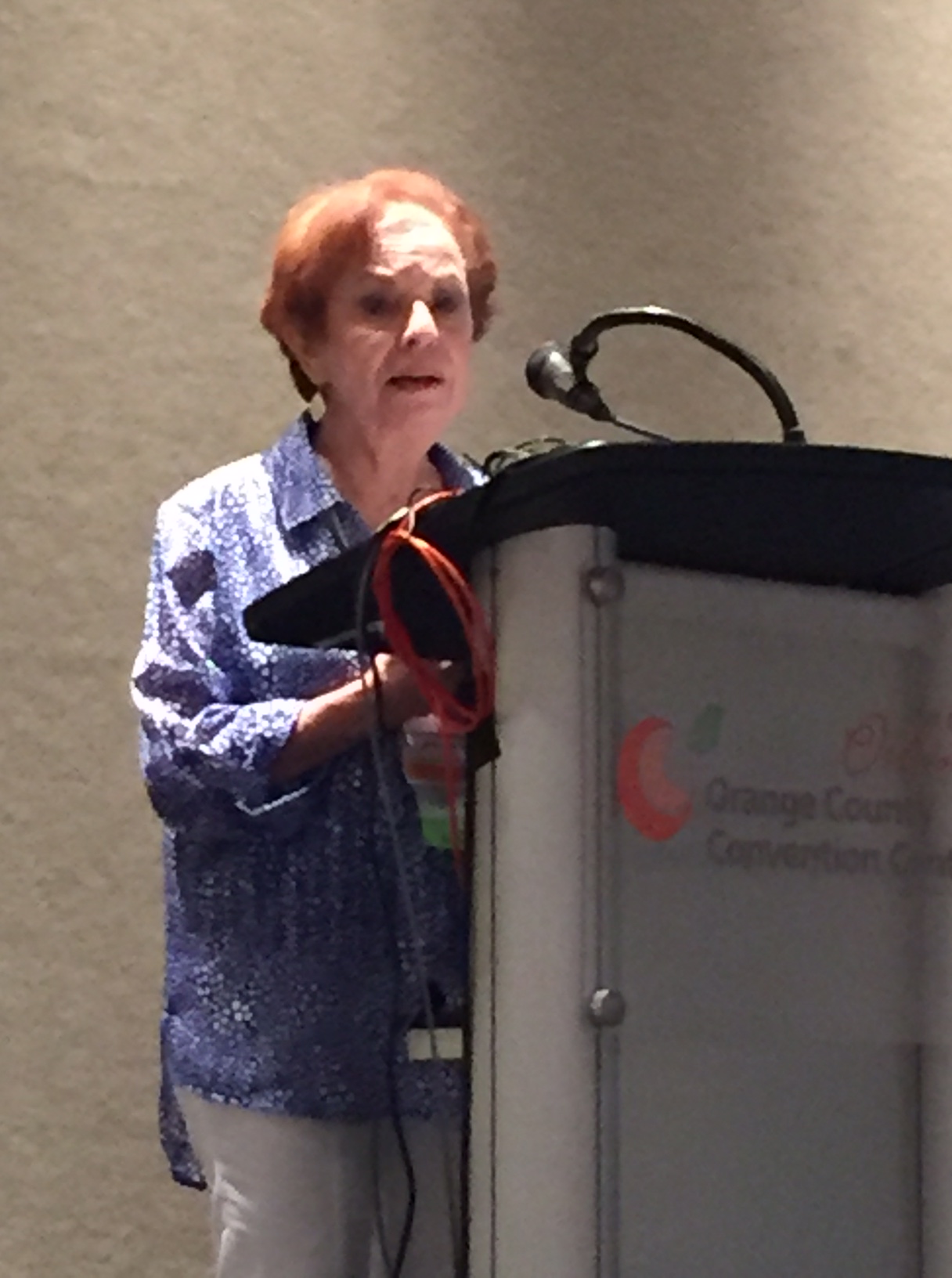
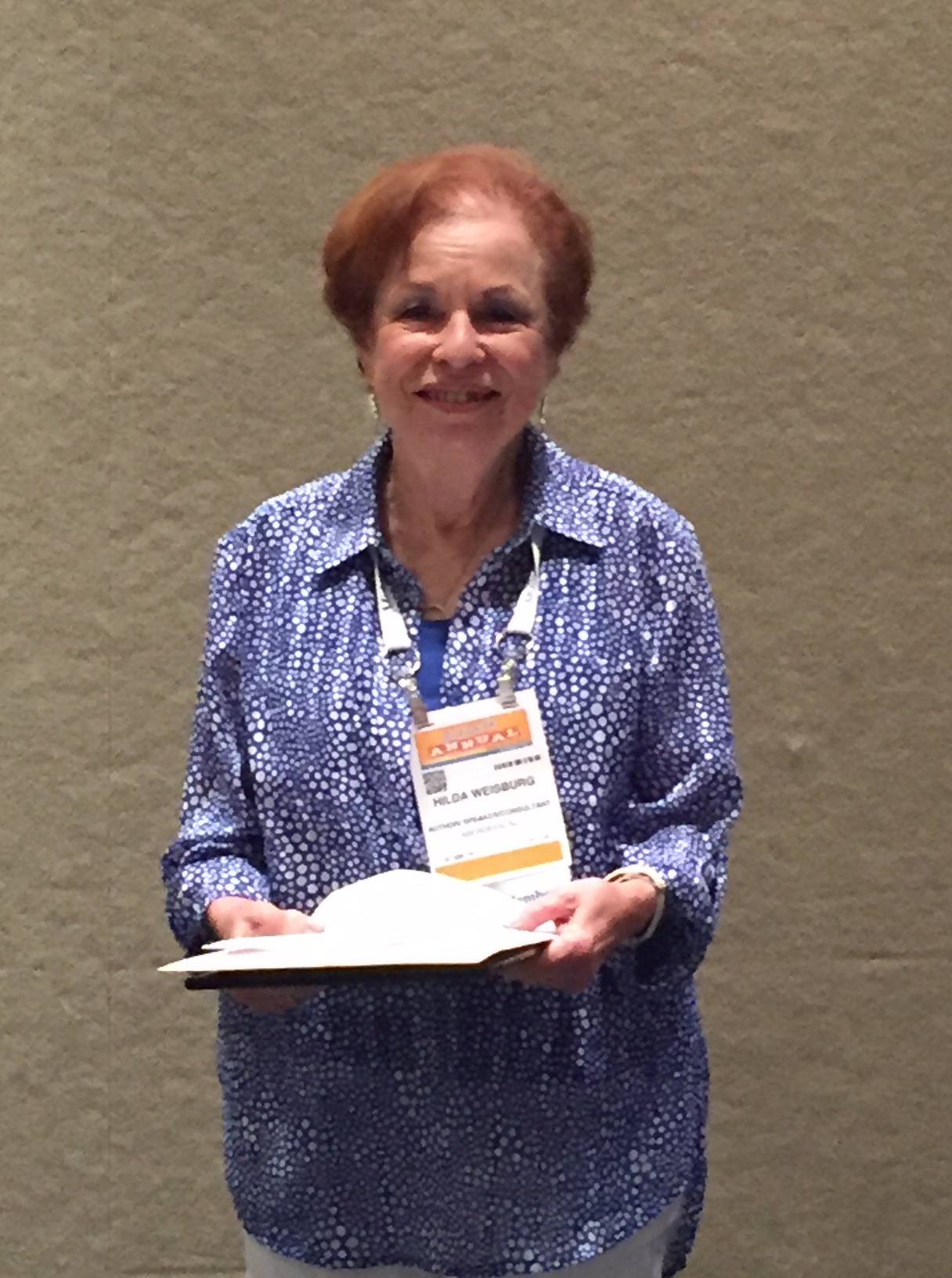
On Saturday, June 25, I was honored at the AASL Awards Program to receive the 2016 aaslDistinguished Service Award.  As part of the presentation, I had the opportunity to speak and I addressed a topic I have been writing about for years. This is something you know I am passionate about, so I am sharing that brief speech as my blog for the week.

~~~~~~~~~~~~~~~~~~~~~~~~~~~~

IMG_3562My deepest thanks to AASL, Baker & Taylor, and to everyone who had a part in nominating me for this incredible honor. To say I was absolutely dumbfounded when I got the news is a giant understatement of how I felt. I have long admired so many of the past winners whom I know personally, and can think of so many others who deserve this award as much as I do.  A good number of them are in the room right now.

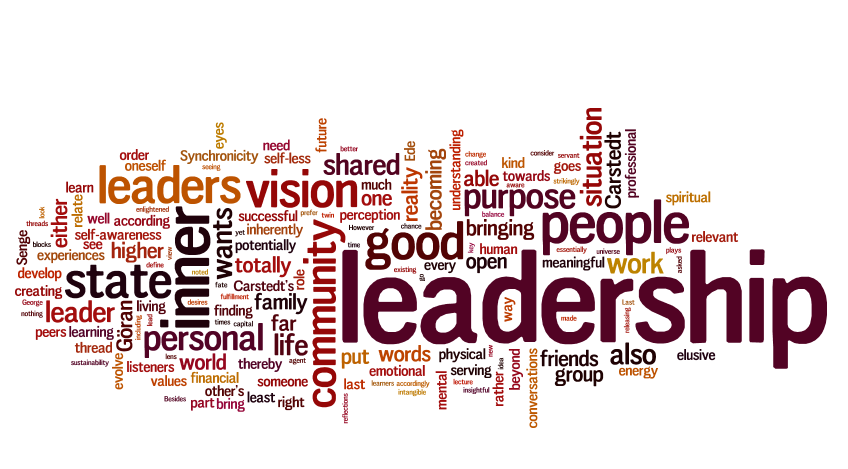
Although it is called the “Distinguished Service Award,” it is truly one that recognizes leadership in the profession and leadership has been a soap box I have been on for decades. Most of you here right now are leaders.  Some farther along than others, but all of you have begun that journey.Leadership wordle

Unfortunately there are too many librarians who have yet to step out of the comfort zone of their libraries and accept the fact that leadership is no longer an option.  It is a job requirement. Our students and teachers need us to be leaders.  And our profession needs librarians who know how to make their presence known and their program be viewed as vital and indispensable.

AASL can provide resources.  All of you can be mentors.  But we must recognize that it is not enough for us to lead and be successful. If we all aren’t successful, too many people will not realize the unique roles we play and how these affect our students, teachers, and often the administration as well.

I honestly think we have turned a corner on the depletion of librarians and libraries, but it will be a slow climb back and the direction will not always go forward.  We must be there to support our colleagues who find leadership a scary thought and have told themselves many stories as to why they can’t be leaders.

I will address only one here, but I have heard it often. “Leaders are born, and I wasn’t born a leader.”  Guess what?  Neither was I.  If you met me in high school and college you would know I was not and would never be a leader.  If you saw me on my first two jobs, you would be convinced I had no idea how to lead.

IMG_3565I don’t think anyone would say that of me today.  What happened?  I joined my state association and was on a committee.  (Note, I didn’t chair it.) I joined ALA/AASL and went to conferences and programs.  There I learned the “language” of our profession, meaning I could speak with authority and conviction about topics relating to school libraries and education.

I moved out of my comfort zone.  I started saying “yes” when my brain was screaming, “are you crazy?  You can’t do that.”  But I was smart.  I got help.  I didn’t do it alone.  We think we are alone because we usually are the only librarian in our building.  But we belong to the most generously supportive profession in the world.

When I had a question, I could get an answer from around my state – and then the country.  And at first I needed a telephone for that. Fortunately, we now have many more ways to connect.

So please, be the help that your librarian colleagues need.  Make it known you are there for advice and help.  We belong to a very old profession that has been important to the progress of civilization for thousands of years.  We can all take it to the next level and insure that we continue to make our invaluable contributions, for we truly transform our communities and our society.

~~~~~~~~~

challenge acceptedFINAL NOTE: The challenge remains.  We  need to commit ourselves to ensuring all our librarians are leaders. What are you doing personally to become a leader or to expand your leadership?  How are you helping the librarians in your state and your district to become leaders?

ON LIBRARIES: You and Your Tech Department

library computersNo one in the school system uses more technology than you do. The computer/tech teachers come close, but they rarely use as broad a range as you.  From your automated system to your databases, to the various resources and apps you incorporate into your teaching, you are constantly accessing different technologies. You may have a website you maintain for the library. If your district permits it, you might have a Twitter account and use Pinterest and/or Instagram.  Technology is intrinsic to almost everything you do.

And then there is the Tech Department that manages and controls access to all the tech in the district.  It can be a love/hate relationship between the two of you.  Depending on how you are handling it, sometimes it’s all hate.  Unfortunately for you, you can’t afford to let that happen.  The tech department is too powerful, and if you can’t

Tug of War

turn the relationship around, the Tech people will be a constant road block.

From the Tech Department’s Perspective

To change your mindset, look at the issue from the Tech Department’s point of view. There are a limited number of them and the faculty and administration are always needing them to attend to an issue immediately. When everything is functioning properly, no one ever praises them.  As soon as something goes wrong, blame is heaped on them.

They are charges with safeguarding the integrity of the system, but students are forever trying to get around any firewalls they construct.  Teachers (and rarely students) don’t always think before opening emails and inadvertently download malware and viruses.  The bandwidth is limited and too many people want to stream videos.  They are in a no-win situation.

Then you come along.  The school year starts and you need them to get any newly-purchased database uploaded to all your computers. You want students in the incoming class entered into your automated system.  New teachers need to be entered as well.  If your ILS system has had an upgrade, you want the tech department handling that immediately as well.

disagreeResearch projects during the year may have you making quick calls to the tech department to open a site the filter has blocked. You may need them in order to make modifications to your website.  They try to keep everything organized and handled in order by requiring you to fill out a ticket, but you want them to realize you have immediate needs and can’t wait for them to get around to dealing with it.  By the time they open the blocked site, the kids are through with the project.

Going from Hate to Partner

How can you turn this around?  You need to start building a relationship with the Tech Department and the best time to do it is when things slow down.  If at all possible, set up a meeting with them during the summer to discuss how you can help each other.  And bring food to the meeting.

Make a list of the jobs you need the Tech Department to do and put them in approximate chronological order.  Ask if you can be “trained” in doing some of them yourself so as not to strain the department’s limited resources.  In my last library situation, we loaded all the new students and teachers into our system.

Let them know whenever a research project comes up, you will explore potential sites ahead of time to identify which ones might be blocked so the Tech Department has advanced warning and has time to unblock them.  That said, see if they can find a way to “fast track” any requests from you to open sites if some are discovered while the assignment is underway.  Explain why it is so important while showing you recognize their concerns and problems.handshake

Find out if the head of the Tech Department is a member of ISTE.  If you are as well, you can use that as a common bond for discussion.  You might even attend the ISTE conference together. When you come across articles or resources you think would be of interest to the Tech people, preferably online ones, send it to them.

If you haven’t done so already, see if you can get on the district’s Tech Committee.  You need to show your tech competence and that you recognize and value the service given by the Tech Department.  When you become part of their solution instead of being their major problem, you will have found a valuable ally in ensuring your program runs smoothly and meets the needs of students and teachers.