ON LIBRARIES: Perseverance, Persistence, and Resilience

The list of leadership qualities seems to be always growing. Listening to librarians as they discuss how they cope with the demands of their job as well as the constant need to show their value, it seemed time to add some more.  For us as school librarians, perseverance, persistence, and resilience are particularly necessary qualities of leadership. We have a seemingly never-ending challenge to prove our worth along with that of the school library and the programs we create.

According to Merriam-Webster, Perseverance is “continued effort to do or achieve something despite difficulties, failure, or opposition.” It’s almost a definition of the school librarian’s world. Every day, we strive to connect with teachers and the administration to demonstrate to them how we increase student achievement, transform learning, and prepare students to be the lifelong learners necessary for success in an ever-changing world.

 

Given teachers’ highly stressed workday, it is a continuous challenge to get them to give you the opportunity to prove your worth. Yet, you persevere.  If you are or want to be a leader, you believe that you will ultimately achieve your goals, accepting it likely that it will be a process of two steps forward and one step back.

In a brief article, Terry Magelakis explains the difference between Perseverance and Persistence.  He sees Persistence as the choice to continue doing something despite the difficulties in achieving the goal. Although this sounds close to the Merriam-Webster definition of Perseverance, Magelakis, emphasizes the idea that Persistence is about the choice. By contrast, he says Perseverance is” the continuation of commitment through action in spite of the lack of success.”  To persevere you need stamina and endurance – and so many of you have just that.  I love his statement that “perseverance is the hard work you do after you get tired of doing the hard work you already did.”

But what if you see no path to making the needed changes in your school and/or district? While I always write about leadership and the successes that have been achieved, that isn’t the whole picture.  The fact is success is a goal not a given. And sometimes it is unattainable where you are.  It is why I blogged a few weeks ago about when It’s Time to Move On.

However, before hauling out your resumé, remember that Perseverance does require a continuous effort to achieve your goal. If you slowly see improvements, persevere. Learn from what doesn’t work and try a different approach. After all, repeating the same action in hope of a different result is a definition of insanity. Make a realistic assessment of what is possible and decide your next course of action.

Persistence, which as noted, is very close to Perseverance, is an interesting term.  I had a highly

Small Plant – Drought Desert

strategic superintendent who led a school district that voted down budgets regularly.  She had learned to make it work as best she could with a stratagem I suspect is used by many administrators.

After approving one of my requests, she told me when someone came to her asking for something requiring funding, her immediate answer was “No.”  According to her, they would go away, and she no longer had to deal with it. I, on the other hand, frequently got a positive answer because I kept coming back with alternatives.

My behavior told her that I was serious about my request.  I was creative, and I probably was not going away.  This made her confident that I would use the funds wisely and the students and staff would benefit.

Some think Persistence carries the connotation of being stubborn. This should send up a red flag.  Be careful how your behavior might be perceived.  Stubborn people don’t listen to others’ ideas, believing their solution or approach is the only possible way.  Review how you are presenting your ideas.  Check with a trusted colleague to see if you are sounding stubborn.  If so, revise your message.

Resilience refers to your ability to bounce back from a setback.   Sometimes one of your ideas doesn’t pay off.  You want to go and hide and hope everyone forgets – or doesn’t notice. Nobody likes to get it wrong.

We try to teach students that failing is a part of learning, but we don’t react that way when we are the ones who failed in some ways.  If you always get it right, you haven’t reached high enough.  Leaders will and do make mistakes. It’s what you do next that makes all the difference.

Yes, you can have a pity party, but don’t stay there too long.  Take a close look at what happened. Was the whole thing a disaster or was there any part of your project/idea that worked?  Any of it salvageable? What went wrong? Was it a matter of timing? Did you count on the wrong people? 

In your analysis avoid going to negative or positive extremes.   Honesty is vital if you are going to learn from your mistakes. You will be a better leader as a result.


ON LIBRARIES: More Stories

In October 2015, I blogged about The Stories We Tell Ourselves that keep us from becoming the leaders we need to be. At the time I looked at three stories, but I have come to realize we have many more. Our heads are filled with stories – and not all the happily ever after kind.

Some stories are about how we believe others see us. Some speak to how we perceive ourselves, often based on societal “norms.” In our mind’s eye, we view ourselves as having handicaps we can’t get passed. As with the other stories, while there may be an element of truth to the story, more often it is not as bad as we believe and it ends up being something that holds us back. If you are going to be a leader or grow more in your leadership, you need to be able to quiet the stories and become stronger as a result.

The first step is to recognize the negative self-talk going on in your brain. What is it saying? When do you hear it the loudest? What does it keep you from doing? Where did it once keep you safe but now holds you back? The more you can answer these and other question, the more you will be able to see where these stories don’t work for you anymore. When you see how they have influenced and stopped you, you will begin to understand how important it is for you to change your mindset. Then, hopefully, you are motivated to find the means to see yourself differently.

The number of different stories we tell ourselves is as numerous as the books in our collections, however, like those collections, we can find some similar themes. I am going to keep the focus on the stories that are keeping you from being more of a leader in your program and school district.

This Job Is Too Big for Me to Do –  This is a common one that keeps many people playing small. There is always a job that’s bigger than what you have done before. There’s a popular meme these days that says “It’s always impossible until it’s done.” Whether it’s running for president of your state association or launching a large, school-wide project, if you haven’t tackled something like it, it is scary. But you don’t want to let that fear stop you from creating something you know your students need.

You probably have heard the quote, “What would you do if you knew you couldn’t fail?”  The truth is if you do your “due diligence,” which means getting information and advice from others who have done it, planning as best you can, and having a clear goal in mind you won’t fail. You will make mistakes. Some correctable, others not. Some will lead you to a better solution than you had originally thought. That’s the benefit of taking these risks – and not listening to this story.

I Talk Too Much – I chose this because it’s one of my stories. Starting in my adolescence, I felt people disliked or avoided me because of it. The true part is I am a talker. Anyone who meets me will agree on this. At first, I tried to not talk so much, but it isn’t who I am. When I thought about how I felt about someone who talked “constantly,” I realized what I didn’t like was it gave me no room to speak or minimized what I was saying. The solution that worked and changed me as a leader was to become an active listener who respects the other person’s views and ideas.

As part of recognizing this story, I had to learn that the fiction is my talking is rarely the true reason I am liked or disliked. And no matter what I say or don’t say, there will always be people who dislike me. That’s about them, not me. Over time, I have learned that it is what you say rather than how much you say that makes the difference. I get to be myself, embrace who I am, and enjoy the friends it’s made me over time.

Others Know More Than I Do – Of course this is true. No one knows everything, even in their own field. This story may manifest in your professional life as keeping you from submitting proposals to give a presentation at a conference or volunteering to serve on a district committee. But the flip side of this truth is there are others who don’t know as much as you do on certain topics and areas of interest. In moving out of your comfort zone, you learn and grow. If (when!) the program committee accepts your proposal, believe them and know that not only is it worthy, but there are many who are going to benefit from what you share. You wouldn’t have been put on the program if those making the selection didn’t think you had something to contribute.

It Is Not a Good Time for Me to Do This – While the statement doesn’t sound particularly negative, it’s one of the most common ones. It becomes a repeated and believed excuse and therefore a story. It allows you to feel as though you will get around to doing it someday – just not today. But the reality is someday never occurs. You have put it on the horizon and like a ship heading out to sea, the horizon always stays the same distance away. You have set yourself up to believe you’ll get to it when in truth you are putting it off or never plan to take the step.

We are smart and creative people. We can always come up with a “good” reason not to take on that task or new responsibility or project, a reason that sounds so well thought out and logical the people around us support our putting it off. But that’s no way to become a leader and improve your program or your skills. Stop and think, “What value will doing this bring to my life/profession/goals?”  If it is truly worthwhile, work on how you can possibly take it on – today.

I’m Too Heavy/Thin or I’m Too Tall/Short – Surprised to see this here? Stories about how we look can regularly hold us back professionally. Having a negative image of how you look is a frequent concern of women – and as librarianship is a female-dominated profession, it is important to look at this issue and how it affects us. We create programs where we can sit behind a desk or stand behind a podium. We don’t take opportunities to speak or meet new people because we’re worried about our appearance. We do whatever we can not to attract attention to ourselves but still hope people will notice our program, our successes, and our abilities.

Sadly, you can’t have it both ways. If weight is your worry, consider looking into programs which will support you to change this. Height has no real fix, although we all know people who hunch over or wear crazy heels to make a difference.  And the truth is, it’s only making a difference to us. The true part of this story is the myriad of ways in which we don’t accept ourselves and fear being seen and judged. As with the other stories, the first step is noticing where these thoughts are holding your back, stopping you from being the leader you want to be. The sooner you take steps to accept who you are  – and realize nobody else cares about your appearance more than you do – the sooner you will be able to let your true abilities shine through.

You will never get rid of all the negative stories going through your head, but don’t let them keep you from becoming all you can. Leaders are not perfect. They have faults and have their own stories in the heads. If you want to change yours, start with the loudest one. The one that most interferes with your growing as a leader then begin to create a solution to quiet it down.


ON LIBRARIES: Space Relations

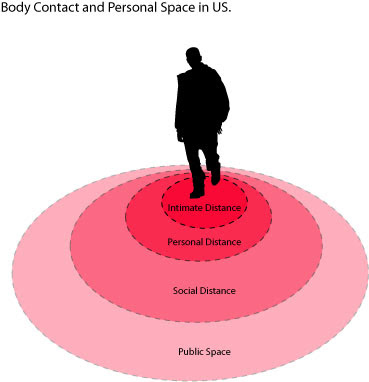
Whether or not we consciously recognize them, we maintain four zones of space in our communications with others: Public, Social, Personal, and Intimate, and this space is important to the success of our relationships. Artists are well aware of the importance of what they call negative space, referring to the area where there are no people or objects.  Negative space exists in relationships too, and, just as in art, it carries messages.  In an article entitled An Update on Proxemics, Nick Morgan explains why the term and the concept, created by Edward T. Hall, still has relevance. The space we maintain from others reflects the zone of our interactions and our connection.

In Public Space, we are twelve feet or more from the speaker.  It includes listening to a lecture or other situation where someone is usually addressing an audience of a number of people.  We are not always mindful of what is being said in public space.  You probably have noticed how many people check their cell phones – or check out completely – during a lecture of any sort. Ask the kids who sit in the back of the room.

For the person doing the speaking, the challenge in this zone is to keep the listeners engaged. If you are the one who is making the presentation, it’s important to recognize this reality and know how to draw your audience in.  Telling stories about your experience as it relates to the topic is one way. It makes it personal.  Moving away from the podium, if you can, temporarily alters the distance and can build a connection.

Social Space varies from four to twelve feet. It is what exists, for example, when we dine in a restaurant. As with Public Space, there is a mental space between us and the other diners in the room.  Unless they become loud, we are aware of then only in the most superficial way.  You might overhear a conversation that is interesting, but it is hard to concentrate on it so you tend to shift your focus.

In the education setting, you are most likely to deal with it in the teacher’s lunchroom. Each group has its own conversation taking place.  If you are alert, you might discover what unit a teacher is working on or planning.  Then you can speak to the teacher to supply the right information to make the project more successful. It can be the beginning of developing a collaborative relationship. And it’s an excellent reason to make it a practice to get out of your library for lunch.

The distance in Personal Space ranges from four feet to eighteen inches, and we are always aware of who is in this space. It’s bred into us as a matter of survival. We also need to be extra mindful here because subtle differences in how we define Personal Space can cause problems. Over time you can fine-tune your senses to be aware of how the person you are speaking with is reacting your distance.  In general, they will instinctively define it for you, taking a step back if you are too close or stepping forward if they sense you are too far.

When having a conversation in Personal Space, always be sure to accept the other person’s boundaries.  Don’t move forward if they have moved back.  It will feel to them as though you are encroaching. Accept the negative space. If you are uncomfortable with how close someone is, you can move back, but know they may read it as you trying to distance yourself from them.

Intimate Space is from eighteen inches to zero. Again, there are cultural differences as well as gender ones which make this acceptable or uncomfortable.  Unsurprisingly, women tend to prefer more distance in these situations than men, particularly in conversations with the opposite gender.  If you are a man, it is wise to be aware that moving too close here or in Personal Space may make a woman feel anxious or concerned, which can ultimately block effective communication.

As I’ve mentioned in the past, most of our communication is nonverbal.  The fours zones of space are another form of non-verbal communication. Most of our conversations, particularly the important ones, occur in the Personal and Intimate Spaces. Being aware of what the other person(s) is communicating in the negative space of body language can make the difference between a successful and an unsuccessful attempt at building a relationship.  And we must never forget that we are in the relationship business.


ON LIBRARIES: Making a Successful Move

It was interesting and helpful to hear all the responses in the School Librarian’s Workshop Facebook group to last week’s blog. Thank you for all your input, comments and feedback. I’m glad so many of you got something from the post. If you decided based the blog that it was Time to Move On, (or if you’d already come to this decision on your own) now the question is – how do you do get the job you want?

First, dig out your resumé and review it.  It likely needs updating.  Although an Objective might work for those looking for corporate positions, every librarian (and teacher) seems to have almost the same objective: “To create or expand a 21st century library program.”  There are variants of course but it uses up valuable page real estate – the opening of the resumé – to add nothing of value.

Spend some time thinking of what you do very well as a librarian. Then, instead of an Objective do a Profile with three or four bullet points highlighting your outstanding skills, such as Experienced Tech Integrator or Skilled User of Social Media.

Under experiences which you list in chronological order, don’t just describe your job.  Highlight what you did. You might have started a One Book, One School event or created a Makerspace.  In other words, how did you make your program successful?  This reinforces what you featured in your Profile.

Include a section on Related Experiences such as being an advisor to a club or making a presentation at a conference.  Next, of course, is Education. You should also have a section on Professional Associations which shows that you are a professional and here you should include any volunteer positions you hold currently or held in the past. Other sections include Publications which include blogs, Honors you have received. Some people close with References available on request, but since this is a given it also takes up valuable space and doesn’t need to be included.

Using your state association’s listserv and other resources, locate (and keep searching for) job openings.  Once you have spotted one, do research and find out as much as you can about the school and district.  Check their state report card. See what they say on their website. Is their Mission Statement mostly boilerplate or does it give an indication as to what they value? If they have photos of students, what are they doing?

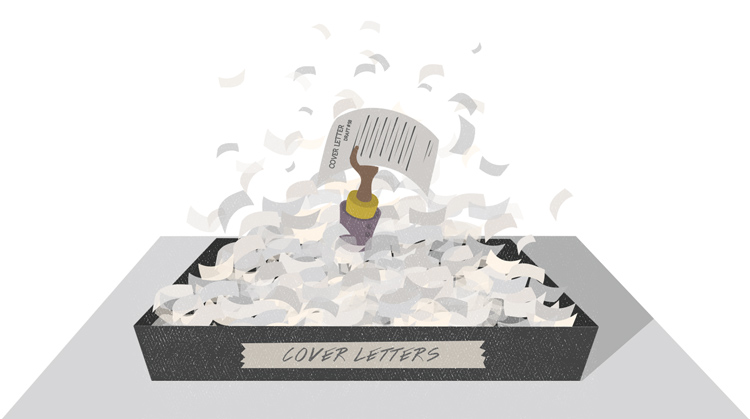
With your research in hand, you are ready to write your cover letter. It’s invariably three paragraphs.  The first paragraph states what position you are applying for and where you learned about it.  Use this space to start your pitch by referring to what you learned in your research. For example, if it’s a high performing school you might say, “I am looking for the opportunity to work with the best and the brightest.”  If it’s in a school that is focused on improving student performance, you “want to be part of the challenge in helping students discover what they can achieve.”

The second paragraph is where many applicants tend to waste the space, restating things that are in the resume, such as the places where they worked.  Instead, show why you are the perfect candidate for the position. You can point to how your abilities as a tech integrator led to increased collaboration with teachers and 21st century learning experiences.  This sets up questions that will be included in your interview.

In the final paragraph, don’t close with the traditional, “I look forward to hearing from you.” Instead, say “I look forward to discussing what and how I can contribute to the school program.”

As soon as you hear they want you to come in for an interview start doing additional research. Find out who will be interviewing you. Will it be just the principal, or will there be a supervisor and perhaps the current librarian?  Google them and see what you can learn. Take a close look at the library’s page on the school website.  If there isn’t one – that tells you something about the current program and a possible way for you to improve outreach. You need to learn as much as you can about what they have accomplished and what they seem to value. Do a dry run to the school preferably at the same time as your interview so you know exactly where to go and what kind of traffic to expect.

You should also consider going online for sample interview questions so you will be ready what they might ask. Inevitably one will be, “Why do you want to leave your current position?” Do not say anything negative about the administration or the teachers.  Instead, answer with something like: “Budget constraints had me teaching two classes resulting in the library being closed. This was unlikely to change in the foreseeable future, and it’s important to me that the library be available to students throughout the day.”

Prepare questions of your own in advance.  Too often when applicants are asked if they have any questions they ask something foolish such as what the salary is or what their schedule would be like. Ask questions that will help you understand the vision and culture of the school and district.

Prepare a portfolio to bring with you showing your best lessons and projects. Bring enough copies for everyone present since you will be leaving it there. In addition to or instead of a printout, consider putting it on a thumb drive.

Listen carefully to what is said and what is not said.  Almost all administrators say the library is the heart of the school. What do they mean by that?  You can and should ask what they like/don’t like about the current program. The response will tell you how well they understand it, as well as where they would like to see it go.  Do ask to see the library and learn as much as you can about the technology it has.

As soon as possible, send thank you letters to all who interviewed you. In general, hand-written is better than e-mail.  It will carry more impact. Again, don’t waste the real estate.  You don’t want to say that you appreciated their time and look forward to hearing from them soon.  Take the opportunity to remind them of who you are.  Refer to something specific the person said that you found informative.

If all goes well you will get a job offer.  Think carefully before you accept it. Mentally review the interview.  What are the negatives about the position?  Do the positives outweigh them?  Know your priorities and if his position supports them. If you don’t evaluate the offer completely, you may jump from the frying pan into the fire.  A mistake here will require that you remain a few years before you can consider a new move.

And although the process is challenging – stay positive. Jobs are opening up.  There are opportunities for those who are willing to leave their comfort zone and go after what they want. Finally, for those of you who are happy where you are, consider bookmarking this post. You never know when things change so it’s best to be prepared.

ON LIBRARIES: Time To Move On

The question is a bit shocking. Although people in other professions do it all the time, librarians and teachers rarely consider changing jobs unless they aren’t rehired. It is probably related to tenure which makes us never think of the possibility.

There are three reasons to start thinking about finding a new job. The reasons range from the obvious to the surprising –at least for those of us in education.  (And even if you don’t fall into any of the three categories, it’s wise to be prepared.)

The most obvious reason is moving.  Your spouse got a transfer or for some other reason, you are going to be pulling up stakes and moving too far away to continue in your current job. Finding a new position can be challenging particularly if you are changing states. You need to research and network.

The research will tell you how complicated it will be to move your certification to your new location and how to go about it. You can also find out about which are the best school districts and salary scales. Networking involves connecting to the school library association. You can’t get on their listserv if you aren’t a member, so join quickly.  Introduce yourself there and on their Facebook page which they are most likely to have.  Ask about job openings. This is not a time to be shy.

The second reason is you dread going to work most days. Everyone has some bad days, but if you rarely have a good one, it is time to move on.  Maybe your workload keeps increasing.  No matter what you try, your administration only thinks of you when they have another job you can take on. Your teachers are so exhausted and demoralized they can’t possibly collaborate with you. The school culture, which I wrote about last week, also will inform this situation.

This is when you need to accept the truth that you are no longer doing well by your students or your teachers.  Your schedule keeps you from doing the things that were why you became a librarian. Your first step is to start checking your state association’s listserv.  If you see any vendors let them know you are looking.  January is a good time of year as districts will soon be getting ready to hire for the fall.

The final reason I’m going to offer is not obvious.  Most of us can see the proverbial handwriting on the wall but few act on it. These are the times you know things are almost undoubtedly going to go downhill, but you just stay put.  It’s like knowing a train wreck is coming and doing nothing about it.  Sometimes you need to trust yourself and take a big leap no matter how scary it seems.

I lived through this.  I had been in a district for twenty-two years. The last five or so I had a principal who was an egotistical bully and a liar. But I had great teachers and a strong program.  I also had a superintendent of schools who always knew what was happening everywhere in the district.  She was the one who had transferred me to the high school six years before this principal showed up because she liked what I was bringing to the educational community.

Then my superintendent announced she was retiring in two years.  I immediately called her and said I was job hunting.  She urged me to stay, but I could read that handwriting clearly.  The assistant superintendent would get her job and stay for three years to get a larger pension.  He was a nice guy but had nowhere near her strength or vision.

Once he was gone my principal would become the superintendent of schools and my life would be all about managing him and working to keep him from undermining my program. Dealing with him would drain so much of my energy, it would affect all aspects of my job.  And it would affect my home life likely leading me to come home so angry at his latest tactic I would rant and rave to my husband.  I knew he would just tell me to quit.

No sense in waiting for his advice.  I decided to act.  There was going to be a workshop on the automation system we used at one library in a great school district. I let the librarian who was hosting know I was job hunting, and she said she was retiring at the end of the school year. I made the necessary contact with the district’s H.R. department and had an interview scheduled for a few hours before the workshop.   By the end of the week, I had a job offer and a signed contract. When I told my superintendent, she asked me to give the principal a chance and to talk with him.

My meeting with him quickly proved me right.  He had no trouble or issues with my leaving. He told me he had done their Middle States Evaluation and talked about their great budget.  Since it would be a much longer drive to work, he suggested I try audiobooks.

I had a wonderful time in my new district and discovered how much I had learned over the years. When I would return for retirement parties at my old district, I found out I had correctly read the situation there.  Four years later, my former principal was the Superintendent of Schools.  And the teachers kept telling me how smart I was for getting out.

Yes, I lost my tenure.  But I knew that I wouldn’t want to work for any district that didn’t grant me tenure.  What I really gave up was my sick days, but only in the short run.  It was worth it.

Next week I will blog on how to get the job you want.


ON LIBRARIES – Culture Conscious

How would you describe your school’s culture?  If you have never thought about it, now’s the time to start.  The school (and district) culture influence everything from your budget requests to the willingness of teachers to collaborate with you and administrators to support you.

I have written in the past of two very different cultures in districts where I worked.  At the first, education was regarded as being like medicine.  You don’t like it, but you have to take it.  The twenty budgets that were defeated in the twenty-two years I was there was an obvious indicator.  The district depended heavily on teachers’ commitment to helping their students since there was never an extra payment or support for what they did.  I knew one world language teacher who taught four different sections including having an AP Spanish class within Spanish IV.

The other district saw itself as a leader in education with a diverse, multi-cultural student population.  The culture reflected pride in what they were doing and bringing to students and, by extension, the community. The Wall of Fame saluted graduates who had made major contributions.  It included authors, government officials, and those in noted businesses

While these districts could not be more dissimilar, I could get funding for projects in either place by working with the culture.  In the first district, I always presented my requests by stressing how this would save money in the long run, using as a theme, “the library gives you the biggest bang for your buck.”  I even had one teacher tell her department chair they didn’t need new textbooks, “as long as Hilda’s library was up-to-date.”

In the second district, my proposals were always tied in some way to why it would keep us in the forefront of education. Knowing how strongly the administrators felt about moving to block scheduling, I put in a request for extra funding to purchase support material for the faculty.  I noted that many teachers were opposed to the change because they couldn’t see how they were to get through their curriculum within the structure of a longer period and alternating semesters, (e.g. Spanish I in the fall of 9th grade and Spanish II in the fall of 10th grade).  The extra resources I was proposing would give them the information they needed to continue to be great teachers and show that the district was there to support them.

On a daily basis, the school culture affects you differently.  My two districts had radically diverse cultures, both had teachers strongly committed to serving the students.  To have teachers collaborate with me, I had to convince them that what I taught would help their students be more successful. The English teachers in one district relied on me to teach each grade the research process for term papers because it ensured every student had received the same background information and experience.

I had a co-librarian in one district who teachers rightly felt didn’t like the students.  When they brought their classes to the library, if I was already scheduled to work with another class, they taught their students themselves.  That situation is an example of how we can also negatively affect the culture around us.

click image to read the full article

In an article primarily directed towards administrators on “5 Ways to Impact School Culture,” Dr. Amy Fast offers suggestions that work well for school librarians.  The first is “Assume Best Intent.”  So, if you send a teacher a resource for his/her students and there is no response, don’t assume you are being ignored “because the teachers don’t appreciate what I do.”  Things get lost in cyberspace.  Either send it again with a message saying, “I don’t know if you received this when I sent it out,” or speak to the teacher in person, which is probably best, and find out what the situation really is.

Her second recommendation is, “Surround Yourself with Greatness,” because “you are the average of the five people you spend the most time with.”  That can be a scary thought.  Work hard to connect and get into relationship with the teachers who are recognized as “stars.”  As they create units with you, the others will follow, and your school library culture will thrive.

“Elicit Feedback” is her third way. I discussed this in my blog on “The Power and Importance of Feedback.” The fourth idea is to “Know Your Sphere of Influence.” Too often we think all the power – and leadership—comes from a title.  You can, in fact, lead from the middle- or the bottom.  In my Weight Watcher program, I have been keeping up enthusiasm which was crushed when the leader we adored was fired. I lead from my seat – and it is recognized by the other members.

Dr. Fast’s final suggestion is “Make Your WHY Transparent.”  You know why you became a school librarian.  You know why you love your job (most days). Make sure you are communicating that in your words and your actions.  It will also keep you from focusing on the negatives that are a part of any job.

If you are struggling to get teachers to work with you or you want your administrators to recognize your value, review the ways you interact with school culture and see which ones might help you improve your school library culture.

ON LIBRARIES: In With The New (Standards)

appy New Year! There is always a flurry of activity around the beginning of the year. Resolutions, goals, intentions, new things to try, old things to toss.

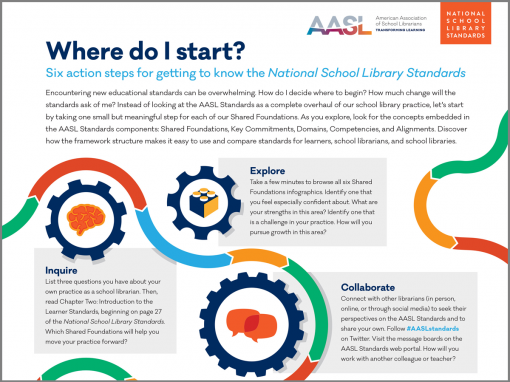
One of the big new things to embrace? The new National School Library Standards for Learners, School Librarians, and School Libraries.  Have you bought your copy yet? Are you excited, or hoping it will go away? (HINT: Go for the former. The latter isn’t happening.) I blogged about this change back in September (the post is here and gives you several links to help you start), and since then I’ve heard about them at the AASL conference in November and started using them. It is a change I am definitely excited about.

Many of you have been put off by the price tag of $199 if you are not a member of ALA.  Even the cost of $99 to ALA/AASL members has caused some gasps. But recognize, these will be our standards for the next ten years. You may as well bite the bullet and get started. If memory serves the old standards, Empowering Learners: Guidelines for School Library Media Programs, cost about $45, but it but had only 64 pages!  The new standards comes in at a hefty 314p.  That’s almost five times the size – so it’s practically a bargain! 

Personally, I have been immersing myself in the National School Library Standards in order to update an online course I’m teaching starting January 17.  Since it’s a course text, I had to re-do much of the syllabus, rewrite sections of my lectures, and change topics for discussion as I figured out how to introduce my students to the standards.

The task of wading into these new standards seemed enormous at first.  It’s such a big book and there didn’t seem to be any parallels between old and new standards which would have allowed me to simply insert new page numbers.  It was intimidating, but I am so glad I couldn’t put it off.  The more I explore the Standards, the more I find to like.

I like the idea that there are three Frameworks: one for learners, one for school librarians, and one for school libraries. All three have the same structure so you can see how the same Domains (Think, Create, Share, Grow) and Shared Foundations connect.  It is simple to compare them and once you have familiarity with one Framework, you can easily grasp the others.

Most likely you will want to begin with the AASL Framework for Learners.  It’s a free download and only eight pages so not having ordered the larger book it is no excuse for not getting started. We all are learners and more than ever we need to focus on our own learning. Spend time with the centerfold that lays out the standards for learners. Read the Key Commitments for each of the six Shared Foundations. You will find your old lessons almost always included aspect of the four : (1) Inquire, (3) Collaborate, (4) Curate, and (5) Explore.

Your lessons may not have incorporated Include and Engage but you now should give these two serious consideration Include (the fourth Shared Foundation) articulates the need to incorporate diversity and global citizenship into student learning opportunities. Engage (6) focuses on the ethical use of information.  Both have been components of your practice, but the six Shared Foundations keep them in front of you.  This is not to say you need to include all six Shared Foundation and all four Domains in one unit, but in constructing your units, you should see which ones fit best.

Check the AASL portal for the Standards regularly.  If you “enter” as School Librarians, you will find resources to support you in getting started with the new National Standards for School Libraries.  New ones are added frequently.

Once you have your copy of the Standards, I recommend How Do I Read the Standards? It boils down how the six Shared Foundations and four Domains combine within the three Frameworks, defining the competencies we want to achieve. In addition, it explains how to identify which of the Shared Foundations and Domains you are using in a lesson.  All this in a one-page (free!) infographic.

Another resource I like is Reflect and Refresh: Getting Started with National School Library Standards. Again, a single page PDF, it briefly explains “What Should I Know?” What Should I Do?” and “What Should I Share?”

Do check the Professional Development AASL is offering.  Upcoming events as well as archived ones are available.  Choose one and get started.

It is a new year and we have new standards.  It’s a bit scary, but it’s also exciting to be here as we truly take our profession and practice into the future.

ON LIBRARIES – Gift Giving

Merry Christmas to those celebrating today!  I hope you received the gifts you wanted.  For those of you who are with family and friends this holiday weekend, being with them can be a gift in itself. For those who find themselves on their own at this season, I wish quiet peace and finding the strength and courage to fill your life with joy. For all of you, I wish time to relax and rejuvenate.  Too often we go from our hectic jobs to an almost frenetic pace preparing for and participating in the holidays.  Before you know it, your vacation is over and you return to your libraries exhausted.

So, take a breath.  Look around. And savor the gifts you have in your life.

It’s too easy to identify what you wish for and don’t have.  Instead, reflect and focus on what you have and all perhaps take for granted.  Commercials and appeal letters in the mail remind me of the many people who don’t have the simple basics of life that we take for granted such as fresh water and ample food (too much for many of us at this time of year).

Give yourself the gift of time. It’s so lacking in our lives. If you live by your to-do list as I do, include yourself on the list. Binge watch a favorite television program you have been too busy to watch. (My daughter recently couldn’t stop talking about The Marvelous Mrs. Maisel on Amazon Prime). Read a book you want to read.  Play some board games.  Do what you enjoy that you haven’t been doing because of the tasks that occupy so much of your life.

For me, I make sure to go out for a walk.  I have been doing this 3-5 times a week for a few years now.  It’s what I do for me.  It gets me away from my computer and out in the world.  I have met so many wonderful people on the way.  Sometimes they even toot their horn and wave when they drive past.  I watch the seasons change, and pet dogs on their own walks.  I have watched exterior home improvements happening, seen people sell their homes and new owners move in.

Most of all I take this time think.  Sometimes it’s about what my I should write for this blog.  Other times I contemplate what I am going to eat. (I am a lifetime Weight Watcher member.) And in-between random and focused thoughts, my mind unclutters. It’s peaceful and my own form of meditation.

Make time to appreciate yourself.  Many of you feel unappreciated at work (and sometimes at home).  Think of the gifts you give to others.  What do you do for your family?  What do you do for your teachers and students?  If you are doing it because it’s who you are, and only on bad days do you feel you are being taken for granted, give yourself a pat on the back.

How many times have students thanked you for your help?  Don’t gloss over their words.  They recognize the gifts you give to them.  Remember the time teachers also thanked you.  They, too, are harried and over-worked.  They may not take time to express their gratitude, but when you reach out to them and build relationships, you will hear it more often.

Do give thanks to others.  Make it a practice to thank those who in any way are helpful to you. If you are specific in your thanks, as I noted in last weeks blog “The Power and Importance of Feedback,” you will help make their day.

Being true to my own words, I am thankful to all my readers and the participants in my Facebook group and to the extensive librarian colleagues and friends in my life.  You make my days richer. You are there to answer my questions and to post comments that keep me learning.  It is challenging for me to keep up since I no longer work in a school library, but thanks to you, I am not lost in the past. I thank you for that gift.

Enjoy your vacation – and the gifts you get and bring.  Merry Christmas and a Happy New Year.


ON LIBRARIES – The Power and Importance of Feedback

Feedback is vital. It’s how we learn whether we are on or off track. Knowing how to get it and how to give it are equally important. Sometimes it’s given as part of your job as when your administrator observes you and offers feedback. Requesting feedback is another matter.

Because of our own challenges, we tend to ask for feedback in a way that tells us nothing. Instinctively, we protect our feelings.  If we ask a teacher, “Did you think the lesson went well?” or some similar question, you are generally going to get a positive response. The wording of the question naturally leads to it.

However, you need to know if you were successful and to what degree. You can start with a more specific positive, such as “What do you think worked in this lesson?” But you also need to ask, “What didn’t work?” and “What would you like me to do differently?”

By being open to their negative comments about a lesson, you will hear the truth even if it stings in the moment.  You don’t have to be perfect as noted in last week’s blog. You just have to keep learning.  And that’s what leaders do.

I once did a unit with a 9th-grade science teacher who wanted her students to work on various recycling possibilities including composting.  I knew what databases would support the project and she brought the class in to find out about them and begin their research.

She asked them for preliminary work and was very disappointed with what they turned in. Fortunately, I was following up on it with her and asked if I could re-do the lesson.  I had not taken time to teach students how to create the questions they would seek to answer and select sources based on relevance to what they were doing.  If the source had one keyword, they assumed it would work and included the information from it whether it fit or not.

The re-teaching proved successful and the teacher was happy.  When she repeated the project the following year we were ready.  We were more specific about what its purpose was.  Her in-class introduction was more focused, and so was my lesson with the kids and how I worked with them during their research.  The results far surpassed what happened the previous year.  The initial feedback, negative though it was, was invaluable.

One of the more common ways to see if students are on track is getting feedback on your lesson from exit tickets.  Asking, “What confused you?” or “What do you still not understand?” will let you know where your instruction missed the mark.  Of course, the classic thumbs up, down, and out are always helpful while you are teaching.

For receiving feedback, I like an article written by Peter Bregman for the Harvard Business Review on How to Ask for Feedback that Will Actually Help You. He lists five ways:

  • Be Clear You Want Honest Feedback– People are hesitant to tell you where you missed the mark. You may think you’re being clear, that you don’t only want to be told you did great, so reinforce your question by saying to the teacher something like, “It’s very important to me to learn where I didn’t do the best job.”  (The exit tickets from students does the same thing.)
  1. Focus on the Future – As I suggested, since the lesson has already been taught you want to show why hearing a negative has a purpose. Saying, “I hope we do this project again next year, so for my notes, what didn’t work and needs to be changed?”
  2. Probe More Deeply – The first response you get may not be as honest as you need it to be. People don’t like to tell you messed up. Follow up by referring to specific parts of the lesson and ask about them.
  3. Listen without Judgement – This can be hard. You don’t want to defend yourself nor show by body language that you don’t accept what the teacher is telling you. Think to yourself, “I will analyze the information later.  Right now I just need to hear his/her opinion.”
  4. Write it Down – Take notes for three reasons. First, it’s human nature to forget or smooth over negative comments.  Next, writing down what is being said to you lends weight to your being really interested in making changes. Finally, it gives the teacher time to think of more things. (Ugh!)

When it comes to giving feedback, Entrepreneur.com offers Five Steps for Giving Feedback in connection with the business world. As usual, I am interpreting them for us as educators.

  1. Create Safety – If students think you only criticize, they aren’t likely to hear what you say or follow your advice. A teacher won’t feel threatened by what you say, but if you don’t have a reputation for your work with your colleagues or don’t have a relationship with the one you are speaking to, your words will fall on deaf ears. Remember to find a balance between what you tell students and understand the nature of your relationships with teachers.
  2. Be Positive – As much as possible offer positive feedback about something they are doing with students and teachers –and don’t always follow it with negative feedback or your first statement will be ignored as they wait for the other shoe to drop.
  3. Be Specific – Don’t just say, “Good job,” or the equivalent. That means very little.  Tell a student something like, “I saw that you continued searching after you first approach didn’t work. Your follow through shows you understand how to do true research.”  With a teacher, you might say, “How did you prepare your class for this project?  They were really on task and focused from the beginning.”
  4. Be immediate – The best feedback happens in the moment. Whether speaking with teachers or students, it reinforces positive directions and alerts the recipient to a potential problem before it becomes an issue.
  5. Be tough not mean – Or to put it in another way, “Say what you mean, but don’t say it mean.” Don’t ignore what is happening when you see a teacher or a student saying or doing something that won’t get them the results they want. Speak the truth, but use the other four steps to ensure they know what you are saying is because you want them to be successful.

Think about times when feedback – either positive or negative – helped you improve your performance. Learning to give and receive feedback is a process and a practice developed over time. Look to your relationships with students and teachers to see if you know how you are doing on this and take the time to think about where you might need to grow this skill set.

ON LIBRARIES: Leaders Aren’t Perfect

Over two years ago I blogged about the Stories We Tell Ourselves referring to the things that we believe about ourselves (usually negative) which aren’t really true but keep us from stepping up and becoming the leaders we need to be. I have found yet another story.  One that’s tied to our belief that leaders do things perfectly.

They don’t. Trust me. I have the mistakes and the successes to prove it.

When we envision library leaders at the national or state level we see them, as we do at conferences, addressing a large and rapt audience of librarians at a conference.  Or perhaps we read one of the columns or blog posts they have written.  They appear self-assured, confident, knowledgeable — seemingly perfect.

That’s where the story kicks in.  You may feel confident as you do your job on a daily basis, but you are so far from perfect how can you possibly follow in their illustrious footsteps. You know your many flaws.  There are all those tech sites you haven’t explored.  Your last lesson didn’t work as smoothly as you expected.  And unlike these leaders, you still haven’t convinced many of the teachers to collaborate with you.  In fact, you’re pretty certain some of them still have no idea what you do.

The story is: these leaders have it all under control. They are perfect.  They are completely unlike you and you will never be like them.

Like many of the other stories we tell ourselves, it’s not true – on both sides. It is not true of you (you are a lot like them) and it certainly isn’t true of them (they are not perfect).  Yes, leaders come from a place of confidence and self-assurance.  But confidence doesn’t mean perfection. They, too, have strengths and weaknesses. One difference they may have from you is that they are aware of both.  They work from their strengths and accept and get help for the areas they need it.

In fact, smart leaders let others know where their weaknesses are. They don’t hide them. They admit them and use them as a way to work with their colleagues.  This creates connection and collaboration because if you a leader is perfect, you might choose not to say something when you notice a mistake or when you have a different opinion or perspective. Leaders encourage their colleagues to let them know when they spot something wrong. They want to know what you see.

For example, I am a “big picture” person.  This generally means I have vision and know where I need to go next.  But it means I can miss obvious details.  I repeatedly tell this to the people I am working with and leading, cautioning them even if they are sure I am aware of something but decided for my own reasons to ignore, that they still need to alert me.  I really could have missed it.

Let me give you a specific example which is amusing in hindsight and would have been disastrous had someone not said something. When I was a high school librarian, I led a 3-year renovation project of the library.  I was focused on flexibility, increasing space where walls couldn’t be moved for environmental reasons, and making the library inviting for all students not just the high-performing ones.

We were going to a system which used movable shelves to create that space along with replacing furniture that was blocky and heavy.  Our reference collection (in the days when we had lots of print reference books) was on counter height shelves along the windowed wall and on additional counter height shelves running perpendicular to them.  I wanted to move the reference to the tall moveable shelving and put fiction on counter height shelving. My reasoning was it would encourage casual browsing.  It was a very attractive area of the library with a lovely view of the outside.  Kids gravitated there because of it. It seemed a great place for fiction.

It might have been, but my plan for the reference collection was not a good idea.  I was so focused on that vision of students casually congregating there and seeing displays of inviting titles I missed the obvious.  My co-librarian pointed out that heavy reference books on a high shelf was a recipe for kids getting hit in the head when they reached for one. Ouch.

Obvious to her – not to me. If she had assumed “Hilda knows best. She’s the leader.” someone – possibly me – would have been clunked on the head. Talk about a hard lesson to learn.

If you take the opportunity and the chance, to step up and lead, it’s important to keep in mind that no one expects you to be perfect.  In fact, most leaders have things that they need to learn from the opportunity they have accepted and they expect to make some errors along the way.  Not only should you accept your imperfections and expect errors, particularly in a large project, but you should seek feedback to ensure you are aware of and can correct your mistakes.

And then get ready for your next leadership opportunity.