Look for Glimmers and Find Joy

Joy is a wonderful feeling. It swells inside you and bubbles over. Life is great. Things are wonderful. When we consider what brings us joy, it’s usually the big moments: particular holidays, important events such as graduations and weddings. But wonderful as joy is, those special moments occur infrequently throughout the year. Unfortunately, we have too much in our lives that brings us down.

The solution? Find ways to increase our joy.

We can’t miraculously create more of those big events, but there is something we can do to bring “mini-joy” into our days: glimmers. Glimmers are micro-moments of joy – the opposite, in many ways, of micro-stressors. These are the everyday moments which give us a rush of happiness, a moment of gratitude, or a sense of calm, peace, safety and goodwill. That instance when some little thing makes you smile or even catch your breath. You might see a rainbow in a puddle, a tree that has burst into flower overnight, or received an unexpected compliment. Glimmers don’t last long, but they are special.

In the article What Are Glimmers and Why Are They Good for You? the Newport Institute explores how to bring glimmers into your life. According to the blog, the term was coined by Deb Dana who said, “[Glimmers are] micro moments that begin to shape our system in very gentle ways.”

While the times of joy are easily recognized, you need to be alert to glimmers as they appear. Glimmers are the opposite of triggers. One lifts you up, the other pulls you down. Some of the sample Glimmers given include:

  • Feeling the warmth of the sun on your skin
  • Getting a hug just when you need it
  • Stopping to smell flowers in bloom
  • Enjoying the feel of the sand between your toes while walking along a beach
  • Relishing the taste of your morning coffee or afternoon tea
  • Looking at a photograph of someone you love
  • Watching a child laugh or a puppy frolic

You can feel the positive effect these Glimmers have on you by how your body reacts. To get the best results from Glimmers, you need to collect them throughout the day. Six suggested ways to gather Glimmers are:

  1. Set a Glimmer Intention – Set a goal for finding a specific number of Glimmers per day. You can start with one and build on that as you become more aware of them. Pick a time of day to find one and keep your focus.
  2. Go Where the Glimmers Are – What places are you most likely to find Glimmers? I find them on walks. You might choose a playground, the library, or a special place in your home. When you know where they are – you can seek them out.
  3. Engage Your Senses – Glimmers can come from any (or many) of your five senses – and the more the better. The sound of birds chirping and the color of their feathers. The feel of the body wash on your skin and its scent as you shower. The taste of a favorite dish or a new one. The smell of a book – and the anticipation of reading it.
  4. Jot Them Down – Recording when you experienced one keeps the Glimmers present in your mind and reminds you of all the places they can be experienced. The Institute suggests a Glimmer Journal.
  5. Limit Screen TimeIf you are absorbed by your devices, you won’t notice the Glimmers. And if you aren’t focused on screens, you will have more time to engage with people and/or things you enjoy, which brings more opportunities for Glimmers.
  6. Connect with Others –  Humans are, generally, social beings. Find and seek out people who spark Glimmers in you. And tell them of the special place they hold for you.

Glimmers are small, but when collected intentionally, the pay-off is big. Be on the look out for the many Glimmers in your life. You will be more joyful – and less stressed – because of it.

A Better Balancing Act

The feelings of overwhelm, exhaustion and burnout are on the rise. Between our work, our world, and our families, we are frequently unsure how to manage all we are responsible for. Then we’re told to take time for ourselves, because if we don’t, we run the risk of things getting worse. Sounds like more stress.

Unfortunately, most of the advice out there is generic. Do this, eat that, stop saying yes. But the truth is we are unique. Our lives are different from the ones we see and read about. Our needs are different. What works for one person, doesn’t work for another. What is true is that we require balance so that the stressors in our lives don’t suck out all the joy.

So how do we find and succeed at our personal balancing act? Fortunately, Sandeep Gupta explains how to go about the process in his blog post, Work-Life Balance: A Myth or Reality? He starts with the following 4 myths referenced in the title of his blog:

  1. Work is pain, and personal life is pleasure – While it’s true that most of us have to work, it isn’t true that work is always pain. If family life is currently stressful, it could be that your personal life is not always pleasure. Which is true for you? Is it always the case? Hopefully we enjoy our jobs – most of the time. We love our family and friends. Most of the time. What is the best balance for you, personally? How much work and how much personal time are the right balance for you?
  2. Work and personal life are separate – We categorize it that way when we think about balance, but the two overlap often. You take work home. You don’t forget personal issues when we are at work. I used to tell my staff to let me know if they were under stress from home so we could adjust their day. As Gupta notes, when you have a bad day at one, you bring it into the other. What we need, he says, is not a “work-life balance” but a “balanced life.”
  3. Time is the only constraint – Gupta says we think having more time would allow us to have a work-life balance. But it’s not about the hours and minutes, it’s the quality of the time and what we choose to do with it. Having the time to enjoy dinner or play with our children is more enjoyable than just making it home at a specified hour while still thinking about a task at work.
  4. One Correct Solution – Just as there is no one-size-fits-all when it comes to having a balanced life, there is not one solution that will always continue to work. What you need today may not be what you need next year. It’s important to be reflective about how you feel and make changes as necessary when necessary.

So, how do you go about it finding your balance? Gupta recommends considering these questions.

  • What needs to happen to make life more fulfilling? 
  • How can life be more balanced and fulfilling?
  • Who do I need to become to lead a fulfilled life?

To answer the first question, ask yourself: what are your priorities? What things can you do to make more time for them? What unnecessary things are you doing which can be delegated or eliminated? Take time to notice when and if these might change.

For the second question, identify your passions – both at work and in your personal life. Ensure that you make a place for them. The usual advice about making time for physical activity is true here as well. It energizes you and promotes a positive mindset.

The third question requires you to include time to reflect on your life. Are you feeling fulfilled? Do you need to revise what you are doing? Remember, there is no one correct solution and today’s solution may not work in a year. Life brings change at home and at work. Accept it, be ready for it, and make any needed adjustments.

Burnout is a real thing. It comes when over a period of time, what we expect or think we can do doesn’t align with the truth. We can burnout because of both work and personal stressors. It may not seem like you have the time to look at this, but the truth is, you can’t afford to ignore it. Ask yourself these questions (maybe you do it one your commute). Listen to the answers you receive, and then do what you can to act on them.

Clear the Clutter To Be More Productive

Merriam-Webster defines clutter as to fill or cover with scattered or disordered things that impede movement or reduce effectiveness. Marie Kondo made a whole career (and a best selling book) about how to eliminate the clutter that fills our work and home spaces. (Although don’t listen to her about books – you need lots of those). Growing up, I used to hear that a cluttered desk was a cluttered mind. Do a cursory search for help on this matter and you will quickly discover the number of services available to help clear our houses, closets, cars, and more. Clearly, this is a problem for many of us.

As I look around my desk, there’s a lot on it, but it wouldn’t call it cluttered.  There are the things I need within easy reach including my to-do list and post-it notes. I have on it the flowers that bring me pleasure.  The walls of my office have positive reminders of my life from photos to various certificates.

So why do I still have a tough time getting started?

Because there are other types of clutter getting in my way In her blog post 4 Types of Clutter –  and How to Get Rid of Them, Stephanie Vozza has the answer, or rather Barbara Hemphill, who she quotes extensively, does. It is Hemphill who identifies the 4 types of clutter—physical, digital, emotional, and spiritual. Examples of these are:

  • Physical – the things around us we can see and touch;
  • Digital – emails, texts, open tabs on our internet browser;
  • Emotional – issues in your life that you cannot stop thinking about;
  • Spiritual – things getting in the way of hopes, dreams and purpose;

While my desk may not have a lot on it physically, once I get on my computer, digital clutter is everywhere. In addition, there are several personal issues that are an ongoing source of emotional and spiritual clutter. And it’s clear that the first two are more easily dealt with than the second – although the second two frequently lead to the first two.

Fortunately, the blog offers these three steps to help us manage these different clutters:

  1. Find Your Focus – What’s your number one priority? Know what it is before you begin. Be clear on how you will start and what you will do next. If what you need to do requires opening your email or the internet, do your best to only go where you need, and close everything else afte.
  2. Establish Systems – To ensure that you can stay focused, Hemphill says you need to have systems that support your focus. Unfortunately, one size doesn’t fit all, so you will need to try different things to find what works for you. For your desk, she likes a “Magic Six” rule – identify the six —and no more— things you need to be able to see. (If possible – don’t make your phone one of those since that can easily lead to digital clutter)
  3. Seek Out Support – Reach out to people who truly understand what your goals are – personally and professionally – and who can support you when clutter builds in any of these areas. Hemphill recommends a five-step process where you share your vision or goal: state your vision, identify your obstacles, become aware of your resources, discuss and execute your plan, and lean on your support to help you sustain your success. Who among your family and friends can you turn to for help? They provide the caring sounding boards and help us find the best ways to deal with these most draining types of clutter.

As a leader, you have so many responsibilities. Your personal and professional life has likely seen an increase in all types of clutter. Whatever you can do to reduce your clutter can increase your productivity and create momentum for continuing. The uncluttered desk is easy. The uncluttered mind is much harder — and more valuable — to maintain. 

Little Things Cause Big Results

Ever had one of those days when everything you did took longer than expected?  Ever had a day when it seemed everyone needed you for something, and you were wondering if you would have time to breathe?  Yeah, me too.  We have all had days like this.

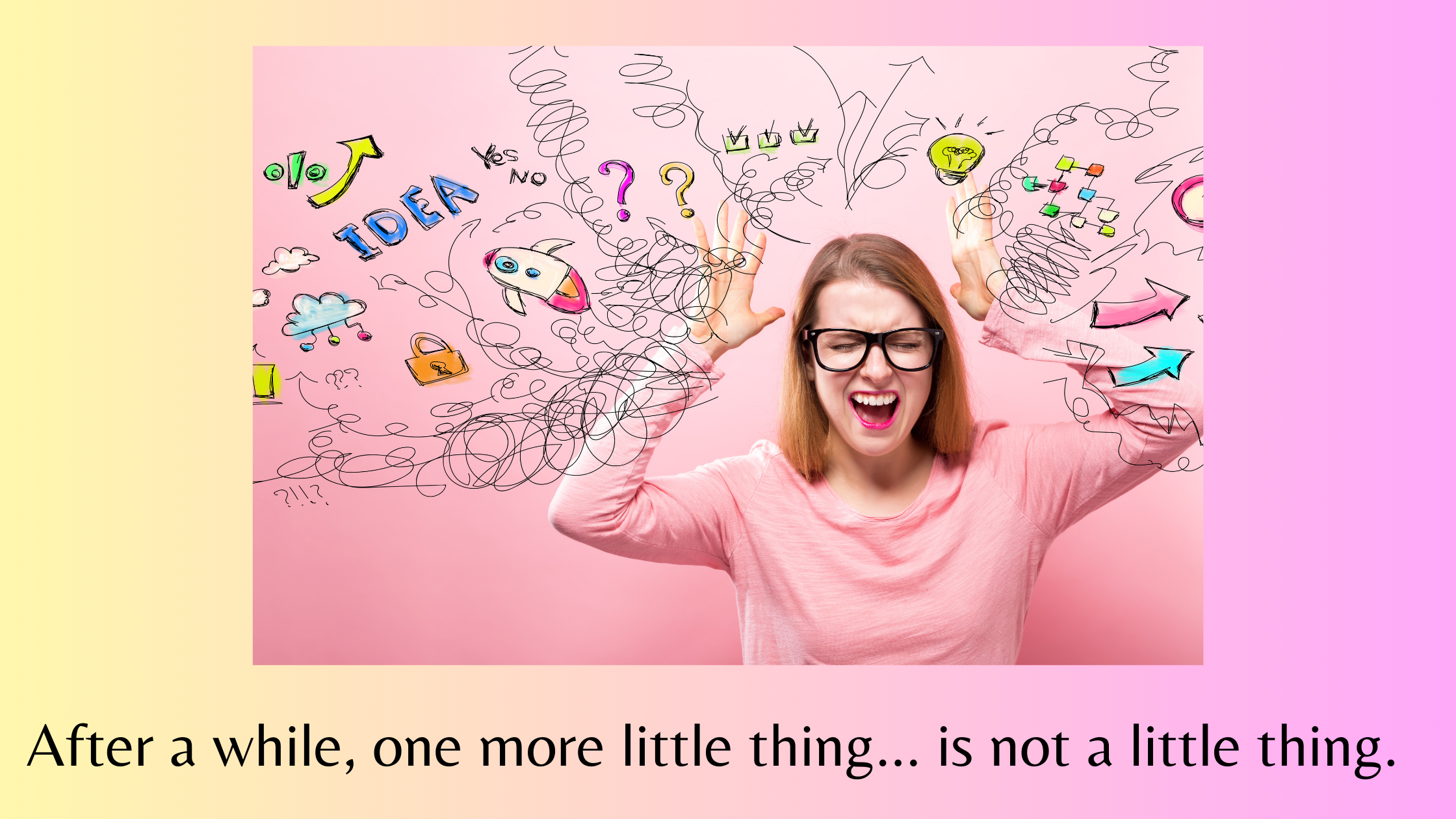
It’s fine if that happens only occasionally, but when it becomes more consistent or persistent, it’s a problem. The stress builds and builds. It’s like what happens when water keeps dripping on stone. That constant drip will eat away at the rock more effectively – if slower – than a flood.

There’s a word for this – “microstressers.” If you’re constantly feeling under pressure, but there is no one obvious culprit, then microstresses, aggravations so tiny you don’t notice or dismiss them, might be what is causing the problem. Rob Cross, Karen Dillon, and Kevin Martin have an approach to deal with them in their blog post, Five Ways to Deal with the Microstressers Draining Your Energy.  The authors identify 14 microstressers, breaking them into three categories. Here are 6 of them in the categories they belong:

Microstressers That Drain Your Capacity to Get Things Done

  • Unpredictable behavior from a person in a position of authority – Principals, administrators and school boards, can be a significant source of microstresses when they ask first for one thing then another or ask you to make something a priority that changes what they previously requested.
  • Surges in responsibilities at work or home – This is a big one for most of us. Constantly being asked to do one more little thing rapidly adds up to ongoing and unending microstresses.

Microstresses That Deplete Your Emotional Reserves

  • Managing and feeling responsible for the success and well-being of others – We care about our students and teachers as well as our families, but it can take a lot out of us when we take on their process as our own.
  • Confrontational conversations – Dealing with a defiant or disruptive student or a challenging discussion with a partner is wearing, no matter how successfully you manage it. We gear up to have the conversation, then are drained after.

Microstresses That Challenge Your Identity

  • Pressure to pursue goals out of sync with your personal values – Librarians choices are being attacked on all fronts. Being able to advocate for the collection and programs you want to have to make your library a welcoming environment for all is more and challenging. (Okay – this one may not be micro!)
  • Attacks on your sense of self-confidence, worth, or control – Anytime we hear something negative about ourselves, our choices, our beliefs, it’s like a pinprick in our confidence. Too many of these small holes, and our self-assurance leaks away.

Now that you can see what some of these microstresses are, here are the author’s 5 steps for dealing with them:

  1. Start small – Always good advice. First, look to identify one small microstresser in your life – the fact that they are micro can make this a challenge initially. Once you can see it, identify steps to address it. For example, if you are feeling a loss of confidence, start keeping a list of great things about you or what you do. Look at them regularly (especially after one of those pinpricks).  And keep adding to the list.
  2. Shift your attention to positive interactions that help create resilience – Is there someone at work you really like?  Can you have lunch with them a few times a week or go for a walk together after school. Enjoy these connections as they happen and look forward to your next time together will help. What about outside of work? Is there a friend you can call regularly?
  3. Tackle two bigger microstresses – Now that you have a handle on two of your microstresser “go big” and try two. Schedule some time with the guidance counselor to get better ideas on dealing with disruptive students and see if they can do a workshop or tutorial for you and teachers. How can you delegate some of the increased workload at home or on the job? Where is there help and support in your life?
  4. Pay attention to areas that create anxiety because of your concern for other people – We worry about the people who matter to us whether at home or work. We can’t make choices for them, and we can’t always rush in to help them. The authors suggest you work with them on developing problem-solving skills, which will allow you to both feel more successful. It may also have the added benefit of giving you peace of mind that you can trust their process.
  5. Finish by pivoting to activities that help you derive a greater sense of purpose – The authors suggest you find a group or two outside work and family that gives you “meaningful activities.” For me it’s my Weight Watchers weekly meetings. I can feel myself shedding the microstresses even if I gain weight. Community and support are something we all need and which can get easily lost in the midst of all the little things that pull at us.

If you want to learn more about this subject, Cross and Dillon also co-authored the book The Microstress Effect. As leaders, we have so many demands we and others place on us, but our focus and energy tends to go to the big things and we don’t notice the little things that are draining our energy, mental health, and joy. When we succumb to these microstresser we can’t give as much to our school community or our family. Look for the little things that are becoming big things and take small steps to reduce your stress.