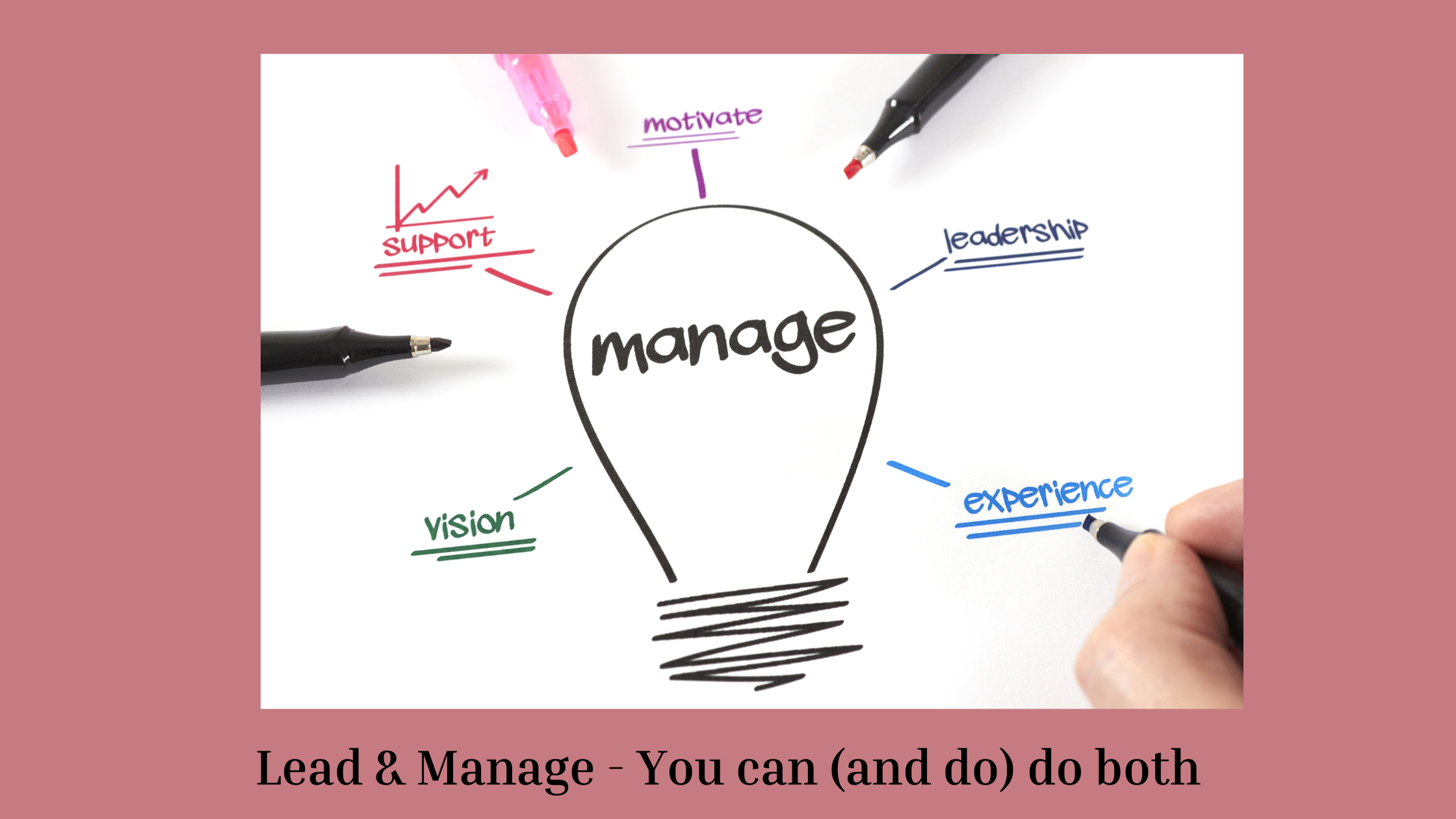
Librarians Lead and Manage

I’ll never stop saying this – You must be a leader. It’s the first of your five roles as a librarian according to the AASL National Standards for School Librarians.But you also have four other roles: Instructional Partner, Information Specialist, Teacher, and Program Administrator. How do those fit into your work? When you think about these other roles, are you a manager or a leader?

For many of us, it depends on the situation. To get clear, look at your Mission and Vision statements. Your Mission is your Perspiration (the work you do). Your Vision is your Aspiration (what you’re working toward). Each of these roles supports both.

As an Instructional Partner, you may have initiated the connection as part of attaining your Vision. While you are engaged in the partnership, you are mostly managing it, although there may be times you are leading such as when you guide the teacher in developing what you will be doing together.

In your role as Information Specialist, you lead the way when introducing new resources into the curriculum. You help teachers master them, either by giving them one-on-one help, sending an email about it, or doing a grade/subject level meeting professional development workshop.

When Teaching, you’ll probably find yourself managing the class. However, you also will have an Essential Question which will lead students to think outside the box. As a leader, you are also thinking of ways to publicize student learning to show the value of the library program to people in and outside the school

Administering the library program requires developing a budget and planning for the future. This part of the task requires leadership and looking into the future for what your program needs. In maintaining the budget and curating sources you will use, you are managing.

When you’re having trouble seeing yourself as a leader, reflect on what you do to make the library indispensable to the educational community. Your leadership is there. You exhibit many of the endless lists of leadership qualities described in numerous business articles.

If you’re having trouble seeing some of your skills, Bart Finelli’s came up with Five Qualities That Set Leaders Apart from Managers. These three are in a librarians’ toolbox:

  • Leaders are coachable themselves – Even as we bring those new resources in our role as Information Specialist, we are always on the lookout for what the next one will be. In our search, we go to conferences, attend webinars, and belong to Professional Learning Networks. We know changes come fast and in order to bring it to our schools and districts we must be role models for lifelong learning.
  • A leader’s actions match their words – Almost all lists of leadership qualities include integrity. That is taken to mean you can be counted on to do what you said. You keep confidences, and people trust you. But this statement goes beyond that. You say the library is a safe, welcoming space for all. You speak of the importance of Intellectual Freedom. But are you living those statements? These are challenging times, and you may have to make difficult choices. Are you living your code of values? It’s tough but be honest with yourself.
  • Leaders are entrepreneurs – This is your Vision at work – and also your role as Program Administrator. You want to grow your library program, but money is scarce or non-existent. What do you do? Many of you have become expert at finding grants or using DonorsChoose.org. You find local businesses who contribute their knowledge/talent or sometimes materials for your Makerspaces. You not only think outside the box, you no longer have a box.

It’s summer vacation, and I know you are using the time to learn and grow even as you take the needed to time to rejuvenate. As you relax, reflect on your accomplishments, notice your moments of leading and managing and what that’s brought your students and your school. What you do is important, and despite the many challenges you keep going. You are a Manager. You are a Leader. You are a Rock Star.

Leadership Must Be a Habit

When you are asked to identify your professional roles, in what order do you list them? Is leader the first? Is it second after librarian? Does it make your list at all? Being a leader is something you need to be each day. And yes, most of the time you are managing your program, but even as you are doing that, it’s important to keep the leader perspective present. In other words, you must make leadership a habit.

In the National School Library Standards (NSLS) (2018) the American Association for School Librarians (AASL) identifies the five roles of a school librarian (p.14). The first is leader. The AASL Vision is: Every school librarian is a leader; every learner has a school librarian. If you are not thinking of yourself as a leader, first and foremost, you are likely to miss opportunities to grow your library program and the recognition by the educational community of the vital role you play.

The good news is, you can make leadership a habit. In her blog post, Five Habits that Separate Good Leaders from Great Leaders Maile Timon explains what needs to be done. She begins with observation that “Most leaders are built, not born.” If you’d seem me at the beginning of my library career, you’d know it was true. No matter where you are, you can grow in to a leader – or a stronger leader.

Here are Timon’s Five Habits all great leaders have – with my comments on them:

1. Leaders motivate and inspire – If people don’t follow you, you are not leading. You are walking alone. It starts by having a clear and focused Vision. Keep yours in front of you and others by having it on a wall in your library for all to see and to remind yourself.

    “Inspiring” isn’t telling others what to do. It’s listening to them and helping them to see their own value and how what they are doing supports both your vision and likely that of the school. It supports them to become leaders, too, as they see you learn from them as much as they learn from you.

    2. Leaders develop focused, forward-thinking visions – Having your vision in front of you is important, but is it an inspirational Vision? Too often we short-change our vision by not allowing it go beyond what we think is attainable. What would your library be like if money or other factors weren’t an obstacle? The AASL Vision statement is a perfect example.

    As Timon suggests, start with your Mission. It’s your purpose, based on your core values. It’s what you do every day. Here’s one from my list of examples: The mission of the School Library Media Program is to ensure that students and staff are effective users and producers of ideas and information, promote literacy, and develop students’ competencies to be ethical participants in a global society. A sample Vision is: The School Library Media Program is a user-centered environment where up-to-date resources and technology and a responsive staff empower students and teachers to achieve their academic and personal goas.

    3. Leaders create relationships This works well for us as we are in the relationship business. Every day is an opportunity to create new relationships and/or to build on existing ones. It’s through these relationships that you develop collaborative learning opportunities that benefit your community and lead to the attainment of your Mission.

    4. Leaders promote a culture of coaching – We don’t usually think of it as coaching, but it’s what we do whether we are working one-on-one with a teacher or present a lesson at a grade or subject level meeting. We share our knowledge with them, helping them become more confident in applying a technique or learning a new resource. It’s being an Instructional Partner, our second role in National School Library Standards (NSLS).

    5. Leaders never stop learning – This is intrinsic to who we are. We are always role models of lifelong learning. We couldn’t be an Information Specialist, our fourth role in NSLS. It’s why our Professional Learning Networks and our membership in our state and national organizations are so important to us.

    We also learn as we help others find the information they need. As the saying goes, we may not know the answer, but we know where to find it. And in finding it, we add to our ever-growing knowledge. We learn every day.

    As you go through your day, be aware of when you are being a leader. Look for opportunities to do one or more of these leadership indicators so they are increasingly incorporated into your daily interactions. Make leadership a habit and you will lead your library with Vision.

    Leadership Power

    Making your Vision for your library a reality requires two things: leadership and power. Power has many faces. Some comes from a person’s title, like principal or superintendent, but at its core (and by definition), power is having or making people do what you want them to do. The best kind of power happens when the person with power inspires – rather than forces – people to follow.

    The strongest and most effective leaders don’t only have power, they are visionaries. Your Vision Statement is just a dream unless you keep it in mind and work toward it, however slowly. In addition, you can’t accomplish your vision on your own. You must make connections with others who help bring it with you to fruition.

    As an example, look at this Vision Statement, “The Blank School Library Program is the center of collaborative learning, producing creative students who have an appreciation of literature, critical thinking skills, and a respect for others and self, and who are prepared to make a contribution to the world.” It is uplifting, as all Vision Statements need to be. At the same time, the importance of others being a part of it to make it a reality is embedded in the statement with phrases including: “collaborative learning,” “appreciation of literature” and “critical thinking skills.”

    Bringing your vision to life requires you to work with teachers at all levels and in all subjects, as well as creating the safe environment that welcomes all, allowing them to produce their best work. To achieve that, you need to be clear on where you are going and have a positive mindset about getting there. Alaina Love in her post, Do You Have the Kind of Power That Really Matters? guides you with these five questions to ask yourself.

    1. What is the over-arching purpose I am here to achieve? The word “purpose” provides the answer. It is your Mission Statement. Your Mission Statement is what grounds you and keeps you focused on what is truly important so that you don’t get distracted –or not for long—by tasks that don’t further your purpose.
    2. What are the outcomes I am hoping to manifest today? A prioritized to-do list has you working towards that over-arching purpose in manageable steps. The pleasure we feel at being able to cross off these tasks keeps us motivated to continue in our always busy world. Love recommends keeping track of your successes as a reminder of what you are achieving. Seeing progress is an incredible motivator.
    3. How do I need to show up for others to get these results? For librarians, this means listening to the people in our community and learning what teachers are doing – and struggling with. When your library is a safe welcoming environment, they are more likely to share their worries and stresses. Offering your help and doing the heavy lifting brings them back. They will see you and the library as a vital resource toward their success.
    4. What needs to shift in the environment I create to allow others to be more successful? Your first thought may be to look at the physical arrangement of furniture in your library. That’s one place but go further. You can invite teachers to put their student projects on display highlighting the success of many. You might also assess if you can make it easier for teachers to talk with you and/or schedule their classes into the library. Is there a place in your library where you can talk privately? Environment is about more than how a place looks. It’s about how it feels when you’re there.
    5. Where do I need to demonstrate more authenticity in my interactions and communications? Establish yourself as someone who can be trusted. Be comfortable sharing what you know – and what you don’t. In addition, be open to feedback, valuable part of leadership. is tough but necessary. After a project is completed, be willing to seek the truth from the people you worked with. Ask, “What do you think worked best?” “Where did you feel most supported?” “What could I have done better?” “How could I have helped you more?” “What changes would you like to see if we repeat this project?”  Asking may make your feel vulnerable, but you will have built trust. And trust is the foundation of relationships.

    You want to be the kind of leader who stays in your power and impacts others positively. With your Mission Statement and Vision to guide you, you can work continuously and successfully to make your Vision a reality because others will want to be a part of what you’re creating.

    Life is a Marathon

    More than two years after the beginning of the pandemic, thinking about masks, reaching for the hand sanitizer, getting vaccines and boosters has become our new normal, but we want it to be over. The reality, which we already know, is that it never will be over. And on the horizon are the next changes and new challenges. Life is truly a marathon, long and winding. All of it requiring our energy and attention. How well we do in this race depends on our mindset and willingness to learn so we are ready as we can be for what comes next.

    In The 18th Mile: It’s Not the Finish Line Leaders Should Focus On, RapidStart Leadership further develops the familiar life-as-a-marathon example. When the pandemic started, we dug down to do what was necessary. But it lasted so much longer. And we are tired. We are now at what RapidStart calls the 18th mile, the true test of a marathoner. The beginning excitement (or, in our case, the willingness to take on the challenge) has faded, and we are faced with miles to go before the finish line. This is the true test of our resolve and our leadership.

    Directed to the business world, RapidStart offers the following 7 steps – along with my tweaks and comments they are:

    1. Expect it – Anything long term hits this point. When you are a leader, you often are involved in complex, sometimes multi-year, projects. It’s around here where things start to go wrong and it’s harder to find the energy to invest. What strategies do you have in place to deal with this point? How about a mini celebration of the distance you have travelled?
    2. Put in the miles – Doing the work means continuing to learn what you need to do the new and old tasks. It also means once you’ve gone this far in the past, you can go further in the future. And as you go further, remember that you don’t have to have all the answers. Look to the other “runners” for support. Make use of your PLN.
    3. Recognize when it comes – If you expect the stress and stumbling blocks, you will be better at recognizing it. Notice changes to your mindset and focus. When you are ready to call it a day before the day has begun, you know you have reached that point. Put your strategies into play.
    4. Pace wisely – Enthusiasm is great, but it can burn out quickly in the enormity of what you are facing. Likewise, starting out too fast can mean you have nothing in reserve. A fast start is fine, but don’t keep that pace. And when you’re flagging, what keeps your reserves up? Time for family and friends and time for yourself are musts. You can’t keep drawing water from the same well without it running dry at some point. Brain, body, and spirit all need to be refreshed regularly.
    5. Watch for the “reveal” – The 18th mile is where you see what you are made of — your commitment to your Mission and Vision. Your perseverance. The longer the project, the more likely the shine is going to come off and you’ll get to see the truth of this work and its impact. Who is still with you? Who’s dropped off? Assess how things are going. Where are there weaknesses that can use some extra support? Whether it’s a pandemic or a project, you are in this together.
    6. Go mental – The power of the brain over your attitude has long been noted. RapidStart says where runners count steps or sing songs, we should look to our why. When fatigue and doubt arise, revisit your vision for and the purpose of the project. There is more to come, but you can do it. You know it because you have already done so much. Review the many accomplishments and milestones you have achieved.
    7. Enjoy the journey – Or as RightStart says, “embrace the suck.” Not every part of the journey will be filled with joy, but these important projects are worth the time and effort. Going through this process, especially with collaborators, brings you all closer together, even (especially?) when it’s challenging.  Find ways to make time for fun and laugh when the situation gets tough, knowing it’s just one more step closer to the goal.

    No matter what a project — or life — throws at you, don’t be stopped by the 18th mile. Keep the end (and your Vision) in sight, work with your team, and look forward to reaching that distant and important goal. Maybe we’ll even get a T-shirt at the end!

    Powerful Words – Powerful Results

    Our word choices – whether speaking or writing—impact how we are perceived, and the results we get. When we write, we take time to search for and edit out weak words, those which don’t say what we want or which muddle the clarity of our message. In conversation, it’s important to choose words that convey surety and confidence.

    This is vital is when writing your Mission and Vison statements. When I give presentations on the subject, I often point out how a simple word choice or change can make the statements more powerful. We eliminate words like “will” and “plan to” and put the statements in the present tense. Even a Vision statement you don’t see as entirely possible to achieve (or at least not for a while) gains strength from being written in the present tense. Let’s look at the difference the right words can make:

    Compare:

    The Mission of the Blank School Media Center Program helps in creating lifelong learners with critical thinking skills and an appreciation of literature with enriching opportunities for all students to gain the self-confidence necessary to successfully learn in an information-rich world.

    With

    The Blank School Media Center Program creates lifelong learners possessing critical thinking skills and an appreciation of literature by collaboratively providing opportunities for all students to gain the self-confidence necessary to successfully learn in an information-rich world.

    “Help” is weak, while “Enriching” is vague in the first example. They aren’t wrong, but they are supplementary. When writing something so concise, and something we want to have an impact, we can’t afford to be supplementary.

    Changing a Vision statement into the present tense immediately adds force.

    Compare:

    The School Library Media Program will be a user-centered environment where up-to-date resources and technology and a responsive staff empower students and teachers to achieve their academic and personal goals.

    With

    The School Library Media Program is a user-centered environment where up-to-date resources and technology and a responsive staff empower students and teachers to achieve their academic and personal goals.

    In our conversations, the subtleties communicated in our word choices can make a huge difference in how our messages are received. Saying, “I believe that purchasing books by diverse authors will make a positive difference in our students’ sense of belonging,” does not convey the same message as “I know that purchasing books by diverse authors will make a positive difference in our students’ sense of belonging,” “Believe” does not convey the same strength of conviction as “know.” Being aware of words that weaken or soften your impact can improve your proposals and have you better positioned to be accepted and approved.

    In his article The Love for Confidence and Conviction, Bob Decker points out how “soft word” choices communicate the degree of confidence you have in your ideas, regardless of how much confidence you actually have. He recommends you eliminate the following terms:

    • Maybe
    • Possibly
    • I think
    • Just
    • I hope
    • Potentially

    because they suggest you aren’t certain about what you’re saying. Each conveys hesitancy and a lack of conviction which does not support your success.

    It is an odd fact of life that as receivers of information, we recognize these indicators of uncertainty and lack of confidence, yet as senders, we are frequently unaware of the implications of our word choices. To improve the power of your communication, both written and oral, tune into how others express themselves. Listen to the words your principal uses in proposing an initiative or plan. Did you hear confidence or uncertainty? Observe how others respond. Then take the time to notice your own language choices and speak (and write) from the passion and enthusiasm of your work.

    Reach for Your Leadership Vision

    I often write and speak on the importance of knowing your Mission and Vision. Missions focus on what you do. It’s your purpose or your “perspiration.” Visions are your “inspirations” and “aspirations.” They are where you would love to have happen. Both grow from your core values, your philosophy. And you can’t reach your school library Vision unless you have one for yourself as a leader. Without that self-Vision, it is difficult to step out of your comfort zone and the take risks leadership requires.

    In Think Deeply About the Leader You Aspire to Be, Art Petty suggests you “mine for early influences and marry them to future aspirations to develop a clear picture of your desired leadership self.” Connecting what you’ve seen and done with what you want can guide you in constructing your leadership Vision using the following four steps:

    1. Start by exploring your leadership inspirations – Look inwardly and widely. Consider the values you hold. What are you passionate about? Who are the people you admire in librarianship and elsewhere? Why do you admire them? Petty suggests you look at the behavior of those people. If they had a direct contact in your life, how did they reach out to you? I became active in school librarianship and began writing because of the people who reached out. Their trust and belief encouraged me to leave my comfort zone.
    2. Spend time reflecting on your best self – Think of those moments when you were proud of something you did as a leader. You may have put together a difficult project or you gave a workshop for teachers, and they were all engaged and participating. Consider what you did to make those instances happen. What aspects of yourself as a person did you draw on? Think of the values that motivated your behavior and/or achievement. Look to the moments when you were proud of yourself and your behavior. It may have been how you connected a reluctant reader to the perfect book. Perhaps you turned a confrontation into the start of a relationship.
    3. Your Leadership AspirationsImagine this was your last year at your current position. You’re either moving on or retiring. What would you hope your students would say about their library experience? How about teachers and administrators? Take time to think about the legacy you want to leave, the impact you want to have, as a librarian and a leader and from that, pull out the pieces you want to include in your Leadership Vision.
    4. What’s most important to you as a leader? Petty recommends answering the following questions:
    • What do I care most about doing and achieving as a leader?
    • How will I guide, teach, and coach?
    • How will I support creating great results through others?
    • How do I want to affect those I come in contact with along the way?

    My Leadership Vision is “School Librarians are recognized everywhere as vital leaders.” I know it will never be universal, but I always work to be a force for change. It inspires all I do.

    Taking the time to see yourself as a leader and the impact your leadership will have on your library can inspire and should inspire you. Reach high and fearlessly create your own leadership Vision.  

    Move Closer to Your Vision

    You live your Mission every day. You incorporate your Core Values or Philosophy into all you do. But what about your Vision?

    Your Vision is your aspiration. It is how the library will be perceived in an all-perfect world. Although the world is not and will never be all-perfect, if you aren’t moving toward achieving it, your Vision can’t come to pass. It remains wonderful words. A dream that has no hope of becoming real.

    So how do you incorporate a goal that won’t completely happen? As always, start small. Develop a plan to take you one step closer to achieving it. When that’s done, review your Vision and determine the one part you will focus on next.

    Consider this sample Vision:

    The Blank School Library Media Program is the center of collaborative learning, producing creative students who have an appreciation of literature, critical thinking skills, and a respect for others and self, and who are prepared to make a contribution to the world.

    First, identify the key concepts of your Vision. In this example, these would be: collaborative learning, creativity, literature appreciation, critical thinking, respect, and possibly activism. It’s a formidable list.

    Since collaboration is needed for so much, this is one good place to begin. What do you need to have the library be a center for collaborative learning? Look around your library. Does it promote collaboration? How is the furniture arranged to encourage that? Are there resources that would help? How can you showcase them so teachers and students will use them?

    Now that you know what you want to achieve, create a plan to get you there. Will there a be a cost associated with it? Can some of the work be done for free? Can you fundraise? Who are your logical allies? Who will you need to convince? How can you sell it?

    The three-step process Paul B. Thornton puts forward in Leaders: Clarify Your Ideas Before Communicating Them, with some modifications, can help you turn your ideas for achieving your Vision into reality.

    Step No. 1: Clarify your thinking – You begin this process when you determined which part of your Vision you will focus on. Take time to think about what you want to do first. Yes, there is so much to do, but thinking is doing in this case. Get clear about your priorities, what you have time for, and what might make the biggest initial impact (early wins are helpful for motivation!) Then before going forward, test it out with allies and those you trust.

    Going back to the earlier example, you might ask a teacher ally if they thought the library promoted collaboration and how it did so.  Speak to one or two students who use the library frequently. Do they think it is comfortable to collaborate in the library? What, if anything, would make it simpler? How close are their ideas to yours? Share what you are contemplating. Do they like it? Have other suggestions? Fold any new ideas into your planning.

    Step No. 2: Prepare Your Message – As Thornton says, you need to engage emotions and address “heart and head.”  Think about why would your audience want this? What would appeal to them (and what’s the emotional appeal)? Hit the big idea quickly and don’t give too many details. They will ask if they need it.

    Thornton also suggests blending optimism with reality. Too much optimism makes you sound like a dreamer. Too much reality, and it’s likely to sound overwhelming. Prepare questions that focus your audience on their values and priorities and show how this will mesh with them. Again, try your message out with your allies and make any necessary modifications.

    Step No. 3: Deliver Your Message – You have worked long and hard at this. Let your passion and conviction show. Thornton says to make your idea visible, dramatic, and consistent. Use pictures of libraries that have achieved what you want. On the create a space that promotes collaboration example, you could rearrange the furniture to show what the changes will look like.

    Don’t let your Vision be just a dream. When you make a plan, create a lesson, consider a new project, look at your Vision and remember what you are always working toward. Every step brings you closer.

    Your Leadership Journey

    As one year ends and another begins (can I get a cheer?) it’s a good time to look honestly at where you are on your leadership journey and think about where you want to go next. The Chinese philosopher Lao-Tzu supposedly said, “A journey of a thousand miles begins with a single step.” Even if it’s only a small step, what matters is that you have begun, and that you continue. Where it will end you cannot foresee, but the farther you go the more lives you will impact and the richer your own experiences will be.

    Thinking of the leadership journey takes me back to my August 24. 2020 blog Follow the Yellow Brick Road. The Wizard of Oz has a lot to teach us about growing and learning in a time of stress and ambiguity. You might want to watch it through the perspective of a leadership journey. Much like you in your initial foray into leadership, Dorothy places a tentative first step onto the road.  With encouragement, she moves forward. (NOTE: If you’re starting out – I hope you have a mentor and if you’re further along, I hope you’ll look to be a mentor to those early in their journey.)   Her path begins as a spiral, coming back on itself but getting larger and more distant from the center each time. So it is with leadership. You take on small things. Slowly you move out of your comfort zone, even if it is still close by.

    Eventually the path widens and there is a large vista in front of you. Your old comfort zone is behind you, but now the risk of everyone seeing your performance and potentially judging it can inhibit you from continuing the journey. Every leader deals with this, and to bring Lao -Tzu back, you won’t reach the thousand-mile mark unless you keep going forward. The good news is, the steps you’ve already taken will support your success.

    As you move onto this larger road, you need to hone the skills you have developed and use them in a focused way. In a post for SmartBrief, Jonathan Dapra offers advice for Navigating the Road from Doer to Leader. The article speaks to the balance of being a manager (doer) while also being a leader.

    Dapra proposes these five steps.

    1. Create a Vision and Share It –Managers work to drive their Mission; Leaders move forward to realize a Vision. I hope you have created a big Vision of how you want your library program to be and be perceived. The second half of Dapra’s advice is equally important – share it.  Post it on a wall in your library. Have it on your website. Put it in the signature of your work emails.
    2. Build Mutually Beneficial Relationships – Relationships are our business, and we need to develop them. This takes the concept to a new level. As a manager, you have undoubtedly included collaboration as part of your Mission. As a leader, you want to be more strategic.  Who are the influencers in your building? There are always teachers who are more respected. Is your principal a genuine leader or does s/he only have the title?  Is the secretary the real power?   These are the people with whom you must build relationships.  Note the term “mutually beneficial.”  What do they need? How can you give it to them?
    3. Be a Master of Feedback – Leaders create more leaders. They do so by empowering others and helping them grow. Feedback is an important element of that, but to master feedback you might want to review last week’s blog. Criticism vs. Feedback. Ensure that what you think is a supportive comment is not taken in as criticism.  Although Deprak doesn’t mention it, you also should seek honest feedback about yourself and use it. Leaders put what they learn into action.
    4. Know Your Business – Our profession has long been about rapid changes, which has been accelerating as part of our response to the pandemic. Staying current is challenging, but professional journals such as AASL’s Knowledge Quest and ASCD’s Educational Learning along with the library-related social media will keep you on top of new tech and important issues. You want to be the one people turn to when they need to know something, secure in the knowledge that you can help them or find the help they need.
    5. Walk the Talk – No matter where you are on your leadership journey, be a model of what a great leader is.  Be trustworthy and empathetic. Give help and be strong enough to ask for help.  Dorothy did and look where it led her.

    I urge you to look for ways to reach the wider road on your leadership journey.  Get involved in your state school library association. Become active on the national level. Start conversations on library social media sites to contribute to and learn from your peers. When you continuously take one step at a time, you can make that journey of a thousand miles.

    ON LIBRARIES: Mission, Vision and a Virus

    Mission and Vision work together for your long-term success – even and especially during a pandemic. A Mission is your purpose.  Most of you have written one for your school library. It has guided your decisions on where to put your energy and in assessing how successful you have been.  Your Vision has been your inspiration, opening your mind –and planning—to what might be possible someday.

    Your Mission and Vision are core to your school library and they can stay the same for years, even when times and circumstances affect how you do your job.  However, the last few months have you dealing with a major shifts in what and how you work.  For your own guidance and the future of your program, it’s a good time to revisit your statements.

    Here are two sample Mission Statements:

    • The Mission of the School Library is to create lifelong learners with critical thinking skills, and an appreciation of literature by providing opportunities for all students to gain the self-confidence necessary to successfully learn in an information-rich world.
    • The Mission of the School Library is to ensure that students and staff are effective users and producers of ideas and information, promote literacy, and develop students’ competencies to be ethical participants in a global society.

    Here are two sample Vision Statements:

    • The School Library is a safe, open, accessible and inviting learning library commons, essential to student achievement, citizenship and support the principles of intellectual freedom. Our students think globally and are capable of creating new knowledge.
    • The School Library is a user-centered environment where up-to-date resources and technology and a responsive staff empower students and teachers to achieve their academic and personal goals.

    All four are powerful statements declaring the value of the school library. (NOTE: I have dropped the word “program” because the National School Library Standards states that we should say “school library” not “school library program”.)  As written, they reflect what you have been doing during quarantining event though you have been doing so differently. And it’s that “differently” which is necessary to address.

    What else have you been doing as part of distance learning?  From what I have been reading, you have been building and strengthening your educational community.  And that community is larger than it was.  Parents are now an integral part of the community you have created.

    You also have drawn on national library association sources, primarily ALA and AASL, to bring the latest information on the virus and how it affects schools. Your PLNs such as the library-based Facebook groups have been a source of creative ideas to further help your students, teachers, parents, and, hopefully, your administrators.

    You have shown teachers new digital tools for distance teaching. While you have always been a tech integrator, now more than ever you have become their tech expert, hand-holding many of them through the steps need to get their lessons to students and helping parents get online.

    Distance learning has also highlighted the digital divide.  What have you contributed in helping students who have limited or no access to wi-fi? (See ALA’s Equity, Diversity Inclusion: An Interpretation of the Library Bill of Rights.)  How will you be able to help the administration deal with the issue?

    Reflect on the changes and all you have contributed.  Come up with a list of words that highlight your new role.  If “community” wasn’t in your old statements, it needs to be now.  And be sure that community means the larger community.  If possible. include your role with administrators.  If technology wasn’t mentioned consider phrases like “bridges the divide between…” or “supports the use of … for…”

    As discussions begin on what it will be like when we return to school, you need to expand your advocacy work.  Schools are facing budget cuts (yet again), and all to often that has meant eliminating librarians. Don’t wait until cuts are announced. Be proactive. Send out information on your updated Mission to show administrators and parents the key role you and the library play for students’ success. Volunteer to be on any committee working on what it will look like when your district returns so that the library is part of the plan.

    Collect evidence that shows how you have been a leader. Show what you have done in making your library a safe, welcoming environment even when you aren’t in your physical space. Check for graphics created by different states to present what librarians have been doing during the pandemic.

    And if you do make changes, don’t forget to use your tech expertise to showcase your new Mission. Share it widely – with teachers, parents, and the administration.

    ON LIBRARIES: Reversing the Energy Drain

    Feeling drained and exhausted?  You are not alone. Even though you’re not commuting or doing as many before and after school activities, the things that energized you – including seeing the teachers and students – are missing. But while you can partially attribute the feeling to cabin fever, the major energy drain is due to fear and there’s no getting away from it.

    Acknowledging the fear and knowing it’s going to be a part of our lives even after the virus is contained (and hopefully cured) is a good first step. But what else can we do to minimize the energy drain so we are at the best we can be now and going forward? In Maximizing Your Energy During COVID-19 Nicholas W. Eyrich, David Fessell and Gretchen Spreitzer offer three ways to accomplish it. (NOTE: There’s a survey at the end of this article which requires personal information at the end.) They recommend:

    Identifying and using your signature strengths – Consider both your people and professional skills. How good are you at lifting the spirits of others? Often helping someone else feel better gives you an energy boost.

    How much of a techie are you?  Working one-on-one with a teacher (online, of course) to demonstrate a resource will help you focus on doing something positive.  When they use it their teaching, they will invariably let you know. Another feel good experience that helps restore energy.

    Those of you who are artistic or crafty can create something to share online. The act of creation, particularly when you tune into it is an energy boost. Bringing beauty to others adds to your pleasure and that too adds to your energy.

    And since energy carries over, think about your strengths and joys outside of your job. Do you like cooking, baking, knitting, gardening or singing? Spend some time purposely doing those things. It’s okay to enjoy yourself.

    Keeping your purpose ever-present – This is probably my theme song.  Your Mission – or purpose – is what keeps you on track.  It’s all about your Why.

    Why did you become a librarian? What powers you when you are in your library?  What can you bring from that into your new environment?

    What values are important to you?  Note where they are still present. Acknowledge yourself for when and how you further Mission and demonstrate your Why.

    Lean into high-quality connections – As always, keep checking in to your PLNs.  You don’t only have to use them for advice on how to do something.  You can also open up and let them know you are feeling.  By sharing your fears and anxieties, not only do you release them (fear hates when you shine a light on it) but you may learn methods others have used for dealing with the same concern or your disclosure could help someone else feel stronger and in good company.

    Recognize when you are feeling drained. Identify its cause.  Most of the time fear will be at the root.  Choose one of the three suggestions to help you restore your energy or let me know others that are working for you. Most of all, be kind to yourself no matter where your energy is. Accept that there will be days when you don’t accomplish much, and don’t expect to give maximum effort all the time.