Maximize Your Time

There are only 24 hours in a day, and no matter what you do – or how much needs to get done – there’s no way to use them all for work. So the goal becomes using the hours we have to our best advantage. But here’s the thing – what works for one person and seems productive, might not work for you and could, in fact, be detrimental to you in the long run. So before you decide how to organize your time – take the time to learn how you work best.

To create your own personal plan for maximizing your time, consider following this 4-step approach Chris Taylor presents in his article How to Make Your Days More Productive:

  1. What To Do –  Start by knowing your priorities – for a project, a semester, a school year. Even knowing this, you won’t get everything done (have you ever?) but if you can get clear on what’s most important and what will get you closest to where you want to be then you can organize your time and to-do lit accordingly.
  2. When To Do It – This is where it gets even more personal. What is your most productive time of the day? When are you most creative?  For me, it’s first thing in the morning.  I know other people who like to work at night when everyone else is sleeping. Schedule your high priority tasks at the times when you are most clear. Of course, if you’re not a morning person but are at work then, as best you can, do the activities that align with your energy and ability to focus.
  3. Where To Do It – Environment can play a large role in our productivity. Is your office space the best place for you to work?  Do you like or not like the buzz of others working nearby?  Do you find being outdoors stimulates your thinking? Be as honest as you can and then see where you can adapt your workflow to fit. Can you clear off your desk? What about adding pictures of favorite places that you can see while you work? When can you close your door?
  4. How To Do It Well – That is the ultimate challenge.  You need to turn off the interruptions that take you away from being as productive as possible.  This is not necessarily other people interrupting you.  It can be seeing stuff popping up in your email.  Or the phone ringing. Turn them off. Don’t see your email when you are working on these high priority tasks.  Turn off your phone until you are ready to attend to those messages. And when it’s time to focus on emails – stay focused on them and get as many answered as you can in the time you give it.

Like anything else, it will take practice and iteration of these four steps to make them part of your routine, but the results are worth it. Be prepared to tweak it as you work with it and learn what supports your success. Maybe you thought you could be creative for two hours at a time, but one is better followed by a break. Do what you can to limit the break, then get back to the priorities. There’s no way to add more time to the clock – so add time to your day by using what you have in the way the best supports you.

A Better Balancing Act

The feelings of overwhelm, exhaustion and burnout are on the rise. Between our work, our world, and our families, we are frequently unsure how to manage all we are responsible for. Then we’re told to take time for ourselves, because if we don’t, we run the risk of things getting worse. Sounds like more stress.

Unfortunately, most of the advice out there is generic. Do this, eat that, stop saying yes. But the truth is we are unique. Our lives are different from the ones we see and read about. Our needs are different. What works for one person, doesn’t work for another. What is true is that we require balance so that the stressors in our lives don’t suck out all the joy.

So how do we find and succeed at our personal balancing act? Fortunately, Sandeep Gupta explains how to go about the process in his blog post, Work-Life Balance: A Myth or Reality? He starts with the following 4 myths referenced in the title of his blog:

  1. Work is pain, and personal life is pleasure – While it’s true that most of us have to work, it isn’t true that work is always pain. If family life is currently stressful, it could be that your personal life is not always pleasure. Which is true for you? Is it always the case? Hopefully we enjoy our jobs – most of the time. We love our family and friends. Most of the time. What is the best balance for you, personally? How much work and how much personal time are the right balance for you?
  2. Work and personal life are separate – We categorize it that way when we think about balance, but the two overlap often. You take work home. You don’t forget personal issues when we are at work. I used to tell my staff to let me know if they were under stress from home so we could adjust their day. As Gupta notes, when you have a bad day at one, you bring it into the other. What we need, he says, is not a “work-life balance” but a “balanced life.”
  3. Time is the only constraint – Gupta says we think having more time would allow us to have a work-life balance. But it’s not about the hours and minutes, it’s the quality of the time and what we choose to do with it. Having the time to enjoy dinner or play with our children is more enjoyable than just making it home at a specified hour while still thinking about a task at work.
  4. One Correct Solution – Just as there is no one-size-fits-all when it comes to having a balanced life, there is not one solution that will always continue to work. What you need today may not be what you need next year. It’s important to be reflective about how you feel and make changes as necessary when necessary.

So, how do you go about it finding your balance? Gupta recommends considering these questions.

  • What needs to happen to make life more fulfilling? 
  • How can life be more balanced and fulfilling?
  • Who do I need to become to lead a fulfilled life?

To answer the first question, ask yourself: what are your priorities? What things can you do to make more time for them? What unnecessary things are you doing which can be delegated or eliminated? Take time to notice when and if these might change.

For the second question, identify your passions – both at work and in your personal life. Ensure that you make a place for them. The usual advice about making time for physical activity is true here as well. It energizes you and promotes a positive mindset.

The third question requires you to include time to reflect on your life. Are you feeling fulfilled? Do you need to revise what you are doing? Remember, there is no one correct solution and today’s solution may not work in a year. Life brings change at home and at work. Accept it, be ready for it, and make any needed adjustments.

Burnout is a real thing. It comes when over a period of time, what we expect or think we can do doesn’t align with the truth. We can burnout because of both work and personal stressors. It may not seem like you have the time to look at this, but the truth is, you can’t afford to ignore it. Ask yourself these questions (maybe you do it one your commute). Listen to the answers you receive, and then do what you can to act on them.

To Do… And To Don’t

Time management is essential for all of us, professionally and personally. As leaders, it is even more important. Our plates keep getting piled higher as we take on or are given new responsibilities. Getting everything done seems impossible. Your to-do list or however you keep track of what needs to get done is getting longer.

What you need is another list.

Stay with me — this second list is “To-Don’t.” It’s time to clear things off your plate. You are undoubtedly doing more than necessary with tasks and treating all of them as having equal weight, but this is not the case. You need a system that allows you to see which things need to be done by you, and which don’t.

Instead of shelving every book as it’s returned – put them on a cart labeled “Just returned—would you like to borrow one?” Instead of creating all your bulletin boards and displays – check with the art teacher(s) to see if they would like their students to take this on as an authentic project. You would give guidelines and topics. You could do the same with different clubs.

Then there are the projects that you started only to realize it’s a much bigger commitment than you thought (genre-fying your collection, anyone?). But you made the commitment or started and now you have to continue. Or do you? Sometimes knowing when to stop is an important as knowing what to start.

David Baker offers a way to avoid these too-big commitments in his blog post, Stopping Is as Important as Starting. To begin he recommends you think of it as trial with an estimated duration. And most important, identify how it will fit into your schedule, making room as necessary by dropping something else. He recommends this two-step approach:

Think of things in season – Quoting the verses from Ecclesiastes, Baker suggests there is a season for all things. Although quitting feels like failure to us, sometimes you need to do it to be successful with your other responsibilities and projects. It’s part of your growth. It’s the learning process. Remember the choice of to-do or to-don’t do is yours. Work to be as clear in your reasons for stopping as you were (hopefully) in your reasons for starting.

Be resolute but not reckless – We are always harder on ourselves than we are with others. Baker advises you to consider what a good friend would tell you to do when you choose a project you shouldn’t have undertaken. It will force you to reflect and evaluate whether the stress of the new commitment will bring about results that are worth it. Think of it a ROI – return on investment. What are you getting out of it that makes it worth the effort. If it is worth it, figure out something you are doing that isn’t worth the time you are putting in and drop that.

You can’t add more hours to the day. When you are over-committed you and your library suffer. It affects your personal and professional relationships. Doing too much will actually move you further from your Mission and Vision. Be honest – and kind – with yourself and make choices that support you and your program. You will be a better leader for it.

Reflect, Renew, Plan

Happy New Year! You probably aren’t quite ready to think about heading back to school yet, but before your super-busy work schedule takes over your life, I thought I’d offer some ideas for how use the remaining time to get the year started in the best possible way.

When there is so much pulling at you and demanding your attention, it is all too easy to push forward without giving yourself time to think. That way leads only to rapid exhaustion with no sense of what you have accomplished or where you want to go. If you can’t do it before, schedule time on or after your first day back to anchor yourself, and you will be more productive and more likely to achieve the results you want by the end of the school year. Helen Tupper and Sandra Ellis offer a musically oriented 3-step approach in explaining How to Create Your Own “Year in Review.”

  1. Press Pause – Although January 1 is not the beginning of the school year for educators, the first half is broken up by many holidays. Learning tends to go into high gear after the winter break. Pause is such an important step before starting anything, and it’s a critical step now.

The authors say to use this time to answer key questions. Ones that can work for us include:

  • What was my biggest success?
    • What made it happen? What can improve it?
  • What didn’t work?
    • What did I learn from that?
  • What can I realistically achieve by the end of the school year? (Make sure it connects to your Mission and/or Vision.)

Take the time to write down your answers. This is an important step as helps you to focus.

2. Play it Back This is where having a mentor really helps. If not a mentor, choose a librarian friend. Schedule a time when you can share your answers to further clarify your thinking. Did you minimize your successes? Miss a key success?

Add some questions. Among the authors’ suggestions are: What was most fulfilling? Most frustrating? You might also add:

  • Where was I afraid to step out of my comfort zone?
  • What was the most useful thing I learned from a print or digital source?
  • Who enjoyed working with me on a project?

3. Fast Forward –Review what you discovered in the first two steps. Use your results to create an action plan. Again, start with some questions. Two of the authors’ suggestions I like are: “What habit will I commit to? What is one mistake I won’t make again?”

I would add:

  • Who can I target for a cooperative project?
  • What do I need to do to inform stakeholders of what the library has accomplished?
  • What do I need to do to move the library’s vision closer to reality?
  • What’s my plan for it?

With the clarity this reflection gave you, you are now ready to start the last half of the school year. Be the leader your teachers and students need you to be, and I hope you have a great second semester.

Fighting Fatigue

Is there anyone out there who doesn’t feel tired – mentally and physically – most of the time? It seems we are all in a state of chronic exhaustion. It may have started with the pandemic, but since, it seems to be unending. And yet being tired is no more of a useable excuse than not having time. The subtitle of my book Leading for School Librarians is: There Is No Other Option. This means tired or busy – we must be leaders.

As pressures on school librarians increase, so does the amount of time required to do our jobs. Working while exhausted means it’s hard to give our best. Not to our students. Not to our teachers. And not to our family and ourselves.

We can’t afford to be in a state of perpetual fatigue, but how can we change that? Art Petty recognizes the challenge and presents seven ways for dealing with it in his blog post Leadership Fatigue Is a Thing –Make Time to Recharge. Here are his recommendations and my comments:

  1. Center on Your Purpose as a Leader – Think of this as your personal Mission Statement. Why are you doing what you do? Perry asks you to think of how you want to be remembered at your retirement party. Create your personal Mission Statement (different from your professional one) and print it out to remind you of the value you bring. Mine is, “I reflect the greatness I see in others and, when appropriate, help them manifest it.”
  2. Adjust Your Attitude Through Beginner’s Mind Thinking – Step back and look at what you are doing as though you were just starting on the job. Do you remember? That was a time when all was possible. One technique that can work is to walk into your library as though you had never been there before. What message is it sending? Is there anything that seems off? Does it reflect today or when your last organized it?
  3. Treat the Workplace as a Living Laboratory and Start Experimenting – Having seen the library with fresh eyes, what one small thing can you change or add? Look for ways to elevate what’s there, even if you like what you see. If you think everything is fine as is, you will never work for something better. Focusing on doing something different gives a lift to your mindset.
  4. Commit to Creating Value at Every Encounter – Ever have a quick encounter at the grocery story with someone in line that leaves you feeling a little more energized after? Maybe you gave or received a compliment. Maybe someone asked about a product you purchased. In addition, if you keep this in mind as you interact with others, you will be “seeing” them, which builds connections and makes your workload feel somehow less stressful.
  5. Get Physical to Rejuvenate the Mind and Body – This one is my favorite. If you’ve read this blog for a while you know – daily walks keep me going in so many ways. Pick your favorite way to move — dance, yoga, weight training or whatever you enjoy. If you like it, you will do it. And doing it brings all kinds of benefits.
  6. Reinvent Your Career Without Resigning – Instead of thinking a new job is the solution to the challenges you have, consider ways to improve or change what you are currently doing. Is there a new program you’ve been aching to launch? Is there a school activity you’d like to be a part of or a course you can teach? Or how about joining a state or national committee. Finding something new to look forward to has amazing regenerative properties.
  7. Do Something Completely Different – Petty took piano lessons. I know many librarians who quilt. I took a drawing course. Maybe it’s time to switch from being a reader to being a writer. Doing something solely and completely for you can be a freeing and energizing experience.

Will any of these magically give you energy? Probably not. Will you still be tired if you do all or most of these? Perhaps. But it won’t be that same draining fatigue that makes you feel you are on a planet with heavier gravity than Earth. Fatigued leaders are not serving themselves nor those that need them. Find things that give you a boost and keep you going.

The Truth About Multi-tasking

Last week, I shared with you about the real problem of decision fatigue and having too many choices. This is what leads many of us to spend our day multi-tasking. But there’s a downside to this skill – it doesn’t work. Studies show that we cannot successfully do many things at the same time. Yes, your brain is constantly chattering at you when you have a lot on your plate, and you have multiple thoughts in your head at any given time, but the simple fact is multi-tasking doesn’t help us to do the job we want.

I was a confirmed multi-tasker. I was proud that I could respond to a few emails, get back to working on a project, and open some junk mail while I was taking a call. But it was costing me. Almost every time I multi-tasked, I didn’t produce my best work. I hit send in my email – and realized too late that I had made typos, or worse, I sent it to the wrong person. Other times, I didn’t fully read an email I received and didn’t follow through properly. Projects were completed, but not as well as they could be. Everything got slightly short changed.

Multi-tasking didn’t and doesn’t work.

So how do you get through it all? Naphtali Hoff advises Instead of Multitasking, Go All in on Your Tasks. We need to be single-task focused. He offers the following 8 steps to take:

  1. Make a to-do list and/or block out times Take note of your priorities and then set time to do them. One at a time. You don’t need to act on your biggest priority first (especially if you don’t have the time until later), but know what you are going to do and when. And then only do this thing.
  2. Break down large projects or tasks into chunksBecause we frequently look at how much needs to be done – and frequently get overwhelmed – this one is important to repeat. Get clear on the steps, and then do each step completely before moving on to the next. It’s the old story, “How do you eat an elephant? One bite at a time.” As each step is taken, success doesn’t seem impossible.
  3. Work in time blocks Hoff says to work for 25 minutes and then take a 5 minute break. This works great if you can keep your breaks to five minutes (To be honest, I’m not always good at that). Working for short, dedicated periods of time helps our brains to not “panic” that we have to stay focused indefinitely. Like breaking things into chunks, breaking down time this way works, too. It is also easy to stay focused on one thing if you know it’s for a shorter period of time.
  4. Remove distractionsHoff has several recommendations, including shutting off your phone (so hard!), keeping your desk neat, and closing open computer tabs. Do what you can to keep your focus on the single task you are trying to accomplish.  
  5. Set unrealistic personal deadlinesThis one is a little more controversial and won’t work for everyone. Hoff believes that if you give yourself a shorter deadline, you’re more likely to stay focused and be more productive. Try it (and let me know if it works!) For example, tell yourself you’ll get something that normally takes you an hour done in half an hour, then push yourself to do it. For some, that deadline and pressure will be motivating.
  6. Write it down Most of the time, when we suddenly remember we need to do something while we’re in the midst of another project, we attend to it. Then when we get back to the original task, we waste time reviewing to find out where we are. Instead, keep a notepad nearby, make note of what needs to be done next (or later), then get right back to what you are doing during this time block knowing that you won’t forget and can take care of the other project later.
  7. Follow your energyWhen do you do your best work? First thing in the morning? After answering emails? Maybe you’re an evening person. Use that time for the work that needs your clearest focus and schedule other tasks for other times.
  8. Enjoy the sensation It’s that inner delight when you cross something off your to-do list. The more you do, the more energized you are. Take the time to feel good about what you’ve done and you’ll have more energy to tackle whatever comes next.

Being a leader puts a lot on your plate. So does running a school library. You will do better at both if you follow as many of these steps as possible and stop multi-tasking and instead, keep your focus to a single task at a time. By doing this, you’ll be amazed at how many tasks you actually get done and how well you’re able to do them.

Don’t Get Overwhelmed

You know you need balance in your life, but what about those times when your balance is so shaky you feel like you are going to tip over? You know what you are supposed to do: Identify the important tasks and start with those, working your way down the list to the items which a lower priority. But most of what’s on your plate is both important and urgent with deadlines looming?

Welcome to the club. Many of us are overwhelmed. When this happens, most of us keep our heads down and slog forward. This is probably why so many school librarians and other educators counted down to the last day of school with more fervor than ever before. And even though the school year is over or almost over, depending on where you live, you know Fall is lurking in the distance and will be here before you know it. Then it will begin all over again.

Unless you have a plan.

Kristen Hendrix knows well what it’s like when your “cup runneth over”. The phrase generally refers to abundance, but it has another meaning to her and to most of us. In her blog post Cup running over? It might be time to dump it out, Hendrix takes a hard look at the quotes and memes around those words. She notes we’ve been told you can’t pour from an empty cup but must keep it filled with self-care making it possible. But she acknowledges that self-care is harder to fit into an already crammed schedule. Hendrix prefers asking, “What goes in the cup? How can I know when it’s too empty or too full? How can I use these insights to anticipate or respond to burnout?”

To answer these questions, she suggests we look at these six ideas which flow into each other:

  • The Cup of Life – While we all have this cup, what we put into it is unique to us. We are the ones who are filling it. If we just keep adding water, the cup will overflow. You can’t keep pouring more into it than it can hold. As Hendrix says, we must be mindful of what we are putting into it before this happens. Which is why the next idea is….
  • Filling Our Cup – Whatever we put into our cup can be put into categories such as work, family, health, volunteering, etc. Her comment about including “adulting (eating, showering, dressing, brushing teeth, etc)” resonated with me. Somedays, I feel getting undressed at night is one more chore. To determine how we fill our cup, we need to recognize whether it’s draining or energizing.
  • Managing to the Brim – It’s our choice whether we fill our cup to the brin or leave a little space in case something needs to be added. I am a to-the-brim person, but what happens when there is a change, and there’s a new task or responsibility? Unless you recognize the effect it will have, you will quickly become overwhelmed. I’ve learned to consider whether the new commitment fits with my priorities, purpose, and passions. If it doesn’t, I don’t take it on. If I do take it on, I look to see what can be delayed, cut back, or even eliminated.
  • Dump It All Out – Hendrix recounts her own breakdown when it all became too much. She had to eliminate everything until she recovered. The object is to recognize when you are approaching this tipping point before it happens. You may have to withdraw from a volunteering job you took on or find someone who can help you with one or more of your tasks.
  • Preventing Burnout – Recognize all that you are doing and prioritize. Hendrix recommends using the 80/20 rule (the Pareto Principle), which says that 80% of your results comes from 20% of your work. Focus on the productive 20%. What are your goals? If what you are doing doesn’t move you toward it, consider eliminating it. And if elimination isn’t a possibility, it may be time for the next step – delegating it.
  • Getting Help – Help can come in many forms, from people to work with which lightens the load to speaking with a professional if you who have become depressed and feel the joy is gone from your days. You can also reach out for a mentor, a friend, or anyone who will listen. Keeping everything bottled up when your stress is bubbling up inside is a recipe for a serious problem.

I recently said to someone that I was “whelmed,” – one more drop and I would be overwhelmed. Leaders need to be honest with themselves and recognize when they have become over-committed. Too many people are counting on us. Abundance is great, but too much is too much.

Time – It’s Irreplaceable

Nothing is more valuable than our time. Once it’s gone, we can’t get it back. Each day, someone or some task claims another piece of it. At the end of a very long day, you are often left wondering where the time all went. When you look closely at a typical (if there is such a thing) day, there are precious few hours to complete all your tasks. How do you manage the available time to get the best results?

It takes organization and focus. Be mindful of what you are doing – and why. Create a system that works for you. Know where you are and what you will do next. For example, as I head into my office to begin my day, I always know what my first task will be. When I was working in a school library, I did a mental review of my schedule while on the drive to work. On my way home, I would shift gears, plan my route if I needed to do an errand or recall what I had to do to get dinner started.

What do you need to do to get a handle on time management? In How to Use Your Time Effectively and Efficiently, Paul B. Thornton recommends for effective time management to “Separate the ‘vital few’ from the ‘trivial many.’ Don’t waste your time solving the wrong problems or pursuing the wrong goals.”

Effectiveness is about using your time for the right things. He lists these five effective techniques:

  1. Writing down priorities and making them visible – Whenever possible, tie these to your Mission and/or Vision statements. It will keep you focused on what really needs to get done.
  2. Periodically reviewing and revising your priorities – Change happens. Are your priorities adjusting and changing with them? And when was the last time you reviewed your Mission/Vision statements? Be sure they are current. I recently read one from a library whose mission dates from 1987.
  3. Learning to say “No.” -Two letters, but a very important word. If the request doesn’t fit your priorities, consider if it’s possible to say no. If it’s not, look for alternatives. (I did a blog post on this a few weeks ago).
  4. Checking for alignment – Again, review your list to see if there are tasks that don’t fit with your priorities. Thornton advises you to see where you can make changes. Also, look for ways to delegate to others.
  5. Schedule uninterrupted time – Officially scheduling this time is incredibly challenging during the school day. If you have a period of time where no one is with you in the library, I recommend shutting off the lights, so people think the doors were closed. Commuting time can also be used this way.

Efficiency means you what you can to not waste time. Thornton’s top five efficiency techniques (he lists ten) are:

  1. Create a “to-do” list – Connect this with your effective techniques (above) by reviewing your priorities when making this list. It’s also important to choose a listing method that works best for you. Do you number the highest ones or star them? Do you prefer a daily or weekly list?
  2. Periodically identify what you can stop doing Just because something was a priority, doesn’t mean it still is or is as high a priority as it was. Thornton recommends looking for ways to eliminate what doesn’t provide value.
  3. Get organized – More than the “to-do” list, this is your calendar allowing you to keep track of meetings and deadlines. What works best for you – digital or paper? How do you ensure you don’t overlook what you have recorded? Do you have a reminder system in place?
  4. Remove the clutter – Looking for things wastes time. If you don’t need it, get rid of it.
  5. Deal with paper and electronic documents only once – A follow-up to the previous one. Thornton reminds you there are only three things to do with them: file it, toss (or delete), or take action. It can be hard to make an immediate decision, but doing this whenever you can will make you more efficient.

And don’t forget about your time outside of work. Be sure you are giving you and your family the time they deserve. You also need personal time to refresh and rejuvenate. It may not be every day, but if you aren’t doing something at least weekly, you are wearing yourself out. Time is your most valuable commodity. Don’t waste opportunities for joy.

Deciding What To Do First

We all have full plates. So many tasks calling for our attention at the same time. New ones constantly being added. Where do you start?  What do you do next?  How you answer those questions determines how efficiently you work and how successful you feel at the end of the day.

There are lots of ways to develop your to-do list and determine your priorities. I use the tried and true pen and paper list. To help me, I break my tasks into categories such as Blog, Montana (where I am teaching online), ALA, and Personal. But where do I begin?

Starring the highest priority items helps, but there are always several starred items. The first item of business is knowing which comes first. On Saturdays, it is this blog. This gives me room to complete it by Sunday should life interfere. The imperative is to get it to my editor who edits what I’ve written as well as posts it on my website on Monday.

My second task on Saturday is checking on my students, responding to their posts, and grading their work. The rest of the week, they come first. I count on the amount of time I need with them to increase slowly through the week as they complete readings and are then able to submit work. The other tasks follow.

During the week there are other things on my schedule. Doctors’ appointments, phone calls that are important, and any other number of things which make planning essential because something is bound to throw me off course at some point. Holding onto my fallback mindset, “Everything will get done — it always does” can keep me calm (mostly) about unanticipated disruptions.

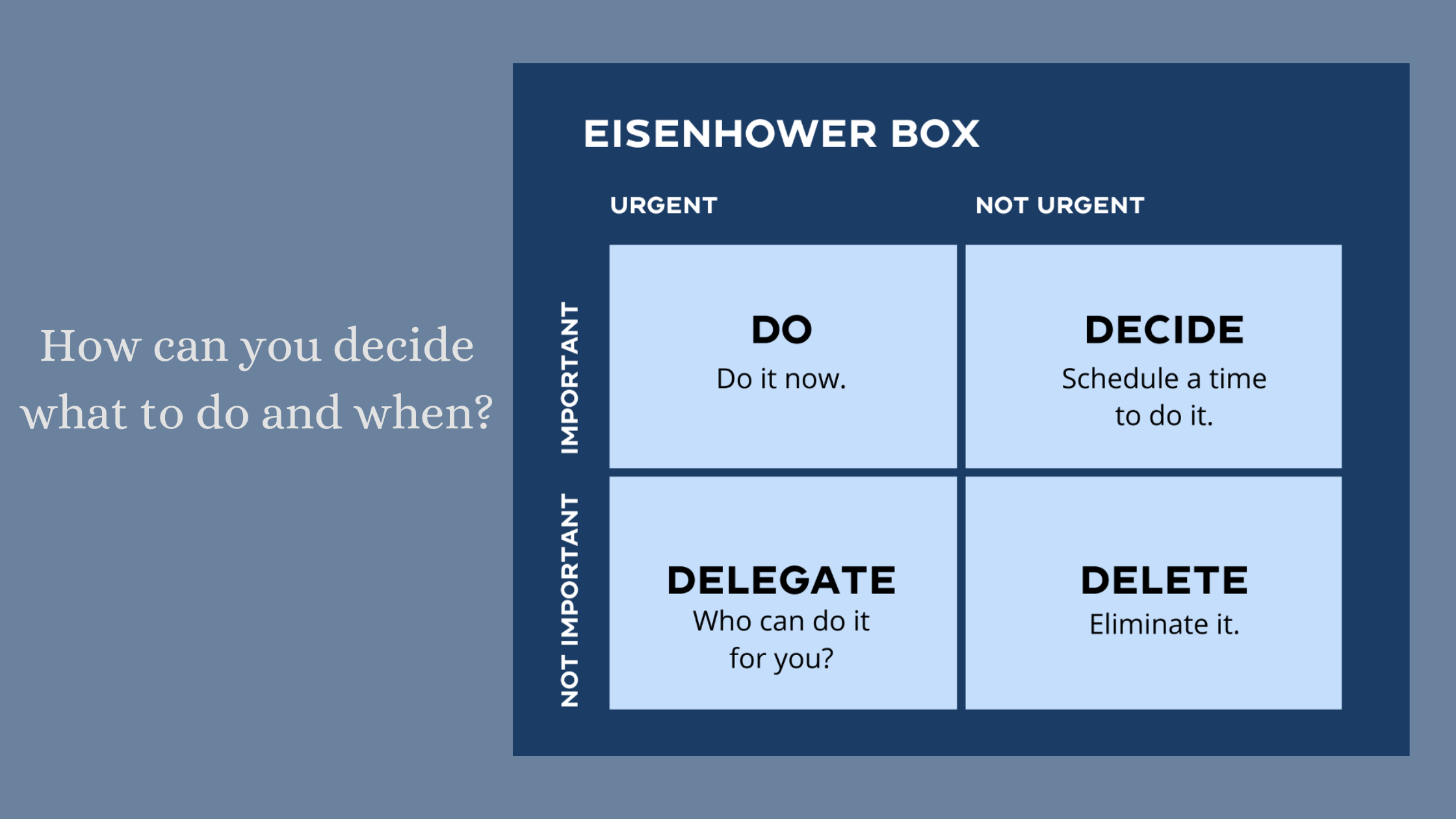
Another way to determine what to do first and what to next is to use the Eisenhower Box or Eisenhower Matrix, named for US President Dwight Eisenhower. It’s an excellent guide for helping you making the decisions on what to do first, next, and so on.

James Clear, author of the bestselling book Atomic Habits, explains how to use this  in How to be More Productive and Eliminate Time Wasting Activities by Using the “Eisenhower Box.”  To construct the Box, you work with two categories, Urgent and Important and their flips, Not Urgent and Not Important which give you a matrix with four boxes. Clear gives the following explanation to help differentiate between the two, “Urgent tasks are things that you feel like you need to react to: emails, phone calls, texts, news stories. Meanwhile, in the words of Brett McKay, ‘Important tasks are things that contribute to our long-term mission, values, and goals.’”  You can easily redefine Urgent for your work environment with school-related tasks – student disruption, fire drill, call from the principal.

The Box is pictured above. If something is Urgent and Important – DO it. It’s a priority. If something is Important, but not Urgent, you can schedule when it will be done. If it is Urgent and Not Important, look for ways you can delegate this – it’s not the best use of your time. And if it’s Not Urgent and Not Important… don’t do it. Cross that off and move on to the things in the other boxes.

What is important about the Eisenhower Box is that it has you identifying the difference between what is urgent and what is important. Eisenhower said, “What is important is seldom urgent and what is urgent is seldom important.” But it is wise to know when it’s both and when it isn’t.

Life being what it is, this matrix doesn’t always work. Sometimes, you cannot delegate something, and because it is Urgent, you need to do it anyway- sooner rather than later. Which may mess up the scheduling you’ve done for the things that were Important but Not Urgent. Fortunately, this won’t be an everyday occurrence and you can return to the matrix when it’s time to plan again.

If this thought process works for you, consider adding the Eisenhower Box to your time management skill set. When you consciously decide what to do and when to do it, you feel more organized and have a sense of accomplishment. I also, am aware of what time of day is best for me to do certain tasks and what small and not very important things can be dealt with when I have short periods of time available. Look for those things in your schedule and hopefully soon you’ll be spending your time on your priorities and crossing things off your to-do list.

Perfect or Good Enough

When my daughter was in high school, I told her, “Good enough is not good enough.”  I was wrong. One reason for our stress and exhaustion is our need to get everything done perfectly. That’s not an option. We have too much to do, and we need to be honest about the importance of our tasks. From making the bed in the morning to leaving the library looking neat, we often treat everything we do equally, but that’s not a good use of our limited time. The result can be that important jobs do not get the detailed attention they need, and we are worn out.

Time management requires more than a to-do list. It means looking at what we do with an eye toward the return we get from our investment of time. In The Costs of Being a Perfectionist Manager, Anna Carmella G. Ocampo, Jun Gu, and Mariano Heyden discuss how to use perfectionist strengths without wearing yourself out trying to get everything done perfectly. They warn that perfectionism frequently leads to dissatisfaction because even when a job is well done, it still may still not meet your standards. It becomes a matter of balance and priorities.

In addition to describing several different types of perfectionists, the trio recommends the following approaches when faced with your own perfectionism:

Design the Right Goals – Ultimately, your goals should be tied to your Mission and Vison, however, as they say, your goals need to be “attainable yet challenging.” Interim goals that inch you towards your larger one will give you the best results. You learn what works and what doesn’t, and you don’t beat yourself up for not seeing your whole Mission in operation or achieving your Vision. You enjoy the process.

Recognize Failure as Part of the Process This can’t be stated often enough. We teach students that failure is learning, then don’t apply the concept to ourselves. We won’t get it right the first time. The learning is as important as the goal. If we don’t accept this, then fear of failure will keep us from taking risks, and risk-taking is an important leadership quality.

Cultivating Mindfulness – How you think is how you feel. Meditation is what the trio recommend. This could be traditional meditation, but anything that gets you away from your desk and immediate demands on your attention can be beneficial (long time readers of this blog know that I’m a walker). Look for times in your day when you can take a break, listen to your own thoughts (or music, or a podcast) so that you come back recharged.

Using Pep Talks – We are well-aware that we speak a lot of critical things to ourselves, things we’d never say to others. Perfectionist tendencies can make these thoughts batter us too often. Ocampo, Gu, and Heyden recommend finding calming and positive mantras to help banish these thoughts. I use this technique and remind myself of past struggles and ultimate successes. Again, what you think is how you feel.

Fostering Positive Interpersonal Relationships – Although every conversation is an opportunity, you don’t have to have an end goal in mind for each one. We know how important relationships are to the success of the library program, and building them begins with casual interactions. The authors point to how good we feel when we help someone. Doing so is a natural part of being a librarian. And not all help needs to be tied to library use. It’s about being an empathetic, caring person.

Managing Emotions – This is part of SEL and is vital for us all. Perfectionism leads to stress which tends to make us irritable and unpleasant to be with. The above techniques can help reduce that as will reframing. Every cloud has a silver lining. Find it and use it to calm yourself. This may also be a good time for a walk or reading some funny memes. Do whatever you need to restore your mental balance.

How many tasks do you have that don’t need to be done perfectly? Look to your priorities, give them the time they deserve, and then let the other things go. Sometimes, and again with apologies to my daughter, good enough is good enough.