A Better Balancing Act

The feelings of overwhelm, exhaustion and burnout are on the rise. Between our work, our world, and our families, we are frequently unsure how to manage all we are responsible for. Then we’re told to take time for ourselves, because if we don’t, we run the risk of things getting worse. Sounds like more stress.

Unfortunately, most of the advice out there is generic. Do this, eat that, stop saying yes. But the truth is we are unique. Our lives are different from the ones we see and read about. Our needs are different. What works for one person, doesn’t work for another. What is true is that we require balance so that the stressors in our lives don’t suck out all the joy.

So how do we find and succeed at our personal balancing act? Fortunately, Sandeep Gupta explains how to go about the process in his blog post, Work-Life Balance: A Myth or Reality? He starts with the following 4 myths referenced in the title of his blog:

  1. Work is pain, and personal life is pleasure – While it’s true that most of us have to work, it isn’t true that work is always pain. If family life is currently stressful, it could be that your personal life is not always pleasure. Which is true for you? Is it always the case? Hopefully we enjoy our jobs – most of the time. We love our family and friends. Most of the time. What is the best balance for you, personally? How much work and how much personal time are the right balance for you?
  2. Work and personal life are separate – We categorize it that way when we think about balance, but the two overlap often. You take work home. You don’t forget personal issues when we are at work. I used to tell my staff to let me know if they were under stress from home so we could adjust their day. As Gupta notes, when you have a bad day at one, you bring it into the other. What we need, he says, is not a “work-life balance” but a “balanced life.”
  3. Time is the only constraint – Gupta says we think having more time would allow us to have a work-life balance. But it’s not about the hours and minutes, it’s the quality of the time and what we choose to do with it. Having the time to enjoy dinner or play with our children is more enjoyable than just making it home at a specified hour while still thinking about a task at work.
  4. One Correct Solution – Just as there is no one-size-fits-all when it comes to having a balanced life, there is not one solution that will always continue to work. What you need today may not be what you need next year. It’s important to be reflective about how you feel and make changes as necessary when necessary.

So, how do you go about it finding your balance? Gupta recommends considering these questions.

  • What needs to happen to make life more fulfilling? 
  • How can life be more balanced and fulfilling?
  • Who do I need to become to lead a fulfilled life?

To answer the first question, ask yourself: what are your priorities? What things can you do to make more time for them? What unnecessary things are you doing which can be delegated or eliminated? Take time to notice when and if these might change.

For the second question, identify your passions – both at work and in your personal life. Ensure that you make a place for them. The usual advice about making time for physical activity is true here as well. It energizes you and promotes a positive mindset.

The third question requires you to include time to reflect on your life. Are you feeling fulfilled? Do you need to revise what you are doing? Remember, there is no one correct solution and today’s solution may not work in a year. Life brings change at home and at work. Accept it, be ready for it, and make any needed adjustments.

Burnout is a real thing. It comes when over a period of time, what we expect or think we can do doesn’t align with the truth. We can burnout because of both work and personal stressors. It may not seem like you have the time to look at this, but the truth is, you can’t afford to ignore it. Ask yourself these questions (maybe you do it one your commute). Listen to the answers you receive, and then do what you can to act on them.
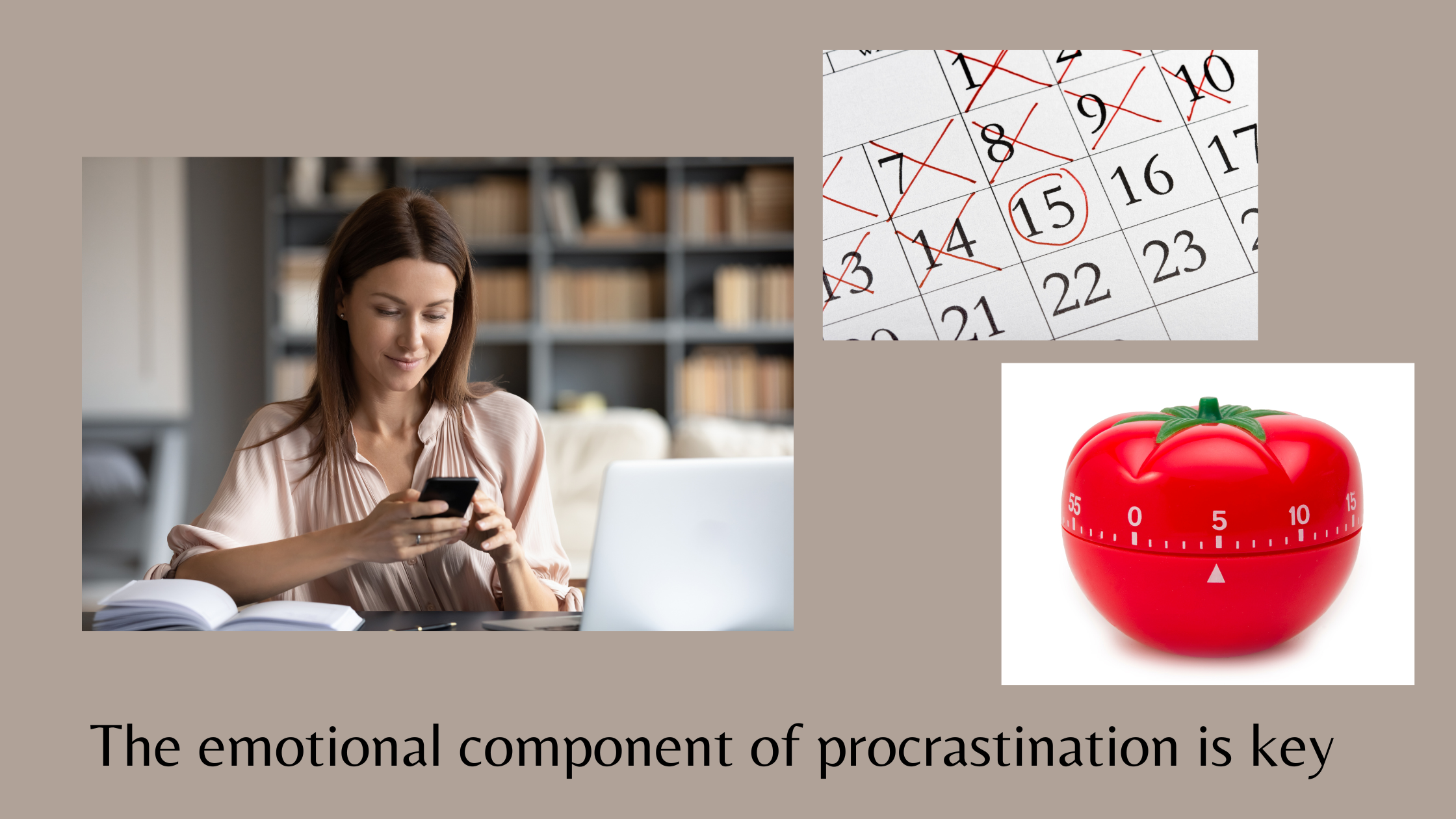
The Emotional Pull of Procrastination

A few weeks ago, I wrote about how regardless of how busy we are, we still sometimes choose to procrastinate and do the tasks that aren’t the most important. But it’s hard to make a change if we don’t know what’s behind it. Not surprisingly, the root is emotional. No matter how well we plan, emotion tends to win over logic.

Whether you procrastinate by eating, doing non-essential tasks, or playing some online game, it’s our emotions that are responsible. Unfortunately, knowing that emotions are the root cause doesn’t mean you can simply stop procrastinating. Kathleen Davies offers some techniques for getting control of our self-sabotaging emotions in her blog post, Why We Procrastinate—And How to Stop,   She notes that procrastination is an emotion-management problem so that is what needs to be managed.

To begin to understand where your emotions are pulling you off track, start by listing everything that needs to get done (or as much as you can) and note which of these tasks are causing you stress or other negative emotions. Then pick one of those to complete along with an easier one. Once you do these, you’re likely to feel successful enough to tackle the bigger ones.

This list will also help keep you from something Davies calls procrastiworking. This is when we spend time doing the things that make us feel busy, but don’t really help our to-do list. It’s when we clean up our desks or go through our endless emails. We tell ourselves it’s work so we are getting things accomplished. It’s not the thing that we needed to get done but we still do it.

If specific action steps will help you to change your choices, Davies has four tips for beating procrastination:

  • Increase the room temperature – Research has shown that higher temperatures increase your focus.
  • Sunlight– Working where you get natural sunlight has also been shown to increase productivity.
  • Exercise during the workday – Doing it even for a short time improves memory and reduces stress while clearing your head and helping your focus more.
  • Setting a timer – Give yourself a block of time, perhaps 20 minutes, to work and allow yourself to take a break at the end.

To make a shift away from procrastiworking, first recognize that you are doing it. Next, go back to your to-do list. Identify the priorities and what steps you can take to deal with them. At the end of the day, assess how you did. To prevent it happening in the future – plan. Know how often you do it, learn to recognize it, and decide what you will do when it occurs. And notice the emotions and stress that come up before and after you’ve completed the tasks. Hopefully positive emotions can guide your future choices.

It’s interesting to note that for some people, procrastination can be useful. If you are someone who works best under a deadline, then waiting until that deadline is looming – and the adrenaline that accompanies this– can help you to be more efficient and effective. When you reach the point that you can’t put it off until tomorrow, you can’t get distracted. You have to stay focused. This doesn’t work for everyone, but if it does for you, then go for it!

But in addition to learning about where our emotions are causing us to veer off course, Davies also writes about the importance of stepping away from the task that is causing our stress.  She says, “Sometimes you just need to take a break. Go for a walk, talk with a friend, or do something that isn’t work. It’s not always worth just powering through.”

So, if reading this blog was procrastiworking for you (“But Hilda writes about libraries, so it’s work, right?”) then get back to your list. If one of the tools mentioned seems like it would support your success, go for it. Here’s to learning how to best use our time for our success.

Are You Procrastinating Too Much?

Procrastinating means to put off doing something. The definition doesn’t include the words “something important,” but that’s usually when we think of it. Because often when we’re putting off something – the bills, returning a call, setting up a meeting with our principal – we’re getting lots of other things done. Just not the one that banging around in our heads, the one we can’t stop thinking about that we know needs to get done.

There is no doubt about it. That list of check marks on the unimportant tasks probably means we’re avoiding the priority or the most impactful action. Why do we do that to ourselves? And how can we stop doing it? Greg Vanourek tackles the problem in How to Stop Avoiding Things: 17 Practices:

  1. Start by noticing your avoidance practices – Awareness is always the first step in being able to deal with a problem. What are you go-to tasks that alert you to the fact that you’re avoid something bigger. (Email? Facebook?)
  2. Seek the root cause of your avoidance behavior – It may be feeling uncertain about how to handle the specific task. It could be something frightening such as dealing with a book challenge and/or preparing for a board meeting where your book selection practices are being questioned. Knowing what’s behind your choices can help you make a change.
  3. Process your emotions – Recognize the emotions. Allow yourself to feel and express them. Vanourek suggests journaling or exercising. Both of these can change your physiological state and put you in a better mindset.
  4. Divide the problem you’re avoiding into smaller, more manageable chunksIt’s the old adage about how to eat an elephant. And as you complete each chunk, you feel successful and ready to tackle the next chunk. Momentum helps you keep going.
  5. Start with an easy task or small encounter to get momentum – This works like chunking and gives you a way to get into action – sometimes the hardest part.
  6. Look for ways to boost your motivation for a better resultKeep track of what you are accomplishing. Consider a Success Journal or visible check list. Cheer your own progress.
  7. Reframe a situation to note the positives and refrain from focusing only on the negatives This may a very challenging project, which is why you were avoiding it in the first place. Keep your focus on the positive results you’re aiming for. If it’s something you are uncertain about handling, consider this a step in your learning. For a book challenge issue, see yourself joining those who stand up for our core values and beliefs as a librarian.
  8. Quiet your negative self-talk – Not easy, but reframing will help. Vanourek suggests being compassionate with yourself, “we are all works in progress.” Know that mistakes are a part of the process, not a reason to stop.
  9. Practice your communication skillsBe ready to talk about the benefits and challenges of what you’re doing by always keeping your communication skills strong. Then you can confidently as you express yourself and when asking for help when needed.
  10. Set a deadline for taking action “By when’s” are vital to starting and continuing. “I’ll have this step done before Wednesday/noon/break.” It also gives you goals and milestone to reach.
  11. Build action habitsThe more you see yourself doing – and as being a doer – the easier it will be to continue. Momentum is your friend.
  12. Recognize that addressing something you’ve been avoiding can make you feel powerful – Instead of carrying around the heaviness of your thoughts as you think about this project and the fact that it’s still not done, taking even that first step will be empowering. You’ll inspire yourself to take the next.
  13. Work on your problem-solving skillsVanourek suggests exploring creative ways of dealing with problems even before you get to a project that you want to avoid. Knowing you are good at problem-solving will help you spend less time procrastinating.
  14. Develop your tolerance and flexibilityRigid ways of thinking rarely help us out of difficult situations and challenging emotions. Be open to the process and recognize some problems are beyond your ability. Look for ways to get help – such as your PLN.
  15. Work on improving your coping skills and strategies – Some suggested questions to ask yourself: “How might I address this? What would my best self do in this situation?
  16. Resist your urge to avoid when it appears Now that you recognize your avoidance behaviors, you are better equipped to deal with them. Get into action as soon as possible. The longer you wait, the harder it is to get going.
  17. Get support – You don’t have to do everything on your own. Look to see who handles this better than you and ask for help. Mentors can be useful in this.

This is a long list – and a long post. If any of these points hit you, then make a change. And if you’re reading this instead of tackling that responsibility you’ve been avoiding? It’s time to get to work.

The Sound – and Benefit – of Silence

We live in a noisy world. Throughout our waking hours, noise, information, background sounds and beeps, dings, and other signals of incoming messages on our phones, tablets, and computers assault our brains. We’ve become so accustomed to it that we don’t realize the toll it’s taking on our mind and body. Schools are out, or nearly so, across the country. We need to take a break from all the noise and luxuriate in silence, at least for a little while. Silence allows us to recuperate, reflect, and rejuvenate.

Justin Zorn and Leigh Marz offer insight into the issue in this article, and their new book, Golden: The Power of Silence in a World of Noise. Using five key insights, they move us through recognizing the scope of the problem to finding a solution that fits us as individuals.

  1. Silence isn’t just the absence of noise–The statement made me pause—and in essence that is what true silence is. It’s the full stop that has us being solely in the moment. Zorn and Marz say it is, “the experience of pristine attention, the space where no person or thing is making claims on our consciousness.” Can you recall a moment of such silence? Frequently, the moment was provided by the natural world. It could also come from reading a perfect sentence that stops you from going on. Sometimes, it’s a deeply spiritual moment. Whatever it is, the world comes to a halt, giving us a gift that’s important to recognize and cherish.
  2. The world is noisier than ever—in our ears, on our screens, and in our heads. Just as many of us lose a lot of time to being stuck in traffic, so to do we lose time figuring out what we were up to before phone call or other noise interrupted us. According to the book “Researchers have found that most people switch between different online content every 19 seconds, and the average person spends one full hour per day working to get back on track after interruptions from phones or social media.” In addition, the mental conversations we have–frequently negative self-talk–are another distraction. All of this noise makes it harder for us to stay focus and take time for what we most want to be doing.
  3. Noise is our society’s most celebrated addiction. We measure and celebrate progress based on what is being produced. Silence adds nothing to that measurement. We have forgotten we are human beings. We are all about being human doings. These moments of pristine attention are not valued. If not valued, we move to the assumption that we shouldn’t waste time with it. And in so doing, we have missed the true value attention and silence bring to our well-being.
  4. To get beyond noise, look beyond the typical rules and tools of mindfulness. We have all been advised and even trained in bringing mindfulness into our lives. While mindfulness has brought improvements into our lives, most of us find we are not managing it well enough. Instead, even knowing that mindfulness helps, we’re more distracted than ever. While there is no one size fits all solution, Zorn and Marz offer this recommendation –“notice noise, then tune in to silence.” Be aware of those great moments of pristine attention. What grabs you is different from what does it for others. Enjoy what moves you.
  5. The simple act of listening to silence can regenerate our brains. The duo quote Pythagoras, “Let your quiet mind listen and absorb the silence.” According to Duke Medical University researchers, listening to the silence promotes neuron development. How wonderful to discover that silence is productive.

Get out in nature, Contemplate art. Sit with your coffee and your thoughts. Learn where your moments of silence occur and seek them out. Silence is truly golden.