The Journey to Wisdom

The Cambridge English Dictionary defines Wisdom as: the ability to use your knowledge and experience to make moral decisions and judgments.” The key here is that wisdom doesn’t come overnight. It is important for us to remember that and embrace the journey.

This message is embedded in our fairy and folk tales. As Jonny Thomson explains in “The 3 colors: What folktales teach about how to grow wise, wisdom as the result of going through three phases. As school librarians we are familiar with the tales, but perhaps we didn’t see the importance of them. Thomson points out how well-known stories show a journey to wisdom through The Red, The Black, and The White. As always in sharing his perceptions, I will add my comments on how they pertain to our daily world.

The Red — Tomson says, “The Red is ambition. It’s life force, ego, desire, and the courage to go beyond the comfortable.” This is what powers us. We enter the profession full of energy, determined to put the library in a central position in the school community. To be successful, we read widely and enthusiastically bring new tech, the best books, and the best new ideas to our library. Because of our enthusiasm, we step out of our comfort zone to speaking up and out for the library. We include helpful information on our website with a section for parents. We are members of our state and national associations and maybe run for office and/or serve on committees. We are visible in the outside community. All are strong positives. It takes an enormous amount of time and effort, but we do it.

And then comes…

The Black – The Black is failure. When our great ideas and plans crash and burn. Thomson says, “It’s when a relationship hits a wall, a career hollows you out, or a depression greys the hues of the world.” There are so many of us living in The Black, particularly with all the politics surrounding library programs. While we tell our students the acronym for FAIL is “First Attempt In Learning,” we can forget that this also pertains to us, particularly late in our career. Even folktales teach us to expect it. It is a life lesson we need to accept is as true for ourselves as it is for our students.

Because without The Black, we cannot get to…

The White – Congratulations! You have reached final stage, The White (and probably have the white hair to prove it.) Thomson quotes from a book by Martin Shaw (The Liturgies of the World) “The White is that precious ground of eldership, of carrying the ability to bless, to raise up others, to encourage.” (Think Gandalf, for my Lord of the Rings fans). You are mentoring new librarians. Some of you, like me, maybe teaching pre-service school librarians. You’re finding ways to give back and guarantee the future. When new initiatives comes down from on high, you don’t panic. You may think, “Here we go again,” but you know how to handle it. You have done it before.

Thinking of these stages, as yourself: Where are you on your journey? And what does this stage need? If you are in The Red many will be benefitting from your energy. If you are in The Black your PLN, Professional Learning Network is there to support you. And if you are in The White, we are so glad to have you. Always remember the resources and encouragement that is there for you wherever you might be.

ON LIBRARIES: PLN’s and Advocacy during COVID-19

We are approaching two weeks into most of the school closures with the likelihood of at least another month.  From the first, librarians have been doing what we do best, getting information for ourselves and then out to our communities.  Many of you quickly tapped into your PLNs and began asking for and exchanging information, but this influx of resources has created an information overload that is adding to already existing stress. What can we do to meet the needs of our teachers and students without becoming more overwhelmed?

A good place to start, if you haven’t done so already, is to make a list of your priorities. Stop and think:

  • Are you doing any teaching? If so, you need resources for that.
  • What types of help do your teachers need? How can you be a resource?
  • Are your providing parent support?
  • How are you communicating with your administration and beyond?

In a Google doc, or whatever format you prefer, keep separate files/folders for the different topics. Go for quality rather than quantity. Even before this crisis, teachers frequently ignored what you showed them if you offered too much information. Now they are more overwhelmed. Keep things focused and brief. Add (and delete) to your lists as necessary.

Besides what you create for teachers, keep a separate file with the highlights of what you are doing. Every so often, send this to your administrator, website, and consider posting to the appropriate places on social media. This can be an important opportunity for advocacy.

Advocacy is about building partnerships with others who support you since you helped them. By showing your contribution, others will recognize that the library program is invaluable to the school system, even with the students can’t go to the library. You are the lifeline teachers and students need.  Parents and administrators need to see this as well.

And don’t forget to make time for yourself. I saw one meme showing a librarian working on her computer and saying, “I have this feeling that if I just curate everything, I can stop the virus.” While we are working hard to serve, we cannot forget the rule about taking care of ourselves first so we can do our best.

To practice what I preach, I am keeping this blog shorter than usual.  Less for you to read and me to write.  And since I have been sitting for an hour, and it’s too rainy for me to go out, I am going to walk 250 steps in my house.

Stay healthy and stay connected.

How Large is Your PLN?

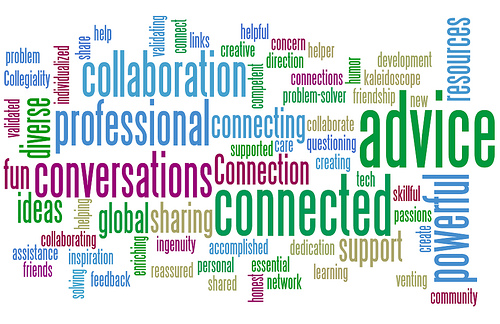
pln wordleYour PLN.

This acronym has two versions and both are important.  PLN can be either a Professional Learning Network or a Personal Learning Network. While it may seem to have arisen along with social networks, the concept has been in use long before the Internet, although the term didn’t exist.

Connecting with colleagues to seek their advice or help on a professional issue has always existed. At first it was within an office or school.  I can remember reaching out to a school librarian when I was planning to automate my library in 1993.  The telephone was my link.  I had already begun building a large Professional Learning Network by becoming an active member first in my state’s school library association and soon after in AASL.

Social networks have made extended these connections. Numerous library associations have Facebook pages.  National and state organizations also have listservs, and, of course, there’s LM_NET which has been a vital listserv for many school librarians who know how to manage the large amount of email messages.  Have a problem? A question? Just put it out on one or more of these and advice and help from experience practitioners will soon help you resolve it.

Sometimes you aren’t looking for anything, but a post gives you an idea.  I was just on the NYLA/SSL Facebook page and there was an illustration of Barbara Stripling’s inquiry model.  I will be teaching a course in the fall which will discuss inquiry-based learning.  I asked the person who posted, if she would send it to me for this purpose. She did, and I will be using it with attribution to her and Barbara Stripling.pln types

Members of Google+ TL Chat share what they are doing with software and other resources you may not have heard of.  Just click on the post and find out more. If necessary, post a question.  Twitter and LinkedIn groups offer other sources of information to grow your PLN.

Personal Learning Networks are a mix.  The greatest number of people in my personal learning network are fellow librarians who are also my friends.  I know them well even if I only see many of them at conferences.  We are always available for each other.  They are my friends on Facebook so I am always keeping up with their lives—professional and personal.

In person and online, we can get involved in discussions about issues arising in the profession.  Occasionally this leads to developing a project together or creating a workshop or presentation for a conference.  We know each other well enough to make drawing on each other’s specific area of expertise a natural part of the collaboration.

The remainder of the people in my Personal Learning Network are non-librarian friends.  Recently, I became interested in yoga for people with limited mobility.  I am a good librarian and researcher.  I could have spent time investigating this on my own.  Instead, I reached out to a friend who has been attending yoga classes for years.  She loved exploring this.  Soon she was sending me information about programs on television and chair yoga classes at a local Y and through the local park service.

yogaBecause she had a yoga PLN, she was able to let me know which had good teachers and the pros and cons of each option.  She also sent me illustrated directions for doing chair yoga at home. I now have a number of options without expending much of my own time.

Knowledge and information keep expanding at a rapid pace. You can’t do it all by yourself. Remember this is a two-way street.  Often you are able to respond to someone else’s query.  You are continually getting and giving in our participatory culture. Being a school librarian today requires you to keep up with the constantly changing technology landscape. PLNs – both professional and personal, are the way you can do it without feeling lost.  How big is your PLN?  How are you going to make it bigger?