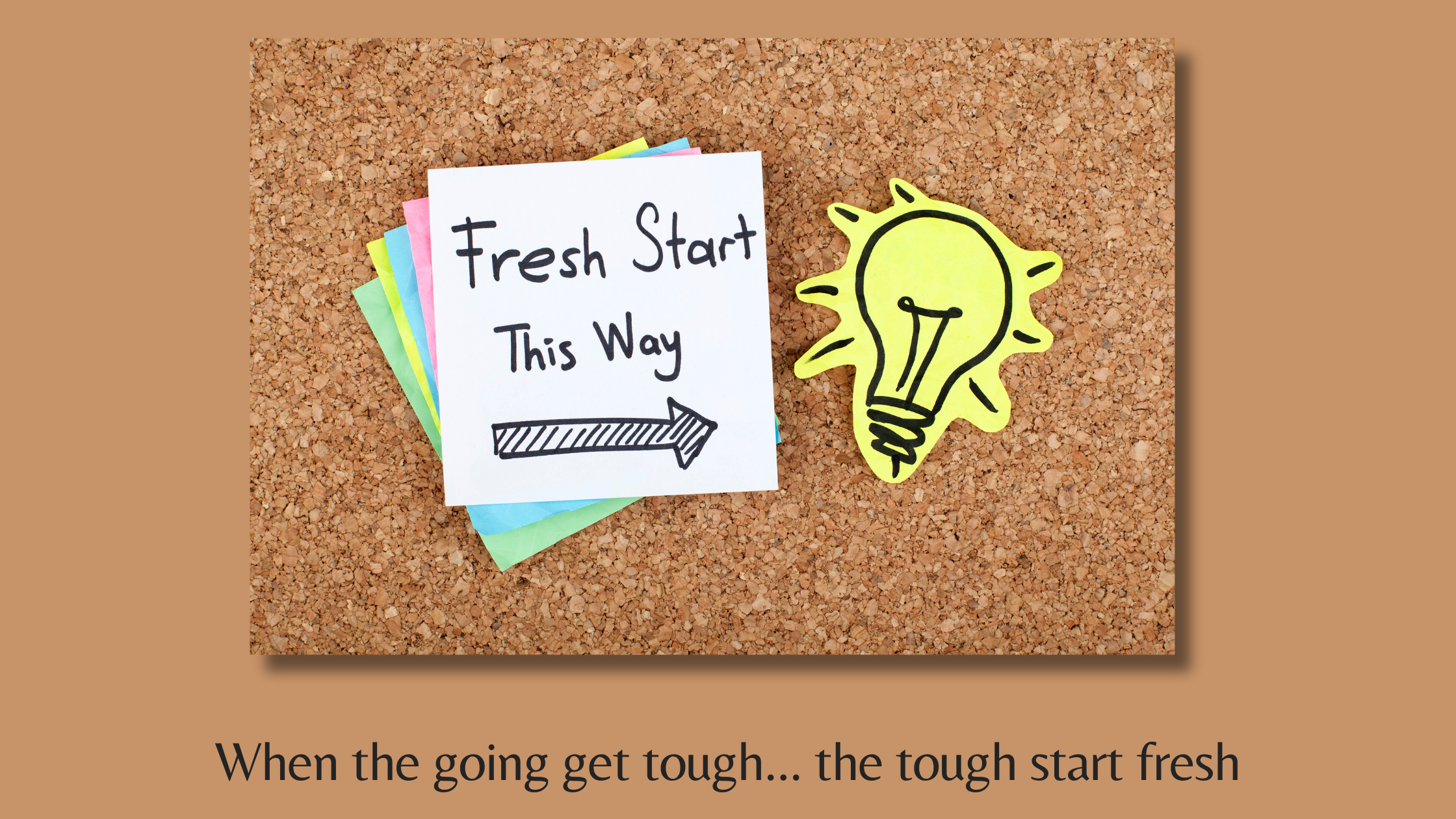
Is It Already Time for a New Beginning?

Has the school year already lost that new beginning luster with all the old and new challenges you are facing? There is so much going on in our lives as we pivot from vacation mode to work mode. Chances are you plunged right in without much thought especially since you know your job. But that means that even though the year is only a few weeks old, maybe you could already use a new beginning.

What would that mean? Probably a combination of things – looking at what can be started, what can be made new, what’s getting in your way, and how to get past those roadblocks. To help you get your motivation back, I recommend looking at the recommendations of Palena R. Neale Ph.D., PCC in her Psychology Today article, Harnessing the Fresh Start Effect : 6 steps to set you up for success with the fresh start effect. Neale notes that giving yourself a fresh start moves you away from any failures you perceive. This can help turn off those negative voices in your head that creep in with the “new” wears off.

Here are her steps and my usual comments on how it works for us in the education world:

1. Create Your Own Fresh Starts  – The first thing to consider is what would a fresh start include. Think about what would you like to accomplish. Do you have a goal or a plan you thought you put into action when the school year began and then it got lost in all the opening activities? Knowing what you hope to achieve can give you some focus.

2. Choose Your Peak Momentum – Now choose the day you want to begin your fresh start. Monday is usually a favorite time, but any day that works for you and your schedule is fine. New month, day after a long weekend. Nothing is off-limits. Accept and use what works best for you. Then, the night before, go through the focus you created in step one.

3. Connect to Your “Why” – What is your Vision for the library? Even though by definition it is not achievable, you are always working to bring it closer to reality. This is where your Mission comes in, what I call your “Perspiration” and “Motivation.” It defines how you operate through the day, how you deal with students, how you work with teachers, and how you communicate with your principal. Why do you want to accomplish what you focused on in step one.

4. Keep It Simple – There are likely to be lots of things you want to change, but it’s better if you focus on one or maybe two goals. Create a strategic plan. It doesn’t need to be complicated. You’ve got your Vision and Mission. Do an Environmental Scan. Do a SOAR analysis by identifying your Strengths, Opportunities, Aspirations, and Results. The first two are what currently exists. The second two are where you want to go. What Action Steps will get you started? Who will be involved? Remember to get approval where you need them. What costs are involved? What’s the timeline knowing it’s bound to need tweaking. Knowing where to start is the key to starting.

5. Change Your Environment – No, you don’t move outside the library. You need to remove the things that make you lose your focus. Clear clutter from your desk. Perhaps plan to save looking at emails until the end of the day or at lunch if you worry you may miss something important. Get things filed or tossed. Bring in something you love to look at. Frame your Vision Statement.

6. Sustain Success – Implementing a plan is important. Sustaining it is vital. Check in with your goal the steps you thought would get you there to see your progress. For my own strategic planning, I use “telescoping”, “microscoping,” and “periscoping”. At the beginning you telescope to see what the end results will look like. Before you get overwhelmed by the thought, microscope by focusing on what needs to be done now. Periscoping involves popping up now and then to check on what comes next. This ensures you won’t miss a deadline or key step.

As the well-known philosopher, Yogi Berra, said, “If you don’t know where you are going, you will end up someplace else.” Create your new beginning and get to where you want to go.


Get Your Motivation Back

REPOST FROM JULY 4, 2022

Finally, it’s summer break. Time to recover and rejuvenate. And to get your motivation back. You need the time to recover, but summer will slip away before you know it. First, take the time to relax, and then set a date to get yourself ready for the fall so you can bring your passion back to your job.

Need some ideas to spark your motivation? Eric Barker gives some great advice in his article How to Stop Being Lazy and Get More Done – 5 Expert Secrets. While being stressed and exhausted is more our issue than being lazy, his tips will work to help us get on track for a successful school year. Here are his 5 with my usual comments:

  1. Define Goals Properly – Barker recommends four steps to get clear on your goals.

Frame goals as an “end” not a means –By identifying what we want to get, we don’t focus on the boring, “don’t feel like it” steps. We want our goals to excite us, not feel like an added burden.

Keep goals abstract – Rather than focusing on the “How” something is going to get done (more inline with SMART goals), think about your “Why” as you write them.

Set “approach” goals, not “avoidance goals – Keep it positive. Don’t focus on the negatives, such as not doing something. Be aware of the outcome you’re working towards. Bonus points for being clear about how this aligns with your Mission and Vision.

Make goals intrinsic, not extrinsic – Don’t make this about what you think you should be doing. What is it you want to be doing? What excites your passion? Creating a goal from this adds to your ongoing motivation.

2. Set a Target – This is where you can be specific. By when will you start? When do you want to finish? What are some of your target numbers – students reached, modules completed, teacher collaborations. Be clear on the steps you wish to accomplish. And as an additional recommendation, make the steps small so you get lots of wins along the way. The goal and a target together support your motivation.

3. Monitor Your Progress – Keep track of all the targets you achieve. It spurs you on. This is why I keep a Success Journal next to my computer. You can create a spreadsheet, keep a log, reward yourself. Whatever works, so you see the steps you’re taking.

4. Beware the Long Middle – Life is a marathon and so are goals for the school year. As the days go by, it can get harder to keep pushing through, and this is where you can lose that motivation. Every so often, pause and note how much you have accomplished. Barker recommends you “shorten the middle.” If you’ve been tracking progress monthly, switch to weekly. If weekly, switch to daily. The extra boost will help. When you are past the midpoint, look ahead and note how close you are to your goal.

5. Think about Your Future Self – This is an important shift that allows you to look at the bigger picture. Baker writes that thinking about our future results allows us to make better choices in the present. Reflect on the difference between how you’ll feel about yourself if you keep putting off the hard work rather than going for something you are passionate about.

Wherever you are on your summer break, this is a short reminder that you can have fun and still be productive. And when the school year does begin again, these five tips can keep you going. Recovery is important. But set a date to get motivated for fall. Put it on your calendar. Set an alarm. The important thing is get started.

Put Purpose in Your Journey

Famous American baseball coach Yogi Berra once said, “If you don’t know where you are going, you are going to wind up someplace else.” It sounds funny at first, but there is truth. First, you need to know where you want to go if you have any hope of getting there. Some people like the “Dream it and do it” concept, but dreaming has an amorphous quality makes clear action tougher. In addition – what if your dreams have nothing to do with working?

So what can help us reach our goals? In my experience, clarity of purpose is the best guide for where you want to go and what you need to do to get there. I once clarified and wrote my purpose which is: “I reflect back to others the greatness I see in them, and, where appropriate, I help them manifest it.”  I want to support more people (specifically librarians) being the leaders they can and need to be. As for the doing, I put this purpose into action in my blog topics, in the amount of curation I do on leadership, and is intrinsic to the books I write.

My view on purpose is echoed in LaRay Quy’s blog article, 4 Reasons Why “Follow Your Dreams” Is Terrible Career Advice. As she notes, following your dreams is more likely to lead to you to spending your life searching for happiness and jumping from one career path to another as your dreams change. In real life, happiness is something you find at the end of a rainbow. It comes from within as you reach the goals you set for yourself.

Here are Quy’s four reasons:

  1. Follow dreams, passion or purpose – Quy observes it is easy to see these three approaches as being the same, but they are different. Dreams are fairy tales and tend to be either lofty or intangible. Passion, Quy notes, is about you. It’s about what you care about. Last week I blogged about passion, speaking to the librarians who lost theirs and were looking to quit. We should have passion for our purpose. But purpose takes the step forward. According to Quy, purpose is about what you can contribute to the world. She recommends you identify what drives you, who you want to help.
  2. Dreams grow and change – Your dreams as a child are far different from the ones you have now. Their frequent change makes them unsuitable for planning and offer little guidance on how you want to live your life. Quy doesn’t ask you to give up your dreams, but rather ask yourself which ones can help as you work toward achieving your career path. The dream in this case supports your purpose.
  3. Find your worth – Reflect on what you do as a school librarian. How does it help and improve the lives of your students? Your teachers? Your administrator? Consider what you bring to the whole community. Embrace the value of it. You may be disenchanted because others do not see that value. Here is where your purpose — or Mission Statement which is your purpose—comes in. Look for ways, get suggestions from your PLN, and make your presence and value known.
  4. Differentiate between dreams and reality – Quy notes that many of our dreams are impractical and would impose an unrealistic financial burden on our lives. Some have nothing to do with our professional lives. Where you can use your dreams, at least the ones for your library program, is to incorporate them into your Vision Statement. My frequent maxim is that your Mission is your perspiration, your “why,” and your Vision is your inspiration and your aspiration.

Dreams. Passion. Purpose. You need all three. Your Dreams will lend greatness and excitement to your planning. Your Passion will be at the root of what you do. And your Purpose will be the stalwart guide for achieving it. Embrace all three, and your leadership will shine through.

Get Your Motivation Back

Finally, it’s summer break. Time to recover and rejuvenate. And to get your motivation back. You need the time to recover, but summer will slip away before you know it. First, take the time to relax, and then set a date to get yourself ready for the fall so you can bring your passion back to your job.

Need some ideas to spark your motivation? Eric Barker gives some great advice in his article How to Stop Being Lazy and Get More Done – 5 Expert Secrets. While being stressed and exhausted is more our issue than being lazy, his tips will work to help us get on track for a successful school year. Here are his 5 with my usual comments:

  1. Define Goals Properly – Barker recommends four steps to get clear on your goals.

Frame goals as an “end” not a means –By identifying what we want to get, we don’t focus on the boring, “don’t feel like it” steps. We want our goals to excite us, not feel like an added burden.

Keep goals abstract – Rather than focusing on the “How” something is going to get done (more inline with SMART goals), think about your “Why” as you write them.

Set “approach” goals, not “avoidance goals – Keep it positive. Don’t focus on the negatives, such as not doing something. Be aware of the outcome you’re working towards. Bonus points for being clear about how this aligns with your Mission and Vision.

Make goals intrinsic, not extrinsic – Don’t make this about what you think you should be doing. What is it you want to be doing? What excites your passion? Creating a goal from this adds to your ongoing motivation.

2. Set a Target – This is where you can be specific. By when will you start? When do you want to finish? What are some of your target numbers – students reached, modules completed, teacher collaborations. Be clear on the steps you wish to accomplish. And as an additional recommendation, make the steps small so you get lots of wins along the way. The goal and a target together support your motivation.

3. Monitor Your Progress – Keep track of all the targets you achieve. It spurs you on. This is why I keep a Success Journal next to my computer. You can create a spreadsheet, keep a log, reward yourself. Whatever works, so you see the steps you’re taking.

4. Beware the Long Middle – Life is a marathon and so are goals for the school year. As the days go by, it can get harder to keep pushing through, and this is where you can lose that motivation. Every so often, pause and note how much you have accomplished. Barker recommends you “shorten the middle.” If you’ve been tracking progress monthly, switch to weekly. If weekly, switch to daily. The extra boost will help. When you are past the midpoint, look ahead and note how close you are to your goal.

5. Think about Your Future Self – This is an important shift that allows you to look at the bigger picture. Baker writes that thinking about our future results allows us to make better choices in the present. Reflect on the difference between how you’ll feel about yourself if you keep putting off the hard work rather than going for something you are passionate about.

Wherever you are on your summer break, this is a short reminder that you can have fun and still be productive. And when the school year does begin again, these five tips can keep you going. Recovery is important. But set a date to get motivated for fall. Put it on your calendar. Set an alarm. The important thing is get started.

ON LIBRARIES: Reversing the Energy Drain

Feeling drained and exhausted?  You are not alone. Even though you’re not commuting or doing as many before and after school activities, the things that energized you – including seeing the teachers and students – are missing. But while you can partially attribute the feeling to cabin fever, the major energy drain is due to fear and there’s no getting away from it.

Acknowledging the fear and knowing it’s going to be a part of our lives even after the virus is contained (and hopefully cured) is a good first step. But what else can we do to minimize the energy drain so we are at the best we can be now and going forward? In Maximizing Your Energy During COVID-19 Nicholas W. Eyrich, David Fessell and Gretchen Spreitzer offer three ways to accomplish it. (NOTE: There’s a survey at the end of this article which requires personal information at the end.) They recommend:

Identifying and using your signature strengths – Consider both your people and professional skills. How good are you at lifting the spirits of others? Often helping someone else feel better gives you an energy boost.

How much of a techie are you?  Working one-on-one with a teacher (online, of course) to demonstrate a resource will help you focus on doing something positive.  When they use it their teaching, they will invariably let you know. Another feel good experience that helps restore energy.

Those of you who are artistic or crafty can create something to share online. The act of creation, particularly when you tune into it is an energy boost. Bringing beauty to others adds to your pleasure and that too adds to your energy.

And since energy carries over, think about your strengths and joys outside of your job. Do you like cooking, baking, knitting, gardening or singing? Spend some time purposely doing those things. It’s okay to enjoy yourself.

Keeping your purpose ever-present – This is probably my theme song.  Your Mission – or purpose – is what keeps you on track.  It’s all about your Why.

Why did you become a librarian? What powers you when you are in your library?  What can you bring from that into your new environment?

What values are important to you?  Note where they are still present. Acknowledge yourself for when and how you further Mission and demonstrate your Why.

Lean into high-quality connections – As always, keep checking in to your PLNs.  You don’t only have to use them for advice on how to do something.  You can also open up and let them know you are feeling.  By sharing your fears and anxieties, not only do you release them (fear hates when you shine a light on it) but you may learn methods others have used for dealing with the same concern or your disclosure could help someone else feel stronger and in good company.

Recognize when you are feeling drained. Identify its cause.  Most of the time fear will be at the root.  Choose one of the three suggestions to help you restore your energy or let me know others that are working for you. Most of all, be kind to yourself no matter where your energy is. Accept that there will be days when you don’t accomplish much, and don’t expect to give maximum effort all the time.