From Adversity to Success

Life is tough, and nothing suggests that it’s going to be getting easier in the immediate future. Between personal and professional fears, being able to slog through the days is a real challenge. But you don’t want to drag your way through them. You want to shine and make your program seen for the value it brings to the entire school community.

If you can’t shake off the weight of stress, continuing the way you are will only lead to overwhelm and burnout. You need a plan. Dr. Christian Marcolli has one. In his article “Setting the Gold Standard: What CEOs Can Learn from an Olympic Champion” he outlines five steps to get you back on track for success. We need to “adapt to adversity” because we cannot avoid or outrun it. To do this, Marcolli recommends we:

  1. Rigorously manage your energy to build up a strong foundation for sustained high performance – You are not the energizer bunny. You can’t keep going at full speed. You need to develop your resiliency. Part of this can be done by setting and managing priorities. Be honest with yourself. What must be done? What must be done now?  Identify what can be dropped, deferred, or shared with someone.
  2.  Think through a robust strategy that will lead to success – Keep your goals front and center. Review your Mission and Vision. Develop a strategic plan complete with action steps, timeline, and assessments as you go along and at the completion. With a plan in motion your energy will be focused rather than diffused.
  3. Work on creating a winning mindset – Find ways to nurture your desire to live your Mission statement. This will allow you to tap into a positive mindset that will give you the boost you need, even when the results aren’t (yet) what you want. When things feel hard, remind yourself of past successes.
  4. Be ready to adapt to changes and setbacks – Fighting change, expected and unexpected, is a waste of energy. It happens. Know how you best bounce back. Leaders recognize setbacks happen but know how to create the path for going forward. Look to your strategic plan to take the next best step forward.
  5. Visualize success – This is a common technique for athletes. It’s not something we think to do. Think about the end result. Imagine yourself getting there – what will it look like? What will it feel like? Hold on to that feeling and do what it takes to live into it. If you’re a visual person, consider creating vision board. Or, if you prefer, make a list of the feelings you are hoping to have, the results you are looking forward to seeing. As an extra benefit, the process of constructing these and envisioning the end will lift you up and improve your mindset.

This quote from Barbara De Angelis serves as a good reminder, “We don’t develop courage by being happy every day. We develop it by surviving difficult times and challenging adversity.” Leaders always need courage. The path forward is continually filled with obstacles to overcome.

Tough times require tough leaders. With a clear plan and vision, no matter what else changes, you will get to your goal and enjoy a well-earned success.


It’s Wise to Have Many Whys

We talk about Mission Statements as our “Why.” Looking deeper, the Mission Statement is focused mailing on what you do. It is, as I say, your Perspiration. The underlying “Why” you do it is tied to your values, your life history, and other forces that have created the you who is in this current place.

Making a difference in the learning and school experience of your students is probably one of the “Whys” you have. Other “Whys” might have developed over time, such as promoting intellectual freedom.

Focusing on only one “why” has been the traditional approach. The thinking was you needed to bring your full attention to it in order to be successful. David Zimmerman has a different take on it in his blog article, Leaders, It’s OK To Have Multiple “Whys” where he discusses why more could be better and the power of multipotentiality. Zimmerman begins with these four reasons:

  1. Diverse Perspectives – Librarians, like everyone else, are not clean slates schooled only in librarianship. We have interests and often other careers which can bring greater scope to what we do. Are you crafty? How can that add to your program? It’s not just in making displays. Think of how it benefits a makerspace. Or perhaps you have a good way of bringing local business people into the library which showcases their talents and exposes students to the choices available after school ends.
  2. Adaptability – In a fast-moving world, our multiple interests make us more able to change, pivot, and go through any other gyrations needed to not only catch up but be ahead of the curve. It allows us to be willing to try the new, build on what works, and release what doesn’t. It also shows us the interconnectedness of our interests.
  3. Continuous Growth – A single focus can be limiting. Having multiple passions makes us more likely and able to be continuously growing, being motivated anew by what we discover. As librarians, we are and need to be role models for lifelong learning.
  4. Greater Impact – The assortment of interests and strengths we bring allows us to communicate more personally with a variety of stakeholders. We have more in common, more reasons for connection. When we communicate, we build the relationships that are so vital to carrying out our Mission – and make a difference in the lives of our communities.

Having multiple “Whys” is at the core of multipotentiality. People who embrace multipotentiality are “an adaptable, quick learners with a wide range of skills and creative pursuits, characterized by their curiosity, capacity to learn quickly, and ability to synthesize disparate ideas.” Zimmerman who presents four ways to lead with multipotentiality.

  1. Leverage Your Passions – Take stock of your passions. How can each of them contribute to your role as a school librarian? Whether a love of nature, cooking, or travel, your passion for these parts of you can add creativity and give you greater dimension as a leader.
  2. Create Space for Exploration – Don’t be limited to your current passions and interests. When something piques your interest, try it out. Look for new activities, and then bring them into the rich mix that fuels your program and your leadership.
  3. Cultivate a Growth Mindset – See these new interests as part of your growth. What did you have to do to learn these new interests? How can you bring the experience of that learning process into your daily work?
  4. Encourage It in Others – This is another passion. Bringing the joy of learning and discovery to others. It’s also about the role of leaders in creating new leaders. Seeing others bloom is a special joy.

Your days are full. It seems like a lot to ask you to add to your “Whys,” but you are probably doing it to some degree already. Instead of ignoring those other interests, focus on and include them so you can lean into your passions and interest to bring you to a greater level of leadership.

Put Purpose in Your Journey

Famous American baseball coach Yogi Berra once said, “If you don’t know where you are going, you are going to wind up someplace else.” It sounds funny at first, but there is truth. First, you need to know where you want to go if you have any hope of getting there. Some people like the “Dream it and do it” concept, but dreaming has an amorphous quality makes clear action tougher. In addition – what if your dreams have nothing to do with working?

So what can help us reach our goals? In my experience, clarity of purpose is the best guide for where you want to go and what you need to do to get there. I once clarified and wrote my purpose which is: “I reflect back to others the greatness I see in them, and, where appropriate, I help them manifest it.”  I want to support more people (specifically librarians) being the leaders they can and need to be. As for the doing, I put this purpose into action in my blog topics, in the amount of curation I do on leadership, and is intrinsic to the books I write.

My view on purpose is echoed in LaRay Quy’s blog article, 4 Reasons Why “Follow Your Dreams” Is Terrible Career Advice. As she notes, following your dreams is more likely to lead to you to spending your life searching for happiness and jumping from one career path to another as your dreams change. In real life, happiness is something you find at the end of a rainbow. It comes from within as you reach the goals you set for yourself.

Here are Quy’s four reasons:

  1. Follow dreams, passion or purpose – Quy observes it is easy to see these three approaches as being the same, but they are different. Dreams are fairy tales and tend to be either lofty or intangible. Passion, Quy notes, is about you. It’s about what you care about. Last week I blogged about passion, speaking to the librarians who lost theirs and were looking to quit. We should have passion for our purpose. But purpose takes the step forward. According to Quy, purpose is about what you can contribute to the world. She recommends you identify what drives you, who you want to help.
  2. Dreams grow and change – Your dreams as a child are far different from the ones you have now. Their frequent change makes them unsuitable for planning and offer little guidance on how you want to live your life. Quy doesn’t ask you to give up your dreams, but rather ask yourself which ones can help as you work toward achieving your career path. The dream in this case supports your purpose.
  3. Find your worth – Reflect on what you do as a school librarian. How does it help and improve the lives of your students? Your teachers? Your administrator? Consider what you bring to the whole community. Embrace the value of it. You may be disenchanted because others do not see that value. Here is where your purpose — or Mission Statement which is your purpose—comes in. Look for ways, get suggestions from your PLN, and make your presence and value known.
  4. Differentiate between dreams and reality – Quy notes that many of our dreams are impractical and would impose an unrealistic financial burden on our lives. Some have nothing to do with our professional lives. Where you can use your dreams, at least the ones for your library program, is to incorporate them into your Vision Statement. My frequent maxim is that your Mission is your perspiration, your “why,” and your Vision is your inspiration and your aspiration.

Dreams. Passion. Purpose. You need all three. Your Dreams will lend greatness and excitement to your planning. Your Passion will be at the root of what you do. And your Purpose will be the stalwart guide for achieving it. Embrace all three, and your leadership will shine through.

Rediscover Your Passion

I have been hearing more often from librarians who are so stressed they are considering early retirement. Given the hostile political climate and its impact on many schools and communities, this is more than understandable. Most of you became school librarians because you were passionate about the differences you can make and the important role school librarians play. When you can’t follow that passion, what do you do next?

Your students and teachers need you to be fully present and engaged in what you bring to learning and growth. That means being as connected as possible to your commitment. In Alaina Love’s article, Are You Sacrificing Passion to Fit in at Work?, she discusses the changes that can be necessary to accommodate our work environment and help us reconnect to what matters most.

To get back to your passion while still being able to fit your environment, Love identifies ten passion archetypes: Creator, Conceiver, Discoverer, Processor, Teacher, Connector, Altruist, Healer, Transformer and Builder, saying we all have at least three. We are at our best when we work from them. Once you know your key archetypes, Love poses looking through that lens and answering these four essential questions:

  1. What is the most essential work you can accomplish to ensure success now and in the future? Think of your Mission Statement. It’s your Why. How have you been dealing with it? It may need some tweaking, but it’s your purpose and your perspiration. By that I mean it’s what you are working toward accomplishing in all the tasks you do and the responsibilities you have.
  2. From which activities do you derive the greatest fulfillment and how can you be more directly engaged in those activities? Is it creating a learning activity with a colleague? Perhaps it is in the one-on-one contacts with students whether guiding them in the research process or finding that perfect book for them. Do you love finding new tech resources and apps and sharing them with teachers? There is a long list of ways you connect with your school community that give you a sense of fulfillment and accomplishment. Look for ways to identify them.
  3. What behaviors are you demonstrating at work that are misaligned with who you are? Have you been so upset and stressed that you are no longer reaching out to teachers? Have you been brusque with students because there isn’t enough time in the day to get everything done? Have you unwittingly been telling yourself that teachers are too busy to care about that new app? Make sure you’re doing what you can to build relationships even with colleagues who may have ideological differences.
  4. What do you want to be remembered for by those you’re closest to? When you do retire, what do you want your administrator to be grateful for? What do you hope teachers will still continue to do because you introduced it to them? When students return, what would you like them to say to you about the impact you had on their time in school? Would you want to be remembered for the person you are today or the one you used to be?

You need to be the leader you were and still are underneath all that stress, frustration, and anger. Reflect on all you have to offer and re-ignite your passion for what you do. Don’t let outside forces take that away from you. Consciously bring back that passion you started with and you will bring back your best. You are too important to your school community to be less than that – and your own mental health will benefit from being aligned with you living from your values.

Powerful Words – Powerful Results

Our word choices – whether speaking or writing—impact how we are perceived, and the results we get. When we write, we take time to search for and edit out weak words, those which don’t say what we want or which muddle the clarity of our message. In conversation, it’s important to choose words that convey surety and confidence.

This is vital is when writing your Mission and Vison statements. When I give presentations on the subject, I often point out how a simple word choice or change can make the statements more powerful. We eliminate words like “will” and “plan to” and put the statements in the present tense. Even a Vision statement you don’t see as entirely possible to achieve (or at least not for a while) gains strength from being written in the present tense. Let’s look at the difference the right words can make:

Compare:

The Mission of the Blank School Media Center Program helps in creating lifelong learners with critical thinking skills and an appreciation of literature with enriching opportunities for all students to gain the self-confidence necessary to successfully learn in an information-rich world.

With

The Blank School Media Center Program creates lifelong learners possessing critical thinking skills and an appreciation of literature by collaboratively providing opportunities for all students to gain the self-confidence necessary to successfully learn in an information-rich world.

“Help” is weak, while “Enriching” is vague in the first example. They aren’t wrong, but they are supplementary. When writing something so concise, and something we want to have an impact, we can’t afford to be supplementary.

Changing a Vision statement into the present tense immediately adds force.

Compare:

The School Library Media Program will be a user-centered environment where up-to-date resources and technology and a responsive staff empower students and teachers to achieve their academic and personal goals.

With

The School Library Media Program is a user-centered environment where up-to-date resources and technology and a responsive staff empower students and teachers to achieve their academic and personal goals.

In our conversations, the subtleties communicated in our word choices can make a huge difference in how our messages are received. Saying, “I believe that purchasing books by diverse authors will make a positive difference in our students’ sense of belonging,” does not convey the same message as “I know that purchasing books by diverse authors will make a positive difference in our students’ sense of belonging,” “Believe” does not convey the same strength of conviction as “know.” Being aware of words that weaken or soften your impact can improve your proposals and have you better positioned to be accepted and approved.

In his article The Love for Confidence and Conviction, Bob Decker points out how “soft word” choices communicate the degree of confidence you have in your ideas, regardless of how much confidence you actually have. He recommends you eliminate the following terms:

  • Maybe
  • Possibly
  • I think
  • Just
  • I hope
  • Potentially

because they suggest you aren’t certain about what you’re saying. Each conveys hesitancy and a lack of conviction which does not support your success.

It is an odd fact of life that as receivers of information, we recognize these indicators of uncertainty and lack of confidence, yet as senders, we are frequently unaware of the implications of our word choices. To improve the power of your communication, both written and oral, tune into how others express themselves. Listen to the words your principal uses in proposing an initiative or plan. Did you hear confidence or uncertainty? Observe how others respond. Then take the time to notice your own language choices and speak (and write) from the passion and enthusiasm of your work.

Knowing When to Say No

With all the talk about self-care, the need to say “No” has not been discussed much. Yet knowing when and how to say “No” may be the one of the most important skills for keeping yourself mentally and physically heathy. You cannot keep giving and doing and then adding to it. Even more important is being able to make that “No” stick, without caving in and saying, “Ok, I will do it.”

The first secret it to know when to say ‘yes’ and when to say ‘no’. This starts by going back to your Mission to get a perspective on what the additional responsibility will entail. Will taking it on advance your Mission or take you away from it? If the task/project/offer doesn’t move you toward your goals, then the answer should be ‘no.’ There will be times when the person asking is someone you can’t say no, which is when it’s time for the second secret.

Sometimes you have to find a way to negotiate. This allows you to set boundaries and gives you some control. The Eblin Group offers Ten Things to Say Beyond Yes organized into three categories of responses: Yes, but…, Learn more, and No, but….

Yes, but…

  • With these conditions – You don’t have to use the word “conditions,” just itemize them. This lets the other person know your boundaries but show you are still prepared to take on the task. It also sends a message that your other work has importance as well. “I can do this if, I can get help with…”
  • Not now – When you say this, you control the timeline. Suggest a date when you will attend to it then follow up with confirmation. This shows your willingness to participate and be a team member while keeping your priorities.
  • Not me – Use this when you know someone who is better suited to the task. You are possibly putting them in the same position you currently are (depending on their priorities and workload), so be sure they’re a good substitution for you.

Learn more

  • Tell me more–You might even open with this. You can’t make a decision unless you know what’s involved and why it’s important. This also gives you time to think about your choice and no rush a response. Also recognize that jobs always involve more than they seem They are like icebergs.
  • Why now instead of later? – This gives you the information as to whether you can use the second “Yes, but” response. It also tells you how critical is to get the job done.
  • What about some alternatives that don’t require as much?–Get the other party to also think about the best way to manage the task. Find out if there are other options available to make the job happen.
  • What else would work or help instead? –  This gets both of you thinking out of the box. Maybe there’s a way to bring in more people or take a fresh approach. It also stops the “do what’s always been done” cycle.

No, but…

  • Here’s what I can do – On the one hand, you know the task is taking you away from your Mission. On the other hand, you still want to be cooperative. After you have Learned More, you can define how much you are willing to give. (If you are saying this to an administrator, instead of starting with, “No, but…” try ‘How about if I….”)
  • What if we tried this instead – Offer a solution that works for both of you. I once had a principal ask me to cover a gym class because there was no substitute available. I suggested the class meet in the library and research what was available on sports, exercise, etc. I had to work fast to make it a quick project with a purpose, but the principal and the kids liked it.
  • I wish you the best–If you must say no, be courteous and clear, “I am sorry I can’t help you with this. Maybe some other time.” We always want to leave a situation open to relationship building and future collaborations. Sometimes ‘no’ is only ‘no, for now.’

At some point – and probably when you least want to say ‘yes’ – you will be asked to do something more. Be prepared. Review your Mission so it’s firm in your mind and be ready to respond with something other than a ‘yes’ that will deplete you. You do have choices, and ‘no’ can be one of them.

ON LIBRARIES – Know Your Value

Value. According to the dictionary: (1) the regard that something is held to deserve; (2) the importance, worth or usefulness of something; (3) a person’s principles or standards of behavior.  We use the word a lot, too often to bemoan the fact we and our programs are not valued. But there are other ways this word comes into play.

We are committed to our professional values as stated in ALA’s Code of Ethics and the Library Bill of Rights. In addition, some of you have your own professional values encapsulated in a Philosophy Statement which I discussed in a blog last January on the Value of Values.

What I have been calling a Philosophy Statement is closely aligned to what the business world refers to as a Values Statement.  Sounds more important somehow.  The Business Dictionary defines it as:

“A declaration that informs the customers and staff of a business about the firm’s top priorities and what its core beliefs are. Companies often use a value statement to help them identify with and connect to targeted consumers, as well as to remind employees about its priorities and goals.”

Translating this into the education world is relatively easy.  The “core beliefs” are your philosophy.  If you haven’t written one yet, you can base yours on the Common Beliefs of the new AASL Standards. The “top priorities” are what’s new.

Do you know your top priorities?  Those who are working from a strategic plan have at least two or three identified in their goals.  But to what extent do those goals help you “identify with and connect to targeted customers?”  In the case of the library, your customers are your students, the teachers, and the administration.

Crafting a Values Statement is a new way to look at how you focus your program. The Free Management Library: Online Integrated Library for Personal, Professional, and Organizational Development has a web page on the Basics of Developing Mission, Vision, and Values Statements. Review what they have on Mission and Vision Statements, but once you have them, go on to the five steps that describe how to construct a Values Statement.

The terminology may be a bit difficult to wade through at first but you will get the idea.  One of which is that Mission, Vision, and Values Statements are the foundation of strategic planning. And you all need a strategic plan so you are always working toward achieving meaningful goals.

From https://www.chiefoutsiders.com/blog/not-screw-up-value-proposition

In 7 Ways Not to Screw Up Your Value Proposition, Mark Caronna states, “a value proposition is a powerful summary of who you are and what you offer.  It defines what is distinct and valuable for those prospects and customers that you want to reach.”  He goes on to say:

“Your value proposition needs to be solidly founded on your distinctive competencies.  Value propositions aren’t aspirational (that’s the role of a Vision Statement).  They translate what is unique about your business into something unique … and of value to your customers.”

In other words, what does your program provide that no one else in the school does?  And more importantly, what makes it of value to administrators, teachers, and students.  Be sure you frame the statement in words your stakeholders understand.  The simpler the better.

Here is a Values Statement from a public library:

Tompkins Public Library (Ithaca, NY) Core Values

  • A welcoming environment to enjoy the written and spoken word, cultural programs, and the arts
  • A well-maintained and safe facility
  • Lifelong learning
  • A vibrant community and the library’s role in as an active community citizen
  • The importance of continuously evolving to meet changing community needs
  • Privacy and confidentiality in patron use of library resources
  • Intellectual freedom and the freedom to read

And here’s another:

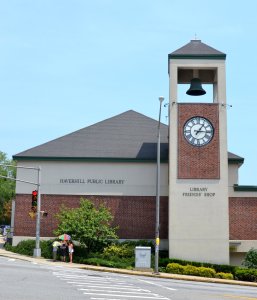
The Haverhill Public Library (MA) – its Board of Trustees, staff and volunteers – is committed to the following values.

  • We value the library as a public forum: it is a community facility for open communication of ideas and information; its collection, displays, programs and services reflect an array of opinions and viewpoints.
  • We value our customers by responding to them with equal, respectful, accurate and friendly service to all.
  • We value reading and learning and promote both for all ages.
  • We value full and equal access to information, the building, its services and its programs.
  • We value the collection of and accessibility to information in all formats: print, electronic, audio and video.
  • We value the community by being active participants in it, endeavoring to enhance the quality of community life.
  • We value the privacy of our users by keeping their transactions strictly confidential.

Note that some statements are about professional values while others are of value to the community. Your Values Statement – best done in a bulleted list as these are—should have a similar mix.

I have long recommended that Mission and Vision Statements be framed and hung where anyone using the library can see them. Your Value Statement belongs on your website, but it’s a bit too long to do that.  Instead, create a word cloud to display your Values.  It will definitely catch the eyes of your users.

What would you include in your Values Statement?  Which ones are of value to your stakeholders?


ON LIBRARIES: The Mission of Mission

(WAVING TO ALL OF YOU FROM ALA NATIONAL IN CHICAGO! – If you’re here — post to our Facebook group and let me know if you want to get together!)

I recently got into a discussion with a professor friend of mine for whom I have the greatest respect, and we disagreed on what should be in a Mission Statement.  He held that the library mission should be the same as that of the school.  I argued that it needed to align with the school’s mission, but had to declare the unique role of the school library program. While we will agree to disagree, I wanted to bring the issue to this blog.

I first blogged about writing a Mission Statement June 8, 2015. At that time I wanted to have librarians recognize the value of having a mission.  What is the purpose (or the mission) of a Mission Statement? 

What I said then was:

The mission defines your purpose—what you and your library program do.  It should highlight what makes you unique and vital to the educational community and expressed in words laymen can understand.  You can start with the mission AASL gives in Empower Learners: Guidelines for School Library Media Programs (ALA, 2009).

And while we need to use evidenced-based practice to ensure we have the best possible program and use the data produced by it to show our administrators what we contribute, it doesn’t mean we don’t need a Mission Statement.

Everyone needs to see what our purpose is.  I recommend that librarians frame their Mission Statement and hang it where it can be seen by all who come into the library. It is our declaration of why we are vital to the school – the students, teachers, and by extension the administration.  It highlights what we do that’s unique.  Because if we aren’t unique, we are redundant. Someone else is doing we what we’re doing – so they don’t need us.

In addition, the Mission Statement gives us a focus.  A reminder of what we strive for each day, each school year.  In that original blog, I noted that “The school year is over. How do you feel as you look back on it? Do you have a sense of accomplishment over what you have achieved?  Or are you tired and exhausted, able to recall a handful of great moments but no real sense of having gotten anywhere? If this describes you, chances are you are operating without a Mission Statement.”

My point is a mission centers you.  Even if events in the school pull you off it on occasion – or regularly – at least you are aware that it’s happening and can work to get back on track the next day. It also becomes central to all planning.

You want to start a Makerspace?  Fine. How does it fit into your Mission?  That’s what you need to consider every time you plan a project.  It helps propel you forward.

If you don’t have a Mission as yet, here are some samples I have been using in some of my recent presentations:

  • The mission of the ______ School Library is to provide students with the opportunity to become not only lifelong users of information but also creators of information. The library strengthens the curriculum by collaborating with teachers, developing a collection that is representative of the community, and implementing literacy instruction for students.
  • The Mission of the _______ School Media Center Program is to create lifelong learners with critical thinking skills, and an appreciation of literature by providing opportunities for all students to gain the self-confidence necessary to successfully learn in an information-rich world. It is a place of safety and learning for all.
  • The mission of the School Library Media Program is to ensure that students and staff are effective users and producers of ideas and information, promote literacy, and develop students’ competencies to be ethical participants in a global society.
  • The ______ District Library Media Program cultivates independent, lifelong readers fosters critical thinking skills, teaches the effective and ethical use of information sources, and promotes equitable access to all forms of information media.
  • The ______ School Library Media Program creates a 21stcentury environment that promotes learning for all students by providing equitable access to information, teaching information literacy skills, and encouraging lifelong learning. The library media center strives to be a center of collaborative learning that produces creative students who have an appreciation of literature, critical thinking skills, and a respect for others and self.
  • The ________ School Library mission is to empower and inspire all students to apply the knowledge, skills, and attitudes necessary to become creative thinkers and problem solvers, to experience individual and team success, and to become responsible, contributing members of our community.

What’s your Mission? Do you think it should be the same as the school’s or do you see the value of having one that shows you are unique?

ON LIBRARIES: Always have a plan

chart your courseThe school year has begun.  Everything is new again. Where do you want to be when it ends? Have you given it any thought?  Now is the time to chart your course.

I have written and taught about strategic planning, feeling very strongly that every library program needs to have a direction for the future.  But strategic planning is normally for a two to three year timeline.  If you haven’t gotten that far, make a plan for this one year.  It will give you the confidence to create bolder and longer term ones.

Start by looking at your Mission Statement.  Every library program should have one that declares its purpose in a compelling way.  If you don’t have one, time to get it written.  I did a blog on it one year ago that briefly explains how to craft the statement.  It doesn’t have to be perfect.  You can always tweak it later.  Check websites of other school librarians to see if they have a Mission Statement.  Borrow wording you like and make it suit your library.  The statement needs to promote the unique purpose of the library program.mission statement

Once you have your Mission, identify any part you haven’t achieved yet.  For example, perhaps mention teacher collaborations yet very few teachers are collaborating with you. Or if you refer to tech resources, what would you most like to add to your collection?  Is your book budget far too small—or non-existent – for you to build the lifelong readers you stated as part of your purpose?  Do you think an author visit would promote reading? What else is lacking?

Now comes the challenge.  How can you achieve this one change in the course of the school year?  If teacher collaboration is your target, identify the teacher(s) most likely to work with you. You really can start with just one teacher to discover what works and what doesn’t.  Remember, you need to have a relationship first before you are likely to win that teacher over.

Figure out what curricular unit would be the best fit for a mini-research project. Look for one occurring early in the school year so you can build from that. Speak to the teacher, stressing what you are willing and able to do.  You don’t want to add to the teacher’s workload. Do your homework first and have a list of helpful resource ready for you share with the teacher.  Offer ideas for a culminating unit in which students demonstrate critical thinking and create new knowledge.

For tech issues and increasing money for book purchases, you need to identify a source of funding. Can you get a grant from the local education foundation?  Will the parent association give you money from a book fair? Are there other sources in your community?  Look into DonorsChoose,org as a possible source.

Before you apply for any outside funding, develop a rationale for your plan.  Know what you want to do as a follow-up. Speak with your principal. Discuss your Mission and why you want to work on developing this aspect of it. If you are prepared, you should be able to get approval without much if any difficulty.

will it be easyLeaders plan and always have a plan.  While you will focus on one thing for this school year, have a list of everything you want to do to strengthen the library program and make your Mission Statement a reality for everyone in the school.  Then you start working on achieving your Vision.

You never know when an opportunity will arise and you have a chance to do something but have to move quickly. I have known of librarians who are informed there is suddenly a specified amount of money available but it must be spent within a short time frame.  I had it happen and called a vendor I trusted, set up a meeting and gave the rep a big order.

I also used to make it a practice to see my Superintendent of Schools over the summer.  Depending on how your district works, you probably would do this only with your principal.  In that quiet time of the year, I would discuss where I wanted to take the library next and why and how it might affect the budget.  We would negotiate for the funds I wanted for a given project.  I would agree to take money from one part of my budget and she would acquiesce in getting me additional funds to make it happen.

What was most telling is that she once said to me, “I have the feeling that if I go one step with you, you have nine others waiting.” She was right.  I needed those other possibilities.  In case my first idea was shot down, I would bring up the next. She also said to me on another occasion that she learned the easiest way to deal with requests was to say no.  Almost everyone would take that for an answer and go away.  But those like me, who came back with an alternative were listened to.  She could see we were committed to getting something done.plan

So what’s your plan?  What do you want to see happen by school’s end?  What else?  What else?  Dream, plan, and work.  Create a mission, build relationships, and grow your program. You can make it happen.