A Better Balancing Act

The feelings of overwhelm, exhaustion and burnout are on the rise. Between our work, our world, and our families, we are frequently unsure how to manage all we are responsible for. Then we’re told to take time for ourselves, because if we don’t, we run the risk of things getting worse. Sounds like more stress.

Unfortunately, most of the advice out there is generic. Do this, eat that, stop saying yes. But the truth is we are unique. Our lives are different from the ones we see and read about. Our needs are different. What works for one person, doesn’t work for another. What is true is that we require balance so that the stressors in our lives don’t suck out all the joy.

So how do we find and succeed at our personal balancing act? Fortunately, Sandeep Gupta explains how to go about the process in his blog post, Work-Life Balance: A Myth or Reality? He starts with the following 4 myths referenced in the title of his blog:

  1. Work is pain, and personal life is pleasure – While it’s true that most of us have to work, it isn’t true that work is always pain. If family life is currently stressful, it could be that your personal life is not always pleasure. Which is true for you? Is it always the case? Hopefully we enjoy our jobs – most of the time. We love our family and friends. Most of the time. What is the best balance for you, personally? How much work and how much personal time are the right balance for you?
  2. Work and personal life are separate – We categorize it that way when we think about balance, but the two overlap often. You take work home. You don’t forget personal issues when we are at work. I used to tell my staff to let me know if they were under stress from home so we could adjust their day. As Gupta notes, when you have a bad day at one, you bring it into the other. What we need, he says, is not a “work-life balance” but a “balanced life.”
  3. Time is the only constraint – Gupta says we think having more time would allow us to have a work-life balance. But it’s not about the hours and minutes, it’s the quality of the time and what we choose to do with it. Having the time to enjoy dinner or play with our children is more enjoyable than just making it home at a specified hour while still thinking about a task at work.
  4. One Correct Solution – Just as there is no one-size-fits-all when it comes to having a balanced life, there is not one solution that will always continue to work. What you need today may not be what you need next year. It’s important to be reflective about how you feel and make changes as necessary when necessary.

So, how do you go about it finding your balance? Gupta recommends considering these questions.

  • What needs to happen to make life more fulfilling? 
  • How can life be more balanced and fulfilling?
  • Who do I need to become to lead a fulfilled life?

To answer the first question, ask yourself: what are your priorities? What things can you do to make more time for them? What unnecessary things are you doing which can be delegated or eliminated? Take time to notice when and if these might change.

For the second question, identify your passions – both at work and in your personal life. Ensure that you make a place for them. The usual advice about making time for physical activity is true here as well. It energizes you and promotes a positive mindset.

The third question requires you to include time to reflect on your life. Are you feeling fulfilled? Do you need to revise what you are doing? Remember, there is no one correct solution and today’s solution may not work in a year. Life brings change at home and at work. Accept it, be ready for it, and make any needed adjustments.

Burnout is a real thing. It comes when over a period of time, what we expect or think we can do doesn’t align with the truth. We can burnout because of both work and personal stressors. It may not seem like you have the time to look at this, but the truth is, you can’t afford to ignore it. Ask yourself these questions (maybe you do it one your commute). Listen to the answers you receive, and then do what you can to act on them.
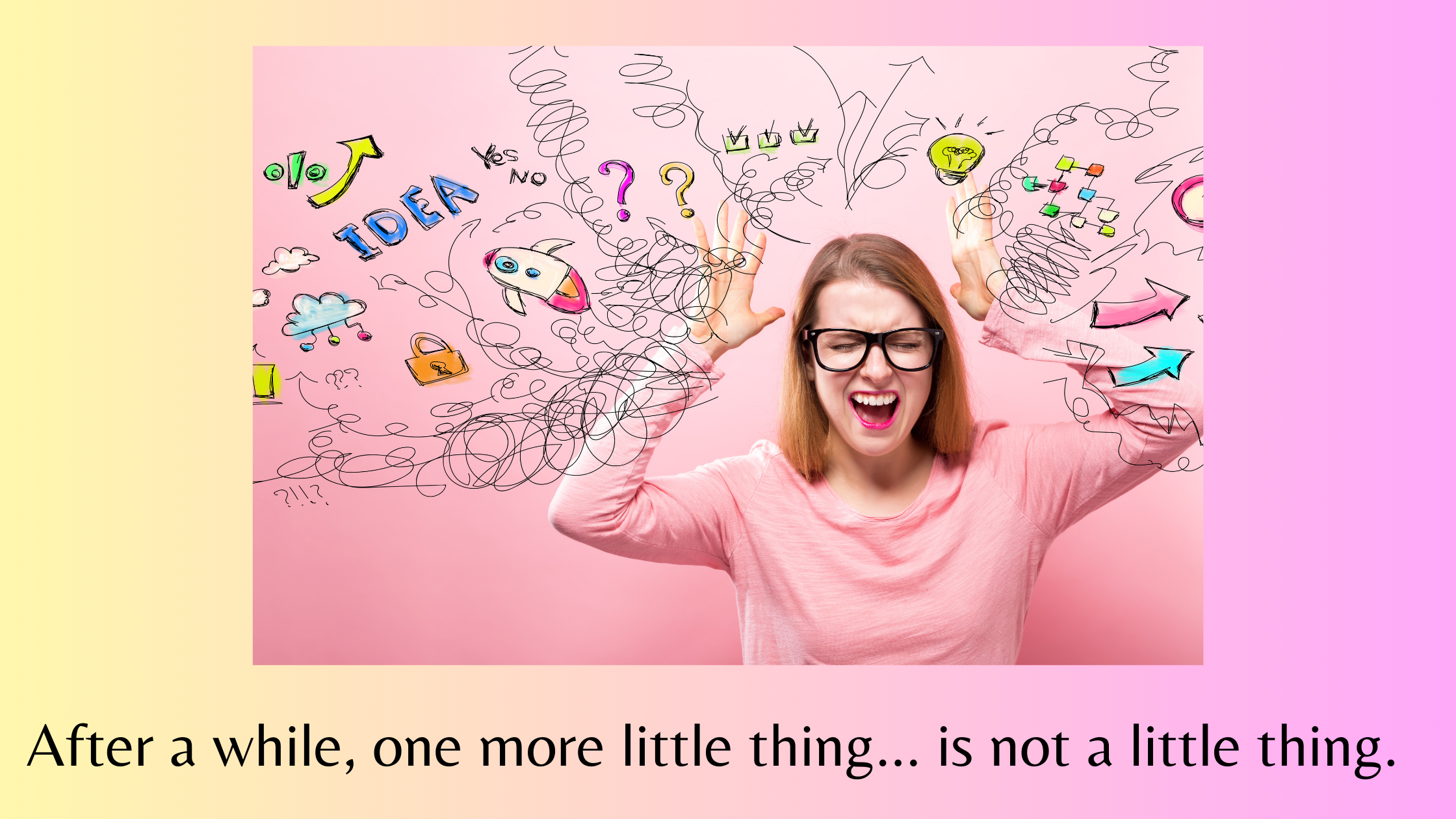
Little Things Cause Big Results

Ever had one of those days when everything you did took longer than expected?  Ever had a day when it seemed everyone needed you for something, and you were wondering if you would have time to breathe?  Yeah, me too.  We have all had days like this.

It’s fine if that happens only occasionally, but when it becomes more consistent or persistent, it’s a problem. The stress builds and builds. It’s like what happens when water keeps dripping on stone. That constant drip will eat away at the rock more effectively – if slower – than a flood.

There’s a word for this – “microstressers.” If you’re constantly feeling under pressure, but there is no one obvious culprit, then microstresses, aggravations so tiny you don’t notice or dismiss them, might be what is causing the problem. Rob Cross, Karen Dillon, and Kevin Martin have an approach to deal with them in their blog post, Five Ways to Deal with the Microstressers Draining Your Energy.  The authors identify 14 microstressers, breaking them into three categories. Here are 6 of them in the categories they belong:

Microstressers That Drain Your Capacity to Get Things Done

  • Unpredictable behavior from a person in a position of authority – Principals, administrators and school boards, can be a significant source of microstresses when they ask first for one thing then another or ask you to make something a priority that changes what they previously requested.
  • Surges in responsibilities at work or home – This is a big one for most of us. Constantly being asked to do one more little thing rapidly adds up to ongoing and unending microstresses.

Microstresses That Deplete Your Emotional Reserves

  • Managing and feeling responsible for the success and well-being of others – We care about our students and teachers as well as our families, but it can take a lot out of us when we take on their process as our own.
  • Confrontational conversations – Dealing with a defiant or disruptive student or a challenging discussion with a partner is wearing, no matter how successfully you manage it. We gear up to have the conversation, then are drained after.

Microstresses That Challenge Your Identity

  • Pressure to pursue goals out of sync with your personal values – Librarians choices are being attacked on all fronts. Being able to advocate for the collection and programs you want to have to make your library a welcoming environment for all is more and challenging. (Okay – this one may not be micro!)
  • Attacks on your sense of self-confidence, worth, or control – Anytime we hear something negative about ourselves, our choices, our beliefs, it’s like a pinprick in our confidence. Too many of these small holes, and our self-assurance leaks away.

Now that you can see what some of these microstresses are, here are the author’s 5 steps for dealing with them:

  1. Start small – Always good advice. First, look to identify one small microstresser in your life – the fact that they are micro can make this a challenge initially. Once you can see it, identify steps to address it. For example, if you are feeling a loss of confidence, start keeping a list of great things about you or what you do. Look at them regularly (especially after one of those pinpricks).  And keep adding to the list.
  2. Shift your attention to positive interactions that help create resilience – Is there someone at work you really like?  Can you have lunch with them a few times a week or go for a walk together after school. Enjoy these connections as they happen and look forward to your next time together will help. What about outside of work? Is there a friend you can call regularly?
  3. Tackle two bigger microstresses – Now that you have a handle on two of your microstresser “go big” and try two. Schedule some time with the guidance counselor to get better ideas on dealing with disruptive students and see if they can do a workshop or tutorial for you and teachers. How can you delegate some of the increased workload at home or on the job? Where is there help and support in your life?
  4. Pay attention to areas that create anxiety because of your concern for other people – We worry about the people who matter to us whether at home or work. We can’t make choices for them, and we can’t always rush in to help them. The authors suggest you work with them on developing problem-solving skills, which will allow you to both feel more successful. It may also have the added benefit of giving you peace of mind that you can trust their process.
  5. Finish by pivoting to activities that help you derive a greater sense of purpose – The authors suggest you find a group or two outside work and family that gives you “meaningful activities.” For me it’s my Weight Watchers weekly meetings. I can feel myself shedding the microstresses even if I gain weight. Community and support are something we all need and which can get easily lost in the midst of all the little things that pull at us.

If you want to learn more about this subject, Cross and Dillon also co-authored the book The Microstress Effect. As leaders, we have so many demands we and others place on us, but our focus and energy tends to go to the big things and we don’t notice the little things that are draining our energy, mental health, and joy. When we succumb to these microstresser we can’t give as much to our school community or our family. Look for the little things that are becoming big things and take small steps to reduce your stress.

On the Path to More Joy

Today I’m concluding what has unexpectedly become a three-part series on joy. It seems especially fitting after a stretch of gray and rainy days where I live and the change of clocks in the United States which heralds a lengthening of daylight hours (something that personally gives me a lot of joy).

Finding and noticing joy are key to our ongoing mental health. And because our mental health affects our physical health, it has an important role to play in our ability and willingness to do the work we love. We think joy comes from an event or occurrence that happens to us. But we don’t need to wait for those moments. Last week in my blog, I shared the first five ways to bring joy into your life from 10 Ways to Find or Create Joy at Work by the Career Contessa Team. Here are the remaining five ways:

  1. Give Back – We usually think of this as volunteering, but at work it can be something as simple and meaningful as giving someone a true compliment – one that is specific to something you saw or experienced with them. Better yet write them a note so they have it to reference later. Is there someone who helped you recently? Send a thank you note (yes, e-mail is ok, but imagine how’d they’d feel getting something handwritten).
  2. Surround Yourself with (You Guessed It) Joyful People – Who are the people in your life who seem to have a zest for living? The people you can’t help but be drawn to. Find ways to see and work with them more often. The Career Contessa Team says these people need not be from your school. Your family and friends can (and hopefully do) bring you joy. Spend time with them. Don’t sacrifice joy with them to get more work done.
  3. Distance Yourself from Work Vampires – The Career Contessa Team says these are the “people who mosey up to your desk to complain, spread gossip, complain, and complain.” They delight in finding and magnifying everything that isn’t going well and suck out any joy you might be feeling. Recognize them for who they are. You may have to see them if they are your colleagues (and we have to be in relationship with everyone), but do what you can to minimize the time they take. And be sure not to agree with them. It will be added to their gossip.
  4. Find Small, New Ways to Do Old Things – Many times when we feeling down makes us yearn for change, we look to do big, sweeping things. Instead, we are often better off making small, sustainable changes to make things one step better. That can give us the momentum to continue to do more and more. Finding small ways to do old things differently can spark all kinds of energy and joy. You can also try a new approach or set up – put your desk near a window, change display areas, redo a bulletin board – and get help and input from others.
  5. Embrace You and Your Strengths – We are all unique. Our inner critic often wishes we were more like someone else. Why waste time on that.? You are you, and you bring your unique strengths to all your interactions. Seeing that what you bring is special and important can help you rekindle the joy for what you do and how you do it. The Career Contessa Team concludes with fun exercise. First, list five of your strengths. Complete this sentence for each one: I am (your strength), and it matters because ­­­­­­­­­­­­­­­­­­­­­­­________________.

Now you have ten ways to find and create joy in your life. I have found that joy is contagious. The more joy you bring into your life, the more you will notice and the more you will attract people who want to be with you. Knowing that joy is something you can reach for and find whenever you need it is very empowering. And feeling empowered supports your work, your leadership, and everything you do. As well as creating more joy. Don’t think of it as secondary – make joy a priority and see the amazing results of your efforts.

Bring Back Your Joy

Do you wake up each weekday eager to get to work or dreading it? Have you started counting the days until your retirement? Somewhere along the way, your joy has drained out, and each day is a grind. Two weeks ago, I blogged on how to Rediscover the Joy in Your Work. I shared five tips then, but we need all the help we can get.

Most of us can handle the usual stress of the jam-packed life of a school librarian. It’s the added tensions of the scrutiny and suspicions of what we do, why we do it, and how we do it, that are siphoning off much of our love and passion. Our students, teachers, and our administrators need us to continue to bring our joy when we help and work with them. Which is why I was pleased to find the blog post 10 Ways to Find or Create Joy at Work from the Career Contessa Team.

The team prefaces their advice by asking, “What if you have tried, and your work holds no joy?” They then proceed to answer their question. Here are their first five suggestions:

  1. Identify Your Core Values + Beliefs – As a school librarian you embrace the Core Values of Librarianship from ALA. You also share the six Common Beliefs in the National School Library Standards. Beyond that, what are your beliefs? Write them down (try to keep it to no more than five so you don’t get overwhelmed).
  2. Find Ways to Infuse Your Core Values into Your Work – Take this identification to the next step by journaling by listing some ways you bring your core values and your beliefs into your day. Look at what you wrote and congratulate yourself for making a difference each day. Take in how these values make you feel. There is joy there.
  3. Make Time to Laugh + Share Laughter – We have only to look at the number of comedies set in challenging situations to appreciate the power of laughter. It has even been scientifically proven to be good medicine. Look around = there are funny and ridiculous things that happen everywhere. If you look for it, you will find it. And when you find it, you can share it.
  4. Share New Ideas – This is natural to school librarians and a wonderful place to find joy. We are curators. The ideas don’t need to be library or even school related. I just shared on my School Librarian’s Workshop Facebook group about a school district that is bringing inclusion into the community by having one school lunch each week be from one of the diverse communities represented in the area.
  5. Start a Club – It could be for students, but it can be for teachers. Your club should be something that you like to do, but it need not be a book club. You might do one on gardening or knitting or some ways to contribute to the school or outside community. Your club can be ongoing or have a limited duration. It forms connections, builds relationships, and makes everyone feel better. Something for people – including you – to look forward to. Instant joy!

Becoming joyful about being a school librarian shouldn’t be one more task. Pick one or two from the list and try it on for size. If it’s not you, pick something else. Let me know if you want me to share the remaining five. And in the meantime, I hope you’re able to find more joy and bring it to your work and life.

Mind Your Mindset

Our brains are wonderful—until they are not. The brain’s most important function is survival and to do that, it looks for danger. But even though there is no longer a lion at the mouth of the cave, it’s still searching for what’s wrong. The result of this is – we find problems and places to worry all the time. This onslaught of negative (and not always true) thoughts lower our mood and add to the stress we are already feeling.

It takes work to noticed when your mind is lying to you and reframe your thoughts to a more a positive mindset. You won’t be able to do this continuously, but awareness is the first step to making a change. In a very long blog post, George Vanourek explains the Power of Reframing to Change Our Outlook. Considering the length of the post, I am focusing on what I consider his key points as to what causes all those negative mindsets and how we can manage them.

First, we need to look at what comes up and how our brains react. Negative mindsets are caused by cognitive distortions resulting in “flawed or irrational thinking.” These result in:

  • Assuming the worst – For example, when your principal asks to see you and you immediately believe they are going to cut your budget and eliminate the new program you started.
  • Discounting the positive – While focusing on all the negative reasons for the call, you dismiss that your principal had complimented the new program and the way the library has been invaluable to the school community.
  • Catastrophizing – You might then find yourself jumping to the conclusion that they are going to eliminate librarians despite what has been said about you and your program.
  • Overgeneralizing – This is what always happens. You knew it was too good to last. Just when you think you have it right, it all goes to pieces and things are worse than before.
  • Emotional reasoning – This is when you shift from how you are feeling at the moment to a judgement about yourself. “It was so stupid when I neglected a key direction for students and had to backtrack to fix it. I am so stupid!”

Obviously, this negative self-talk causes you more stress, erodes your self-confidence, and affects your performance. Among the nine techniques Vanourek suggests to counter this negativity, my favorites are:

  • Context reframing – Change how you look at the issue. Instead of feeling you are stupid, consider the benefits students get from seeing you acknowledge an error and move on from there.
  • Stop taking things personally If a student complains that the book you recommended was terrible, that may not have anything to do with your ability to choose books for your students.  They could have had a bad day and are mad at things in general, or they might not have been clear about what they liked. Maybe there was something triggering in the book that you couldn’t have known because the student doesn’t talk about. This is where context reframing comes in again. Use this as an opportunity to discuss the student’s interests and see what you can do next.
  • Multi-dimensional view – Where we focus makes all the difference in what we are able to see. Look for ways to get a wider perspective instead of the narrow one in which you are viewing the problem. Ask yourself: What has made you so upset? What perspective changes this feeling? What previous experiences are affecting your thoughts? What can you learn from this moment? And remember the bigger picture – your Why, your Mission, and Vison. See where you are furthering them, no matter the stress of the moment.

If you put your hand in front of your face that’s all you see. Move your hand further away, and you not only see your hand, but everything else as well. Your hand (the stress of the moment) becomes only part of the view.  You can’t stop things from going wrong or the stresses that life brings, but you can be aware of and control your reactions. Keep watching for your negative self-talk and then look for ways to shift your mindset. There is always a more positive way to frame the situation and when you do, new solutions are more likely to appear.

Take A Walk

Self-care has got to be one of the most frequently given pieces of advice to help us manage stress. Unfortunately, as with much good advice, we nod in agreement and then don’t do anything about it because we are too busy. The irony is almost comical. We need self-care because we are all too busy and we’re too busy to start a self-care routine.

While many forms of self-care are suggested, from yoga to bubble baths, walking shows up probably more often than any other. There is a reason for that. It results in an array of positive results even when you don’t put much time into it, and it requires next to no equipment to get going.

Need a few more reasons or benefits to add more movement to your routine? JiJi Lee presents this list of Reasons to Get Outside and Move Around During Your Workday along with some ideas to actually implement it. Their suggestions are all about going outside, but if that’s not possible, indoor locations (or a treadmill) still provide a boost. The benefits include:

  • A Good Night’s Sleep – According to Lee, getting early sunlight can lead to a good night’s sleep as the early sunlight affects your circadian rhythms. For those who need coffee in the early afternoon because their eyes are closing, try a walk instead. The residual caffeine can affect your sleep at night.
  • Boost Your Creativity – A walk outside f you just can’t turn on your creative juices and a deadline is approaching, go for a walk outside. I have found it to be almost magical. As soon as I hit the fresh air, it’s as though my thoughts unlock. You don’t have to walk far, although Lee reports that Charles Dickens supposedly walked as much as 20 miles a day. As you walk, take in the scenery. Even if you take the same route every day, you will notice something new. Your eyes focus on distance rather than the close-up work of your desk or even the library.
  • Reduce Stress – We are well aware of the negative effects stress has on our professional and personal life. We are irritable with people for big and little things, which affect our relationships. There are medical effects including weight gain, high blood pressure, and anxiety/panic attacks. Walking lowers cortisol, the stress hormone. When you get outside, you can feel it flattening out.
  • Enhanced Productivity – We tend to think of going out for a walk as taking away valuable time, but in fact it results in more work getting done and frequently a higher quality. As Lee says, “it will help you reset, improve your attention and memory, and put you in a better headspace for your work”

So how to start this practice? Lee has the following recommendations:

  • Go for a walk in the morning – Get up a little earlier and head outside. It will start your day off right.
  • Schedule your breaks – Put breaks on your daily calendar or to-do list. Set an alarm. You know your schedule. Look for small chunks of time, even 10 minutes, to walk.
  • Have lunch outside – Do it alone or with a friend. Lee suggests pairing it with a gratitude journal. You get the benefit of some positive thoughts along with the benefits of fresh air.
  • Get off at an earlier stop – This works for those who take a bus. For those of you who don’t, park your car at a distance when you shop. Walk along the strip mall. Five minutes more won’t cause a problem – but it may prevent one later.
  • Walk around your floor – Don’t use inclement weather as an excuse. If the weather is bad, walk around your building. You will notice things differently. It’s not as good as going outside, but it’s better than staying inside your library.

I cannot say enough about how walking has benefited me. I’ve come up with book concepts, blog ideas, and made neighborhood friends because of this habit. Each day as I begin my walk, I feel the difference in my breathing, my stress, and my thinking. I urge you to find something like this for you (maybe it’s yoga, playing piano, or coloring). You will feel better for it and the benefits will spread beyond you.