Fielding Tough Questions

We live in a confrontational, polarized world. Tough questions—and charges—are a part of it. If you are a leader, chances are someone is going to challenge you. It happens to every president, CEO, director and head coach. Even if you don’t think of yourself as a leader, people know you lead the library. If someone has an issue related to the library, you are going to be challenged. What you do next defines you as a leader.

A story I have told before occurred when I took a new position in a school and a teacher came storming into the library and started haranguing my clerk. I came over immediately, indicating if there was a problem, the responsibility was mine, not the clerk’s. It was in the early days of automation, and the practice had been to use teachers’ social security numbers for their barcodes. The teacher was opposed to this. I listened to what she said and apologized for not being aware of the policy. It was my library, and I was responsible. I told her would return all her books, issue a new barcode for her, and re-check out the books to her. At the end of the school year, we changed all teacher barcodes.

What worked when I was challenged? I listened without getting defensive or arguing that I wasn’t the one who put the practice in place. I came up with a satisfactory solution. The result – she became one of my strongest library advocates.

The tough questions are getting tougher, the challenges louder and more fierce. To help us be prepared, Allison Shapira has some answers for you When a Tough Question Puts You on the Spot. Here are her four points.

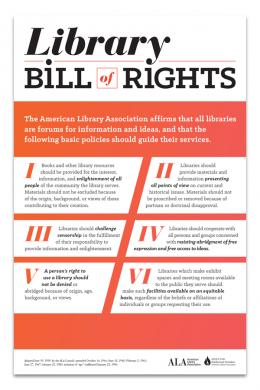
  1. Prepare in Advance–You can expect to have questions and accusations directed at you for books in your collection and displays in your library. Don’t be caught off guard. Be familiar with the Library Bill of Rights and be able to quote key sections. (You might keep a copy on hand). Have a Selection and Reconsideration Policy in place. This ALA toolkit will get you started if you don’t have one yet.
  2. Pause and Breathe–Being confronted is scary. Your body goes into fight, freeze, flight response. While it is trying to protect you, the process shuts off your cerebral cortex–the part of you that thinks. Allow yourself a moment to respond and get your (hopefully) pre-planned response into action.
  3. Express Sympathy and Honesty–This is what I did with that teacher. When a parent comes to you with a challenge, acknowledge their awareness and their concern. Explain how you don’t seek to override their decisions for their child. Once things have stopped escalating, explain that other parents have the right for their children to have access to those subjects.
  4. Acknowledge the Uncertainty–This is often at the root of challenges and frustrations, rather than true animosity. A teacher is angry and wants to know why the material they requested for inclusion in the library last year is still unavailable. A principal wants more data on the impact of your Makerspace and you hadn’t thought of that before. Be honest about your lack of knowledge, assure them you will look into the matter when possible, and give them a date by which you’ll have an answer.

In some of these confrontations, you need to take a stand and that can be difficult. Shapira recommends you use this PREP framework:

  • Point: State one main point.
  • Reason: Provide a reason behind it.
  • Example: Give an example that supports your point.
  • Point: Before you start rambling, re-state your main point.

You will have to face tough questions and never know when. As with any other aspect of leadership, planning is key. Knowing what you will say when it happens will put you in the best position to handle the challenge and help you trust yourself in difficult, emotional situations.
ON LIBRARIES: Taking A Stand

You can order this poster from the ALA store

We can all agree that being a school librarian is a rewarding, challenging, and frequently exhausting job. We never think of it as scary until the day we are faced with a book challenge that threatens our mission, the integrity of our program and possibly our personal beliefs. How you react if and when it happens can be a defining moment for you as a librarian and a person.

The Library Bill of Rights clearly defines our responsibilities as librarians.  The seven articles spell out the beliefs of the profession, such as article III: “Libraries should challenge censorship in the fulfillment of their responsibility to provide information and enlightenment.” ALA’s Code of Ethics states, “ We uphold the principles of intellectual freedom and resist all efforts to censor library resources.

AASL further recognizes the importance of access to information in the National School Library Standards for Learners, School Librarians, and School Libraries. It highlights our obligation to implement these values in the fifth of the Common Beliefs: “Intellectual freedom is every learner’s right.”

Of course, you support intellectual freedom and the access to information — but what happens when you are faced with a decision regarding it.  I know there are librarians who don’t buy books that may trigger a challenge.  Some of them live in communities where they would be pilloried for such purchases.  I can understand and respect their fear. A few of them acquire the books with their own money and keep them in the office, handing them to a student when it seems appropriate. Still dangerous, but less so. In the public library, there are several librarians who can stand by each other in support. You are alone.  And it can be scary.

Hopefully, you have a Board-approved policy dealing with this.  If you don’t, get started on writing one now and getting it approved.  You may never have a challenge.  Most librarians never face the issue in their entire career, but you never know.  Because it can happen, it’s best to be prepared.  To help you, ALA has a new Selection & Reconsideration Policy Toolkit for Public, School, & Academic Libraries.

Having a policy in place doesn’t mean all will go smoothly if someone challenges a book.  ALA offers help and a wealth of resources in Challenge Support  I also recommend reading How to Respond to Challenges and Concerns about Library Resources to get an idea of what it contains.  You can review it, if it becomes necessary.

There’s a specific story that sparked this week’s blog.  I’m not going to go into the details, but for the second time, I know a school librarian who had a book challenged.  Both courageously stood up for the principles of intellectual freedom, and it makes me proud to know they got a lot of support from the library community and from those in organizations that also strongly support the First Amendment.

In the most recent situation, there shouldn’t have been a problem.  There was a Board-approved selection and reconsideration policy. It was the principal who pulled the book.  When the librarian reminded him of the policy, he told her it didn’t apply since it wasn’t a challenge but rather an administrative decision. This put her in a particularly difficult dynamic.

What do you do when the censor is your administrator?  In this case, the librarian swung into action.  She reached out to high school librarians to see who owned the book without having problems. She contacted her state and county school library association, ALA, and AASL.  Those on the Board of the library association reached out to other library associations in the state. Soon advocates for intellectual freedom lined up including the National Coalition Against Censorship and the National Council of Teachers of English Intellectual Freedom Center.  Letters were sent to the Board of Education. Support was there when the Board met and the media covered the controversy.

Ultimately, the book was allowed back on the shelf. Or it was until a student checked it out.  The librarian kept detailed notes of the whole process.  She plans to share it with others who find themselves in a similar position.  Her next steps include working to mend her relationship with her principal and the administration who wanted to make this decision regardless of policy. Because even though the “fight” was won, she must continue to work in that environment and sustain and grow the success of her library program.

Judy Blume has said, “Librarians save lives: by handing the right book, at the right time, to a kid in need”. She’s long acknowledged the librarians and teachers who have put their jobs on the line to share her (often banned) books. It’s not something we want to face, but there are times it must be done. We are a strong community who fight for our beliefs. I salute all those librarians who have stood up for Intellectual Freedom. We are a vital part of our democracy.