Moving from Fear to Success

Leaders have to effect change and work towards making their Vision a reality. To do this, they must take risks. Risk and growth are the only ways to achieve success, but they carry with them the chance for failure. And knowing this creates fear.

Fear manifests in many ways including that inner voice that says you aren’t good enough. Or it says even though you were successful before, it was a fluke. Fear is what underlies the well-discussed Imposter Syndrome. At its worst, it has you believing every success is a precursor to failure the next time you try something, keeping you from enjoying what should be a triumph. In its lesser forms, it has a paralyzing influence on your willingness to attempt a new project.

How do you deal with the fear of failure?

In her Smart Brief article, Laura Gassner Otting writes about the impact of Imposter Syndrome and proposes you Leverage Your Fear of Failure for Success. Use one to reach the other. She offers these three approaches for doing it:

  1. Let’s not fake it ’til we make it – Otting rejects the “fake it till you make it approach.” She maintains that when we are faking it, we don’t use our own thinking but restate the consensus, and that doesn’t lead to success. Faking it also means you know you are pretending, which keeps you from feeling confident. You are always waiting to be “caught.” This leads to trying to control everything rather than leaving space for learning. Better to make mistakes and learn than to pretend they are never going to happen.   
  2. Re-categorize failure from finale to fulcrum – We teach our students to see “fail” as an acronym for “First attempt in learning.” Although we know the learning process includes failure, we don’t always apply it to ourselves. No one likes to fail. Once again, mindset is critical. Look back at your failures. What did you learn from them? What were you able to achieve because of that learning? Had you not failed, you wouldn’t have had that success. It’s a process. As long as you don’t let a failure be final, the more success you have to overshadow any failures.
  3. Take a lesson from the pros – Athletes are out there for all the world to see. When they “fail,” it’s obvious to all. When a pitcher loses a game, or a player misses a much-needed basket, they face jeers and negative comments made by fans, sportscasters, and coaches. It’s painful. But tomorrow is another day, another game. They will look at the video and see what they missed, then learn and move on. When an attempt fails, it’s the start of the next step on the road to success. We can all use this as an example of how to face setbacks and mistakes and keep moving forward.

Your brain is a powerful tool. As often as possible, leaders accept the challenge of keeping their mindset focused on their Vision and Mission – not on fear. Both failures and successes – and learning from each – are part of any leadership path.

ON LIBRARIES: Saying Yes – and No

It’s important for leaders – and you are a leader—to step out and take on new challenges. Moving out of your comfort zone is how you learn and grow.  I would venture to say you’ve already done this in so many places in your life, not just in librarianship. My personal leadership journey took a leap forward when I started volunteering in my state association, then called EMANJ now NJASL. Over time, however, I’ve learned when it’s important to step into a new opportunity and when I need to say no. “No” can be a very effective leadership tool.

I learned so much about leadership and leading when I became president of NJASL.  It was a bit scary at the time, but I had a lot of support.  And it built my confidence which was an important benefit. I took another leap forward when my position as president-elect and then president took me to the AASL Affiliate Assembly.  Suddenly I was swimming in a bigger pool.  There were so many leaders with more experience than I had, but they were easy to approach and always extremely helpful.

I also was developing a much broader perspective. I began learning what the other library associations in my region and the country were dealing with and what they were doing.  Many of their challenges were the same as my state’s, others were not.  Occasionally their issues surfaced in my state at a later time.  Not only was I prepared, I knew whom to reach for advice.

From the state level, I moved on to AASL committees. Each one focused on a different aspect of school librarianship.  I have been on so many over the years including an early one on strategic planning, programming for the AASL Conference, the Fall Forum, several Task Forces, and Advocacy.  Committees change over the years, but they were all key learning experiences. Almost every time I accepted an appointment to a committee or task force, I felt I didn’t know as much as I would like to be able to do a good job.  No worries.  The chair knew, and I was able to learn on the job.

I was very secure in my AASL niche.  Then I was appointed as AASL liaison to ALA committees.  Time to step out of my comfort zone. The pool became huge.  I understood school libraries, but now I was working with public, academic, government, and special librarians.  Their world was very different from mine.

When I am on an AASL committee I can count on knowing at least some of the members.  It’s not quite the same when it’s ALA, but the same welcoming response I found in AASL was here as well.  I have gotten to know presidents and past presidents of ALA and other major leaders and have a much larger perspective on how each type of library impacts all the others.

As a result of my ongoing volunteering for ALA and AASL (and I am going back to Affiliate Assembly as my state’s delegate after several years away), my ability to talk to those outside our field about the value of school libraries—and all libraries—has increased incrementally.  I have the vocabulary and the fluency to communicate these ideas. I have often said I should have received CEU credits from what I have learned.

Saying yes to new opportunities is a positive and an important aspect of leadership, but what about saying, “no?” When is that powerful?The answer depends on why you are saying it. I first blogged about “The Stories We Tell Ourselves” in 2015 and have expanded on it.  There are always reasons to say no. But too often these prevent you from becoming the leader you absolutely need to be.  But sometimes a leader must learn to say no.

When you have been a leader for a long time and are accustomed to getting out of your comfort zone, saying yes becomes your automatic response.  But recently I came face-to-face with the need to step back.

As a number of you know, a few weeks ago I had major surgery and for the most part was not able to take care of many of my daily tasks from online teaching to committee work for two weeks.  My natural tendency is to quickly get back to what I was doing.  But I had to accept I couldn’t resume everything at once.  I have to go more slowly.

It’s easy to help others.  It’s hard to ask for and accept help but that’s a component of leadership as well.  In addition to delegating, it’s important to trust others in the different areas of your life to step into the breach. In some cases, it’s empowering.  For example, one of my students took on a leadership role in getting her classmates to continue posting on the online Discussion Board and supporting each other.  In my personal life family members, including extended ones, have been there to help, some in unexpected ways.

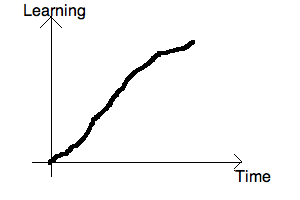
I’m still impatient to get up to full speed.  I’m dealing with a steep learning curve with regards to some new (and hopefully temporary limitations) and reminding myself to draw on past successes to maintain my confidence.  Leadership is a continual learning activity, and I expect it will always continue to be one of mine.