Lead With Grace

Grace as a leadership tool? Yes!

The word “grace” is usually associated with religious practices, but it goes beyond that and used properly, it can deepen your leadership ability. One of the many definitions of “grace” given by Merriam-Webster is “the quality or state of being considerate or thoughtful.” With that in mind, it is easy to see grace-based leadership as a natural outgrowth of the recently popular concept of servant leadership, which is about leading from a place of being clear on who and how you wanted to serve.

While the business world struggles to incorporate either or both of these leadership styles, they are natural to school librarians and the work we do. Even as the pressures on teachers and librarians grow, bringing grace into our lives (treat ourselves) and our leadership (treat others) is very powerful and has the potential to have a huge impact..

In her blog article, Short fuses, high stakes: An argument for grace-based leadership, Julie Winkle Giulioni says that Grace-based leadership is  “the ability to meet people where they are — with patience, understanding and compassion — while still upholding clear expectations and accountability.” She then offers six practices to incorporate in your daily interactions. Giulioni is speaking to the business world, so I have tweaked these to match our world. Keep in mind these apply when working with all of your audiences: students, teachers, administrators, volunteers, parents, and more:

  1. Make space for humanity – Due dates matter but so do people. Pressures abound. Recognize these feelings as you deal with students, teachers, administrators – and yourself. Things will be late, mistakes will be made. It’s part of the process.
  2. Assume positive intent – Jumping to conclusions is easy, particularly in stressful times, but it only exacerbates the problem. There usually is a reason for someone’s anger/frustration/challenge. Be curious as to what is driving the negativity rather than making judgements. Come from a place of “they’re doing their best” and you’ll have a different perspective and response.
  3. Respond rather than react – It is natural to respond with hostility when someone directs a negative emotion at you. Remember to pause and breathe. It will lower your temperature and blood pressure, allowing you to give a more reasoned response and give you a chance to do the first two steps (space for humanity and assuming positive intent).
  4. Honor multiple realities – We know from the political climate, we aren’t going to be able to convince someone who holds an opposite position that your belief is correct. As librarians we serve the whole school community, even (may especially) those we don’t agree with. Find a common ground among your differences.  It is part of how your build relationships.
  5. Offer “soft landings” for hard truths – This is particularly helpful with students as Giulioni says to frame “feedback respectfully, focusing on behaviors and results.” It also applies when you need to explain to a teacher or administrator why you want to tweak their plan. People don’t want to hear ‘no’. Find a better way to share what you have to say.
  6. Hold people capable, not just accountable – Part of your feedback should recognize the other person’s abilities and strengths. It’s also knowing they have a “Why” for what they did or didn’t to that is as important to them as yours is to you.

Giulioni adds these three suggestions on how to Grow in grace which I am quoting directly:

  • Use curious language (“Help me understand…”) instead of accusatory language (“Why did you…”).
  • After a mistake, lead with support first (“What do you need to get back on track?” or “How can I help?”) before jumping to blame.
  • Share your learning moments openly. Modeling self-grace normalizes growth and reduces fear.

And when practicing grace, remember to offer it to yourself because you deserve at much as everyone around you. Leaders need to be gentle with themselves just as they offer this to those around them.


Leaders Show They Care

Watch the news the news or scroll through social media and it’s quickly clear that everyone is feeling stressed, overworked, and underappreciated. As librarians, we not only feel, but are actually under attack as well. Our jobs, our collections, our programs are under some intense scrutiny. Fortunately, there’s an unexpected tool that can help – Caring.

Sometimes the best way to deal with the negative emotions is by helping others. Our students need their teachers and librarians to bring our best selves each day, no matter how difficult. When we start by remembering how important and impactful the work we do is, we can tap into the power of connection.

In her blog article, The duty of care: How leaders can anchor teams in turbulent times,  Julie Winkle Giulioni presents seven ways to show caring in the business world. Here they are her seven, along with my adjustments for their application to the school setting.

  1. Benevolence– Make time to know what others value, what they care about in their school and personal life. Your interest in them opens the door to sharing and easing a burden they were carrying on their own.
  2. Trust – As I have often said, trust is the foundation of relationship, and as a leader you must build these relationships. Trust can come from keeping your word as well as keeping confidences. What a teacher may have shared with you is not one for you to share with others unless you have been given permission.
  3. Respect Giulioni says this is about how you listen. Listening is a core skill in leadership.

You honor the other person’s journey and don’t jump to judgement if you don’t agree with their path.

  • Empathy – When teachers allowed you in on their worry and pain, let them know you care. You can share a similar pain, but don’t try to top theirs.  This isn’t a contest.
  • Communication – You show your caring by how you speak to students, teachers and, yes, administrators. According to Giulioni, you do so by welcoming their perspective and accepting their emotions. I would add the importance of tuning it to what is communicated in their body language. People sometimes mask their emotions on their faces, but you can often pick up what they are feeling by the way they are standing and subconscious hand movements. Pick up on these and ask about them if you notice something isn’t right.
  • Vulnerability – In this case, it doesn’t refer to over-sharing. Giulioni says it means admitting when you don’t know everything and when you have made mistakes. We are all human. Show your human side. It give others the space to do the same.
  • Support – You are in this for the long haul. It isn’t a one-time thing. Follow up on your conversations. Ask how things are going when you know there’s been a problem. Offer to help if they need it.

We are going through tough times, but I have always held on to the mantra, “This will change.” Nothing stays the same. Bad times become better, and good times go bad. But even when we can’t control what happens, we can control how we deal with it. What you do now will impact your relationships when times get better. Stay connected with people. In the words of Theodore Roosevelt, “Nobody cares how much you know, until they know how much you care.” Leaders care about others.

Hope is Powerful

What did you think when you read the title? Did you agree or is it something you generally don’t believe. Hope, while considered positive, is often thought of as a passive thing and reserved for something you don’t think will become a reality.

But consider your Vision Statement. Is that something you hope for? And yes, it isn’t currently your reality, but if you don’t believe it is possible to achieve, you will never reach it. The truth is, as cliché as it might sound, if you believe it, you can achieve it.

So how do you make hope happen? Strategy.

Hope, according to studies, is characterized by Goals, Pathways (the way to to goal), and Agency (capacity to get the goal), In her article, What Leaders Misunderstand About Hope,  Paula Davis provides strategies for using these in four parts. I have added my interpretation for our education world.

Provide role clarity – You aren’t leading a team, as Davis discusses, so the clarity is for you. What is your supposedly unachievable goal? Why is it so important? Who will benefit? Who are your potential allies? This will help you focus on a path, however slow, to reach your goal – your Vision.

Use micro-goals to build momentum – When the end is so far away, it is hard to believe you will get there.  Keep your hope alive by looking for milestones and for small wins to celebrate. When I am walking, I frequently have micro-goal to keep me moving. It is sometimes as small as getting to the next driveway. Consider this sample Vision. “The Library Media Program cultivates independent, lifelong readers fosters critical thinking skills, teaches the effective and ethical use of information sources, and promotes equitable access to all forms of information media.” What have you done that shows your students are actively doing leisure reading? What learning experiences have you taught that shows students are using information sources ethically?  These are your micro-goals.

Track progress – Notice what you’ve achieved along the way, the bricks that are building this path. For me, keeping a success journal reminds me of what I have achieved and inspires me to continue. If it helps, celebrate these successes by sharing them. Include it in reports to your principal and show them the progress being made. Share it with your PLN. The more widely you share it, the better you will feel and the easier it will be to believe your hope will become a reality.

Find mastery experiences – Davis says when you learn new skills, it changes what you believe you are capable of doing. Learning by doing is a powerful contributor to success and builds hope. Look to webinars offered by your school library professional associations or from some library specific social media can give you the opportunity to grow.

These are stressful times for librarians, in out of the library, and it’s hard to hold onto hope. Make working on getting closer to your Vision a priority remembering that hope can boost productivity. Seeing what you can accomplish may stir what was a dying ember of hope back to life. Remember to track and celebrate your achievements, even when small, and keep your administrator informed so they see you as the leader you are. I don’t hope – I know you can do this.

You Have Power – Use It!

All too often, school librarians feel and act as though they don’t have power. We do. And the first step to using it – is recognizing it. Consider today’s blog a refresher and a reminder.

The power librarians are speaking of when they say they are powerless is Power Over. It comes from a position someone holds and is authoritarian in nature. It is used to control. Much of the time it is used (even by teachers and librarians), it indicates uncertainty and lack of confidence. It can also be uncomfortable to use.

Power Over does not work for us. It suppresses initiative, produces resentment, and, in some cases, rebellion. It certainly does not lead to the safe, welcoming environment you want to create in your library. You have far better types of power to cultivate and use.

Paul Thornton in his article, Maximize Your Power and Effectiveness, identifies three types of power and offers advice on how to use them. I have added my suggestions on how they work best in our world.

Position Power – This is Power Over, but refers to what is in your control. For example, you create your budget. Although it is subject to administrative decisions, you identify what the library needs are. You, hopefully, have some control over your curriculum.

Tips for gaining and using your position power:

  • Consistently deliver high-quality work and exceed expectations – Make sure your administrator is aware of what you are doing and how you are delivering.
  • Make decisions that align with the organization’s strategy and values – Create your Mission with the goals of your principal in mind. In your reports to them, connect your work to their wants and needs.

Expert Power – You have a large body of knowledge about how the information is organized, information literacy, information technology, and factual and fictional reading. You are a resource for teachers and students. To increase this power, Thornton says:

You can gain expertise by

  • Acquiring degrees, certifications and other credentials that reinforce your expertise – Your state library association as well as AASL and ASCD offer webinars on topics to keep you at the peak of your game.
  • Taking on challenging projects. Learn by doing! – It may be scary but it builds your knowledge base. Present an author visit. Plan a library renovation. (Lots of preliminary work with your administrator). Your PLN will be a great resource for you.
  • Attending conferences to keep your knowledge and skills up to date – Your state and national library associations usually have an annual conference. They not only serve to expand your knowledge but they help you build your PLN. Plan to attend the next one. Remember, there are more virtual opportunities for this all the time.
  • Working with mentors and other experts to benefit from their insights – Before and during the challenging project, look to find a librarian willing to be your mentor. It could be someone who presented at a conference or taught an online class.

Personal power – Sometimes called charismatic power, this is about being likable. It is linked to your social and emotional intelligence. When you have it, people like being with you, which translates into teachers collaborating with you and principals appreciating your contributions. Thornton suggests these actions you can take to increase your personal power:

You can gain expertise by

  • Learning to eliminate distractions and be fully present with people – Work on your active listening skills.
  • Being approachable and show genuine interest in others – While in informal interactions with teachers and administrators, listen for where their passion is. Ask questions. Note any hobbies they have. You might then send articles or new books on them. This is also good advice with students.
  • Understanding and responding to the emotions expressed by others – This is an extension of the previous action. Notice body language. I once recognized a teacher’s distress by how she was walking and holding her head. It lead to a much stronger relationship.
  • Command attention with poise and authenticity – Now look to your body language. Does it show your confidence?

Power can be used or abused. Guess which one works to build you as a leader and move your Mission forward? Work on strengthening the ones you are good at. Seek to improve the ones in which you are weak. Leaders need to embrace and grow their power.

To-Do’s to Make You A Better Leader

Librarians are lifelong learners which is key to supporting and growing our programs. We learn about the latest tech and the newest books for our students. We learn about the ways they take in information and how we can support them to be critical thinkers so that they keep an open mind and are also constantly learning.

What we don’t often focus on what we need to learn to become better leaders. The vision of AASL is “Every school librarian is a leader; every learner has a school librarian.” It is incumbent on us to be the best leader we can be. The better we become at leading our school community, the better we can do all the other things that are our high priorities.

To lift your leadership to the next level, consider using David Durand’s Four Daily Habits That Separate Giants From the Pack. Here are his recommendations with my modifications for our education world:

Daily habit 1: Bring your thoughts to life with action

If you think it, write it. In the course of your busy day, you may have a passing thought of a possible change that would address a problem or increase the reach of the library. Lock on to it. As soon as you have time, record it digitally or manually.

Review your list regularly to identify which of your ideas needs to or can become a reality. Start the planning process with action steps, including start and by-when dates. If it is a big project, such as developing a new strategic plan, begin with your Mission Statement, then look at who will be involved, what needs to be done, and how you will assess it.

Daily habit 2: Find concrete reasons to believe

It’s too easy to say the idea is “pie in the sky” and will never happen. Yes, it might not work. But you will learn much along the way if you try. And what if it does work?

Durand say, “Giants find reasons to believe, and they do it daily. They set a goal and begin building a realistic case for how and why they can and should accomplish it.” You have seen what leaders in the field have done. If they can do it, so can you. You might even contact them for advice or ask if they would consider being your mentor. Trying is the only way to know for sure.

Daily habit 3: Break your morning down into 3 daily tasks

  • First task: Get your head right – Focus. What mindset will forward your Vision and Mission today? Remind yourself of it during the day to maintain you focus.
  • Second task: Guard the culture – Your library culture which should stem from your Mission usually is related to the idea that the library welcomes everyone. It is a safe haven and a place where learning happens. Embody it in all your interactions.
  • Third task: Do the thing that moves the needle most before anything else – Know your priorities. It’s easy to get sidetracked. Know what comes first and get it done. At the end of the day you will be able to see you accomplished something that moved the library forward in some way.

Daily habit 4: Keep primary responsibilities primary, or you will unconsciously complicate secondary responsibilities

Durand warns to keep the third task in mind. You have many responsibilities but there will always be interruptions in your day. Keep your focus (First Task) and be sure the first thing you do is what needs to come first, or you are likely to have a day filled with only secondary tasks. You may be preparing monthly report and start designing the infographic you will use. However, as you work on the content (your primary responsibility) you realize the infographic needs to be tweaked or redone.

Just like librarians, leaders are always learning. When you look for the ways you need to learn and grow, you become the librarian and leader your students, teachers, district, and administrators need.

Hidden Bigotry in the Card Catalog

The song in the musical Avenue Q, “Everyone’s a Little Bit Racist,” acknowledges a truth that is important, if difficuly, to accept. Racism, at varying levels, is pervasive. The good news is that when we are aware, we can work to eliminate where we have exhibited racist beliefs and keep them from affecting our interactions with others.

While there is evidence of progress, there is still a long way to go. The title of this blog reveals a sad truth. Numerous subject headings in our catalog reveals long held bigoted perspectives. Our cherished Dewey Decimal System is loaded with bias. We need to be aware of what is there and what alternatives we have for dealing with it.

Consider the subject heading, “Westward Expansion.” We think of Lewis and Clark and the opening of the West to exploration and development. Our Indigenous population doesn’t see it that way. This is likely to be true of subject headings concerning the colonial history of many other countries.

The Dewey Decimal System, long the organizing system of school libraries, has a distinct U.S. Christian view of the world. Look at the history of North America (970s). Mexico’s history is all in 971 and Canada’s is 972 leaving from 973 to 979 for the United States.

As another example, the 200s begins with myths followed by the Bible in 220. Christianity and aspects related to it are in 230 to 289. That leaves the 290’s for all other religions, including Greek and Roman religions, Germanic, Indic (such as Zoroastrianism), Judaism, Islam, Bábism, and Bahaï Faith. Not quite equal representation.

Mike Olsen takes an even broader look at the built-in bigotry in his article, Classification as Colonization: The Hidden Politics of Library Catalogs. While in the US, we deal with the current administration’s efforts to eliminate DEI, we have not really embraced it in our catalog. Olsen points to where Dewey “relegates women’s issues to domestic subcategories, while centering the experiences of White Christian men as universal. When ‘women’s health’ becomes a minor subdivision and ‘health’ means men’s health by default, classification performs exactly as its creator intended: marginalizing some voices while naturalizing others.”

Some headings have changed over the years. For example, Homosexuality is no longer categorized under “Social Problems.” But the fact remains, the catalog and the classification system has built-in racism and bigotry. If this can be changed, other changes can be made as well. We can also consider eliminating the Dewey Decimal system. Genrefication (which makes the library organization more like what you’d find in a bookstore) is one option being embraced.

The good news is that progress has been made against racism, but there is still much to be done. Being aware of the issue makes it incumbent on finding solutions. Added to this, we should take a stand so that our library associations work on changing headings that are contrary to making the library a space that welcomes all. As leaders, we must always be looking for ways to learn more and do better.

Update Your Library for Little Cost – and Lots of Benefit

ALA once had a campaign entitled “Libraries Transform.” (retired in 2022). But what if it’s your library that needs a transformation? New displays and bulletin boards can’t distract from the somewhat dated appearance. You keep seeing beautiful school libraries on your various social media channels and you wish you could emulate them. But the school budget is tight so what are your options?

First, get clear on what you want and why you want it. Then, read Natalie Screen’s article for District Administration: 5 Budget-Friendly Ways To Revitalize School Libraries. Here are her recommendations:

  1. Start with stakeholders – There are more potential supporters than you might realize at first. Your stakeholders include students, teachers, parents, and community members. Screen points out that “Engaging stakeholders ensures the redesign meets diverse needs and fosters a sense of ownership and pride in the library, transforming it into a vibrant, well-used space.” You should start by scheduling a meeting with your principal. Let your administrators know what you are planning and what you hope to do so that it won’t be a budget buster.
  2.  Tap into student talent – There are so many wins here. Students have great ideas about what the library should have and look like. Asking for their input, and using it, gives them voice and ownership of the project. Not only can they offer creative ideas, but they also have talents such as art, carpentry, and design.
  3. Partner with a platform – Your resource management system may be as dated as the rest of your library. You want one that integrates digital tools, such as eBooks and online databases, and simplifies searching doing reserves. Use your PLN to get recommendations to help you make your choice. Then make sure your stakeholders (especially your principal) knows that “an updated system reduces reliance on costly manual processes and opens the door to digital resources that expand your library’s reach without taking up physical space” In other words, it can be a money saver in the long run. The cost is worth the improvement.
  4. Mix it up – Look for ways to make your space more flexible to meet different needs. How and where can furniture be moved. Screen suggests foldable tables and stackable chairs. Be creative in repurposing materials. Old furniture can be refurbished. Crates can be painted and used in various ways (pained by students?). Form areas for different activities and encourage people to see the library in new ways. Screen also recommends power strips and whiteboards to increase versatility.
  5. Connect with community – Another big win-win and a way to extend your connection to stakeholders. Look for ways to work with local businesses for funds, creating fund-raising events, and recruiting volunteers. A home renovation company might off pro-bono work by helping in the design process or doing the actual renovation. Parents may have skills they can and will contribute as well as doing some of the more physical aspects of the updating process. Look for the resources around you.

When you look at it from this perspective – there are so many amazing things that can come out of a low-budget renovation project. Not only does the library look and work better, but the different groups who contribute now have a deeper ownership of the library and are invested in its success. They have expanded their perspective on what the library does and can do. And you have created an army of advocates all while transforming your library.

Craft Your Leadership Statement

You have written a Mission and Vision Statement for your library. Hopefully, they are what energize you every day as you see them (they are in a prominent spot, right?). Your Mission, as I often say, is your perspiration, announcing what and why you do what you do. Your Vision serves as inspiration and aspiration, igniting ideas for future goals and plans. Today, I’m going to add another one: a Leadership Statement.

Like a Mission Statement, a Leadership Statement grounds you as you move out of your comfort zone. It defines you and how you present yourself to others. It is a place to take what you are best at, most known for, or enjoy the most, and use it to grow into the leader you want to be.

In her article, What Do You Stand For? The Power of a Leadership Statement, Elizabeth Hayes writes “A clear leadership statement not only builds trust and aligns expectations but also creates a more engaged and motivated team. When your team understands what you stand for, they are more confident, engaged and empowered to perform at their best.”

Writing the statement takes time and thought. To help you craft your statement, Hayes gives these four guiding steps:

  1. Define what matters most – Identify your core values. Where won’t you compromise? Do you stand for intellectual freedom? If so, what does that look like for you and your library? Perhaps it is that the library is a safe, welcoming space for all. You can combine values in your statement, but don’t overload it. Hayes says to reflect on how you want others to describe you.
  2. Draw inspiration from great leaders – The library profession provides a host of great leaders from whom to choose. You might go further and look at leaders in politics and those who led the way for significant change. Or authors who didn’t change what they wanted to write based on the biases around them. When you identify what inspires you in others, you’re likely to see that this is something you strive for —or already do.
  3. Learn from leadership missteps – No leader is perfect. We have learned from our mistakes; learn from where leaders took a wrong turn. There are always those who don’t recognize when it was time to leave, having become hooked on power and prestige. Some leaders stop listening to others, convinced their view or approach is the best possible route. Where did they falter?
  4. Pull it all together– This is the hard part. What do you write in your statement? Hayes says to, “Start by jotting down key ideas from your reflections…It must be authentic and reflect your true values, as any disconnect between your words and actions will erode trust.” To structure your statement, she gives the following frameworks:
  5. Values-based framework – A personal “I believe” statement followed by a goal.
  6. Commitment statement framework – Identify your core principles followed by daily commitment to it.
  7. Mantra style framework – Hayes says this is “A single sentence encapsulating your core leadership principles.”

If this is something that clicks for you, give it a try. Make notes, imagine what you want your leadership to be like. Like your Mission and Vision, it is likely something that will need a few iterations before you feel it’s finalized. When you feel comfortable, share it with others and see if they agree it’s a good fit. I built mine from my personal mission statement: “I seek daily opportunities to inspire school librarians to become the leaders they need to be.” The clearer you are about who you are, the more powerful and impactful your leadership will be.

It’s More Than Your Words

You are a relationship-builder. It’s one of your most important abilities. The relationships you create power and empower your program and the advocates who support it. To build relationships, you need to send clear messages. Unfortunately, there are many ways in which you can inadvertently garble it. Your communications are too important to the sustainability and growth of your program to chance them not being heard.

To avoid sending a mixed message, it’s helpful to be aware of ways in which it can go wrong and how to prevent that from happening. Wilson Luna in his article, Your Words Only Tell a Fraction of the Story — Here’s Why Tone and Body Language Actually Matter More, discusses a rule you probably don’t know and how to use it: Dr. Albert Mehrabian’s 7-38-55 Rule.

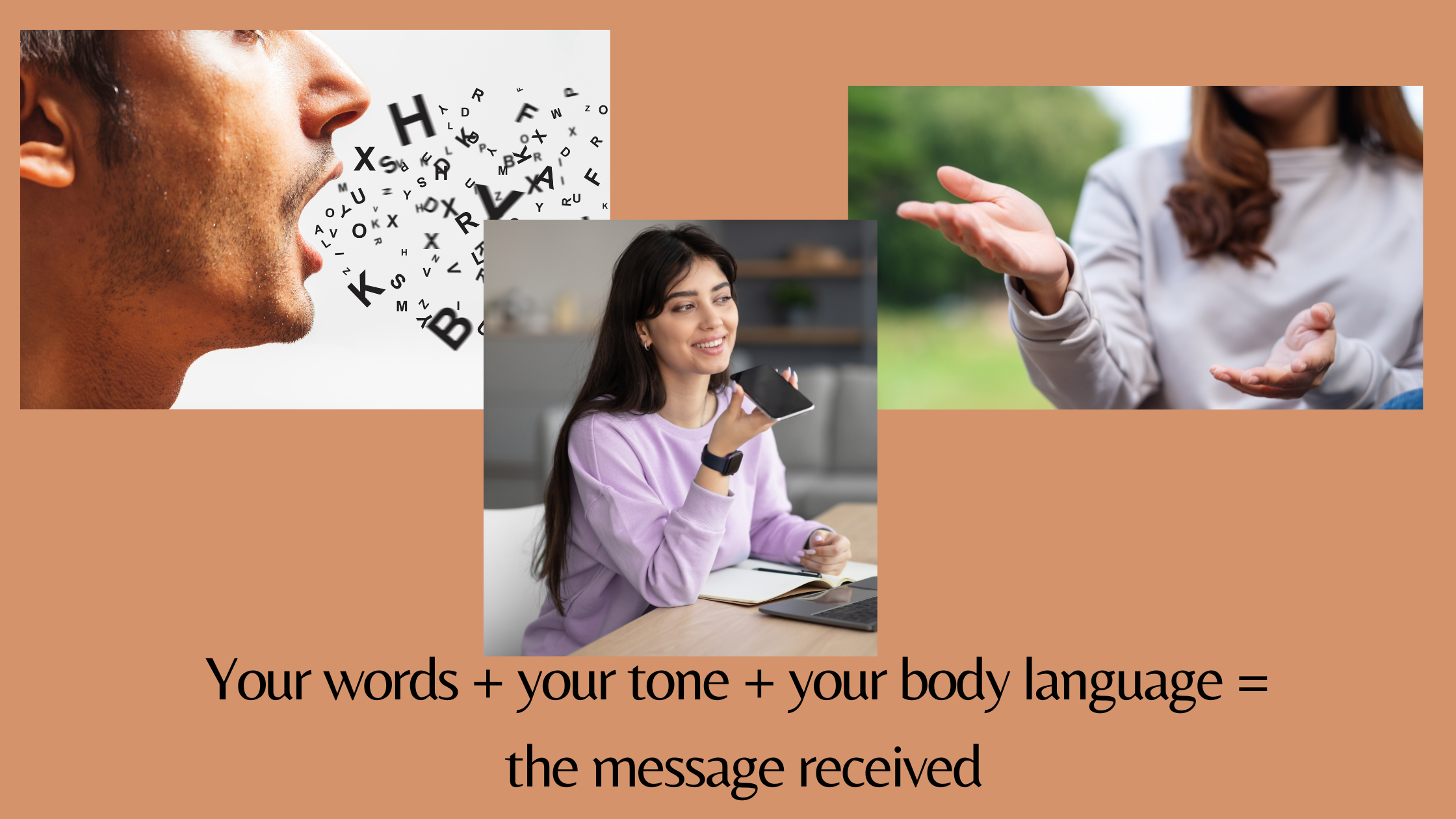
 Developed by psychology professor Albert Mehrabian in 1971, it states that “7 percent of meaning is communicated through spoken word, 38 percent through tone of voice, and 55 percent through body language.” It is astonishing to discover the words you use say only constitute 7% of what is taken in by the listener and more than half comes from your body language which involves your facial expressions, gestures, posture and eye contact.

Let’s try an exercise. Choose a sentence or two. Think of an emotion and then, saying the sentence out loud, convey that emotion using your vocal tone (pitch and pace). Repeat the sentence while thinking of another emotion. Let’s move on to body language by repeating the last exercise. Say the sentence with supporting body language. Now say it with contradictory body language. Can you hear the difference? Can you feel the difference?

Hopefully, most of the time, your voice and body language are aligned with your verbal message. The challenge is to be aware of times when the three or two of the three might not be in sync. To keep the communication channels clear, Luna offers these ways to ensure each of the ways you are sending the message you want:

Improving verbal communication: The practical ways

  • Clarity and brevity – Keeping it short and to the point is always safest. Everyone is pressed for time. Don’t clutter up your message. This is particularly important in speaking with your principal.
  • Intentional speaking – Think before you open your mouth. For important conversations, try mentally rehearsing your opening statement. Tell them what you most need them to know.
  • Eliminate filler words – “Uh’s, ” “umm’s,” and “you know’s” block the clarity you are trying to achieve. Rehearsing helps here, too.

The 38%: Using your voice effectively

  • Tone matching – Your tone of voice should match the message. The exercise you did with tone will help you keep them aligned. Don’t laugh off difficult news. Don’t assume good news will be met with more problems.
  • Pitch control – Speaking in a high pitch makes you sound nervous, which the listener may translate as unsure. Low pitches transmit confidence. Women’s pitches are naturally higher than men’s which give men an advantage here. See if you can modulate your tone lower. Also, ending your sentence with an up pitch sounds like you are asking a question, which is heard as insecurity with your message.
  • Controlled pacing – How fast or how slowly you speak can reduce the impact of what you are saying. Too fast and they may not hear every word. Too slowly and you might bore them, and they will tune out. Moderate is good for most things, with slightly faster speaking suggesting eagerness that pulls  listener in.

Strategies to improve nonverbal communication

  • Maintain eye contact – The expression “shifty-eyed” shows what happens when you don’t look someone in the eye. On the other hand, non-stop staring can make a person uncomfortable, too. Luna says “avoid doing it regularly. Instead, use eye contact as a gesture when speaking.”
  • Use facial expressions – Your face does most of your communication. A genuine smile goes a long way in getting your message heard. Do some mirror practice if you don’t feel confident with this. Head tilts also suggest interest, as does nodding when the other person responds.
  • Use purposeful gestures and open posture – You want your body to be loose and responsive to the content of what you are saying. When watching a program, see how the actors use gestures. Note how politicians use them in their speeches. Crossed arms say one thing. Hands in your pockets, another.

Save these suggestions, particularly the rehearsal ideas, for when you need your message to be as clear as possible. Whether it’s a meeting with your principal or a job interview, knowing how to communicate with clarity and confidence will have them hear and recognize you as leader you are.

Create the Culture to Make Your Library Thrive

How would you describe the culture of your library? It’s not a question we usually think about. Normally, we focus on purpose, Vision, and Mission, but this is a different way to look at what you are creating and how it is being received.

The Merriam-Webster online dictionary defines corporate culture as the set of shared attitudes, values, goals, and practices that characterizes an institution or organization.” Using this definition as a guide, you might say:

  •  The attitude of the library is that everyone is welcome here.
  • The values probably include intellectual freedom and a love of literacy and learning.
  • Your goal likely is to have students, teachers, and administrators view the library as a valuable part of their world.
  • Your practices seek to eliminate barriers to accessing the library.

If your answers closely matched the ones given above, are you certain this is an accurate analysis of your library culture? Manar Morales the author of THE FLEXIBILITY PARADIGM: Humanizing the Workplace for Productivity, Profitability, and Possibility (Georgetown University Press, 2025) collaborates with organizations to develop inclusive, flexible work cultures that cultivate diversity in leadership, foster a more humanized work experience and drive workplace well-being. In the business would, not being clear on the culture of your organization or having it misaligned leads to loss of engagement and productivity as well as higher turnover. How can we use this awareness to support our work?  

In her article “Work is Not a Place, Culture is Not a Location,” she recommends a process which can improve your culture, resulting in a flourishing, successful library. Morales starts by having you identify the following “4 ‘W’s that define culture:”

Who do you serve? – Your key stakeholders are your students and teachers. They are always primary, although there are others, including administrators, parents, and the outside community.

What do you stand for?- Your Mission Statement should drive your daily actions. What values do you hold and how can this be seen by others?

Why do you do what you do? – Beyond your library’s Mission Statement, this is your personal mission. Why are you a school librarian? What brings you back through the stress and challenges?

Where are you headed? – This is your Vision Statement. It is your inspiration and aspiration. It’s not fully realized, and may never be, but you should come closer and closer through your strategic planning.

By your answers to the 4 ‘W’s, you recognize that the library is just a room, a place, unless you can connect others to it. Relationship building is key to making the library thrive. How do you share those 4 ‘W’s with your key stakeholders in a way that connects them to the library and its value to them?

Let’s go back to the definition of culture.

What do you do daily to demonstrate the attitude that everyone is welcome in the library? On the simplest level, it starts with a welcoming smile. It also is shown by your connecting with classroom teachers and specials. Reach out to art, music, and physical education teachers. You will be amazed at what creative results you can produce together.

How are you sharing your values? Posters and displays send powerful messages. Visual images reinforce words. Are your Mission and Vision Statements posted where everyone entering the library can see them? And do your words (what’s posted) match your actions? If people feel a disconnect between what you say and what you do, they won’t feel connected to the library.

What barriers have you taken down? – Are your computers handicap-accessible? Have you eliminated fines? Does your collection include materials in languages spoken by your students? Have you taken surveys to find barriers you might not have identified?

One last step. How have you brought the library’s culture into the wider community? Have you created a way to keep parents informed about the library and students’ successes? Do they know about the accessibility? Are you and the public librarian working together on projects aimed at reaching students while informing the community? What contacts have you made with local businesses? Building connections and allies deepens and strengthens your culture.

Creating the culture that results in a thriving library is an ongoing practice. But isn’t this why you became a librarian? Look at where you are already succeeding and then take a first step to go either deeper, broader, or both. The results may embolden you!