ON LIBRARIES: The Myth of the Lonely Librarian

I have written about the stories we tell ourselves that hold us back from being the leaders we need to be, but there is one other that too many librarians believe.  They see themselves as isolated.  As the only librarian in the building, there is no one who understands what they do and what their challenges are.

As with the other stories, there is a surface truth but it is far from the whole story.  What’s more, believing it turns you into a complainer.  Even if you don’t express your thoughts to your colleagues, you unwittingly communicate your attitude and it sends them a negative message.

Yes, you are likely the only librarian in your school.  Perhaps you have multiple schools for which you are responsible. Possibly you are the only librarian in your district. But you are alone only if you choose to be.

There are others who are “alone” in their jobs.  The school nurse is one.  At the elementary level, the art, music, and physical education teachers have no else doing their job. Then there is the computer teacher—and the principal.  Have you ever considered reaching out to them and seeing if you can collaborate on a unit?

Years ago, I worked in an elementary school where the “specials” selected a theme and each of us worked with all the grades, bringing our area of specialization to having students explore the topic in great depth.  One of the projects was on marine life.  While I had classes research different aspects of the subject, the art teacher had them making murals and paintings of underwater life, the music teacher taught sea chanties and other sea songs, and our very creative physical education teacher devised a series of game and activities dealing with the underwater realm.

We had fun planning together.  It was a great opportunity to find out more about my colleagues as people as well as their individual knowledge and discover how it could all be brought together. The complete project culminated in an evening presentation that utilized the halls and gym.  The walls were covered with student art and along the way, students performed and shared their new-found knowledge of marine life. In the gym, there were exhibitions of the activities they had learned. Parents were enchanted and the students loved it. I met a number of them later when I was transferred to the high school and invariably mentioned the “special projects” they had been involved in over the year. I am sure they remembered these far more clearly than any class assignment they had.

You don’t have to do something on this scale although perhaps you can build toward it. Choose one of these teachers whom you think would most probably want to take on this type of project.  See if the nurse has a health-related project he or she would like to do. It could include decorating the nurse’s office.

The same is true with the computer teacher.  What specific applications is he or she is teaching students.  Can you come up with a real-life project where students would have to use those applications to present or track their findings?

And then there is the principal.  Granted it’s harder, but administrators in small schools are likely to be the “only” one doing the job, and it’s a tough one.  Could you help?  You both see the big picture, knowing all the students and teachers and the curriculum. Perhaps you can offer to do any research he or she needs. If you read Educational Leadership, the journal of ASCD (the high school should have a subscription or check your periodical databases), you can keep current with the trends in education.  Then share any information you get on those topics.

But what about how you do your job?  Nobody in your building gets that.  But your librarian colleagues do.  Social media has made it simple to connect to them.  There are a host of school library-related Facebook groups from LM_NET to Future Ready Librarians, to my own School Librarian’s Workshop.
Your state association is likely to have a Facebook group as well as a listserv.  Be part of it. Ask for help when you need it. Your state association’s conference is another important way to connect with colleagues. And if you venture out further there is the AASL biennial conference and ALA Annual. If you haven’t reached out before you will be amazed by how willing librarians, including the leaders, are to help others in the profession.

If you feel lonely in your job, it’s because you aren’t making use of all the potential connections.  What are you doing to connect and show you are part of your educational and library communities?

ON LIBRARIES: Giving Back

I know many of you take part in community service activities. You also give of your time to support functions at your school. Giving back is putting your thanks in action. It’s how you demonstrate your appreciation and your caring for others. Giving back to our profession is also important, and not enough of librarians do it.

(EDITORS NOTE: Much of this post comes from Hilda’s book, Leading for Librarians: There is NO Other Option from ALA Editions)

In becoming a leader you were helped along the way. A librarian mentored you or gave you some good advice. Your state and national organization provided resources from which you learned. No one emerges full-blown as a leader all on their own.
Once you have demonstrated your leadership abilities, are being taken seriously, and your program is regarded as vital to both student and teacher success, it is important to give back. Those starting out in our career need a trusted mentor. No one else in their building can do the job. Teachers and administrators assume new librarians learned everything they needed to know in library school. You know how far from the truth that is.


I blogged about Mentors in August of last year, but I will review some of the highlights.
Once you decide to become a mentor, you need to find a mentee. The first place to look is in your district. You know it’s vital that all the librarians are seen as leaders. If there is someone new, let them know you are available to help them over the rough spots.
If your state association has a mentorship program, join it. If it doesn’t propose one. You can get help in setting it up from other states that have done so. Go on AASL Forum and ask –or use LM_NET (or my School Librarian’s Workshop Facebook group). Get copies of Mentor/Mentee agreements to ensure that all participants understand their individual roles.


Your state association depends on volunteers even if they have a paid director and/or other positions. If you haven’t served on a committee as yet, volunteer to do so. If you have, step up to chair one. You might even consider running for an office. In addition to serving the librarians in your state, you will get recognition from your administration.
As a member of the board, you become aware of the state level political situations that affect librarians at the building level. You will see the scope of the challenges librarians are facing and become part of the campaign to make changes. Although you are doing this to give back, your own leadership abilities will grow as a result and it will impact your students and teachers.
Now take a deep breath and consider doing this on the national level. I am a very active member of ALA and AASL but you can also volunteer for ISTE or AECT if that’s your preference. I know some librarians who are active in AASL and ISTE, and they are recognized as leaders nationally as well as in their home states and school districts.
Working at the national level might seem intimidating at first but you will find everyone is welcoming and eager to help you settle in. It’s an eye-opening experience. You discover where challenges are similar across the country and what situations are developing that you haven’t seen in your state but now can be prepared to deal with them should they arise.
One of the unexpected benefits of serving at the state and even more so at the national level is what happens to your vocabulary. You develop a fluency in talking about the value of school librarians and what a strong library program brings to students, teachers, and the educational community. In talking with administrators and others you sound like the expert you have become. And you are taken much more seriously.
Some of you might have reservations about volunteering at this level because of the time and financial requirements. ALA has two meetings a year, Annual and Midwinter. ISTE and AECT have one. Their locations vary from year to year but inevitable require travel and sometimes days off from your job.
I consider the expense a professional expenditure, part of my job, the way I look at the cost of commuting to work or having an appropriate work wardrobe. For those who are already operating on a tight budget, ALA has a possible solution for you. You can become a virtual member and not be required to attend meetings in person. Much committee work these days is conducted on conference calls to get major tasks completed before in-person meetings.
These are all serious and important commitments as well as ways to give back on a larger level. Two quotes to keep in mind as you consider stepping up. The first is anonymous or attributed to several people with variations. “If serving is beneath you, leadership is beyond you.”
The second is also anonymous but was most recently attributed to Elizabeth Warren. “If you don’t have a seat at the table, you are probably on the menu.”
How do you give back? Are you serving at the state or national level? If you are not, what’s holding you back? What help do you need from mentors or other leaders?

ON LIBRARIES: The Many Layers of Diversity

An unquestioned tenet of librarianship is that the library collection will encompass diverse materials to meet the needs of all users.  Sounds good, but in practice this is not always easy to accomplish. There are challenges librarians must face along with difficult choices.

On the surface, a diverse collection contains fiction and non-fiction and all genres are represented in as many formats as possible. While it took a while in some places for graphic novels to be accepted, they now are in most if not all libraries. But there is far more to diversity.

As the liaison to ALA’s Intellectual Freedom Committee (IFC) from ALA’s Committee on Professional Ethics, this topic is on my mind frequently. Currently, IFC has a draft resolution in the works on Library Bill of Rights Interpretation – Equity, Diversity, Inclusion. In fully defining what those terms encompass, the draft is a strong reminder of what libraries stand for—and the challenging decisions implicit in this stance.

Here are some highlights of the document:

  • Books and other library resources should be provided for the interest, information, and enlightenment of all people of the community the library serves. In a school library, this means you can’t be limited to what the jobbers make available. If you need books in languages other than English (and Spanish), you need to seek out those publishers who have books for whatever ethnics are represented in your school. Fortunately, this information is becoming more widely available. Your collection should also include materials representing difficulties many students face such as homelessness, a parent in prison, a parent serving the military, foster homes, learning and physical limitations of self or siblings, and the stressful situations.  It’s important they see themselves reflected in the collection.  Those who have more traditional lives benefit from being made aware of their good fortune as well as developing empathy for their classmates.
  • Libraries should provide materials and information presenting all points of view on current and historical issues. Materials should not be proscribed or removed because of partisan or doctrinal disapproval. Although those working in parochial schools which have a strong doctrinal view on certain subjects do not have to adhere to this, public school libraries are expected to follow this principle. Among the “current” issues that can cause a school librarian to pause before ordering would be climate change and evolution. In some places a sizable group does not accept the general scientific viewpoint.
  • Libraries should challenge censorship in the fulfillment of their responsibility to provide information and enlightenment. This another area where it gets difficult for librarians, particularly those who are the sole librarian in their school. You are charged with meeting the needs of everyone in the school.  This means those who have same sex parents or are LGBTQ.  In some communities these topics are a red flag and are likely to bring forth challenges. It is easy to just not purchase them.  Who would know?  Your budget is limited in any case.  You can’t afford to put your job at risk.  All true statements. Each librarian needs to make a personal decision between doing what our ethics and philosophy require or taking the safe route. I can’t condemn their choice. But I do applaud and acknowledge those who face this head on.  We are supposed to create a safe, welcoming atmosphere for all our students.  Our LGBTQ students struggle to feel safe, in and out of school.  Countless adults have told stories of how important their school library was in giving them a measure of security and acceptance.
  • A person’s right to use a library should not be denied or abridged because of origin, age, background, or views. This is one is obvious, but it harkens back to the days of segregation. It’s important for students to know our history – the bad as well as the good- so they see injustice can be corrected. There is much nonfiction on the subject, but it’s in fiction—including picture books –that students can discover what it was like in those days, and develop empathy for those who lived then and extend it to those now who are targeted as being “other.”

It’s incumbent on every librarian to be familiar with the ALA Code of Ethics, the Library Bill of Rights, and the Access to Library Resources and Services for Minors. Protect yourself and your students by having a Selection Policy approved by your Board of Education. You can get help in doing so from the Workbook for Selection Policy Writing.

Also, celebrate Choose Privacy Week May 1 -7, and Banned Books Week September 24-30.

Have you been faced with a difficult choice in purchasing a book for your collection?  What did you do?  How do you make your library a safe, welcoming environment? What help do you need or can you offer to others?

ON LIBRARIES: Speak Up

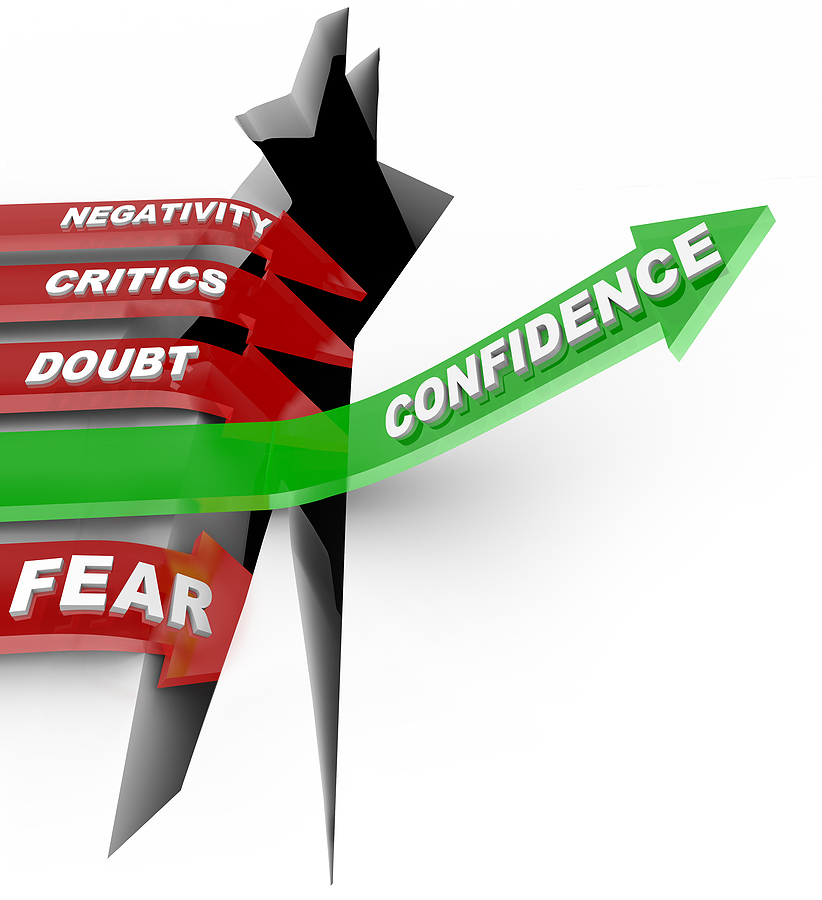
Fear. It’s the biggest roadblock to leadership.  Whenever there is an opportunity to step out of your comfort zone, your head starts running scenarios of what can and undoubtedly will go wrong.  It’s what’s underneath the Stories We Tell Ourselves.

When I blogged about it in October 2015, I acknowledged that speaking to colleagues, your administrators or in front of parent groups is not the same as teaching students.  You fear you will sound shaky, your knees will wobble, and everyone will know you are a fraud.  Certainly not a leader.

In that blog I was reassuring, pointing out the fear of public speaking is common and surveys have shown people fear it more than death. You don’t have to speak to large groups to become a leader.  There are many quiet avenues to leadership.  All that is true, but the more you become a presence in your school and district, if you step up to volunteer on the state or national level, at some point you will inevitably have to address a large group.

Before discussing strategies for coping with this fear, it might help to become acquainted with what often lies under the fear.  It’s something called The Imposter Syndrome and it mostly strikes high performing people—women more than men.  I have experienced it personally, and I know many of my colleagues who are regarded as leaders have moments when it hits them as well.

The Imposter Syndrome is the voice in your head that says, “What am I doing?  I am such a fraud, and everyone will know it.”  It happens when you get up to speak before colleagues and think, “Everyone knows all this.  Why should they listen to me?”  I heard those words in my head when I started writing books for librarians and thought, “Why would anyone take my advice?  I don’t have a doctorate degree. I have no formal research to back up what I am saying.”

The American Psychological Association in a post described it as it affected graduate students. They offer six ways to deal with it:

  • Talk to Your Mentors – If you don’t have one, speak with a trusted friend about your uncertainties. They will point to your achievements and remind you of why you have reached the place you are now in.
  • Recognize Your Expertise – In addition to what your mentor or friend said, reflect on your journey to this point. Recall what you have learned, the challenges you faced, and the solutions you found.  Others will benefit from your experiences when you share your knowledge.
  • Remember What You Do Well – We all have our strengths. It can be using social media or being ahead of the curve on current with technology. Me, I have learned a lot about leadership and advocacy.  We all have something to offer.
  • Realize No One is Perfect – You may see one of the leading librarians and think I am nowhere as knowledgeable. Yet that same leader has undoubtedly felt the Imposter Syndrome at time. As someone once said, “Don’t judge your insides by someone else’s outsides.”
  • Change Your Thinking – Your mindset controls much of your actions and behaviors. Remember, “If you think you can or you think you can’t –You are right!” Reframe how you are approaching the public speaking experience.  The audience wants to hear what you have to say.  If they didn’t, they wouldn’t be there.
  • Talk to Someone Who Can HelpThey recommend speaking with a therapist if the Imposter Syndrome is crippling, but I believe if you start small – doing a professional development workshop for your teachers or talking to a parent group, you can become more confident and trust that the Imposter Syndrome is just background noise you need to tune out.

But how do you deal with the basic fears you have about public speaking? There are loads of websites with advice on how to deal with it, further proof you are not alone.  Here are my tips:

Know Your Audience – In preparing your talk, consider what your audience already knows.  What do they need to know about the topic?  You neither want to overwhelm them with information above their heads nor do you want to talk down to them.  Think about how you prepare a lesson for your students. You always know where they are and where you want to take them next.

Rehearse Your Speech.  Don’t memorize it.  You will panic if you forget a line. PowerPoint presentations help keep you on track.  Don’t use text heavy slides, they overwhelm everyone. I mostly use only a few words to highlight the point I am making.  I also have notes for each slide, but I allow myself to digress and add comments that strike me in the moment.

Be Personal. As appropriate, share your personal experiences.  It’s an extension of your relationship building.  By letting them know who you are, they are more accepting of what you are saying.  Think of it as a variation on “They don’t care how much you know until they know how much you care.”  I have let my various audiences know about my failures as well as my successes.

Arrive Early – You need time to breathe. Check the layout of the room.  Make sure any equipment you need is set up and working – including internet connections.  Greet those who are there.  This means you won’t be speaking to strangers. They will be rooting for you.

About That Shaky Voice – Once you are past your opening, it will disappear.  And your audience never knows you are that nervous.  Have some water nearby.  Take a drink now and then.  I have had people fall asleep.  I tell myself it isn’t me – they were tired before they got there.

What’s been your experience with public speaking? Are you afraid of it?  Do you have the Imposter Syndrome at times?  When does it show up?

ON LIBRARIES – Are You Future Ready

Leaders look to the future.  They know what is good today won’t be so tomorrow, and they recognize as Jim Collins has said, “Good is the enemy of great.”  If you are pleased with what you are doing but not looking to make it better you can never be great.  With this in mind what does it mean to be “Future Ready?”

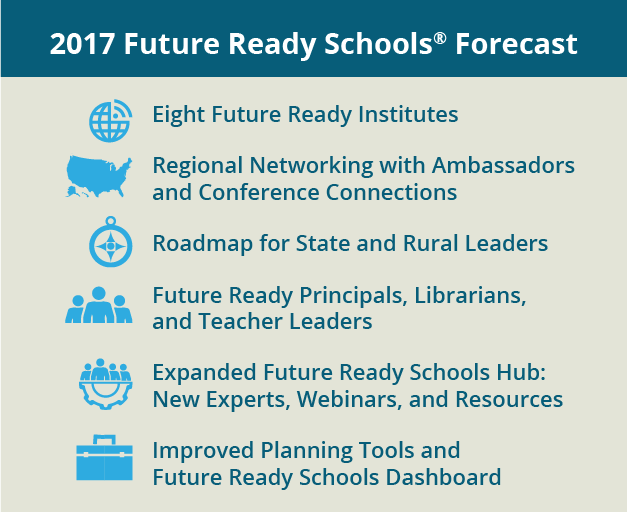
Future Ready is not an empty phrase.  It has a solid foundation and is continuing to develop. Launched by the U.S. Department of Education’s Office of Educational Technology in November 2014, Future Ready Schools . The homepage urges school superintendents to take the pledge to have their districts make a commitment to implement meaningful change “towards a digital learning transitions that support teachers, and addresses the district’s vision for student learning. Over 3,100 superintendents have made that pledge and you can check to see if yours is one.

The homepage is rich with resources, not the least of which is the Interactive Planning Dashboard which walks participants through a 5-step collaborative planning process. What I particularly like is that this process offers a “comprehensive approach and an action plan for implementing digital learning before purchasing anything, ensuring a smoother implementation and digital transformation.”   The page has the ability for the team to save all their work in a password protected format making it easy to revisit and update goals, strategies, and implementation plans.

What has me excited is on the homepage there is a link to Future Ready Librarians. It says, what we have always known, that “School librarians lead, teach, and support the Future Ready Goals of their school and district in a variety of ways through their professional practice, programs, and spaces. If properly prepared and supported, school librarians are well-positioned to be at the leading edge of the digital transformation of learning.”

Follett formed Project Connect which is designed to help librarians work with their district leaders in creating Future Ready Schools and in so doing firmly position themselves as leaders. To this end they have developed online courses to “promote innovative models of school libraries|, and help librarians “cultivate powerful library and school leadership … with a future-ready approach.”

Future Ready Librarians came into existence in the summer of 2016. Follett is one of its strong supporters, and the indefatigable Shannon McClintock Miller has been named a spokesperson for it. On the homepage you will find a link to her presentation “What Does It Take to be a Future Ready Librarian.” In it, she explores the exciting challenge of Future Ready Schools.

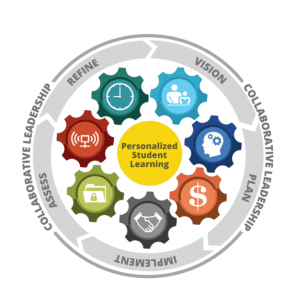
So what does it specifically mean to be Future Ready? The core of it is shown in the Framework, consisting of seven “gears” surrounding Student Learning, which is at the center. (Changed to “Personalized Student Learning” in the framework for Future Ready Librarians—which is what we have been doing all along.) The gears and how they translate into the school library (and I borrow extensively from Shannon McClintock Miller’s  presentation) are as follows:

  • Curriculum, Instruction, and Assessment – You become a partner with educators to design and implement an evidenced-based practice curriculum integrating deeper learning critical thinking, information literacy, creativity, innovation, and technology. (Big job)
  • Use of Space and Time – For school librarians this means designing flexible, collaborative spaces. Learning Commons are perfect for this, but you can achieve this goal in steps by taking a fresh look at your floor plan and seeing how furniture and shelving can be made mobile. Get help from high school design classes.
  • Robust Infrastructure- In the library, you advocate for equal access to digital devices and connectivity in support of the district’s strategic vision
  • Data and Privacy – Teach and promote student privacy.
  • Community Partnerships – In addition to developing partnerships within the school, reach out to the community including parents, public and academic libraries, and businesses to promote engagement and lifelong learning.
  • Personalized Professional Learning – Provides personal professional learning to develop awareness/understanding of the skills needed for success in a digital age.
  • Budget and Resources– Leverages and understanding of school and community needs to advocate for the digital resources needed to support student learning.

Collaborative Leadership is an extra gear in the Future Librarians framework.  It requires you to lead beyond the library.  As I have been saying, if you stay in your library, no one really knows who you are or what you do. Participating on district committees is vital. One of the most important is any that sets a vision and creates a strategic plan for digital learning.

What can you do if your Superintendent did not sign the pledge and you are not in a Future Ready School? Talk to your principal. Show him or her the Future Ready Schools site and all the supportive resources it has.  Suggest joining the Future Ready School Facebook group. Offer to do a brief presentation on it at an administrators’ meeting. (Definitely moving out of your comfort zone – but being a leader.)

Choose one or two gears that call to you and start working on them while you advocate for the district to become Future Ready.  Join the Future Ready Librarians Facebook Group and attend the webinar Leading Beyond the Library on April 11.

Are you a Future Ready Librarian?  What are you doing to show it?  If you aren’t, what will you do to become one? How can I and other librarians support you?

ON LIBRARIES – Risk and Reward

Leaders take risks.  You are all aware of that, and that awareness leads to something we don’t like to talk about.  In 2015, I blogged about the Stories We Tell Ourselves. I skipped a big one.

The story we tell ourselves is that if we take a risk we’ll embarrass ourselves so badly we won’t be able to face our colleagues and administrators.  It could even potentially cause us to lose our job. And that story is the secret reason why some librarians avoid taking on the challenge of leadership.

Fear of failure can be crippling.  It keeps you from growing.  Oddly enough, the converse is an equally big barrier—fear of success.  If you are successful, people will expect you to continue to do more.

And just like the other stories, it is only that —a story.  No one is suggesting you suddenly decide to campaign to redesign your library as a learning commons if you have never done anything to make your presence known in your building, but you do need to take some first steps.  You do need to build some “street cred” first.

Start small. Share your knowledge of new web and app resources by sending weekly emails to teachers describing just one, explaining how it could be used, and offering to provide one-on-one help for them to learn it.  Include your principal in the email. You may not get any takers at first, but eventually one will click with a teacher.  Slowly, teachers will begin to recognize the help you can give them.

There is no risk in doing that, but two important little goals have been achieved.  You have stepped out of your comfort zone, and teachers begin to take you into consideration when planning a unit. And those two accomplishments are the first building blocks of that very important “street cred.” Look for other no-risk or minimal risk ideas.

Try a book club.  If you don’t know how to do it, ask your library colleagues on your state association’s listserv or other places where librarians help each other. LM_NET is the big one, but there are many more.  Once you know what you are doing, speak with your administrator before putting it in place. Explain your goal for the program, how you plan to run it, and acknowledge there is no guarantee it will work but is worth a try.

If you launch the club, send updates on activities and accomplishments to your principal. Include videos of the kids discussing the books.  Now you have demonstrated your value to the administration.  And your reputation as a leader begins to grow.

Then it’s time to take a few bigger risks. Gardening projects have proved very successful at the elementary level.  There are connections to STEAM and the produce can be given to the cafeteria, to food banks, or a local shelter depending on what seems best for your community.

Other low- risk projects include starting Hour of Code or a Makerspace. For either of those ideas, you can get all the help you need in organizing it from other librarians. We are an incredibly supportive profession.

These early risks build your confidence and you can begin to look for other possibilities. Are you thinking of genre-fying your collection?  How about a Skype author visit?  What about a joint project with students in another school district—or country? Before long you might even be ready to turn your library into the learning commons that had seemed an impossibility.

Being a building leader is vital.  If you and your program are to thrive you must demonstrate you are invaluable to the entire educational community.  Now that you see that risks don’t result in those disasters you imagined, you can step even further out of your comfort zone.

Take your place among leaders.  There is always room for more.  Choose one of your new successful programs and write a proposal to present it at your state conference.  You may think it’s been done, but there are always librarians who haven’t tried it, and you bring your unique perspective to it. If it’s selected let your principal know.  It will build your reputation even further.

Serve on one of your state association committees.  Better yet volunteer to do the same in AASL or ISTE. Although it’s too late for this year’s AASL Conference IdeaLab, start planning to do it in two years at the next AASL conference.  You would be in a large room with many other librarians all presenting their best ideas. You talk one-on-one with those who stop and want more information.  Totally non-intimidating.

The first step in becoming a leader is deciding to step out of your comfort zone.  Every leader has done so.  I still take on challenges wondering how I am going to do it, but somehow it almost always works.

Have you stepped out of your comfort zone?  What did you do?  What was the result? Where do you need help?


ON LIBRARIES – Effective Feedback

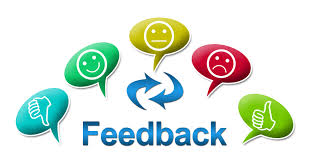
Feedback, in essence, is evaluation.  When given at the end of a project or unit, it’s summative.  When it occurs while the learning is taking place, it’s formative. While both are important, formative evaluation is the most effective, giving the receiver of the information a chance to correct any mistakes. Both, of course, have their place.

It’s best to provide feedback as rapidly as possible. The longer it’s delayed the more distant the learner is from the event, making it difficult to integrate the information in a meaningful way. However, time is only one factor.  The feedback also needs to be meaningful.  Whether you are correcting a written paper or making comments as students are working, what you say should be focused and specific.

“Good job” is not specific feedback. It’s nice to hear but what does it mean?  Far better to add, “Your conclusion clearly sums up the issues and the points you raised.” This is something that can be used in the future.  The learner can see what is considered to be a good conclusion. 

For most people, it’s more challenging to make a negative comment, but these can be even more valuable, especially when the project is still underway.  Saying the sources selected are not authoritative and suggesting the student review the criteria for finding such sources points makes the feedback a learning experience and provides a direction for success.

Don’t overlook receiving your own feedback.  It’s important that you have an accurate picture of how your lesson or a complete project went.  As you see what your students have done and given them constructive feedback, identify what concepts they are getting and which ones are causing them difficulties.

Reflect on this information.  Why were you successful with the concepts they understood and integrated? What kept them from getting other concepts?  How can you reintroduce the difficult ones so they are learned?  And how can you teach it differently in the future so you need not review it from another perspective?
Exit tickets are another way of getting feedback from students.  Come up with thoughtful questions to ask and give the class time to reflect on their responses before ending the lesson. Don’t make it too complicated but give them the chance to decide what they want to let you know.

For example, you can have one box of exit tickets that say, “The most important thing I learned today was….”  A second box of cards might ask, “I’m confused about….,” while a third set has the statement, “I’d like to know more about….”  When students get to choose which card they wish to complete you will get more relevant responses.

Don’t get defensive or upset about getting many “I’m confused about…” cards.  This is your opportunity to refine your teaching.  In addition look carefully at the ones answering “The most important thing I learned today was….”  Are the statements only surface learning?  Did they receive an Enduring Understanding?  Did they deal with the Essential Question? If not, how can you better focus your lessons?

You also need to get feedback from the teachers with whom you work either collaboratively or cooperatively. Don’t just ask, “Did the lesson I gave go all right?”  You most likely will get back a reassuring affirmative answer.  Like, “Good job,” this doesn’t tell you anything.

Although it’s more difficult, and sometimes painful, ask the hard questions to learn how to improve your instruction.  You can start out by asking what they think worked for them and the students and then follow up with, “What didn’t?  Was there something I should have done differently?”

I once did a unit with a general science teacher on composting.  She was passionate about the subject and knew what she wanted students to discover.  I thought I did a great job with the first lesson, but when she got back the initial reports from students they hadn’t located relevant sources.  As is so typical, they grabbed the first two hits.  Even though they had used a database, their searches were not sufficiently refined to target the key ideas.

I retaught the lesson and students did better.  The teacher also realized how she could frame the assignment better.  The following year when we taught it again, the students did much better.  Because they did, the teacher saw ways of continuing to improve the lesson.

Incorporating regular feedback in your dealings with students and teachers will help you do a much better job and improve your students’ learning.

Do you give and get feedback regularly?  How?  Do you use exit tickets?  What are your best questions?

ON LIBRARIES: Start With Emotion

Since the 1990’s education has focused almost exclusively on cognitive learning as high stakes tests became a nationwide obsession.  Along the way, we forgot that emotions are at the root of everything we do, and that means it affects learning.  It is time to review what we once knew and see how it can be implemented today. (EDITOR’S NOTE – Our images are larger than normal so you can see the details in each)

Maslow’s Hierarchy of Needs – In 1943, Abraham Maslow proposed his “Hierarchy of Needs” in an article entitled “A Theory of Human Motivation.”  All of us learned his pyramid during our educational studies, and if you were like me, you wondered whether you had achieved “self-actualization” which is at the pinnacle of the pyramid and if you are truly all you can be.  It’s what we want for ourselves and for our students.

To reach the top, Maslow said you needed to fulfill all the other lower levels of the hierarchy in your life.  Educators have long recognized that if the Physiological Needs of students such as shelter and food aren’t met students’ ability to learn will suffer.  And the efforts to eliminate bullying speak to the Safety Needs required for learning. There has been less appreciation for the importance of Love and Belonging.

As a librarian, you can’t provide family or intimacy, which are components of Love and Belonging, but you can focus on friendship, in this case meaning you show you care about the student. The safe, welcoming environment you create in your library addresses the Safety Needs along with the Love and Belonging Needs.  Once students find the library is a safe place, they are open to your interest in them as a unique person. Some of the students you reach out to feel alienated in the general school population for many reasons and so are prone to loneliness which can lead to depression.

Most important, in my opinion, is the need to build students’ Esteem. The overtures you make help them realize their self-worth.  This gives them the impetus to believe in their ability to tackle a task and succeed.  When you can do this, you have given that student a gift of inestimable value.

Bloom’s Taxonomy – In 1956, Harold Bloom published his Taxonomy of the Cognitive Domain and followed it in 1964 with the Taxonomy of the Affective Domain. The Psychomotor Domain was released in the 1970s.  We are all familiar with the Cognitive Domain which has been used in developing higher order thinking skills, but since the 1990s we have ignored the Affective Domain as too “touchy/feely” and besides it can’t be reflected in high stakes test. This has been a serious error.

What we ignore is that the Affective Domain is emotions-based and therefore affects how students approach learning.  Big Dog & Little Dog’s Performance Juxtaposition provides a list of the categories of the hierarchy with examples and verbs associated with each level. In many ways, the Dispositions in Action and the Responsibility strands in the AASL Standards for the 21st-Century Learner reflect this domain, but there are librarians still focusing almost exclusively on the Skills strand.

What I hope you see is that the Affective Domain puts emphasis on students’ response to the material.  It gives you ways to guide them into making a connection with it. And the strongest connections are those that tie to emotions.  We all have seen how students’ beliefs about a task or subject affect their success.  “Whether you think you can or think you can’t – you’re right.”

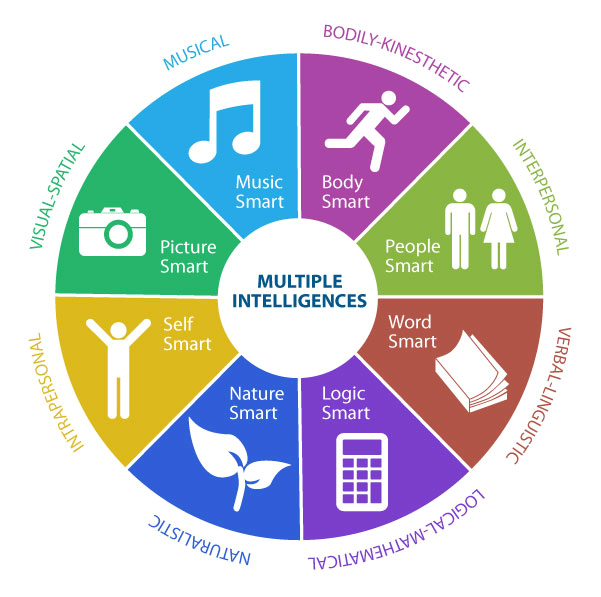
Harold Gardner – In 1983, Harold Gardner developed his theory of Multiple Intelligences Originally there were six intelligences which have subsequently been expanded to nine and there may still be more.  It was a revelation at the time to discover there was more to intelligence than Verbal/Linguistic and Logical-Mathematical.  He observed that excelling in either or both of those intelligences were not a good predictor of success in life.  Yet those two are still the prime focus of our testing.

Indeed, having high Interpersonal Intelligence was a far better indicator of success. Those who had high Interpersonal Intelligence have the “capacity to detect and respond appropriately to the moods, motivations, and desires of others.” Does that sound at all familiar?

Those skills are aligned with Emotional Intelligence which I have discussed in the past.  It’s imperative for leaders to have a high EI and continue to work on improving it.  Success in life is strongly rooted in understanding and managing emotions.

Most of our decisions are based on emotions (studies put it as high as 80%). If you can identify a student’s or adult’s emotions about a given topic, you can determine the best way to reach them.

The works of Maslow, Bloom, and Gardner were all published in the last century and, sadly, we seem to have forgotten their universal relevance. When business discovered Emotional Intelligence a decade or so, a shift back began to occur. It’s taking longer to fully reach education but some schools are beginning to see value in integrating emotions into teaching.

Education Week had an article on “How Students Emotions Affect their Schooling.” There are many more articles on the topic.  Emotions are more than just a series of faces we add to texts and posts. Isn’t it time you began incorporating it into how you work with students?  Are you already doing so?  What successes have you seen?


ON LIBRARIES: To Do and To Don’t

I am very disciplined.  Usually.  And sometimes I am not. I have a feeling many of you share this duality, and I think there is a good reason for it.

Back in August, I did a blog called A Matter of Time. In it I discussed time management techniques to keep you from getting overwhelmed.  I advocated various forms of To-Do lists to keep you on track, recommending you find one that works for you.

And I certainly have a To-Do list.  I couldn’t function without one, yet there are some days when almost nothing gets checked off.  I used to become upset with myself for being so unproductive and not completing all those important tasks.  But I have come to realize it isn’t all bad to take time off.

I have found I am most likely to procrastinate the day after I have been extremely busy and productive.  It’s as though my mind and body are sending a signal they need to recharge.  And we do.  We can’t keep draining ourselves.  There is a cost.

Most of us have numerous obligations outside of work.  Whether it’s getting kids to sports or other activities, preparing dinner, doing laundry, taking care of the lawn, or shopping.  The list is long.  Consider what happens to your attitude and your patience when you have been on the run for days on end.

When you have been going full tilt on your job, you are likely to get impatient when you are interrupted, whether by a student or a teacher.  And yet, our jobs are full of interruptions.  It’s who we are and we want people to know we are there to help them.  I once wore a button that said, “Please disturb me.”

You know by now the importance of building and maintaining relationships.  They are key to our success.  The last thing you want is for teachers and students to think you don’t have time to respond to their requests.  You can destroy a relationship much quicker than you can build one, particularly if it isn’t well established.

There’s also the matter of burnout.  When you keep going without a break, you stop enjoying your job.  As I have said, much of our communication is non-verbal.  Your exhaustion sends a message that you are uninterested.  And that definitely you don’t want to be disturbed.

Worse, discipline problems in the library will increase. Students who are at loose ends because they didn’t think it a good idea to ask for assistance can get into trouble quickly.  Then there are those who love disruptions and recognize a great opportunity to set you off. Usually, you are able to distract them and prevent most problems.  But not when you are in overload.

Yes, when you get back to your usual helpful demeanor, people begin approaching you.  But if you spend too much time in that harried place, you may find fewer teachers dropping by to see you and ask questions.  Students will not risk a rebuff. What you need to do is recharge.

ticking now on check boxes on blackboard

You will have to focus on high priorities.  Classes must be taught, but you can scale them down.  At the elementary level, instead of a major lesson, consider having a coloring day, and join the kids.  More and more adults are discovering what a de-stresser that can be.  And the kids can use that too. At the end of the class, discuss if they liked the activity and why.

In upper grades, let kids research on their own and walk among them seeing how they are doing.  Ask them about what they are finding.  Close the period by having a group discussion on how successful they were and what they can do differently.  It’s a good self-assessment lesson.

For those of you who picked up the challenge of leadership, you may have been thinking that this is why you didn’t want to become a leader.  It is too time-consuming.  However, leaders must learn to set an example for others.

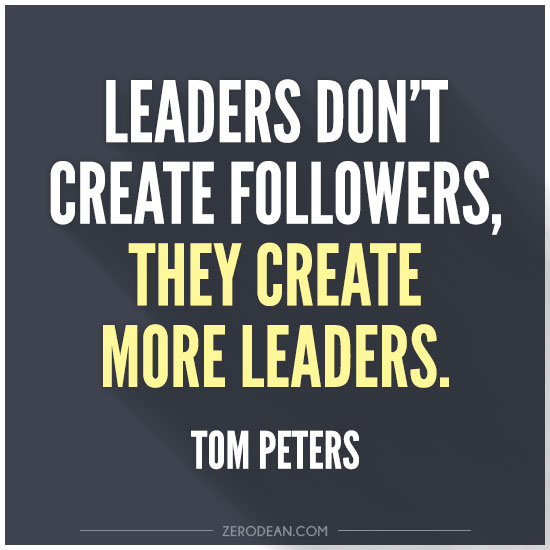
Among my favorite quotes is the one by Tom Peters, “Leaders don’t create followers, they create more leaders.” If a leader is seen as being exhausted and constantly in motion, no one will want to emulate them.  You need to show the rewards of leadership.

So ask for help. It may take time before you can figure out just what you need, but you will also be giving someone the opportunity to see what leadership entails. Librarians don’t usually know how to delegate, and if you are accustomed to being in control, it’s hard to give some of that up.  But the benefits are worth it.

Don’t overlook how your being overwhelmed affects your family and personal friendships.  Even if you are able to be your usual wonderful self on the job, when you get home you are not anywhere near your best for them.  Much as you love being a librarian, your work should not be the priority in your life.

You need to live a balanced life so you maintain your joy. Moments you chose not to spend with family and friends because you had “too much to do” can never be recaptured.

To rejuvenate look for small ways to procrastinate.  There are several things I do.  I play solitaire on my computer or spend time on Facebook.  As long as I keep an eye on the clock, the “away time” lets me return with new energy.

My favorite downtime activity is taking a walk.  It clears my head.  I can figure things out so much better than when I am on the computer.  Most of my blog ideas and how I am going to discuss them are figured out while I am walking.  At the same time, I stop and talk to people walking their dogs or take note of the change in season and how the trees and plants are changing.

I also make sure to see my friends on a regular basis.  I work at home primarily, but when my son comes over I stop what I am doing.  I have learned the task will get done.  It always does.  And cherishing the joys in my life helps me do a better job in completing them.

What gives you joy?  How are you living a balanced life?

ON LIBRARIES: Why Are You a Librarian

whyIt’s not a question we are often asked, and we almost never ask that of ourselves.  But it is a worthwhile exercise, particularly when you feel stressed by your job and the world.  As Socrates is attributed to have said, “The unexamined life is not worth living,”

In my own case, I became a librarian because I needed a job, and it was available. I was graduating from college and getting married.  I needed to know where I would be working so my future husband and I could find a place to live.  The superintendent of schools who interviewed me was desperate to find a librarian. I had worked as a page in the public library for two years, and I could get an emergency certificate attached to my new teaching license.socrates

Not a very good reason for becoming a librarian, but despite being terrible at the job, I realized I truly liked it. So I continued going for my masters even when I was justifiably not rehired at the end of the year. I found another job as a librarian and began to get better at what I was doing.

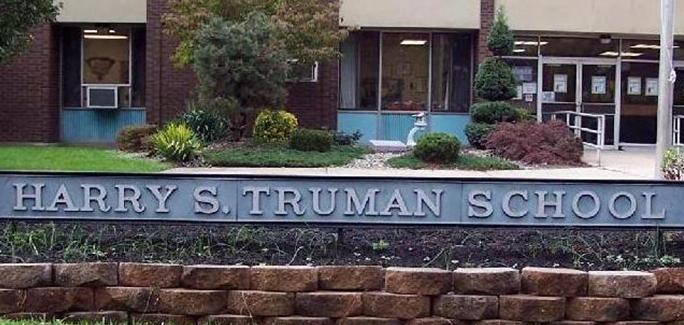
truman-schoolAfter taking several years off to raise my children, I looked for another library position as soon as they were ready to go to school.  Although I had trained to be a high school teacher and my first jobs were at that level, I was happy to find something in a brand new elementary school.  The school was unusual and it gave me a new “why” for being a librarian.

As an elementary level novice, I learned from the teachers. And that is how my next “why” came to be. I discovered how being open to what teachers could show me made them willing to learn what I show them.  The collegial atmosphere bred collaboration.  I was a librarian because I could help teachers do a better job.

My professional growth continued when I decided to go back to school for additional graduate courses. Because I was going for a Supervisor certificate I met librarians who were looking to become leaders.  I also met Ruth Toor, and as a result of the course, we wrote our first book, The Elementary School Librarian’s Almanac.

My career continued and my ‘whys” evolved.  The reactions of my students to the help I offered made me realize they were a central reason for why I was a librarian.  The better I got at my job, the more they appreciated what I could teach them.

I am extremely active in ALA/AASL and this too has affected my “why.”  I am a librarian so I can be a resource to other librarians.  I do so through mentoring, the books I write and the workshops I give.  But we are all resources for our colleagues. question-2

I also now recognize that I wasn’t aware of another “why” when I was working in schools.  By my interactions with students, teachers, and administrators I was making a significant contribution to the whole school community.

My experiences and the research has led me to in essence share why I am a librarian with just about everyone I meet.  Whenever I can, I let them know the value of school librarians.  And even though I no longer work in a school library, I am still a librarian.  And I know why.

Yes, your “why” will change over time.  It will continue to change if you are open to the possibility.  When the “whys” are positive you become even better at what you do.

What are your “whys” and how have they changed?