
Hope is Powerful

What did you think when you read the title? Did you agree or is it something you generally don’t believe. Hope, while considered positive, is often thought of as a passive thing and reserved for something you don’t think will become a reality.

But consider your Vision Statement. Is that something you hope for? And yes, it isn’t currently your reality, but if you don’t believe it is possible to achieve, you will never reach it. The truth is, as cliché as it might sound, if you believe it, you can achieve it.

So how do you make hope happen? Strategy.

Hope, according to studies, is characterized by Goals, Pathways (the way to to goal), and Agency (capacity to get the goal), In her article, What Leaders Misunderstand About Hope,  Paula Davis provides strategies for using these in four parts. I have added my interpretation for our education world.

Provide role clarity – You aren’t leading a team, as Davis discusses, so the clarity is for you. What is your supposedly unachievable goal? Why is it so important? Who will benefit? Who are your potential allies? This will help you focus on a path, however slow, to reach your goal – your Vision.

Use micro-goals to build momentum – When the end is so far away, it is hard to believe you will get there.  Keep your hope alive by looking for milestones and for small wins to celebrate. When I am walking, I frequently have micro-goal to keep me moving. It is sometimes as small as getting to the next driveway. Consider this sample Vision. “The Library Media Program cultivates independent, lifelong readers fosters critical thinking skills, teaches the effective and ethical use of information sources, and promotes equitable access to all forms of information media.” What have you done that shows your students are actively doing leisure reading? What learning experiences have you taught that shows students are using information sources ethically?  These are your micro-goals.

Track progress – Notice what you’ve achieved along the way, the bricks that are building this path. For me, keeping a success journal reminds me of what I have achieved and inspires me to continue. If it helps, celebrate these successes by sharing them. Include it in reports to your principal and show them the progress being made. Share it with your PLN. The more widely you share it, the better you will feel and the easier it will be to believe your hope will become a reality.

Find mastery experiences – Davis says when you learn new skills, it changes what you believe you are capable of doing. Learning by doing is a powerful contributor to success and builds hope. Look to webinars offered by your school library professional associations or from some library specific social media can give you the opportunity to grow.

These are stressful times for librarians, in out of the library, and it’s hard to hold onto hope. Make working on getting closer to your Vision a priority remembering that hope can boost productivity. Seeing what you can accomplish may stir what was a dying ember of hope back to life. Remember to track and celebrate your achievements, even when small, and keep your administrator informed so they see you as the leader you are. I don’t hope – I know you can do this.
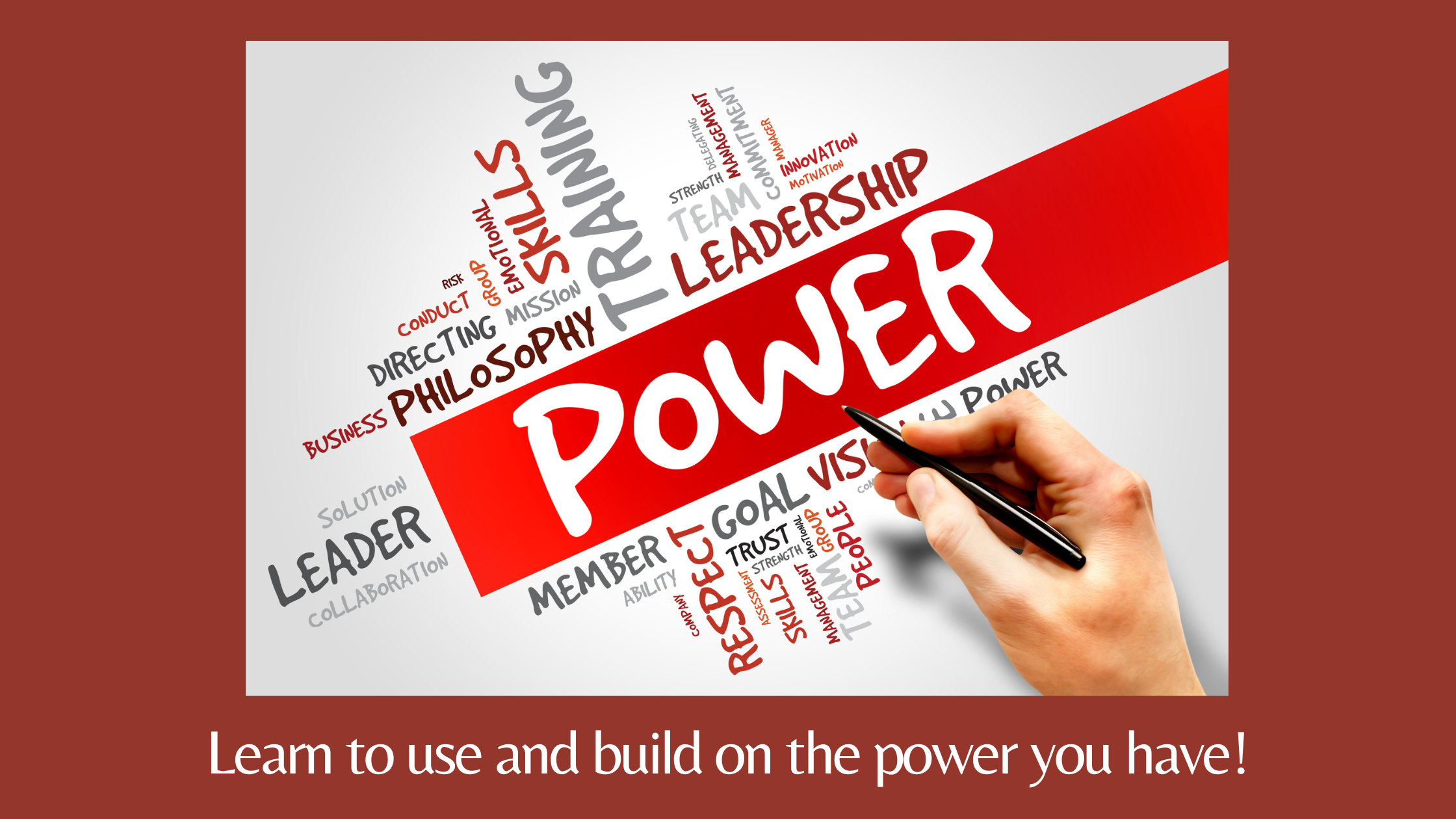
You Have Power – Use It!

All too often, school librarians feel and act as though they don’t have power. We do. And the first step to using it – is recognizing it. Consider today’s blog a refresher and a reminder.

The power librarians are speaking of when they say they are powerless is Power Over. It comes from a position someone holds and is authoritarian in nature. It is used to control. Much of the time it is used (even by teachers and librarians), it indicates uncertainty and lack of confidence. It can also be uncomfortable to use.

Power Over does not work for us. It suppresses initiative, produces resentment, and, in some cases, rebellion. It certainly does not lead to the safe, welcoming environment you want to create in your library. You have far better types of power to cultivate and use.

Paul Thornton in his article, Maximize Your Power and Effectiveness, identifies three types of power and offers advice on how to use them. I have added my suggestions on how they work best in our world.

Position Power – This is Power Over, but refers to what is in your control. For example, you create your budget. Although it is subject to administrative decisions, you identify what the library needs are. You, hopefully, have some control over your curriculum.

Tips for gaining and using your position power:

  • Consistently deliver high-quality work and exceed expectations – Make sure your administrator is aware of what you are doing and how you are delivering.
  • Make decisions that align with the organization’s strategy and values – Create your Mission with the goals of your principal in mind. In your reports to them, connect your work to their wants and needs.

Expert Power – You have a large body of knowledge about how the information is organized, information literacy, information technology, and factual and fictional reading. You are a resource for teachers and students. To increase this power, Thornton says:

You can gain expertise by

  • Acquiring degrees, certifications and other credentials that reinforce your expertise – Your state library association as well as AASL and ASCD offer webinars on topics to keep you at the peak of your game.
  • Taking on challenging projects. Learn by doing! – It may be scary but it builds your knowledge base. Present an author visit. Plan a library renovation. (Lots of preliminary work with your administrator). Your PLN will be a great resource for you.
  • Attending conferences to keep your knowledge and skills up to date – Your state and national library associations usually have an annual conference. They not only serve to expand your knowledge but they help you build your PLN. Plan to attend the next one. Remember, there are more virtual opportunities for this all the time.
  • Working with mentors and other experts to benefit from their insights – Before and during the challenging project, look to find a librarian willing to be your mentor. It could be someone who presented at a conference or taught an online class.

Personal power – Sometimes called charismatic power, this is about being likable. It is linked to your social and emotional intelligence. When you have it, people like being with you, which translates into teachers collaborating with you and principals appreciating your contributions. Thornton suggests these actions you can take to increase your personal power:

You can gain expertise by

  • Learning to eliminate distractions and be fully present with people – Work on your active listening skills.
  • Being approachable and show genuine interest in others – While in informal interactions with teachers and administrators, listen for where their passion is. Ask questions. Note any hobbies they have. You might then send articles or new books on them. This is also good advice with students.
  • Understanding and responding to the emotions expressed by others – This is an extension of the previous action. Notice body language. I once recognized a teacher’s distress by how she was walking and holding her head. It lead to a much stronger relationship.
  • Command attention with poise and authenticity – Now look to your body language. Does it show your confidence?

Power can be used or abused. Guess which one works to build you as a leader and move your Mission forward? Work on strengthening the ones you are good at. Seek to improve the ones in which you are weak. Leaders need to embrace and grow their power.

To-Do’s to Make You A Better Leader

Librarians are lifelong learners which is key to supporting and growing our programs. We learn about the latest tech and the newest books for our students. We learn about the ways they take in information and how we can support them to be critical thinkers so that they keep an open mind and are also constantly learning.

What we don’t often focus on what we need to learn to become better leaders. The vision of AASL is “Every school librarian is a leader; every learner has a school librarian.” It is incumbent on us to be the best leader we can be. The better we become at leading our school community, the better we can do all the other things that are our high priorities.

To lift your leadership to the next level, consider using David Durand’s Four Daily Habits That Separate Giants From the Pack. Here are his recommendations with my modifications for our education world:

Daily habit 1: Bring your thoughts to life with action

If you think it, write it. In the course of your busy day, you may have a passing thought of a possible change that would address a problem or increase the reach of the library. Lock on to it. As soon as you have time, record it digitally or manually.

Review your list regularly to identify which of your ideas needs to or can become a reality. Start the planning process with action steps, including start and by-when dates. If it is a big project, such as developing a new strategic plan, begin with your Mission Statement, then look at who will be involved, what needs to be done, and how you will assess it.

Daily habit 2: Find concrete reasons to believe

It’s too easy to say the idea is “pie in the sky” and will never happen. Yes, it might not work. But you will learn much along the way if you try. And what if it does work?

Durand say, “Giants find reasons to believe, and they do it daily. They set a goal and begin building a realistic case for how and why they can and should accomplish it.” You have seen what leaders in the field have done. If they can do it, so can you. You might even contact them for advice or ask if they would consider being your mentor. Trying is the only way to know for sure.

Daily habit 3: Break your morning down into 3 daily tasks

  • First task: Get your head right – Focus. What mindset will forward your Vision and Mission today? Remind yourself of it during the day to maintain you focus.
  • Second task: Guard the culture – Your library culture which should stem from your Mission usually is related to the idea that the library welcomes everyone. It is a safe haven and a place where learning happens. Embody it in all your interactions.
  • Third task: Do the thing that moves the needle most before anything else – Know your priorities. It’s easy to get sidetracked. Know what comes first and get it done. At the end of the day you will be able to see you accomplished something that moved the library forward in some way.

Daily habit 4: Keep primary responsibilities primary, or you will unconsciously complicate secondary responsibilities

Durand warns to keep the third task in mind. You have many responsibilities but there will always be interruptions in your day. Keep your focus (First Task) and be sure the first thing you do is what needs to come first, or you are likely to have a day filled with only secondary tasks. You may be preparing monthly report and start designing the infographic you will use. However, as you work on the content (your primary responsibility) you realize the infographic needs to be tweaked or redone.

Just like librarians, leaders are always learning. When you look for the ways you need to learn and grow, you become the librarian and leader your students, teachers, district, and administrators need.

Hidden Bigotry in the Card Catalog

The song in the musical Avenue Q, “Everyone’s a Little Bit Racist,” acknowledges a truth that is important, if difficuly, to accept. Racism, at varying levels, is pervasive. The good news is that when we are aware, we can work to eliminate where we have exhibited racist beliefs and keep them from affecting our interactions with others.

While there is evidence of progress, there is still a long way to go. The title of this blog reveals a sad truth. Numerous subject headings in our catalog reveals long held bigoted perspectives. Our cherished Dewey Decimal System is loaded with bias. We need to be aware of what is there and what alternatives we have for dealing with it.

Consider the subject heading, “Westward Expansion.” We think of Lewis and Clark and the opening of the West to exploration and development. Our Indigenous population doesn’t see it that way. This is likely to be true of subject headings concerning the colonial history of many other countries.

The Dewey Decimal System, long the organizing system of school libraries, has a distinct U.S. Christian view of the world. Look at the history of North America (970s). Mexico’s history is all in 971 and Canada’s is 972 leaving from 973 to 979 for the United States.

As another example, the 200s begins with myths followed by the Bible in 220. Christianity and aspects related to it are in 230 to 289. That leaves the 290’s for all other religions, including Greek and Roman religions, Germanic, Indic (such as Zoroastrianism), Judaism, Islam, Bábism, and Bahaï Faith. Not quite equal representation.

Mike Olsen takes an even broader look at the built-in bigotry in his article, Classification as Colonization: The Hidden Politics of Library Catalogs. While in the US, we deal with the current administration’s efforts to eliminate DEI, we have not really embraced it in our catalog. Olsen points to where Dewey “relegates women’s issues to domestic subcategories, while centering the experiences of White Christian men as universal. When ‘women’s health’ becomes a minor subdivision and ‘health’ means men’s health by default, classification performs exactly as its creator intended: marginalizing some voices while naturalizing others.”

Some headings have changed over the years. For example, Homosexuality is no longer categorized under “Social Problems.” But the fact remains, the catalog and the classification system has built-in racism and bigotry. If this can be changed, other changes can be made as well. We can also consider eliminating the Dewey Decimal system. Genrefication (which makes the library organization more like what you’d find in a bookstore) is one option being embraced.

The good news is that progress has been made against racism, but there is still much to be done. Being aware of the issue makes it incumbent on finding solutions. Added to this, we should take a stand so that our library associations work on changing headings that are contrary to making the library a space that welcomes all. As leaders, we must always be looking for ways to learn more and do better.