The Lasting Legacy of Librarians

In the May 2024 issue of Educational Leadership (EL), the journal of the Association for Supervision and Curriculum Development (ASCD), the opening of the article “Increasing the Psychic Rewards of Teaching” caught my attention. The author, Koss Minor, quotes the following from Dan Lortie’s book Schoolteacher: A Sociological Study:

While lawyers know whether they have won or lost a case, and architects get to see their designs rendered into a house, teachers must rely on more psychic rewards—subjective experiences that lend themselves towards feelings of success.

It is perhaps even truer for school librarians. Teachers can point to standardized tests (not that these are the best indicators) and end-of-unit assessments. As librarians, we create  our own ways of measuring what our students learned and took away from any given learning experience – often only lasting for one class. And, yes, there are studies such as those written by Keith Curry Lance and Debra E, Katchel showing what we bring. The studies are sadly too often been ignored by administrators who sometimes see them as self-serving. Some days it’s hard to keep doing what we do as we see budgets and positions being eliminated.

But today I can tell you quite definitively that what we do is not only important, but remembered.

Fifty years ago, I returned to school librarianship after my youngest began an all-day nursery program and became the librarian of a brand-new, K-6 public school based on the British infant school plan. It was there that I learned much about cooperating with teachers – and did what I thought was the main job of a school librarian – I read stories to all grades.

That wouldn’t be the focus of any librarian today. It can’t be. However, as I recently learned, we must not lose this aspect of what we bring to students. To recognize the 50th anniversary milestone, the borough decided to celebrate it. There was a carnival – and a Facebook group for it. When I posted I had great memories of my time there and was looking forward to being there, former students began commenting. A few hoped I would read a story again.

The request for a story was my first indicator of what I saw once I was at the event. My former students kept coming to me talking about what they remembered. They spoke of specific books that lingered and mattered. One mentioned the Phantom Tollbooth by Norman Juster. She noted when she saw it in a bookstore, she bought six copies to distribute to friends to read to their kids. Others shared that they got their love of reading from me. The day made reminded me that the most lasting gift we can give our students is the joy of reading.

In the 50 years since I started this journey with you, librarians have pivoted constantly. We have become the tech experts in our buildings. We keep up with whatever new technology comes along. We share our expertise with teachers. We adapt our collection for the times and the students in our building.

And still our numbers shrink.

Librarians are leaving the profession at an alarming rate, partially from exhaustion and stress. Unfortunately, a bigger reason is the attacks we have been facing not only from parents and boards of education but also from state legislators. How do we continue to get up each day and enthusiastically work on carrying out our Mission Statements and bringing our Vision Statements into reality?

In writing this blog, I searched the internet to find articles on the part of our Mission Statement we often overlook – creating lifelong readers. The best I could do was this MiddleWeb blog, School Libraries Build Lifelong Reading Skills. Although it was from a classroom teacher’s perspective who started with her classroom library, she did reach out to the school librarian. The cooperation was great, but students had very few opportunities to be in the library.

What is missing is the joy. That is something key we bring and must continue to bring.

I hope you can find ways in today’s tech-driven world to bring the joy of reading to students. Keep reading stories at the elementary level, have book clubs at middle and high school. Because one of the ways we create a legacy is through fostering the love of reading. Keep being there for your students – and trust that you are making a lasting difference.

Learning To Be Likeable

Beyond books, special projects, and curriculum, we are in the relationship business. This means we must always be making positive connections with teachers, students, administrators, and other advocates. Being likeable can go a long way in furthering these associations.

When your community enjoys being around you, as well as trusting your expertise, they are open and willing to work with you. You’ll find yourself creating collaborative projects with teachers and building lasting relationships. When students like you, they will come to you as a resource for questions beyond their reading. And when administrators like you, they are more apt to reach out to you to add your support and skills to the overall goals they have for the school. When you see the benefits, it’s clear that we need to be sure we are doing all we can to be likable.

Fortunately, there are aspects of likeability that are learnable. In an article entitled 6 Habits of Instantly Likable People, Gwen Moran presents these traits which we all need to cultivate. What makes someone likeable?

  1. They are present – If you are in a rush, you tend to make it obvious that you don’t really have time to listen to what the other person is saying. You can’t make a connection that way, and people feel you are too busy to care about them. Be focused on the conversations you are having. Moran says asking questions shows your interest, and people are likely to respond positively to that interest.
  2. They give and share credit – After working with a class, make sure to make positive comments about how well-prepared students were and acknowledge any faculty support. When you share the results with your principal, focus on the teacher’s contribution.  You needn’t explain your contribution. And if the principal praises the teacher, they are more likely to come and work with you again.
  3. They are authentic – Always be yourself.  In your library, a classroom, or the parent/teacher night. People are good at spotting when you are trying too hard or are assuming a persona to fit the situation. Trust who you are and what you bring.
  4. They are caring and empathetic – As the saying goes, “People don’t care how much you know until they know how much you care.”  When you have asked questions, follow up on the answers when problems and stresses are mentioned. Be alert to the body language of others to recognize when they are concerned and follow-up.
  5. They are good and active listeners – People appreciate and value being heard. If you are doing numbers 1,2, and 4, this is probably happening naturally. When you are not “present,” there is no way you can be actively listening. Some of us think we are listening, but we are only waiting for a chance to respond and/or get our thoughts expressed. Be focused on what the person is saying and trust you will have time for your input.
  6. They are good communicators – Be clear in what you say and how you say it. Ambiguity makes people uncomfortable and frequently leads to them wondering if you are trustworthy. This does not lead to being likable. Look for ways to share the truth without being rude or hurtful.

We make quick decisions about others. If our initial impression was negative, it can take a long time to change it. Therefore, it’s important to continually improve our ability to build relationships. The better we are at it, the more we will be seen as vital to the school community. With each new relationship we build advocates for what we do. Our students, teachers, and administrators need us and this connection ensures we’re around for them.

The Return of Imposter Syndrome

I posted a meme recently which asked, “Do You Talk to Yourself? I know I do, and I know I’m not alone. But the more important question is, “What are you saying to yourself?” Because most of the time, we’re not very kind.

For some reason, we say things to ourselves we would never say to a friend or anyone we like. Our self-talk is overloaded with negative comments, putdowns, and impossible comparisons. Most of the time, it’s about small little things we did or didn’t do. Other times, the negative self-talk becomes much harsher. Especially when we’ve taken a big step. We accept a new position or we are going to give a presentation. Now what we hear is: “You are in over your head,” “What makes you think you are such an expert?” “Others are so much better at this than I am.” “I am a fraud.”

Welcome to Imposter Syndrome. I have written about it before (once in September 2021 and again in December 2021) but it felt like time to revisit it. It’s something both new and experienced librarians face. And if you listen to that voice, it can stop you from taking on new opportunities and keep you from growing as a leader.

To combat this insidious (and erroneous) voice, Marlene Chism wrote How to Push Past the Imposter Syndrome and offers three ways to get over that bleak self-view:

  • Shift Your Focus – When Imposter Syndrome arrives, you are focusing on yourself. Positive self-talk is not always strong enough to defeat it. What can help more is to focus on your values, on what you care about. Which of your values will you be expanding in that new position? Talk to someone who is passionate about something you care about and get their views. Chism says you don’t feel like an imposter when “you are giving value or being curious about others.” Shift to see what you are offering.
  • Rewrite Your Narrative – Some believe that Imposter Syndrome should be welcomed as the price you pay for growing. According to Chism, accepting that narrative is not good for your mental health. She recommends you see it as your opportunity to learn. Yes, you’ve grown to a new level – but you’ve earned that growth. You’ve done the work, and you deserve to be proud of this next step.
  • Stop Competing and Comparing – Sometimes you are “faking it till you are making it” because you’re in a new place, and yes, maybe you are a bit of an imposter because you’re starting out. But remember, this is part of your process for growing. We all have our strengths – and weaknesses. The person who you think is better than you in this new field might not be able to to do what you can in another area. Recognize and accept both your strengths and weaknesses. Think like an athlete and focus on your performance. How can you build your strengths? Are there weaknesses you need to address? Who can help you do this?

Imposter Syndrome will make its reappearance many times in your life. It can be paralyzing if you don’t take the time to dismantle it. Noticing when it has arrived can let you recognize where you are growing. Don’t let it stop you. Failing isn’t fatal. It’s another step in the process. And something to think about: Imposters don’t get Imposter Syndrome.

Bring Aliveness To Your Life

Last week I wrote about how becoming aware of the glimmers brings more joy into your life. To benefit from glimmers, you need to notice them as they occur. Those instances are precious, and you can add to them by extending that focus.

With so much on our plates and so much stress in our lives, all too often we go through the day like automatons moving from one prescribed thing to the next. Whatever is next on the to-do list gets our focus – while we are also frequently thinking about what comes after that. In addition to becoming aware of glimmers, we must become an active participant, present in our lives. In other words, we need to be truly alive. Doing so will bring positive changes to mental and physical health.

In his article, Jack Craven explains Why You Need to Prioritize Aliveness, Starting Today. He defines aliveness as: “a sense of being fully awake, fully present.” According to Craven, overwhelming stress is the opposite of aliveness because it is a reactive state. To get started, he asks us to respond to these three questions:

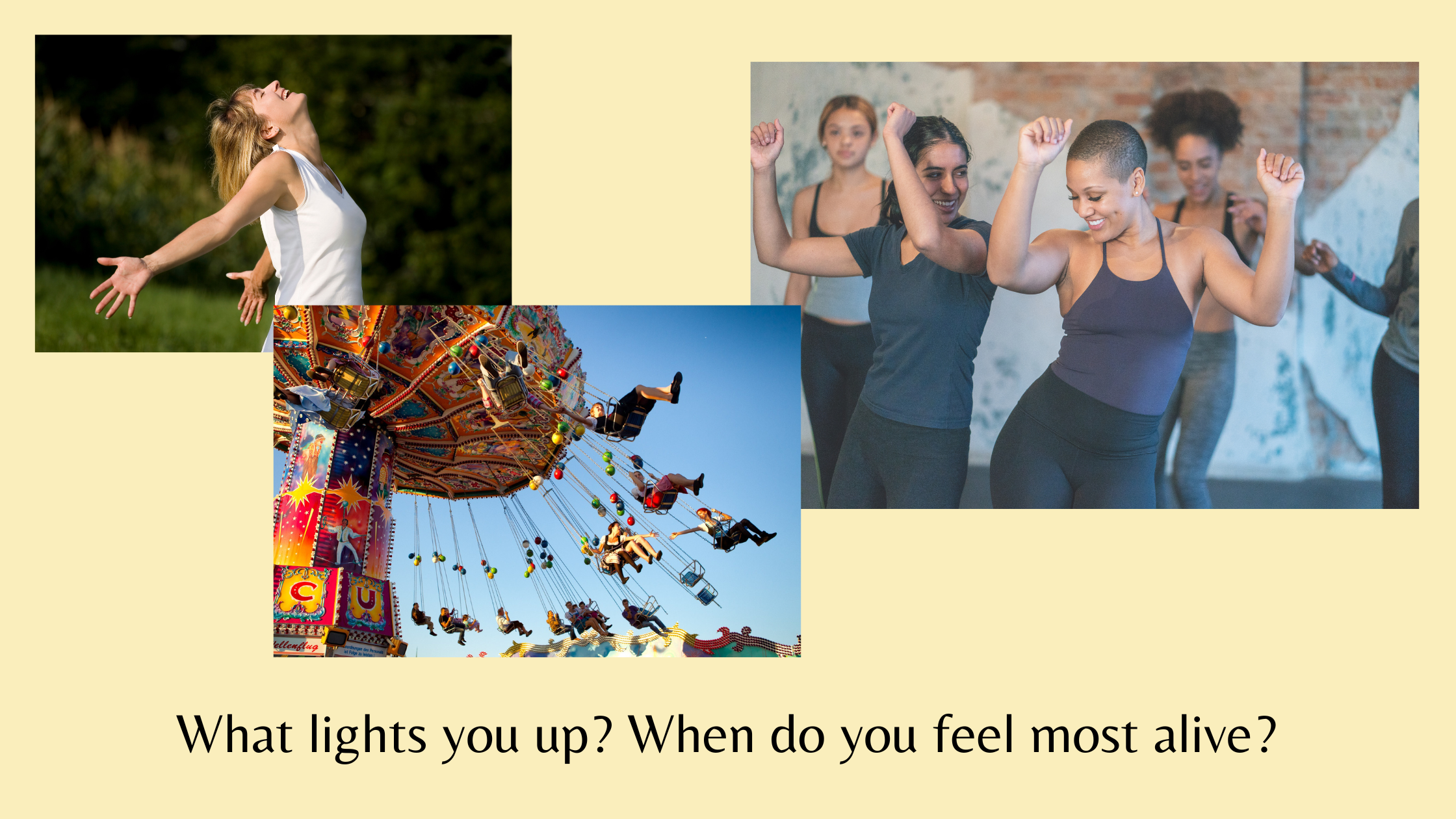
  1. When have you felt most alive? – Think backwards from today – go in five year increments if that helps – and go back as far as you need. Was it a special occasion? Maybe it was viewing the recent eclipse. Go back as far as you want. One I remember is running as fast as the wind when I was a child. What moments can you recall?
  2. What does aliveness feel like to you? –What words come to your mind? For me, it’s exuberance. Others might choose serenity or laughter. Bubbly. Present. Make a list. We are unique. Everyone’s answer will be different. Whatever feels true to you is right.
  3. What could you do today to increase your aliveness? – With this memory and these words, begin what hopefully is a never-ending journey to add these steps into your life. What is one thing you love doing that brings you this feeling? When can you do it? (Today would be great!) The more you can intentionally add this to your life, the more you will become increasingly alive. And keep in mind, this is not a sprint. It’s a lifelong marathon.

 Some aliveness principles to consider:

Aliveness is always with you – It’s there. You have experienced it. Now you need to move it to a more central place inside you. Bring your awareness to it, and you will notice it more.

Prioritize how you want to feel each day, not what you want to doAn important change to your To-Do list. It’s about becoming a Human Being not a Human Doing. Craven says to set your mindset for the day each morning and keep that in focus as you go through your day. If it helps, write it down someplace you can see it.

Avoid calendar creep – This is when more and more is added to everyday. What gets pushed out? You – and this wonderful feeling. When your To-Do list becomes too long, stop and ask yourself: Do I have to do this? What can I let go? Who else can handle it? If it needs to be handled by you, make sure you’re also making time for those things that light you up.

We need to be in the relationship business. When stress overwhelms us, we are less approachable. And that is not good for building relationships. Or for our own health. It’s time to become alive and be a presence in and present to the world. Find what makes you come alive and add more of that to your life.