Calming the Butterflies

Public speaking. It can make even the most polished professional panicky.. Getting up to speak before an audience can be a terrifying moment. It is said that people fear it more than death. It’s even a challenge for even well-known performers. Adele, Rhianna and Barbra Streisand all reportedly suffer from stage fright.

But you need to face these fears. You are a leader, and at some point, you are going to have to speak before a group or do something else that makes you nervous. When this happens, don’t avoid the possibility and lose the opportunity to show your value to an administrator. It is not what leaders do.

Instead, prepare for it by knowing what to do when the butterflies start churning. In her article, Why the First 30 Seconds of a Stressful Situation Are the Most Critical, Stephanie Vozza provides four steps to get you through those moments. Vozza explains those first seconds are the peak anxiety time. Since this is when all your bodily functions go into freeze and flight, they are the key to getting past the worse of this. Here are her four steps:

  • Practice Meditation – It doesn’t need to be more than two minutes, but if do it each day (or at least regularly), you become accustomed to stilling your heartbeat. When you are faced with getting up to the podium, or anything that has your pulse racing, you can do your accustomed routine. Your body will easily recognize what it needs to do.
  • Just Breathe – Not the usual in and out, but in a more fully mindful way. Become aware of your breathing and your body. Notice the physical manifestations of your tension. Are you clenching your teeth? Are your fingers tightened into fists? By being mindful you can do what it takes to physically relax. Breathe. Notice. Untense those tight muscles.
  • Harness Your Inner Superhero – Just as your body adds to your tension by its responses, it can do the opposite and telegraph confidence. Straighten your stance. Throw your shoulders back. You have this. You know your stuff. You are well prepared. Think of your favorite empowering song and go for it.
  • Rehearse Challenges – One of the best ways to be calm in the moment is to prepare in advance. If you’re giving a presentation, know the opening paragraph. Print it out on something you can read easily without it being too conspicuous. Once you get past that opening, you will be fine. Can you get into the room early? Seeing where you will be can help you to envision yourself succeeding.

How you manage the challenges and stresses you will face as a leader is up to you. As with so many things in life, you can go one of two ways. You can let the stress engulf you and avoid ever doing it again. Or you can embrace the challenge. Prepare yourself in advance and prove to yourself you can handle this.

Being a leader involves getting out of your comfort zone and taking on new challenges. Whether it’s public speaking or running for an office in your state/national organization, there will be scary moments as you start and even once you have attained a new level of being in the public eye. The more often you take the chance, the more often you will succeed. And each success will build an extra layer of confidence.

Failure Is Part of the Path

When we plan a project, set a goal, aim for a target, we think of all the things we need to do and what will think and hope will happen along the way. Something we generally don’t factor in is the times when we will fail.. Although we often tell students that Fail stands for “First Attempt In Learning,” we rarely accept it as true for ourselves. Failure is scary. It makes us look bad. We do everything we can to avoid it. But is also necessary. Without it we don’t learn, and we don’t get better.

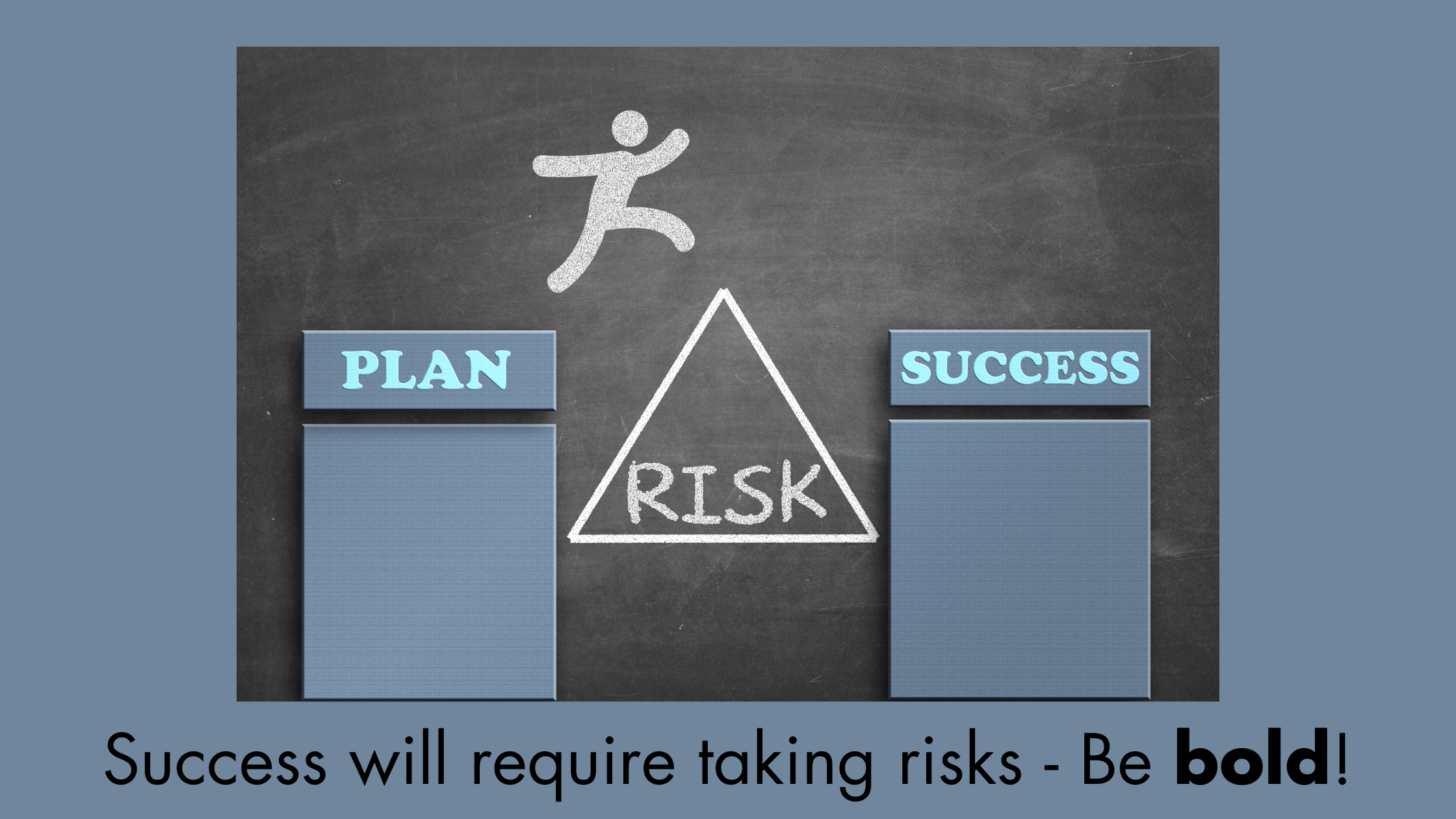
Nothing great is ever achieved in one step. The steps along the way will always include some failures. And if you let the fear failure get in the way, you will either back away from what you are doing when it happens or not start at all. As a leader, you need to take risks, and risks bear the possibility of failure. But without risk there is no reward – and no success.

In her article, How That Wretched Slog Makes Way for Your True Potential, Laura Gassner Otting says, “Each time we accomplish something — big or small — we see a version of ourselves that we didn’t yet know existed.” Ironically coupled with this, each success often brings new worry about being good enough, capable enough to do it. Even in our success we are fearing future failure. If this is the case, we need to accept and get through this fear. Gassner offers this way to get past the fear of failure:

  • Let’s Not Fake It Till We Make It – Playing it safe will not bring big changes. Doing only what has been done before, the way it has been done before, won’t get you anywhere. Think of what it must have been like to be the first or one of the first to generify the collection. Give up Dewey? Unheard of. Who would ever think we would suggest dropping fines or even charging for lost books. Out of the box thinking isn’t safe, but it moves us into the future. Embrace the fear that may be part of taking the risk as part of the process – and a sign that you’re moving forward.
  • Re-Categorize Failure from Finale to Fulcrum – Gassner suggests we adopt a beginner’s mindset. We need to see failure as the point from which we learn something that will help us accomplish the next step. Failures should raise new questions and give us the opportunity to see something we didn’t anticipate and pivot. Think, why didn’t this work? What was missing? What, if anything, needs to be changed? How can I do it differently? And never forgot to consider, who can I ask for help?
  • Take a Lesson from the Pros – Professional athletes spend a great deal of time perfecting what they are already doing right. But they also face the fact that they aren’t perfect. They watch videos of their performance and see where they are not doing it well. Then they work on that. It’s harder and uncomfortable, but they do it. Go back to the basics first so you have those to build on, make changes and see if they work. If they don’t take a step back and adjust. Remember – athletes don’t expect perfect, but they are always looking for how they can improve.

Fear is part of the process – but it doesn’t get to stop the process. What fears are keeping you in a safe place? Don’t let fear of failure keep you from stepping out of your comfort zone – and making it bigger. Accept the possibility of failing and embrace that it isn’t saying anything negative about your or your plan. Take a chance. Although you will fail some time, as you pile up your successes your reputation as a leader will grow – and so will you.

Moving from Fear to Success

Leaders have to effect change and work towards making their Vision a reality. To do this, they must take risks. Risk and growth are the only ways to achieve success, but they carry with them the chance for failure. And knowing this creates fear.

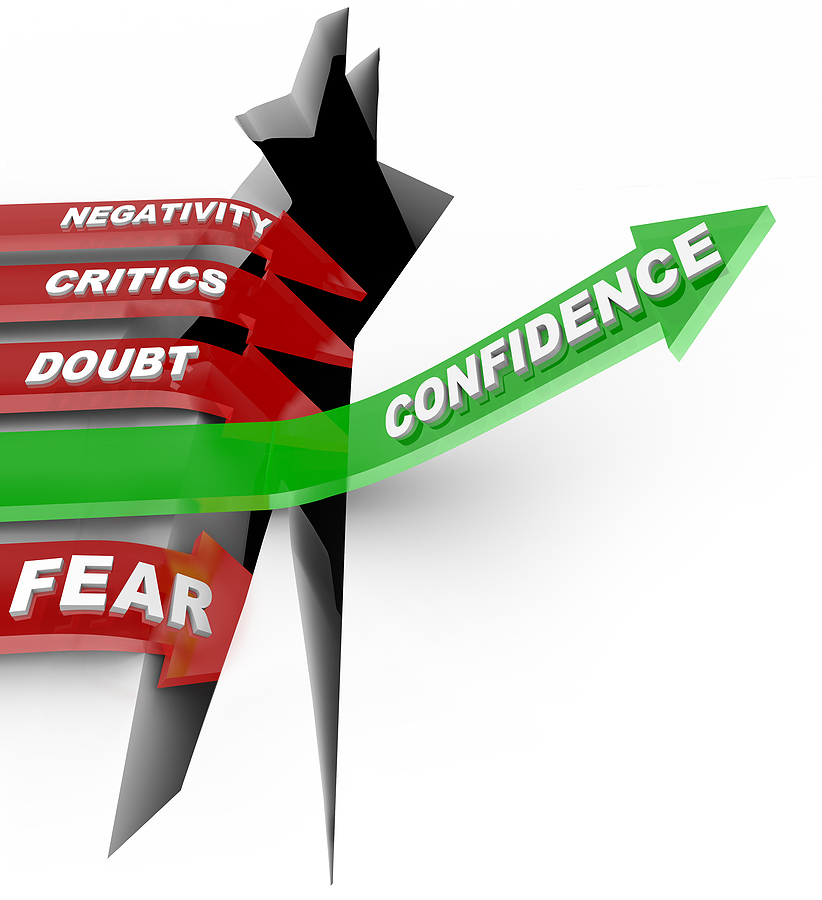
Fear manifests in many ways including that inner voice that says you aren’t good enough. Or it says even though you were successful before, it was a fluke. Fear is what underlies the well-discussed Imposter Syndrome. At its worst, it has you believing every success is a precursor to failure the next time you try something, keeping you from enjoying what should be a triumph. In its lesser forms, it has a paralyzing influence on your willingness to attempt a new project.

How do you deal with the fear of failure?

In her Smart Brief article, Laura Gassner Otting writes about the impact of Imposter Syndrome and proposes you Leverage Your Fear of Failure for Success. Use one to reach the other. She offers these three approaches for doing it:

  1. Let’s not fake it ’til we make it – Otting rejects the “fake it till you make it approach.” She maintains that when we are faking it, we don’t use our own thinking but restate the consensus, and that doesn’t lead to success. Faking it also means you know you are pretending, which keeps you from feeling confident. You are always waiting to be “caught.” This leads to trying to control everything rather than leaving space for learning. Better to make mistakes and learn than to pretend they are never going to happen.   
  2. Re-categorize failure from finale to fulcrum – We teach our students to see “fail” as an acronym for “First attempt in learning.” Although we know the learning process includes failure, we don’t always apply it to ourselves. No one likes to fail. Once again, mindset is critical. Look back at your failures. What did you learn from them? What were you able to achieve because of that learning? Had you not failed, you wouldn’t have had that success. It’s a process. As long as you don’t let a failure be final, the more success you have to overshadow any failures.
  3. Take a lesson from the pros – Athletes are out there for all the world to see. When they “fail,” it’s obvious to all. When a pitcher loses a game, or a player misses a much-needed basket, they face jeers and negative comments made by fans, sportscasters, and coaches. It’s painful. But tomorrow is another day, another game. They will look at the video and see what they missed, then learn and move on. When an attempt fails, it’s the start of the next step on the road to success. We can all use this as an example of how to face setbacks and mistakes and keep moving forward.

Your brain is a powerful tool. As often as possible, leaders accept the challenge of keeping their mindset focused on their Vision and Mission – not on fear. Both failures and successes – and learning from each – are part of any leadership path.

Be Bold

Being a leader requires risk-taking. How did reading that make you feel? Did your stomach drop? Did your mouth get dry? There is no question about it. By definition, taking a risk is scary. But you won’t ever get where you want to go unless you take some big risks along the way. And that’s going to mean leaving your comfort zone.

Here are some big risks I have taken in my career:

  • Planning a new library wing.
  • Automating my library in the very early years of library automation.
  • Leaving a job (and tenure) after more than two decades to take another.

Some risks you might be considering are:

  • Genrefying your library.
  • Giving a presentation at your state library association or at the national level.
  • Running for president of your state association.
  • Speaking at a Board of Education meeting.
  • Creating an Advisory Council of parents and teachers for your library.

Taking a risk means you might fail. Depending on where you are in your career, any one of those possibilities could cause you to change your mind several times before coming to a decision. How do you get unstuck and take a bold action?

Remind yourself of your Vision and Mission Statements. Then ask if the risk supports one or both of them. How would Genrefying your library support your goals? Would giving a presentation or running for president improve the position of your program? Would speaking at a Board meeting highlight the roles you play and the values you hold as a librarian? Can an Advisory Council give you the support you need for challenges to your collection?

Before taking the leap, Cheryl Strauss Einhorn recommends these five steps to help you Become More Comfortable Making Bold Decisions:

  1. Identify the decision you need to make. – Get as clear as you can on the decision you really need to make, risks aside. What is the reason you are doing this? How does it connect to your Mission and Vision? What will happen if you don’t do it? Once you’re clear, lean on your Professional Learning Community. Ask who has done this before or attempted it. What do they wish they had known before they started? Are they glad they did it? What do they recommend you do or not do?
  2. Examine your past bold decisions. – Take time to notice your previous successes. What made them successful? Identify the leadership qualities that helped you achieve your goals. What did you achieve as a result of taking the risk? Would you have done it the same way if you were making that decision now? We often don’t recognize we have grown on the job. Looking to the past will reveal your growth as a leader.
  3. Ask yourself what attributes or similarities are shared between the bold decision you are considering and your prior decisions. – This new step may feel risky, but it probably isn’t entirely new ground. For example, if you are considering genrefying your collection, notice that you’ve already created a section for professional reading or graphic novels. It is reassuring to recognize that not only have you been successful in the past, but also that you can draw on how you accomplished that success. You are not really starting from scratch. The bold decision you are considering may be bigger than what you have done before, but you have some past experiences to guide and support you.
  4. Consider whether there are attributes of your past bold decisions that might impede your ability to get to a good outcome for your current decision. What happened with past decisions (bold or not) that you wish you could have done differently? This is your chance to make that change. Where there things that kept you from being as successful as you hoped? What did you learn from missteps?
  5. Apply the lessons from your past data to your current decision. — Take what you know worked with what didn’t and apply it to the new success you’re looking to have. Don’t let those mistakes stop you because that is how we learn. (Don’t you tell your students this all the time? Apply it to yourself!) And remember – don’t only look at the negatives. You deserve the praise for what worked.

You need to be a leader. Leaders are visionaries who take risks and try new things. If it’s time for you to be bold, take time to be smart about how you do it.

Build Your Confidence

Leaders are risk-takers. You can’t make changes or achieve your Vision unless you take risks. But risks imply the possibility of failure. (Did you get a sinking feeling in your stomach?) In order to take on the challenge of stepping out of our comfort zones and taking risks, we need to build our confidence. As with learning anything new, it starts with baby step. Just like exercising, the hardest step is lacing up your sneakers—or in this case, determining to build your confidence and take risks.

In Build Confidence in Yourself and Your Leadership, Gregg Vanourek lists the various benefits of confidence (including improving health and boosting attractiveness and creativity!) and goes on to list these steps for developing self-confidence:

Focus more on areas of our capability and achievement, and less on areas of weakness and struggle—What are you good at? You may be crafty and/or have artistic ability. Use it to decorate a wall outside the library to call attention to it. Do you write well? Try a newsletter. Are you great at tech? Offer an after-school teach-in on a new resource for students or staff.

Set and meet goals that lead to personal and professional accomplishments– If you have big goals (and most of us do), look for the small ones that will get you there. You don’t have to conquer the world on your first forays. Look at your Mission and Vision. What small goal can showcase your Mission and/or get you closer to your Vision?

Switch off negative self-talk, self-criticism, and limiting beliefs—More than any actual circumstance, this is what stops us most of the time. We judge ourselves much more harshly than we would anyone else. Noticing this negative inner dialogue can help us take risks and build confidence.

Swap in positive thoughts for negative ones—Once you’ve taken steps to switch off the negative self-talk, go one step further by talking to yourself as though you were speaking to a friend. Look to previous successes, positive feedback, and glowing responses.

Face our fears and, in the process, build a sense of agency and capability–What is the worst that can go wrong? Whatever you think that might be, you will recover, learn, and be wiser the next time. You can use the experience to bolster your creativity.

Stop the unhealthy practice of comparing ourselves to othersNever compare your insides to someone else’s outsides. Typically, we focus on their strengths and don’t notice that, like you, they have weaknesses, too. (And you never know when they may see your strengths and compare themselves to you.)

Continue learning, growing, developing, and building new capacities—Work on areas of weaknesses, but also build your strengths. Our world and our profession are constantly evolving. Grow with it.

Engage in consistent self-care practicesYou can’t feel confident if you feel drained and exhausted. Make yourself a priority. You have heard this before. Knowing that increased confidence is a byproduct may make you more willing to take care of yourself.

Speak up for ourselves (self-advocacy)—This can be challenging, but it’s a necessary part of leadership. Remember, it’s not about you. It’s for your program. Look for ways to showcase and promote it to as wide an audience as you can.

Stop thinking in terms of fixed traits (e.g., “I’ve always been bad at math” or “I’m not a confident person”)—Have you ever thought “I am not a leader”? Let go of this belief. You are if you are willing to be. And your students, teachers, and program need you to be a leader.

Think about a time when we felt high confidence and ask how we’d act if we were feeling that way now—You have been successful in the past. How did you feel? You are still that person. Tap into that feeling, remember that energy, and use it going forward.

We know that failure is part of the learning process. We teach that to our students. Yet, when it comes to our own behaviors, we stop short. All we see is the possibility (probability) of making mistakes. Confidence is a combination of mindset and efficacy–the knowledge that you have the ability and the resources needed to complete a task or goal. Have confidence in your knowledge and resources and go for your goals!

ON LIBRARIES: When In Doubt

It takes a certain amount of courage to be a leader.  If you read this blog regularly or attend one of my workshops, you’ve heard me say leaders must take risks and move out of their comfort zone. That leads me to my question – do you doubt you have the kind of courage necessary?

For some of you, the idea of taking a risk is paralyzing.  It’s natural to want to keep your head down and continue doing what is working.  You may have some good reasons for not taking a chance.  Librarian positions have been drastically cut not only in this country but worldwide and those that remain are frequently overloaded. You may be covering more schools and lost any staff you had. There is no time to add anything to your schedule.

So the doubt creeps in.

If you take a risk and get it wrong, you could be putting your job on the line. At least that’s the story you tell yourself. Seeing this in print may remind you of a blog I did in 2015, The Stories We Tell Ourselves or the one I did last February, More Stories.  Since we all have a tendency to fall back into old habits, it bears repeating.

The self-doubt is tied to Imposter Syndrome which I have discussed in Leading for School Librarians: There Is No Option.   Imposter Syndrome is the voice inside your head that says you can’t do it. You don’t know enough.  You will fail. It may even be there when you succeed, telling you this was a onetime thing. There are probably a number of other negative things this voice is telling you and when you listen, it’s keeping you from taking that risk, from moving out of your comfort zone.

This week I have two articles which I think offer some great ways to move through self-doubt. I’ve added my comments and connections to our work for each one. First, Jeff Barton suggests four ways to help you get past self-doubt in Why Self-Doubt Keeps You Stuck and How to Begin to Overcome It:

  1. Self-Reflection Make an honest self-reflection of your strengths and weaknesses. You do have strengths – quite a few, in fact. You might want to work on the weaknesses, but for that first step past self-doubt try a project or take on a task (run for an office, do a presentation) that focuses on and uses your strengths.
  2. Avoid Perfectionism –You will never get it all right. Any author can tell you they proof-read many times. So does their editor.  Then the book (or the blog) comes out, they immediately see an error.  Nothing I have ever done has been perfect.  Reach for excellence and for improving on what you’ve done before.
  3. Comparison to Others – We always see what others do better than us. This is related to focusing on our weaknesses. We don’t look at the corollary—what we do better than others. Our assumption is, if we do it well, others must also be doing it well.  We can’t really know if that’s true. In addition, you can’t know another person’s struggle or process. Comparing yourself is a waste of time and attention.
  4. Self-Compassion – Treat yourself as you treat others. You are kinder, gentler with others than you are to yourself.  We would never say to a friend or loved one many of the things we say to ourselves.

Petrea Hansen-Adamidis gives 5 Steps to Deal with Self-Doubt and Trust Yourself Again. Some of you may never have trusted yourself, but this is a big factor in dealing with self-doubt.

  1. Ground Yourself – The thought of taking risk is likely to have your brain whirling with the many negative comments you are saying about yourself making it hard to go beyond thinking of the potential risk. Notice the noise. Then focus by writing down the pros and cons of a project.  And ask yourself that classic question, “What would you do if you knew you couldn’t fail?”
  2. Balance the Negative – Find more ways to answer the negative self-talk with kindness. Keep a journal/log of your successes.  Include any positive comments you get from students, teachers, parents, administrators. Read through them before tackling something new.
  3. Take a Break – Step away from the problem/issue. Do something else. I walk. By the time I get back, I have come up with several ways to deal with it. You may want to knit, listen to a podcast, color, bake.  Get creative – and fun – with the ways you choose to step away from the challenge.
  4. Nurture Yourself – This is like self-compassion, but it can also mean healthy eating and getting enough sleep as I recommend last week in Positive Self-Care. When you aren’t tired and filled with junk food, you are in a better frame of mind which will mute much of the self-doubts. It’s also a way of acknowledging your own importance to yourself and others.
  5. Connect with Others – Who are your cheerleaders? We all have people in our lives who believe in us.  Talk to them. Let them give you a pep talk.  After all, you would do it for them.

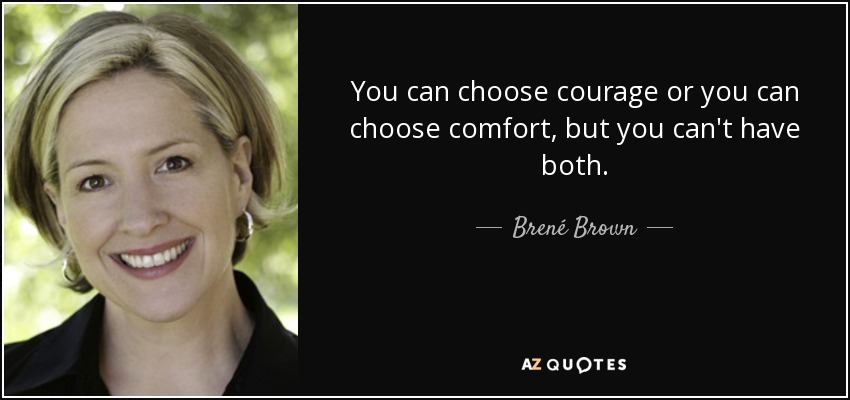
Bestselling author Brené Brown, whose work on shame, self-doubt, and leadership is truly inspiring writes, “You can choose courage, or you can choose comfort, but you can’t have both.” Give it a little thought. What’s your choice?

ON LIBRARIES – Risk and Reward

Leaders take risks.  You are all aware of that, and that awareness leads to something we don’t like to talk about.  In 2015, I blogged about the Stories We Tell Ourselves. I skipped a big one.

The story we tell ourselves is that if we take a risk we’ll embarrass ourselves so badly we won’t be able to face our colleagues and administrators.  It could even potentially cause us to lose our job. And that story is the secret reason why some librarians avoid taking on the challenge of leadership.

Fear of failure can be crippling.  It keeps you from growing.  Oddly enough, the converse is an equally big barrier—fear of success.  If you are successful, people will expect you to continue to do more.

And just like the other stories, it is only that —a story.  No one is suggesting you suddenly decide to campaign to redesign your library as a learning commons if you have never done anything to make your presence known in your building, but you do need to take some first steps.  You do need to build some “street cred” first.

Start small. Share your knowledge of new web and app resources by sending weekly emails to teachers describing just one, explaining how it could be used, and offering to provide one-on-one help for them to learn it.  Include your principal in the email. You may not get any takers at first, but eventually one will click with a teacher.  Slowly, teachers will begin to recognize the help you can give them.

There is no risk in doing that, but two important little goals have been achieved.  You have stepped out of your comfort zone, and teachers begin to take you into consideration when planning a unit. And those two accomplishments are the first building blocks of that very important “street cred.” Look for other no-risk or minimal risk ideas.

Try a book club.  If you don’t know how to do it, ask your library colleagues on your state association’s listserv or other places where librarians help each other. LM_NET is the big one, but there are many more.  Once you know what you are doing, speak with your administrator before putting it in place. Explain your goal for the program, how you plan to run it, and acknowledge there is no guarantee it will work but is worth a try.

If you launch the club, send updates on activities and accomplishments to your principal. Include videos of the kids discussing the books.  Now you have demonstrated your value to the administration.  And your reputation as a leader begins to grow.

Then it’s time to take a few bigger risks. Gardening projects have proved very successful at the elementary level.  There are connections to STEAM and the produce can be given to the cafeteria, to food banks, or a local shelter depending on what seems best for your community.

Other low- risk projects include starting Hour of Code or a Makerspace. For either of those ideas, you can get all the help you need in organizing it from other librarians. We are an incredibly supportive profession.

These early risks build your confidence and you can begin to look for other possibilities. Are you thinking of genre-fying your collection?  How about a Skype author visit?  What about a joint project with students in another school district—or country? Before long you might even be ready to turn your library into the learning commons that had seemed an impossibility.

Being a building leader is vital.  If you and your program are to thrive you must demonstrate you are invaluable to the entire educational community.  Now that you see that risks don’t result in those disasters you imagined, you can step even further out of your comfort zone.

Take your place among leaders.  There is always room for more.  Choose one of your new successful programs and write a proposal to present it at your state conference.  You may think it’s been done, but there are always librarians who haven’t tried it, and you bring your unique perspective to it. If it’s selected let your principal know.  It will build your reputation even further.

Serve on one of your state association committees.  Better yet volunteer to do the same in AASL or ISTE. Although it’s too late for this year’s AASL Conference IdeaLab, start planning to do it in two years at the next AASL conference.  You would be in a large room with many other librarians all presenting their best ideas. You talk one-on-one with those who stop and want more information.  Totally non-intimidating.

The first step in becoming a leader is deciding to step out of your comfort zone.  Every leader has done so.  I still take on challenges wondering how I am going to do it, but somehow it almost always works.

Have you stepped out of your comfort zone?  What did you do?  What was the result? Where do you need help?