Hidden Bigotry in the Card Catalog

The song in the musical Avenue Q, “Everyone’s a Little Bit Racist,” acknowledges a truth that is important, if difficuly, to accept. Racism, at varying levels, is pervasive. The good news is that when we are aware, we can work to eliminate where we have exhibited racist beliefs and keep them from affecting our interactions with others.

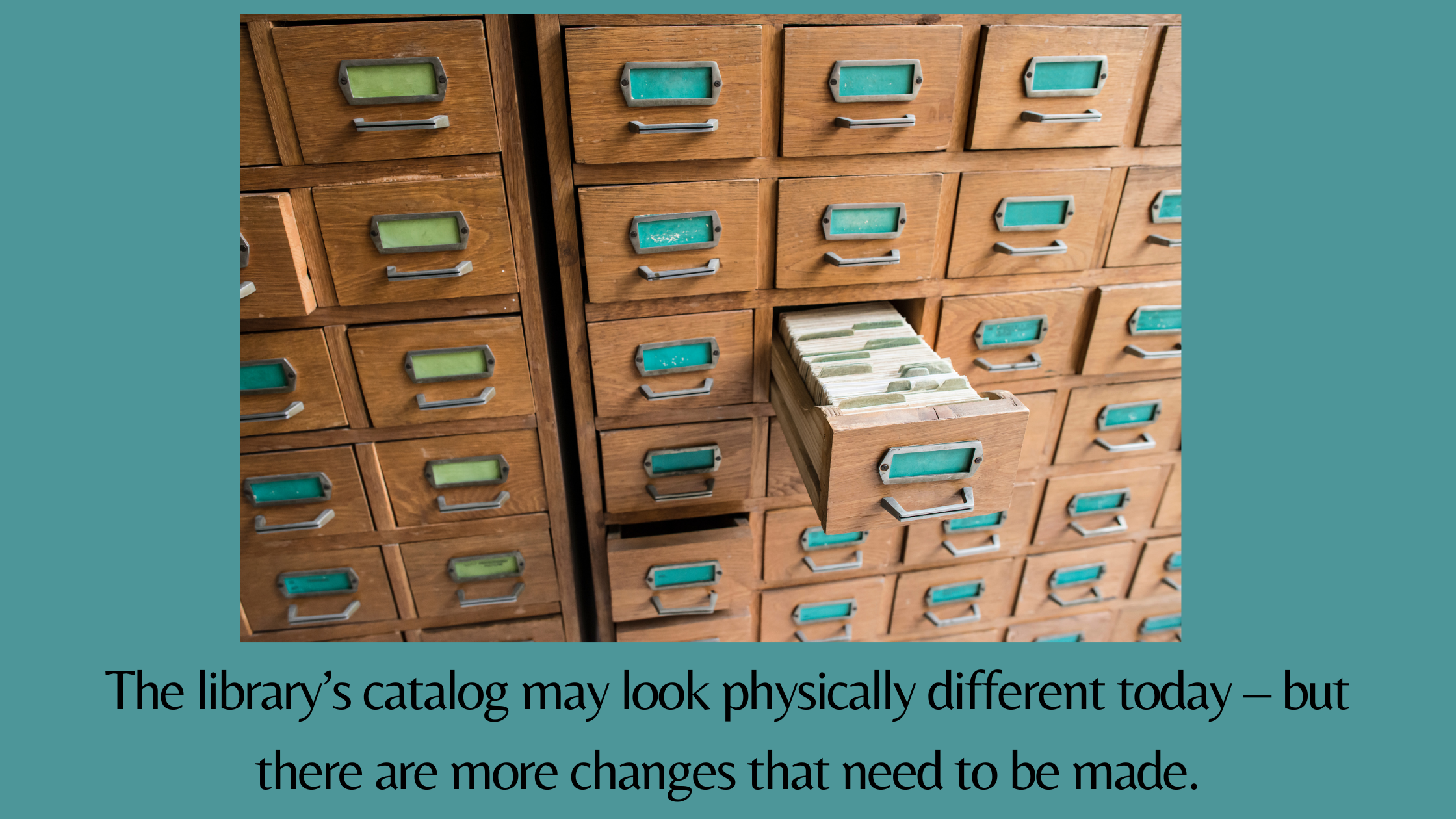
While there is evidence of progress, there is still a long way to go. The title of this blog reveals a sad truth. Numerous subject headings in our catalog reveals long held bigoted perspectives. Our cherished Dewey Decimal System is loaded with bias. We need to be aware of what is there and what alternatives we have for dealing with it.

Consider the subject heading, “Westward Expansion.” We think of Lewis and Clark and the opening of the West to exploration and development. Our Indigenous population doesn’t see it that way. This is likely to be true of subject headings concerning the colonial history of many other countries.

The Dewey Decimal System, long the organizing system of school libraries, has a distinct U.S. Christian view of the world. Look at the history of North America (970s). Mexico’s history is all in 971 and Canada’s is 972 leaving from 973 to 979 for the United States.

As another example, the 200s begins with myths followed by the Bible in 220. Christianity and aspects related to it are in 230 to 289. That leaves the 290’s for all other religions, including Greek and Roman religions, Germanic, Indic (such as Zoroastrianism), Judaism, Islam, Bábism, and Bahaï Faith. Not quite equal representation.

Mike Olsen takes an even broader look at the built-in bigotry in his article, Classification as Colonization: The Hidden Politics of Library Catalogs. While in the US, we deal with the current administration’s efforts to eliminate DEI, we have not really embraced it in our catalog. Olsen points to where Dewey “relegates women’s issues to domestic subcategories, while centering the experiences of White Christian men as universal. When ‘women’s health’ becomes a minor subdivision and ‘health’ means men’s health by default, classification performs exactly as its creator intended: marginalizing some voices while naturalizing others.”

Some headings have changed over the years. For example, Homosexuality is no longer categorized under “Social Problems.” But the fact remains, the catalog and the classification system has built-in racism and bigotry. If this can be changed, other changes can be made as well. We can also consider eliminating the Dewey Decimal system. Genrefication (which makes the library organization more like what you’d find in a bookstore) is one option being embraced.

The good news is that progress has been made against racism, but there is still much to be done. Being aware of the issue makes it incumbent on finding solutions. Added to this, we should take a stand so that our library associations work on changing headings that are contrary to making the library a space that welcomes all. As leaders, we must always be looking for ways to learn more and do better.

ON LIBRARIES: Taking a Stand Against Racism

The Oxford Dictionary defines racism as “prejudice, discrimination, or antagonism directed against a person or people on the basis of their membership in a particular racial or ethnic group, typically one that is a minority or marginalized.”  In our schools, virtual or physical, we must actively fight racism – in our collection, in our educational community, and in ourselves. Many of you have been working on making your collection more diverse, but when creating a collection which includes “mirrors and windows,” ensuring that our students can find books that reflect their lives and let students see into the lives of others, how successful have you been?

Sadly our efforts have fallen short if too many of our diverse books fall into one of the four “F” categories: Folklore, Fashion, Food, and Festivals. This not only misses the mark when it comes to multiculturalism, but potentially veers into stereotyping cultures in terms of language, ethnicity and traits. True multiculturalism can only happen when significant attention is given to many different backgrounds in a particular setting.

What proportion of your books on Blacks are about slavery or the Civil Rights Movement?  That isn’t a mirror.  We need to be more pro-active about having a more representational collection. There are some very helpful websites such as https://diversebooks.org/ and if you do searches for titles under Own Voices.

Even better is to do a Diversity Audit. Library Collection Shelf Audit for Diversity and Inclusion is a relatively simple one. As you check the books, note whether the author is writing in their own voice.  Too many books are authored by those not sharing the history they are writing about, although more publishers are now actively seeking those who write from their own voice. Diversity audits take time, and you probably cannot accomplish it in the virtual world, but plan on doing one when you have physical time in your library.

To make a change in your educational community, you need to step out and lead. Adding diverse books to your collection does not mean that students – or teachers- will read them.  How can you promote them?  One way is a book tasting with book jackets covered as you offer students a sample of what’s inside the book, piquing their interests without engaging biases. New books that increase your collection’s diversity and inclusion should be shared with teachers along with suggestions for ways to bring them into either library or classroom projects.

Going further, look for ways to curate information on microaggressions and related topics and make it available to teachers and administrators – this can go beyond books to websites, podcasts, and videos.  Become informed and give a workshop on it. You want the entire school addressing the issue. If there are books in your collection which are problematic, use it as an opportunity to create a program about racism and how race is portrayed (don’t remove the books or we start down the slippery slope of censorship). See if the PTA/O is open to doing an event around resources available at the library and offer support for parents who want to talk more with their children.

While it’s important to fight racism in our collection and look for ways to lead our educational community in becoming anti-racist we also need to look at ourselves. The more we learn about how we’ve been taught and raised to look at the world through a white lens the better we become about changing how we think.  I know I have benefited from White Privilege. It doesn’t mean I don’t respect people no matter their ethnicity, gender, religion, or any other of the many ways are different.  It means my life has not been made harder because of the color of my skin. When I am in a store, I don’t expect to be watched by security.  When a policeman stops me, I am not afraid.  I don’t worry about my grandkids going out with their friends at any time of day.

Recognizing White Privilege is only a start.  As a lifelong learner I am committed to learning more, to leading by example, and to speaking up when I see racism. I am a leader for change, and I accept that this starts with me. The Chicago Public Library posted Ibram X. Kendi’s, author of How to Be An Antiracist, Anti-Racist Reading List, and I highly recommend it. (It is also a good list for expanding your collection, especially at the high school level).

As librarians we are staunch defenders of the First Amendment. We are committed to making our libraries safe, welcoming spaces for ALL. We support Equity, Diversity, and Inclusion as a basis, along with curriculum connections, for building our collections. We have not been just talking the talk.  We have been walking the walk, but it is likely we can and need to do more. We are not only responsible for our actions but tremendously influence the future of the communities we serve.