ON LIBRARIES: It’s The Law(s)

RanganathanMost of you learned Ranganathan’s Five Laws of Library Science when you were in library school.  You discussed them and have probably since forgotten them.  Students in my online graduate course are discovering those laws this week, and as I reviewed them it struck me once again how incredibly relevant they still are and how brilliant and prescient Ranganathan was.

S. R.(Shiyali Ramamrit) Ranganathan and with Melvil Dewey, both born in the 1800’s, can be seen as the creators of librarianship. However, while even non-librarians are familiar with the greatest of Dewey’s contributions (others are the founding of the American Library Association and the originator of Library Journal­ – did you know Dewey did that?), it’s unlikely that many outside the profession have ever heard of him. In this age of always striving to move forward and be modern and/or relevant, there is something comforting about looking at our roots and discovering unchanging truths.

First LawBooks are for use in the stacks

This is a reminder that they are not to be hidden away.  It repudiates the concept of closed stacks, but for me it also is a caution about restricting students from reading books not on their Lexile level and it suggests that requiring a parental note before a student can borrow a book deemed too sophisticated or more specifically having content that might be challenged is not how librarians should be operating. For me, it’s also a message about weeding.  Those dusty titles sitting on your shelves are not being used.  Libraries are neither warehouses nor museums. Why are you keeping them?

Second Law – Every book its reader

Libraries need to have something for every user. It means if you have ELL students you need to be looking into getting books in their language.  Recognize visually challenged students should have access to books in large-type.  As you prepare your orders, do you think about who will be interested in this title?  You don’t purchase something merely because it has a good review. In whose hands do you see it? Does it connect to a curricular area?  Do you know one or more students who like this author or type of book? Ranganathan used “book” generically.  He also meant magazines. Today we should be thinking about e-resources and databases.  Who will be served by adding this to the collection?
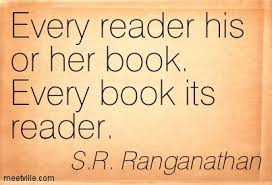
every bookThird Law – Every reader his book

This may be my favorite of his laws.  I personally know someone who was a lifelong nonreader. Quite by accident, she decided to try one of those wildly popular titles everyone was reading and talking about and fell in love.  It was the first in a trilogy, so she read all three. And re-read them, and re-read them.  Finally she knew the text virtually by heart, and was ready to take a risk and read another in a similar vein.  Suddenly she is a voracious reader, proudly announcing to me she got a library card and has been shopping at Barnes and Noble. It is a complete reversal.  I travel everywhere with my e-reader and patiently read while waiting my turn to be helped (PERSONAL NOTE OF HORROR: My Nook broke this week – I had to replace it in under 24 hours or risk insanity).  Invariably someone tells me they love to read and often trace it back to the one book that got them started. And that is a special role and gift of our profession.  We know our users and we know our books. It is our delight and our mission to connect our users with the perfect book for them.

Fourth Law – Save the time of the reader

The purpose of library organization is to do just that – and the work of Ranganathan and Dewey made it possible.  However, as we have discussed, there are other thoughts today. The rationale for genre-fying the collection is to save readers’ time.  It also means you need to regularly look at you facility and procedures to see if you have any obstacles keeping readers from easy access to what they need and want.  School librarians need to remember this law when students ask for assistance.  Too many times, we want them to learn to do it for themselves and just give directions to be followed.  Yes, they need to learn, but sometimes the need is to get to the answer. You can impart the lesson by going with the student, explaining the steps as you do them.

Fifth Law – The library is a growing organism

Students work on an in-class assignment in an Electrical and Computer Engineering 230: Circuit Analysis course taught by faculty associate Michael Morrow on the fourth floor of Wendt Library at the University of Wisconsin-Madison. (Photo by Bryce Richter / UW-Madison)

Ranganathan recognized that a static library is a dead one.  Even in today’s heavily technological world, bookshelves do get filled.  In the haste to add more space for computers and other devices, libraries are reducing shelving to a bare minimum.  These are crammed with what is being retained, but where will the new print acquisitions go? Certainly there won’t be as many as the past, but they are still being purchased.  On a larger level, this law speaks to the constant change libraries undergo as they transform themselves to meet the needs of users and reflect the technological and other changes of society.

I suggest it is time to bring Ranganathan and his five laws to the attention of our users. Print them out in a large, easily read format, frame and hang it in your main area. Put his name and 1931, the year they were published, at the bottom.  It is a great explanation of what your program does and why.

As I said, the Third Law is my favorite.  Which is yours? Or which challenges you?

ON LIBRARIES – Standard Approach to Leadership

be calm and leadNo, this is not about a basic way to be a leader. I meet so many school librarians who feel being a leader is too difficult or too time-consuming or too—add you own reason (for more excuses see my blog October 15 Stories We Tell Ourselves).  This is about a very simple way to ease into leadership.  And you do need to find a path to leadership because, as I have been saying for some time – Leading isn’t an option—it’s a job requirement.

Standards have become an educational obsession.  Many librarians have proven their value by showing how they can help teachers in meeting the Common Core Standards, and the research results consistently show a high correlation between an active library program staffed by a certified school librarian and student performance on high stakes test. By doing so, these librarians have shown the value of their program, but you can use standards to do even more to showcase you as a leader.

And good news – there is a shortcut.short cut

AASL has a Crosswalk between the AASL Standards for the 21st-Century Learner and the Common Core Standards for English Language Arts, Reading Standards for Literacy in History/Social Studies, Reading Standards for Literacy in Science/Technical Subjects, Writing Standards for Literacy in History/Social Studies, Science & Technical Subjects, and Mathematics. In other words—the Common Core standards in all subject areas are matched to the AASL Standards for the 21st-Century Learner and you can either start with the Common Core standard and find the matching AASL one(s) or start with the AASL standards and get the related Common Core standards.

You can look at your lesson plan and see which AASL standard(s) you are addressing: Standard 1 – Inquire, think critically, and gain knowledge: Standard 2 – Draw conclusions, make informed decisions, apply knowledge to new situations, and create new knowledge; Standard 3 – Share knowledge and participate ethically and productively as members of our democratic society, and/or Standard 4 – Pursue personal and aesthetic growth.  When you click on that Standard you find a two column table.  The first column lists the indicators for each of the four strands. The second column give the applicable Common Core standard that matches.

crosswalkSince I am more familiar the AASL Standards than with the specifics of Common Core, this is the way I would begin.  I know what AASL Standards I want students to get as the result of a learning opportunity, so I check for the Common Core standard that includes the grade level I am dealing with.

However, if you want to really focus on Common Core, go in that direction. Select the appropriate standard area and click on the grade level.  Don’t be alarmed by the many standards for which there is no corresponding AASL Standard.  Just keep scrolling down.  The empty cells reflect areas not part of the library program. You are not reproducing what happens in the classroom.  Your unique role is in providing those components of Common Core which are central to the library program.

Now when you write your lesson plans, do a copy/paste of the matching Common Core and AASL Standards.  Not only does this show how you address the needs of students, it also highlights how our national standards are in alignments with Common Core.  Once you have done this a few times, make an appointment with your supervisor or principal and show how this crosswalk works.

If you have purchased the 12-copy packet of AASL Standards, give one to the administrator, if not, download them and do the same. Point out what is on the first two pages and then discuss the four strands which are explained on the last page.

How does this make you a leader?  It demonstrates you are an instructional partner to teachers. It also highlights your understanding of the importance of standards and how AASL has national presence in developing standards for 21st century learners. (Do stress the word learners as opposed to students – it focuses on the need to realize we are all learners.)

On a final note – Common Core is slowly moving out of the picture and AASL is in the process of revising the standards which are now eight-years old.  This is a fast-moving world and AASL seeks to stay on top of the changes.  As a leader in your building you must do the same.  Be on the lookout for whatever succeeds Common Core.  Something will.  Keep checking the AASL website so you are aware of the new standards when they are published.  Your students, teachers, and administrators need you to be prepared.  That’s how leaders behave.

ON LIBRARIES – You Are Unique

you what you believeRecognizing that you are unique in your building is essential for establishing you and your program as indispensable to the educational community.  No one else in the building has the expertise you bring in working with students, teachers, and administrators. While most of you have heard this before and may even say so to others, far too many of you don’t believe it is true of you personally.

My aim in this blog is to convince you that you are unique because once you believe it you will be communicating your essential contributions in all your interactions.  So here is a list of what is done by no one else but you.

Information Literacy – You do this every day, but in discussing it you should always explain the specifics of what the term encompasses.  The first component of information literacy is to know when information is needed — and of course students and teachers recognize that most of the time.  What they don’t understand is that doing a search — on Google, Wikipedia, or YouTube is far different from doing research. .  Finding is not a problem. Finding quality in the sea of information available requires a more complex set of skills and understandings to accurately evaluate it what has been located for accuracy and relevance. Citing what was selected has become far more complex in the digital age.  Teachers are generally capable of explaining how to cite print sources, but knowing what and how to cite online databases, websites, videos, audio files, and graphics is less understood.  You are the only one teaching students about Creative Commons and how to use it.information literacy

Inquiry-based Learning – Technically this and the following ones are all part of Information Literacy but it’s important to separate them so you and others recognize the scope of what you bring to students and to teachers who collaborate or cooperate with you. In the classroom the stress is laid on answers.  But answers show only that the content has been learned.  Nothing new comes from re-stating what is already known.  What is important is taking learning to the next step, to probe deeper by asking significant questions and then searching for answers to those questions.  Inquiry-based learning, which is central to the AASL Standards for the 21st-Century Learner, challenges students to develop questions on a topic, preferably in an area where they have a personal interest, and discover possible solutions.  In the process, they frequently have to refine their search, modify and/or add questions.  Information Literacy skills are employed, and students are asked to assess what they did and how they did it to learn what worked and what they might do differently next time.  While the learning opportunity is usually connected to a classroom unit encompassing state and national standards, it more significantly is building the techniques and skills for lifelong learning in student’s personal lives and future careers.

you show studentsTechnology Integration – You are the one person in the school who keeps current with new technology and the latest resources to be found on websites and apps.  You hear it from your colleagues who share their latest “discoveries,” or see a presentation at a library conference or webinar, or search the AASL Best Websites for Teaching and Learning and Best Apps for Teaching and Learning. What you learn you share with teachers and students giving them new ways to organize, share, and present information.  When a student does work for one person — the teacher—it means s/he tends to frame it in ways to please that sole reader and lasting learning is lost.  In this world we are expected to reach out to colleagues and others using tech resources suited to the targeted audience.  A paper meant for the teacher alone is therefore as outdated as an audio cassette. You show students how the tech they love can be used to help them grow academically and personally.

Knowledge Creation – The challenge is not to repeat what is already known, but to build knowledge and create new content. Students should not be expected to do “busy work” with culminating projects that take time – such as dioramas and poster boards or even presentations using current technology—but have no ultimate purpose.  Did their research lead them to believe a law should be changed?  How can they work to make that happen?  Should people be informed about an issue?  What tool should they use for it and what information needs to be included?  Students of today must be more than information consumers.  They must become knowledge creators.  The activities occurring in the library are structured so they become true participants in society.

Digital Literacy – A subset of Information Literacy, digital literacy is the ability to find, evaluate, use, communicate, and create across a variety of platforms and formats.  It expects students to be “transliterate” which also includes using social and mass media.  Digitally literate students understand how to exist safely in cyberspace, are aware of the benefits and how to avoid the dangers.

Global Connections – More and more librarians are connecting their students with others around the country and globe.  It is vital for students to become tolerant and understand different cultures and peoples. Working with them from an early age opens minds and builds the understandings necessary for working and living in a global culture.                                                                             

Literacy Leading to Lifelong Learning – And of course, at the core of what we do is promote reading for pleasure and information. Others teach the skills necessary to read, we provide the environment where students discover the joy in reading unfettered by tests.lifelong learning

Some of you are saying you don’t do all of this. You still do much of it – and no one else does it. Yes, you can possibly do more – but that’s where your work stays exciting and new for you. Keep building your Professional/ Personal Learning Network (see the blog for August 10, How Large Is Your PLN?) and you will find it much easier to add those unique components to your library program.

Don’t sell yourself short.  You are unique.  Recognize it.  Believe it, and be sure to let others know it.

ON LIBRARIES: Time To Move On?

changes aheadElecting to stay in or leave a job is rarely an easy decision, but it can be a vital one for your career. When your passion and enthusiasm are being sapped by what is happening on a daily basis, how well can you do your job?  How long will you go to work each day without the joy that first filled you?

I have been exchanging emails with a librarian who is dealing with difficult problems in her district.  She is a recent part-time hire but has found both the job responsibilities and relationships are causing a problem.  Her principal wants her to teach lessons in the classroom, but when she created a sign-up sheet no one was interested.  I suggested direct contact with the teachers first, but as a part-timer she doesn’t get lunch and has no opportunity to meet with teachers.

The principal said if she couldn’t manage to set up some lessons he would transfer or get rid of her. He has also asked for an SGO (Student Growth Outcomes) but she is not yet clear on her responsibilities.  There are two other librarians and at this time they are refusing to share lesson plans with her.  The younger one has become openly hostile.  frustrated

Whether or not the librarian made some errors in creating relationships with the other librarians, anything she does now will take twice as long to get results.  It is also quite possible that she won’t be able to accomplish much.  It’s time to start job hunting.

Another librarian with whom I have spoken has seen her budget cut in half and then completely eliminated. Her part-time clerk has been let go and the position won’t be refilled.  Being able to read the handwriting on the wall is a critical but often ignored skill.  Even more challenging is acting on it.

There are a number of situations where it is toxic to remain.  If you find yourself constantly frustrated by one or more administrators who ignore you completely; if you are now obsessing about how they are creating roadblocks to your program to the extent that you are bringing it home every day; it is time to consider moving on.

Are you in a district with antiquated technology and dusty library books with no hope of a change?  Recognize that the situation is keeping you from staying current with the profession.  You may want to think about leaving.

But, you argue you have tenure. Jobs are hard to come by.  What if the new place doesn’t work out?  It’s far easier to deal with the devil you know, and it’s a truism that teachers (and librarians) don’t leave a job voluntarily unless they retire or a spouse is transferred.  I have faced that challenge.  I was in a district for 22 years.  I had built a strong reputation.  However, a principal who came on board saw me as competition, feeling too many people turned to me (I was also head building rep for the union) and he wanted to be the absolute boss. My superintendent always seemed to know what was afoot and would run interference. On the day she announced she would retire in two years, I began job hunting.  I knew the principal would become the superintendent a few years later, and even the interim would be exceptionally difficult with superintendent gone.

jobI was fortunate, I found a job within a few weeks.  I was at my next district for nine years before retiring and loved every minute of it.  I didn’t worry about the loss of tenure, although I did regret losing my sick days.  Yes, finding a good opening was easier then, but jobs are opening up again.

If and when you decide to leave – be careful.  You never criticize your district or people in it. When you interview for a new position, point to what you want to learn by being in this new district.  Suggest that you are looking for more opportunities to create a truly 21st century library and 21st century learning experiences for students.  Talk about what you want to achieve, not why you want to leave.

There are times when you shouldn’t or truly can’t leave. If you left your previous position less than three years earlier, you need to find a way to stick around a while longer. Employers are wary of those who can’t seem to hold a job. I know someone who stayed in a job because she couldn’t equal her current salary and had two kids in college.  That is a sacrifice you make at times.  In that situation, when you have a rough day you need to remind yourself why you made that choice.going up

If you are thinking of leaving, you are in a good position to search for a new one. You have a job which means you interview from strength.  Should you hear of an opening that sounds interesting, go for it. Listen to what they tell you in the interview — and what they don’t.  If you like it, and they make an offer you can negotiate knowing you don’t have to accept the job.

You want to make a difference for kids. If you are fortunate enough to be in a district where you can give your best, enjoy it.  If not, maybe it’s time to move on.


ON LIBRARIES – Reach Out To Collaborate

collaborationCollaboration is an important word in librarianship.  We all accept that it’s vital in giving students the best possible learning opportunities.  Most often, the word is used when we talk about collaborating with teachers. It’s time to think past the school building when developing collaboration.

The easiest bridge to build is with your local public librarians.  Are you aware of what programs they are offering?  Do they know what you are doing?  Is there a way you can work together?  In many places the children’s librarian visits the public school to promote a summer reading program, but you can invite them to come in during September for Library Card Sign-up Month.  It’s sometimes surprising to discover how many students don’t go to the public library. Talk with the librarian about creating a joint program, possibly a Makerspace and alternate venues.  Have the librarian showcase some of your programs and events on their bulletin board and/or website and do the same in return.

If at all possible, try to schedule a field trip to the public library.  Even middle and some high school students might be interested to see the “back rooms” to find out how materials get processed and get a chance to speak with the different levels of librarians as well as the clerks.  Most public libraries now have a teen section and, of course, they circulate DVDs audio books, and video games. Since their collection is larger than yours, it is good for students to know what’s available.  Their online databases also tend to be more extensive and those with library cards can access them from home.  The more students become aware of the existence and value of all types of libraries, the more likely they are to become lifelong learners and library advocates.public library

You can also collaborate with other schools in your district. Some of you run district-wide Battle of the Books contests, but you can also do joint projects with your students working the students from another school using Skype, Google Docs, or other tech to connect.  Perhaps their final product can be displayed one night at the public library.

Visits by older students to lower grades can be beneficial to both groups.  On Read-Across-America Day, some high school students go to elementary schools to read books to younger ones. I once had a U.S. History project where students had to take a topic, such as the Great Depression, and create a picture book.  First we borrowed historical fiction picture books from an elementary school library and discussed how the authors made a complex idea comprehensible to young children.  What background knowledge would they lack and need to be informed about in order for the book to make sense? With that understanding, they went to work. They field tested their results by reading their creations to kids in the elementary school.

Consider collaborating with 2 and 4 year colleges in your area.  The latest issue of Knowledge Quest, the magazine from AASL has numerous articles dealing with different ways to do this.  Field trips, again, acquaint students of the huge jump from a high school to a college library including the size, number of databases, and Library of Congress replacing the familiar Dewey Decimal System.

A visit from a college librarian talking about research projects at the college level is an eye-opener for students.  Years ago, a colleague of mine, arranged with a college professor to grade research papers that had already been graded by their teacher.  They were stunned when the college grade was returned as it was a full grade lower on average. Check Knowledge Quest for more ideas.

build bridgesOnce you start thinking outside the box—and outside your school—look for ways to involve the community.  Is there a Historical Society in your town? Could you come up with a project to collaborate with them?  Check to see what is out there, reach out to their contact person (with the knowledge and approval of your administrator) and see what projects you can create together.

Go worldwide. A number of librarians are connecting their students with students in another country. In the August/ September 2014 issue of School Librarian’s Workshop Shannon McClintock Miller explained how she devised a project that had her students making Rainbow Looms and sharing them first with students in an orphanage in India. She found the location in India by tweeting about her project and posting it on her Facebook page.

She and her students created a Banding Together Facebook and Tumblr on the project called Banding.  You can find out more about it at Banding Together” project on her Smore

Besides your teachers, with whom can you collaborate?  Start thinking.


ON LIBRARIES: Are You Getting Full Value from Your Library Associations?


Ivalue1 thought this would be a short blog.  I was wrong. This is important to your future as a librarian and the future of the programs for which we are responsible.

Most of you are members of your state association. A good number of you, although it should be much more, are members of ALA/AASL but only a small percentage of you are getting all you can from your membership.

Are you using the resources our state and national associations provide?  How often to you check their websites?  AASL has a wealth of information and resources—and for most you don’t even need to be a member.

Become an active member. Although AASL has paid staff, and your state association may have some paid positions, the organizations direction an accomplishments are powered by volunteers.  Even if for some reason you don’t feel ready to participate at the national level (and they welcome newbies), do contact your state association to find out how you can be of service.

I can hear you saying, “I agree those are great resources and I would really love to be more active, but I haven’t the time.”  That’s our favorite response to almost everything.  And as I said last week with the stories we tell ourselves, it’s grounded in truth.  You don’t have time, but when you recognize it’s a priority in your life, you are willing to make time.

I keep hearing librarians complain about irrelevant PD offered by their district.  Although I believe you can always get something from these offerings, AASL has webinars geared specifically to areas you need. Do you sign up for them?  AASL also offers e-Academy asynchronous courses lasting only a few weeks on topics of concern to school librarians. I give two six-week e-courses for ALA editions, one based on Being Indispensable and the other on New on the Job. You can’t take advantage of them if you don’t know they exist.aasl

Are you on your state’s listserv?  Their Facebook page if they have one? If you are an AASL member you can be on the AASLForum electronic discussion list.  It’s a great source for getting and sharing information you need every day on your job.  You will also get to recognize the leaders, those who know and use the latest in technology.  Because of my presence on my state’s listserv I had a librarian contact me and ask me to mentor her.  Of course I did so.  Although she is now well on her way to being a leader in her own right, every now and then she still checks in with a question.

Fall conference season is upon us. Several state library associations have already had theirs. In my state, the New Jersey Association of School Librarians will be holding its annual conference from November 15-17, and before that AASL will have its biennial conference November 6-8 in Columbus, Ohio.  I will be at both of these.  Will you be attending any?

Even if you can’t take professional days to attend the AASL and/or your state conference, it’s worth it to take personal days.  When you do, write up a brief report letting your administrator know what you learned and how it will affect what you are doing with students.  It shows you are a professional, and what you receive from your time at conference will inspire and rejuvenate you.  It’s the best PD you can get.

Looking further down the road, and registration has been open for some time, ALA’s Midwinter conference is in Boston this year from January 8-12. Book now since rates go up after November 12.  You needn’t attend the whole conference.  Arrive Friday after work and leave on Sunday in time to be back on the job on Monday.  There is no official programs at Midwinter, but the exhibits are far more extensive than all but the very largest state conferences. (I am thinking of Texas.)

While there you can sit in during AASL’s All-Committee meeting, which I believe will be on Saturday. Round tables are set up in a very large room for the various AASL committees to meet and conduct business.  Guests are welcome.  It’s an excellent opportunity to see whether you would like to serve on one.  If you find one to your liking, let the chair know to recommend you be appointed to it.  You needn’t get to every ALA Annual and Midwinter to serve on a committee.  Most of them have virtual members and a lot of business gets done in conference calls and through ALA Connect which is onlne.

ala midwinterI learned to be a leader thanks to my participation in my state association and ALA/AASL.  I was nervous when I was asked many years ago to run for president-elect of my state association. When I won, I had to figure out how to plan and run our annual conference.  Beyond that, I had to deal with budgets, agendas for meetings, dealing with conflicting views of board members and more.  In AASL I learned about long range planning, advocacy, and strategic planning.  The latter I also did at the state level.  I have been and am on ALA Committees and developed a deeper understanding of how all types of libraries connect and need to support each other.

Each committee, each task taught me more than I ever learned in library school or at my district’s PD offerings.  I became a much better librarian and one whom administrators and teachers respected for what I knew and brought to them and students.

Is that enough of a priority for you to consider becoming active?


ON LIBRARIES: The Stories We Tell Ourselves

storytellingAs librarians we love telling stories.  It’s story time at the elementary level, and we delight in entrancing students with tales new and old.  In the upper grades, we work hard connecting students to just the right book, knowing that is how we build lifelong readers.  We believe in the power of story… the power of fiction…. the power of a lie?

Because there’s another type of story – the ones we tell ourselves. The ones about why we do or don’t do certain things, and like the ones we bring to students, these have power.  When our stories are positive, it helps us do great things, but most often we cling to our negative stories.

I am most concerned with the stories you have about being a leader.  I have spoken with many librarians who recognize the value of being a leader but know they can’t be one.  And they all have a story.  Are any of these yours?

I don’t have the time.  I have a full schedule.  I work in two (or more) schools. I barely have time to breathe on the job.  I go home to more work.  It’s hard enough for me to complete all my responsibilities.  When would I find time to be a leader?

Leaders are born, not made, and I wasn’t born to be a leader. I can tell you countless stories of how I have never been a leader.  I was last picked for teams. I was always the nerdy girl (or guy). Whenever I did run for an office, I didn’t get elected.

I can’t talk in front of a large group. Teaching a class of students is not the same as speaking before my colleagues or parent groups. I am really an introvert.  If I have to get up before a group, my palms sweat and my voice gets shaky.  I don’t sound like a leader, I sound nervous and scared.what's your story

Even fairy tales have elements of truth. It’s why we can relate to them, and each of the stories I’ve mentioned above has an element of truth, but like those tales, there is quite a bit of fiction within them.  But let’s look more closely and see if it’s all true.

No time: Most of you are very busy, but the fact is in our world no one can find time.  You have to make time.  Which means look at what you are doing and determine priorities.  Yes, you must get your lessons taught but there is much you do within your school day that does not have as a high a priority.  Getting every book into the catalog as soon as possible.  Checking everything in before the end of the day. You have others depending on your job. Yes, they are important, but making your presence known in the building, leading the way with tech integration, and sending visual quarterly reports to your administrator featuring what students are learning in the library are more important in assuring your program and you are valued.  Pick on and add it to your “to-do” list.

Born Leaders: Sure, some people seem to be natural leaders from childhood, but as Shakespeare said, “Some are born great, some achieve greatness, and some have greatness thrust upon them.” The bottom line is, the need to be a leader has been thrust upon you.  You can do it.  You have achieved so much in your life by this time, you are more than capable of going those extra steps and taking the risk of stepping out as a leader.  Look for a mentor in the field, someone who you see as a leader and ask for advice and help.

get rid of the storiesPublic Speaking: It’s true that in countless surveys people put the fear of public speaking higher than death, but who said leaders must speak in front of large groups? That’s only one aspect of leadership and not everyone needs to do it.  Quiet leadership can be equally and sometimes more effective.  Be the person who teachers can count on to show them how to use a new tech tool.  Help your principal carry out a new administrative directive.  When rubrics first erupted on the educational scene, I had a few teachers come to me quietly to ask for help.  I had not made one for myself as yet, but they were confident I could help them—and I did.  I also worked with the administration when the decision was made to move to block scheduling, getting material for teachers and giving them advice based on my research.  That, too, is leadership.

What stories are you telling yourself that keep you from being the leader your student need you to be?

ON LIBRARIES: Grassroots Advocacy

library_word_cloudYour biggest supporters are right in front of you.

Many of you are uncertain about advocacy, feeling you don’t have the time and/or it’s too big a job. But doing it in a grass roots way – person-to-person – is quick, easy, and you get better the more you do it. Advocacy is a responsibility of all of us. You don’t have to do it every day, but you do need to get it into the habit. The future of our students is at stake.

Administrators and many teachers often don’t realize what you do; the general public is even more clueless. You can begin to educate them.

Start with your friends. Do they know what you do?  Yes, they are aware you are a school librarian, but do they have any idea what your job entails?  Make a point of sharing a story about a student (not giving names) and how you made a difference for the child that day. Or a project in which minds were stretched, curiosity nurtured, and a more sophisticated approach to searching online was learned.busy library 4

Some recommendations:

  • Always be positive. Focus on what is great about your job and why you love it. If you mention job cuts discuss how that will impact students, not you.
  • Don’t go on and on about your job. One story at a time is sufficient. You want to plant a seed and help it grow, not inundate and bore your listener.
  • Do include the public library in your conversations. I was recently talking with a friend from another state and mentioned how all libraries are being affected by budget cuts. I pointed out the services the public library provided from free internet to help with finding jobs. My friend was stunned. She had no idea, and shared that her boyfriend was out of work and becoming frustrated. Now, she is sending him to the public library. The two of them are likely to become strong library advocates.

And then there’s your elevator speech. Always be prepared for a quick library promotion. I usually focus mine on school libraries. Someone mentions local budget cutbacks and I say something like, “The cost to students has been drastic and it is will have a negative impact on their success on high stakes tests as well as their readiness for college and careers.”  With that bold statement, I usually get their attention and follow it up with, “Countless research studies have shown the relationship between student achievement and a school library with a certified school librarian.”  These days I close with, “Eliminating a classroom teacher is bad enough since it increases class size, but getting rid of a librarian eliminates the entire library program.”  When I still worked in a school I would also invite the person to come in and see a school library program in action.

Click for blog: Partnering for student success

One more way to build grassroots advocacy is by going to District Dispatch from ALA’s Washington Office. Sign up for their Legislative Alerts so you are aware of any pending legislation which will affect school and/or public libraries. You will be able to quickly contact your legislators to ask them to support important acts. It takes under a minute to complete. Your state association’s legislative chair will also send out messages about it on your association’s listserv. If you have parents or friends who have become library supporters, give them the link for when you want them to reach out to legislators. Legislators listen very closely to people who are not in the profession as they logically see us as having a vested (read: biased) interest.

One-on-one advocacy can be the most impactful, particularly if a relationship already exists between you and the other person, but even with a stranger it’s a great way to get the message out about libraries.

When Being Right Is Wrong

two sidesIn the past few days I have gotten e-mails from two librarians from different states with very different responsibilities but a similar challenge. Each is now coping with big challenges with their superiors stemming from the administrators’ strong belief that they are right. What should you do in a situation like this?  Cave in?  Accept an incorrect assessment?  Ignore being disrespected? Definitely not.  But it’s obvious that insisting on being right is not going to lead to the outcome you want.

In the first case, the librarian worked with one department in a large educational consortium. A relatively new administrator instituted procedures that worked against what the librarian was trying to accomplish and seemed unaware of the dynamics in coordinating practices and interests of the different members of this department.  A job performance review highlighted this disparate view and hinted at the administrator’s correct perception that the librarian disliked her. In the other case, an elementary librarian was copied on an email to a teacher (and hadn’t read it), telling her to bring her class to the library as part of schedule changes caused by testing.  The administrator had sent it without checking to see if any classes were already in the library, and the librarian felt disrespected.Relationship over ego

Having heard the details of what occurred, there is no question that both of the librarians are right—and therein lies the problem. We are in a relationship business, and in relationships, unlike with tasks, being committed to being right can create trouble.  When a librarian is critical of a directive or approach taken by an administrator, he or she invariably reacts negatively deciding, correctly, that the librarian is not a team player and is possibly a threat to what the administrator is trying to achieve—rightly or wrongly.

Consider this, “Do you want to right, or do you want to make it work?”  Because, if you focus on being right, it most certainly won’t work.  As I noted earlier, we are in a relationship business and maintaining your position will destroy not build relationships.

Here’s an example of how this works.  You are a middle or high school librarian and a teacher schedules his class for an upcoming research project.  You work on the lesson, find websites and apps, pull relevant print material and are fully prepared but the class doesn’t show.  You are angry with the teacher—and rightly so.  Do you go to the teacher and let him see you are furious? If you do, what will the results be?  Your ultimate goal is to reach the students.  Being right will prevent you from achieving this – and harm your working relationship with this teacher.

right or what worksIf you go to the teacher instead and say “I probably should have sent you a reminder, but your class was scheduled to come to the library.  Do you want to reschedule or should we cancel the project?”  The teacher will likely be contrite and the two of you can come up with a workable revision. You also have not alienated the teacher who will be glad to work with you in the future.

Letting go of being right is not easy.  It’s natural to guard our territory—and our emotions.  However, we are also big picture people.  When dealing with a situation where you know you are right, step back before you speak or email in response.  Consider whether being right will get you where you want to go.  Remember, “Do you want to be right, or do you want it to work?”


Shush?

stereotypeThe classic stereotype of a librarian is a plain female with hair in a bun and wearing a dowdy dress who shushes anyone speaking above a whisper.  This dated view of librarians is still very much with us, to a great extent because, sadly, it still occurs in many places.  Should libraries be silent?  Do you like it quiet?  Do your students?  I associate a hushed library environment with those large libraries with vast expanses of books visible on multi-levels with aging researchers buried over huge tomes.  Certainly not the picture of a modern school (or public library).

A 21st century library is a bee-hive of collaborative activity, with students moving seamlessly from electronic to print resources using multiple devices to access them.  True, not every library approaches this level, but it should be what we are aiming to achieve.  Students are comfortable learning from each other and sharing what they know.  In fact – they love it. It’s how they develop skills in video games and discover new tricks and apps on their smartphones.what society thinks

They are accustomed to a world of continuous information feeds whether audio or text. We need to capitalize on that inclination to learn by teaching them how to become global citizens, creating content, and building knowledge which they share in a participatory culture.  And that means, silent libraries are part of the past (or exist only in research libraries).

I am not advocating for a loud, out-of-control environment.  You should be able to be heard if you raise your voice just above normal speaking level. That’s a safety issue.  I am also not talking about a library where kids are horsing around.  On the other hand, all talk does not need to be work-related. Some socialization is acceptable and even important if they are to move from casual conversation to exploring their ideas, interests, and academic pursuits.

My libraries, both elementary and high school, were always a hubbub of activity – and the busy sounds – and energy – it entails.  A visiting superintendent was so impressed to see how engaged students were and how crowded the library was.  This was during lunch period (we were on block scheduling and managed a one-hour lunch for all 1,500 students simultaneously).  It was not a quiet place.  But learning was happening everywhere.

busy library 3Many of you already have this level of activity – and “noise” in your library.  Kids love coming there.  You have made your library the warm, friendly, environment that encourages questions, accepts diverse ideas and opinions, and promotes the desire to learn.

Elementary librarians are more inclined to keep noise levels down.  I suspect it’s caused by the fear that students would quickly become unruly and hard to rein in.  The answer is to change the culture of the library with their cooperation.

Students need to be a part of setting the rules and guidelines.  Talk about the difference between noise in the classroom and noise in the library.  What is good noise?  When does it become too much? What needs to be done if students become too loud?  I have found it best to talk to those students individually or the small group causing the disturbance rather than loudly addressing everyone.

Consider couching these guidelines under the heading of Respect.  Respect for yourself, respect for others, and respect for the library.  If at all possible provide a quiet area (much like trains today with their quiet cars) for those who need more silence to get work done.  Most often it’s the teachers who need it.

What do you think is the optimum level of noise vs. silence?  Is your library too quiet?  Too noisy?  What do your students think?   What do you want to change?  And what help do you need to get to this new level?