Lead With Grace

Grace as a leadership tool? Yes!

The word “grace” is usually associated with religious practices, but it goes beyond that and used properly, it can deepen your leadership ability. One of the many definitions of “grace” given by Merriam-Webster is “the quality or state of being considerate or thoughtful.” With that in mind, it is easy to see grace-based leadership as a natural outgrowth of the recently popular concept of servant leadership, which is about leading from a place of being clear on who and how you wanted to serve.

While the business world struggles to incorporate either or both of these leadership styles, they are natural to school librarians and the work we do. Even as the pressures on teachers and librarians grow, bringing grace into our lives (treat ourselves) and our leadership (treat others) is very powerful and has the potential to have a huge impact..

In her blog article, Short fuses, high stakes: An argument for grace-based leadership, Julie Winkle Giulioni says that Grace-based leadership is  “the ability to meet people where they are — with patience, understanding and compassion — while still upholding clear expectations and accountability.” She then offers six practices to incorporate in your daily interactions. Giulioni is speaking to the business world, so I have tweaked these to match our world. Keep in mind these apply when working with all of your audiences: students, teachers, administrators, volunteers, parents, and more:

  1. Make space for humanity – Due dates matter but so do people. Pressures abound. Recognize these feelings as you deal with students, teachers, administrators – and yourself. Things will be late, mistakes will be made. It’s part of the process.
  2. Assume positive intent – Jumping to conclusions is easy, particularly in stressful times, but it only exacerbates the problem. There usually is a reason for someone’s anger/frustration/challenge. Be curious as to what is driving the negativity rather than making judgements. Come from a place of “they’re doing their best” and you’ll have a different perspective and response.
  3. Respond rather than react – It is natural to respond with hostility when someone directs a negative emotion at you. Remember to pause and breathe. It will lower your temperature and blood pressure, allowing you to give a more reasoned response and give you a chance to do the first two steps (space for humanity and assuming positive intent).
  4. Honor multiple realities – We know from the political climate, we aren’t going to be able to convince someone who holds an opposite position that your belief is correct. As librarians we serve the whole school community, even (may especially) those we don’t agree with. Find a common ground among your differences.  It is part of how your build relationships.
  5. Offer “soft landings” for hard truths – This is particularly helpful with students as Giulioni says to frame “feedback respectfully, focusing on behaviors and results.” It also applies when you need to explain to a teacher or administrator why you want to tweak their plan. People don’t want to hear ‘no’. Find a better way to share what you have to say.
  6. Hold people capable, not just accountable – Part of your feedback should recognize the other person’s abilities and strengths. It’s also knowing they have a “Why” for what they did or didn’t to that is as important to them as yours is to you.

Giulioni adds these three suggestions on how to Grow in grace which I am quoting directly:

  • Use curious language (“Help me understand…”) instead of accusatory language (“Why did you…”).
  • After a mistake, lead with support first (“What do you need to get back on track?” or “How can I help?”) before jumping to blame.
  • Share your learning moments openly. Modeling self-grace normalizes growth and reduces fear.

And when practicing grace, remember to offer it to yourself because you deserve at much as everyone around you. Leaders need to be gentle with themselves just as they offer this to those around them.

ON LIBRARIES: Empathy – It’s Not Just for Students

After years of focusing solely on the cognitive area, educators have re-embraced the knowledge that learning has its basis in emotion.  We also recognize the need for the library to be a safe, welcoming environment for all.  Our professional journals discuss the importance of diversity in our collections so students can see themselves in books and also learn about those whose lives are much different. To achieve these goals, we want our students to develop empathy.  I just recently posted on my School Librarian’s Workshop Facebook group a list of picture books that promote empathy.  But there is little out there in library literature about becoming empathetic ourselves.

Empathy is one of the many qualities of leadership.  It’s a part of Emotional Intelligence which I have discussed before, including a blog about being Emotionally Connected. Since that post, it’s become increasingly obvious that we must better at it.  We need it to communicate more successfully with our students, use it to build relationships with our colleagues, and in today’s often highly-charged atmosphere, we need it to ensure we can get along even with those with whom we disagree.

LaRae Quy, whom I have quoted previously, writes Empathy Makes You a More Effective Leader. She makes six points to help you become empathetic starting with Understand[ing] the Meaning of Empathy. It’s not the same as sympathy.  That’s something you offer.  Empathy is about being open to receiving the other person’s emotions or feelings. If you know where the other person is coming from, it is far easier to connect with them.

What blocks most people when they try to read body language is their own determination and commitment to be right.  We have all dealt with administrators or teachers whose attitude is “my way or the highway.”  It doesn’t work. While you never want to communicate in that way, you will need your empathy skills to reach those people.

Quy says we need to Realize Empathy is Driven by Our Brain.   It’s the neurotransmitters in our brains that help us make connections with one another. The brain rewires to adjust to new situations and help us survive. Getting along with others is a survival mechanism that goes back to cave days.  Humans are very fragile creatures.  They quickly learned they needed to be with each other and work together for protection. If you think of a clan living together in the confines of a cave, it is easy to see why we recognized the importance of getting along.

In our schools today, there are bound to be colleagues who don’t think as we do. We aren’t going to change their minds by arguing.  Instead, do what you can to validate their views without violating your own beliefs. Before things get too heated, say something like, “We aren’t going to agree, but I respect your willingness to share your views.”  And say it like you mean it.

As has been often noted here in several contexts, it’s important to Pay Attention. Facial expressions and body movements all communicate what is going on in someone’s mind.  If you are thinking about what you are going to say, or even worse, what you have to do next, you will miss a lot of important information.

We also need to Communicate Empathetically. This begins by becoming aware of the cues others send. The signals we send our read by others.  If you are talking with a difficult teacher, is your body stiff?  Are your lips tight?  That will affect your voice as well.  When you are engaged in a conversation, tune in to yourself as well as others.

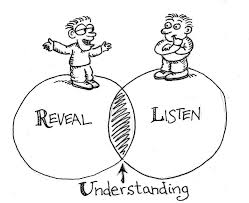
Active listening, which supports empathy, is a skill that can and must be learned. It’s one I’ve been working on for years. Do you look up from your computer when someone is talking to you? Better yet, do you stand up and move away from it? Our actions and body language communicate whether we are listening and another person’s willingness to open up is enhanced by our focus.

Finally, there is the tried-and-true Fake It Till You Make It. There may be people you feel you can never empathize with.  It can be done. Quy, who worked with the FBI, tells of managing to fake being empathetic with a child molester, finding that after faking it for a while she was able to develop a bit of real empathy. That is quite an extreme case but shows it can be done.  You just have to be willing to make the effort. Willingness goes a long way.

Looking at the ways we are creating relationships by using empathy – or not using it – can show us where we are succeeding or missing the mark when creating a library and library program which is a safe, welcoming environment for everyone.

ON LIBRARIES – Emotionally Connected

For several years I have been writing and speaking about Emotional Intelligence (EI) and its importance in leadership success.  Emotions drive us in our lives and are at the root of, according to some studies, at least 80% of all of our decisions.  The more we are attuned to them, the better we can use them to achieve our goals. And when we connect EI with empathy, we have a powerful leadership tool.

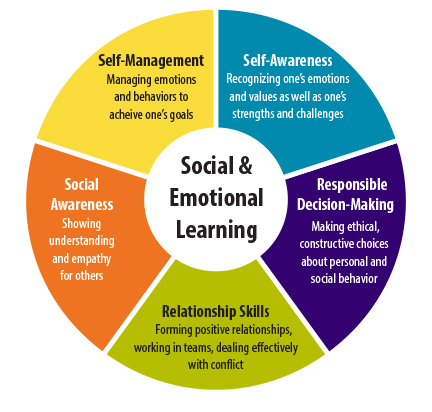
ASCD  began promoting Social and Emotional Learning (SEL) in the late 1990’s. The May 1997 issue of their journal, Educational Leadership  was devoted to the topic, and included an article on “How to Launch a Social & Emotional Learning Program.”  The article discussed attitudinal and logistical roadblocks to instituting a SEL program. Those attitudinal roadblocks are undoubtedly why it has taken so long for districts to develop SEL programs. 

Also in 1997, ASCD published Promoting Social and Emotional Learning by Maurice J. Elias, Joseph E. Zins, Roger P. Weissberg, Karin S. Frey, Mark T. Greenberg, Norris M. Haynes, Rachael Kessler, Mary E. Schwab-Stone and Timothy P. Shriver. In the opening chapter, the authors state,

  • “The challenge of raising knowledgeable, responsible, and caring children is recognized by nearly everyone. Few realize, however, that each element of this challenge can be enhanced by thoughtful, sustained, and systematic attention to children’s social and emotional learning (SEL). Indeed, experience and research show that promoting social and emotional development in children is “the missing piece” in efforts to reach the array of goals associated with improving schooling in the United States.”

The book is still available or you can read it online – amazing to find something from 20 years ago that isn’t completely out of date!

Recently, I have been seeing more districts add SEL to their curriculum. Education is finally accepting the fact that emotions do affect learning.  In New Jersey, my home state, the Department of Education has a page on their website on Social and Emotional Learning filled with helpful links.

Interestingly enough, the website page falls under the heading of “Keeping Our Kids Safe, Healthy & In School” and is part of a section on “Safe and Positive Learning Environment.” While we have recognized for some time that feeling safe is required for learning, it is only recently the role of emotions is being seen as playing an important role in that safety.  Without directly referring to EI, the core of the information shows how to develop and improve EI.

If your district hasn’t gotten started with SEL, discuss it with your principal.  You can start by sharing this PDF from the New Jersey site. You will notice that the first three are the “what” about EI and the remaining two are the “how” to infuse it.

Despite the slow reaction of districts to adopt SEL into the curriculum, librarians have always been doing it even when they didn’t have a name for it.  It’s intrinsic to making the library a safe and welcoming space for all.  Now you have the opportunity of being at the forefront of incorporating it throughout the school.

One aspect of SEL – and EI—that many find difficult to master is empathy. According to LaRay Quy, “empathy is the most important instrument in a leaders’ toolbox.” Good leaders take care of their people who in turn take care of them.  If you are fortunate enough to have a clerk or even more staff, you must take care of them.  But your teachers need care as well, and to do so effectively you need empathy. 

Quy, who used to work for the FBI, notes that empathy is like a mind reading tool.  By being attuned to another’s words and body language you can tell what they are thinking/feeling. To take care of them as you learn what’s going on with them, you can’t make your need to be right a priority.  One of my long-time mottos is, “Do you want to be right, or do you want it to work?” Because if you want to be right, it’s not going to work.

This connects to another aspect of empathy, showing that you value the other person’s work.  As librarians, we know how we struggle to feel validated.  Don’t forget others in education feel the same way. Validated another is a way to start an important change throughout your district.

When you are talking to someone, focus on them.  Look at their eyes even as you note their body language.  Don’t multitask.  This is not the time to go through junk mail, or see if another email has come in.  As with the other leadership techniques, it’s as important to use this with students as with your colleagues.

And if there is someone—teacher or student—who seems to rub you the wrong way, you still have tools that can help smooth this relationship. Start by watching your body language as you interact with them. They may be responding to something they are reading in you. By staying open, you may be surprised to discover you can feel empathy for this person.

Graphic from http://www.teachingwithdesign.com/empathy-skill-sets.html

I remember a teacher who I felt was highly confrontational.  My first instinct was to draw away. But by listening and focusing on what she was saying and her body language, I became aware she was reacting to the way people responded to her.  She was very intelligent and had high standards.  Many students disliked her because she was “tough,” which meant she dealt often with angry parents.  By letting her see I respected her knowledge and valued the way she got her students to succeed beyond their expectations, we developed a wonderful relationship.  She became one of the strongest advocates for the library program.

Does your district integrate SEL into the curriculum?  What training did everyone get? What’s your part?  If your district doesn’t include SEL, how will you bring the idea to your administrators?