Making Decisions – Emotions vs. Logic

How do you make your decisions? Do you make them logically or trust your gut and go with your emotions? Most would say they decide logically. But more than 80% of the time, this is not the case.

While we may be logical when doing grocery shopping and choosing between one brand or another (cookie aisle not withstanding), it is rarely true when making any significant decisions. What we typically do is make our decision emotionally and then substantiate it logically. Understanding the power of emotions, and how they are impacting you and those around you, will improve your communication and help you achieve your goals.

In his article “The Power of Emotions,” Kell Delaney explains, “Humans are fundamentally emotional beings, and our emotions often drive our narratives and decision-making processes.” Because of this, we identify our feelings as being accurate. The problems occur when interacting with administrators, teachers, parents, and students who have different emotional responses to the same situation. The result is miscommunication along with worsening the situation.

How can you arrive at something logical when emotions are in control?

Delaney says we need to advocate for our core values and create stories and visions that others can engage with and help shape. He adds that bringing in your vision and actively listening to others’ perspectives develops a collaborative narrative for mutual understanding and action. That’s a big promise.  How do we achieve it? My recommendation is to consider your audience – and bring it back to the students.

With Administrators – Whether it’s a budget request, a plan for a new library service, or anything that requires administrative approval, I lead with the students. How will this affect them positively? Do I have any student work to share that connects to my request? By giving them an emotional reason for what I want, I am far more likely to get a positive response.

With Teachers – While some teachers like working with you, others are resistant. Find a time to talk with them, complimenting them on an aspect of their teaching you’ve experienced, particularly their connection with students. Add that you would like to contribute to their success and offer, if you can, to handle any additional work that is involved. Listen carefully to their response and continue the conversation accordingly.

With Parents – While it has become a far larger issue recently, dealing with parental objections to what books their child has access to has always been part of being a school librarian. When a parent comes to you directly, acknowledge them for being an aware and involved parent. Let them know you will see to it that their child no longer has access to those types of books. If they want to have the books removed, share the values of school librarians according to AASL standards.  When the charge comes at a Board of Education meeting, draw on parent advocates you have been building.

With Students – From “This is stupid!” to “Why do we have to learn this?” there are always students who resist doing what is required. Ask them what they would rather learn. That will pause the narrative. Many will be surprised by the question. Recognize their desire to learn (hopefully) along with their concerns with this lesson, then ask them to participate and see if the lesson provided an answer to their question or an interesting experience.

We are all under stress. Be ready for what is apt to be a contentious school year by readying yourself with how to deal with this paradox between logic and emotion. Knowing how to harness emotions, and not avoid them, to reach a reasonable way of dealing with an issue is key to creating a better work environment.  You will be a more effective leader and school librarian as a result.

Lead With Grace

Grace as a leadership tool? Yes!

The word “grace” is usually associated with religious practices, but it goes beyond that and used properly, it can deepen your leadership ability. One of the many definitions of “grace” given by Merriam-Webster is “the quality or state of being considerate or thoughtful.” With that in mind, it is easy to see grace-based leadership as a natural outgrowth of the recently popular concept of servant leadership, which is about leading from a place of being clear on who and how you wanted to serve.

While the business world struggles to incorporate either or both of these leadership styles, they are natural to school librarians and the work we do. Even as the pressures on teachers and librarians grow, bringing grace into our lives (treat ourselves) and our leadership (treat others) is very powerful and has the potential to have a huge impact..

In her blog article, Short fuses, high stakes: An argument for grace-based leadership, Julie Winkle Giulioni says that Grace-based leadership is  “the ability to meet people where they are — with patience, understanding and compassion — while still upholding clear expectations and accountability.” She then offers six practices to incorporate in your daily interactions. Giulioni is speaking to the business world, so I have tweaked these to match our world. Keep in mind these apply when working with all of your audiences: students, teachers, administrators, volunteers, parents, and more:

  1. Make space for humanity – Due dates matter but so do people. Pressures abound. Recognize these feelings as you deal with students, teachers, administrators – and yourself. Things will be late, mistakes will be made. It’s part of the process.
  2. Assume positive intent – Jumping to conclusions is easy, particularly in stressful times, but it only exacerbates the problem. There usually is a reason for someone’s anger/frustration/challenge. Be curious as to what is driving the negativity rather than making judgements. Come from a place of “they’re doing their best” and you’ll have a different perspective and response.
  3. Respond rather than react – It is natural to respond with hostility when someone directs a negative emotion at you. Remember to pause and breathe. It will lower your temperature and blood pressure, allowing you to give a more reasoned response and give you a chance to do the first two steps (space for humanity and assuming positive intent).
  4. Honor multiple realities – We know from the political climate, we aren’t going to be able to convince someone who holds an opposite position that your belief is correct. As librarians we serve the whole school community, even (may especially) those we don’t agree with. Find a common ground among your differences.  It is part of how your build relationships.
  5. Offer “soft landings” for hard truths – This is particularly helpful with students as Giulioni says to frame “feedback respectfully, focusing on behaviors and results.” It also applies when you need to explain to a teacher or administrator why you want to tweak their plan. People don’t want to hear ‘no’. Find a better way to share what you have to say.
  6. Hold people capable, not just accountable – Part of your feedback should recognize the other person’s abilities and strengths. It’s also knowing they have a “Why” for what they did or didn’t to that is as important to them as yours is to you.

Giulioni adds these three suggestions on how to Grow in grace which I am quoting directly:

  • Use curious language (“Help me understand…”) instead of accusatory language (“Why did you…”).
  • After a mistake, lead with support first (“What do you need to get back on track?” or “How can I help?”) before jumping to blame.
  • Share your learning moments openly. Modeling self-grace normalizes growth and reduces fear.

And when practicing grace, remember to offer it to yourself because you deserve at much as everyone around you. Leaders need to be gentle with themselves just as they offer this to those around them.

Leaders Show They Care

Watch the news the news or scroll through social media and it’s quickly clear that everyone is feeling stressed, overworked, and underappreciated. As librarians, we not only feel, but are actually under attack as well. Our jobs, our collections, our programs are under some intense scrutiny. Fortunately, there’s an unexpected tool that can help – Caring.

Sometimes the best way to deal with the negative emotions is by helping others. Our students need their teachers and librarians to bring our best selves each day, no matter how difficult. When we start by remembering how important and impactful the work we do is, we can tap into the power of connection.

In her blog article, The duty of care: How leaders can anchor teams in turbulent times,  Julie Winkle Giulioni presents seven ways to show caring in the business world. Here they are her seven, along with my adjustments for their application to the school setting.

  1. Benevolence– Make time to know what others value, what they care about in their school and personal life. Your interest in them opens the door to sharing and easing a burden they were carrying on their own.
  2. Trust – As I have often said, trust is the foundation of relationship, and as a leader you must build these relationships. Trust can come from keeping your word as well as keeping confidences. What a teacher may have shared with you is not one for you to share with others unless you have been given permission.
  3. Respect Giulioni says this is about how you listen. Listening is a core skill in leadership.

You honor the other person’s journey and don’t jump to judgement if you don’t agree with their path.

  • Empathy – When teachers allowed you in on their worry and pain, let them know you care. You can share a similar pain, but don’t try to top theirs.  This isn’t a contest.
  • Communication – You show your caring by how you speak to students, teachers and, yes, administrators. According to Giulioni, you do so by welcoming their perspective and accepting their emotions. I would add the importance of tuning it to what is communicated in their body language. People sometimes mask their emotions on their faces, but you can often pick up what they are feeling by the way they are standing and subconscious hand movements. Pick up on these and ask about them if you notice something isn’t right.
  • Vulnerability – In this case, it doesn’t refer to over-sharing. Giulioni says it means admitting when you don’t know everything and when you have made mistakes. We are all human. Show your human side. It give others the space to do the same.
  • Support – You are in this for the long haul. It isn’t a one-time thing. Follow up on your conversations. Ask how things are going when you know there’s been a problem. Offer to help if they need it.

We are going through tough times, but I have always held on to the mantra, “This will change.” Nothing stays the same. Bad times become better, and good times go bad. But even when we can’t control what happens, we can control how we deal with it. What you do now will impact your relationships when times get better. Stay connected with people. In the words of Theodore Roosevelt, “Nobody cares how much you know, until they know how much you care.” Leaders care about others.

Be Resilient and Persevere

It is a long-term truism that we live in a rapidly changing world. Keeping up with change is an ongoing component of a school librarian’s toolset. But the current speed of change is outrageous. From one day to the next there are so many changes from so many directions it is nearly impossible to keep up.

The stress level created by this is high and is a true test of your abilities as a leader.  Think of yourself as the captain of a ship dealing with safely navigating a ship in a wind-laced storm. As you weather these constant challenges, you must simultaneously review and sharpen your ability to persevere and draw on your resilience. These two in combination will help you to not only survive but thrive.

Danna Diaz in her article, Resilience and Perseverance: Keys to Effective Leadership in Schools, writes about the process of strengthening your abilities in these two areas by defining them then presenting strategies to do so. As always, I have added my comments to more firmly root them in the daily work life of school librarians.

Definition – According to Diaz, “Resilience is the capacity to recover quickly from setbacks, while perseverance is the steadfastness to stay committed despite difficulty.” We are all familiar with the pivoting that has been necessary in the past years. Fluctuating situations require us to be even more nimble in making changes to meet new requirements. Our perseverance is tested as we hold true to our commitments and Mission in the face of the ongoing challenges.

Building resilience in leadership – To build this necessary component, you need to have a growth mindset and a belief that a potential or possible crisis can be turned into an opportunity. A blog post I wrote on May 27, 2019, Crisis? No! It’s a Chopportunity, details the many ways you can use an apparent disaster into a chance to strengthen and grow the library. When presented with a challenge—look to your Mission and Vision to find possibility.

The role of emotional intelligence – Your ability to create a Chopportunity relies on your awareness and understanding of what motivates others (whether positively or negatively). For example, if you have been informed of a drastic cut in your budget, the opportunity you present to your principal needs to be based on how well you know your principal’s needs, wants, and goals and your ability to show them how your work supports what they are trying to do.

Perseverance: The long game of leadership – Diaz says, “While resilience helps leaders recover from setbacks, perseverance ensures they remain committed to their vision.” Your Mission Statement, combined with your knowledge of what a your school or administrator needs, guides you in creating the opportunity or recommendation you present. Your Vision keeps you fighting to see it through. It is why you write a Vision in the present tense. While it isn’t the current reality, it is the aspiration that should inspire you to hang in there and bring it closer to existence.

Strategies for building resilience and perseverance in schools

  • Foster a culture of collaboration and support – You are a relationship-builder. Use the relationships you have with teachers, students, and administrators to further your plan. They have come to count on you to deliver on your promises.
  • Model self-care and wellness – Never neglect to take care of yourself. Relying on Persistence and Perseverance without including self-care leads to burn-out. In taking care of yourself, you are showing others that much can be accomplished while not losing yourself. It’s another aspect of your leadership.
  • Develop a data-driven mindset – We always need the data, but I’d go one step further and remind you to look for emotional context to bring to the data. Decisions are rooted in emotion substantiated by data and logic. Give them a reason to care about the data you present.
  • Build strong community partnerships – Expand your thinking to find and work with others who can help you in strengthening the library in challenging times. Parents can be a good source. If you have parent volunteers, they know your value. Parent-Teacher associations can also be helpful as can relationships with the public library.

Diaz concludes by reminding us of the ripple effect of doing this work: We will inspire resilience and perseverance in others. Remember, the job of a leader is not only to have followers, but also to create other leaders. Times are likely to always be tough in one way or another, but so are you.  You have or are building a track record and can thrive. Be Resilient and Persevere. So many will benefit when you do!

How To Tap Down Triggers

EDITOR’S NOTE – This blog about a specific and contained type of triggers. More serious, lasting triggers need a different kind of attention and help. Please get the support you need and deserve.

~~~~~~~~~

What is a trigger? A month ago, I wrote Look for Glimmers and Find Joy which discussed how Glimmers were the opposite of triggers. Both cause an unanticipated emotional reaction. The first is wonderfully positive. The second can cause us any number of negative effects including damaging our relationships and how people perceive us and our program.

Glimmers and triggers are opposite in one other way. You have to notice glimmers to appreciate them. Triggers slam into you without any invitation.

While triggers take you unaware, if you are going to deal with them, you need to recognize when you are having a trigger response. This isn’t easy when your emotions are taking over.

Andrea Mein DeWitt’s article, A Leader’s 3-Step Strategy to Being Less Emotional, Reactive, recommend you Name, Claim, and Reframe. This approach will give you skills to modify what could be a damaging response from you. Notice that she references “leaders.” Leaders can’t allow triggers to affect how they react in a given situation.

Here are her steps:

  1. Name – Look for the source of the trigger. (This is not like noticing glimmers, but in reverse.) She asks you to identify what is causing you to react rather than respond – an important distinction – and what specific emotion is in play. Also note what, if any, of your core values have been attacked. For example, book banning and malicious name-calling is on the rise leaving us emotionally exhausted. We are tired of explaining. When one more attack comes, particularly if it comes from what we thought was a friendly source, we can explode.
  2. Claim – Now that you know where your reaction came from, what can you do about it? De Witt wants you to identify the action(s) you can take to bring you back to your core values. Take your ego out and think what might have caused the person to say/do what then triggered your reaction. Then, look to what can you do to get the conversation back to the issue at stake. Rather than responding by saying “we are not…(insert charge)..” turn to the positive, reminding parents, teachers and administrators that,“libraries need to be a safe, welcoming space for all.” From there, you can better discuss what to do.
  3. Reframe – This helps you to move on positively from a stressful conversation. DeWitt says to ask yourself what you learned and what is now an opportunity to use your creativity. Which of the ideas you came up with will produce the best results and promote your Mission and Vision? Notice any new resources you can now use. As you reflect on what happened, you might decide to do a bulletin board or infographic identifying how libraries create a safe space. Perhaps mention the Mirrors, Windows, and Sliding Doors concept. Do something interactive such as having teachers/students anonymously post notes on the bulletin board saying how the library/librarian made them safe and welcome.

We are in the relationship business. With emotions running high and politics affecting libraries and librarians, we must do all we can to avoid being further sucked into the intensity of the triggers and stresses around us. Emotional Intelligence includes Managing Your Emotions for a reason. Leaders – and you are a leader – need to have all the tools possible to do it.

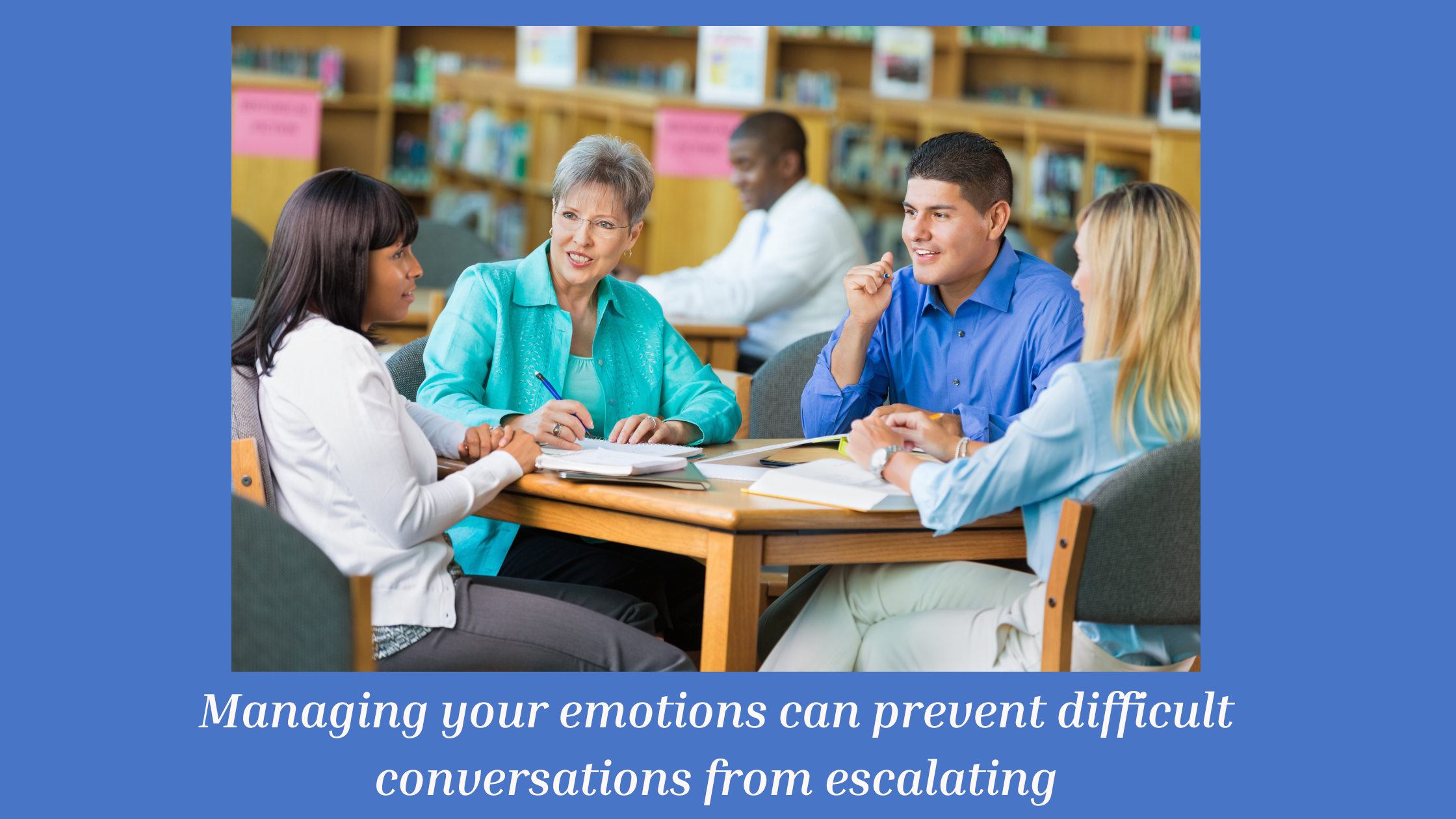
Managing Emotions During Difficult Conversations

I recently gave a talk at my state’s School Librarian conference on managing difficult conversations. It doesn’t take much for a situation to get out of hand when intense emotions become involved. Our emotions are powerful forces, and if we’re not conscientious, they can work against us.

When we are having a difficult conversation, our emotions can reduce our ability to think logically, hear what the other person is saying, and manage the discussion. Since a negative outcome can hurt a relationship we worked hard to build, it’s critical that we keep our emotions out of these talks.

LaRae Quy recognizes the difficulty in managing your emotions and offers these four tips in her blog post, How to Have Hard Conversations Without Emotions Taking Over:

  1. Repeat the statement as a question – Take the statement that is creating a rise in emotion for you and reframe it as a question. You give yourself time to think as well as a chance to hear why the other person made the choice. For example, a teacher is using your desk while they are in the library. After you bring it their attention, and they say, “It’s the most convenient space available,’’ you can respond with, “Do you need a convenient space in the library?”  This does two things. You put a pause before you next speak and have turned your attention outward onto the teacher with an opportunity to hear what they need rather than venting your anger at your space being violated.
  2. Speak in soothing tones – This doesn’t mean a sweet, artificial tone, but rather speaking calmly. People can hear the tightness when anger creeps in. Consciously using a reassuring timber has the benefit of calming your emotions and that of the other party as well. Quy recommends noticing your tone of voice when you are stressed and working on calming it down. In regular conversations practice using different tones to convey your meaning. As you become more aware of how you use your tone of voice you will become better at it.
  3. Employ active listening – This works in all situations. People need to know you hear them – and see them. Be observant of body language and the many non-verbal ways the other person is communicating.  It helps you recognize what they are saying and develops your empathy. Quy explains that “Empathy is the ability to recognize, understand and share the thoughts and feelings of another person.” When we use this skill, relationships develop deeper connections, even during more difficult moments.
  4. Gather significant information – If you are initiating one of these conversations, you have time to find out more about the person and what might be happening outside of the circumstances that created the difficult situation.  You may discover there was a reason for whatever triggered their behavior. This is especially true for students, whose Emotional Intelligence is still developing. Student behavior is often triggered by issues out of your control – or your purview. If you are seeing something that concerns you, speak to teachers and seek out the guidance counselor to learn what you can.

Difficult conversations are going to happen. If we cannot avoid them, we have to know how to manage them. The more you learn about managing hard conversations, the better you become at building and maintaining relationships.  And as we know – we are in the relationship business..

Managing Conflict

Wouldn’t it be great if we always got along? I’m not sure it would always be a good thing because everyone agreeing would mean we would explore new options less frequently. But for good or ill, we don’t have to worry about that. There will always be conflicts.

Handling conflicts requires two aspects of social intelligence: understanding your emotions and managing them. How do you normally respond when you feel attacked or judged? Do you go on the offensive? Do you try to prove you are not responsible? Or do you deflect and try to show how you were misunderstood, and that isn’t what you meant or intended?

As Socrates said, “To know thyself is the beginning of wisdom.”  You must be honest about your own behaviors to be able to manage the response. Remember, the conflict won’t be defused unless calm heads prevail, and it starts with you. A question to keep in mind is, “Do you want to be right, or do you want it to work?” Because, if you want to be right, it won’t work.

In her post, How Leaders Can Start Building Conflict Capacity, Marlene Chism defines conflict capacity as, the “ability to tolerate conflict without getting triggered into unconscious reactions.” She notes it requires self-awareness, which boils down to knowing yourself. Chism then offers four ways to develop the necessary capacity.

  1. Reframe Conflict – Mindset is always crucial. If you see conflict as two sides fighting each other, you are likely to focus on being right and winning. Instead, view it as a chance to explore where things aren’t working with the goal of improving the situation. A challenge almost always provides an opportunity. This disagreement provides the impetus to move forward in a better way.
  2. Get Curious – Rather than thinking some form of “Well, they’re wrong,” find out why and how they came to their viewpoint. Chism says you do this by inviting conversation with questions like “Will you walk me through your thinking?” or “I’m curious. How did you come to that decision?” This pauses the heat that is building. It also communicates your willingness to listen rather than drown out what they are saying.
  3. Expand Your Comfort Zone – When you are dealing with people with low conflict capacity, as defined by Chism, it is hard to resist interrupting them. Don’t. Let them go on. Eventually, they will lose steam. As the person keeps talking, keep your focus on listening for the core issue that set them off. It will help you respond when they get to the end of their rant, and it will also send a further message that you see them and their issue.
  4. Seek Mentoring – This recommendation is to build relationships before the crisis comes. You know which teachers have the reputation as complainers. In an organization, there are always some who don’t want to follow the leader. When you interact with these people, be sure to do your best to release what you’ve heard and connect. Get to understand them, and what motivates them. Any challenges that come – and they mostly likely will—will be less heated because of your pre-existing relationship. Don’t neglect the relationship with your principal. This connection shouldn’t wait for a crisis. Find reasons to ask for their advice and support  – and listen to it.

When you change your perspective, conflicts can become opportunities. The more you grow as a leader, the more of these you will need to deal with. Learning to manage yourself and handle these challenges are an important part of building strong relationships and part of your growth. Keep going.

Instincts + Facts = Strong Decisions

If you are an NCIS fan, you know that Special Agent Jethro Gibbs, played by Mark Hamon, always trusts his instincts. But should you trust yours? And if so when?

For me, and I assume for many of us, the answer is sometimes. My instinct is an accumulation of life experiences, good and bad. It’s faster than data analysis in telling me about any given situation. I can rely on it for taking on speaking engagements, agreeing to a new project, or choosing to join a committee or board. But it can steer me in the wrong direction, especially when I’ve been influenced by incorrect information, such as the language and biases I was raised with.

How can you know when your “gut” is drawing you to the right choice? In the last part of her blog post, Efficient Decision—Making with EQ Skills in Business, Dr, Anna Rostomyan offers these five steps to guide you. She concludes by noting the importance of the additional information intuition and gut instincts lend to the decision-making process. These are her steps with my comments:

  • Delay the decision – Akin to counting to ten, a pause prevents you from going too fast and not seeing all aspects of the situation. It also keeps you from drawing on the implicit bias that has built up over the years. It helps you to notice if you’re responding out of learned emotion, the facts that have been presented, or a combination of both.
  • Recognize your emotions, and the emotions in those with whom you interact – We all have triggers that can set us off. Is your reaction based on one of yours? Have you accidentally set off someone else’s trigger? Can you stop and see why certain emotions have come up for you or the person you’re talking to? We sometimes use phrases where we don’t realize the potential for harm and need to stop and reflect if we don’t get the reaction we’re expecting. As an example, look up the history of the phrase “grandfathering in” to see where racial inequality has influenced our language.
  • Identify the emotional side of the decision – Identifying emotions allows us to take a step back from experiencing them. This is one of the key reasons for the first step of delaying the decision. There’s nothing wrong with having a strong reaction to information, news, or change, but it is important to not act on that first response and instead notice how we’re feeling.
  • Reappraise the feelings which are hindering your rational decision-making – Rostomyan says this will let you analyze whether the emotions are helping or interfering with the process and allow you to see the facts more clearly. In my blog last week, I talked about leaving a position after 22 years. As relevant as they were, I had to remove the emotional components (my dislike of the principal and my dismay at the approaching retirement of the supportive Superintendent) from the rational aspect of the situation. The facts were the principals track record of restricting the library program and his known aspirations to becoming Superintendent. Big decisions are usually connected to deeply held feelings, not always easy to identify. When you can separate your emotional reaction from the facts that led to that reaction you can see whether you have truth to back up your response and then make your decision accordingly. Taking the time to explore them will help you make the best choice.
  • Look for substitute or alternative decisions – Have a Plan B. If the decision is important, you need to know what you will do if your first solution doesn’t work. Here Rostomyan says to be careful of “FOBO” (fear of a better option). To avoid this, she advises… getting back to your gut.

Your gut or intuition can be a reliable guide, but despite Jethro Gibbs, it is wise to check in with your emotions and the facts surrounding your response to make certain your gut is leading you in the right direction.

Love The Life You Live

Do you love your life? Only on special occasions? You are not alone. Many people count the days to their retirement even when it’s years away, and it’s not a healthy way to live. When we are not seeing the positives in our life, we are easily stressed. In addition, our negative perspective affects how we see events and people. Studies have proven our mental and physical heath are affected by our emotions.

Mindset is powerful. You know that from your experiences with students, teachers and administrators. We discuss it in SEL (Social and Emotional Learning) and possibly in Professional Development groups you belong to. A negative mindset hampers your Emotional Intelligence.  

In a post about the central tenants of his book, The Earned Life: Lose Regret, Choose Fulfillment, Marshall Goldsmith offers this 5-step approach to re-examining your life and coming to love it:

  1. Align your aspirations, ambitions, and actions—Just as you have a Vision for your library, you need one for your life. Why are you doing all this? Why are you working so hard? Goldsmith says to ask yourself what you are trying to achieve. What is your big goal? In a way, this is like your Mission statement. Follow that up with ideas and plans of how to get there. In essence, you are creating a strategic plan to have the life you really want. Goldsmith cautions against basing success on the quantity of your achievements. That leads to the overwork many of us are prone to – and the exhaustion that accompanies it. Hustle culture doesn’t work. Focus instead on the doing rather than the totality (the end result) –relishing the learning that is part of the journey.
  • Eat the Marshmallow – Referring to the experiment where children were asked to decide if they want one marshmallow now or wait until later and get two, Goldsmith asks what if you are asked to delay further for three? How much gratification should you delay? Waiting for an ultimate reward can suck the joy out of everyday accomplishments. Delight can and should be incorporated into your every day. You don’t need to wait until you earn it because of some big event. Use the good dishes. Buy the thing you want so much.
  • The “New Me” Paradigm—We need to remove the “when” from our life view. Deciding that happiness will come only when a certain event or achievement is reached keeps you from enjoying the now. Goldsmith notes that there is no correlation between achievement and happiness. You don’t need to be better, thinner, more financially secure, or any other version of a “better” you to embrace being happy now.
  • Credibility Must Be Earned Twice – I have never seen the idea put this way before, but it is vital for school librarians to recognize. According to Goldsmith, for people to trust you, you have to be competent at what you do, and you are. But that isn’t enough. Your work must also be recognized. And that is where we sometimes miss the mark–and miss out on happiness. The lack of recognition for our work is a big factor in not loving our lives. The answer is to market yourself so that what you’re doing is noticed by your core audience. If that feels too hard, start by promoting your program. As Goldsmith says, “If good work really spoke for itself, no company would need a marketing function.”
  • The LPR – This is your Life Plan Review, a daily reflection of how you are doing. Goldsmith did it with a group, but you can do it alone. I keep a Success Journal near where I work to track my daily accomplishments so I can see what I’ve done in a day, rather than only focus on what still needs to be done. If you’re only looking forward, you cannot take joy in what is happening now.

You have so much in your life that is good and so much you’ve accomplished. True, there are challenges and problems, but if you look closely, you can see how much is right with your world. Take time to see all the good choices you’ve made, the wonderful people in your life, the opportunities you have. Start loving the life you live–or keep waiting for more marshmallows.

Managing Frustration

You know the feeling. The internet is down just as you are setting up for a lesson. You had the item in your hand, put it down some place, and now you can’t find it. The secretary called to say the principal can’t make the meeting you had scheduled to discuss a project after you spend days preparing.

You just want to scream.

Worse, as frustration and anger fill your mind it becomes almost impossible to figure out what to do next. Now, with so much waiting to get done, you are frozen in your tracks. Your self-talk is turned up to a litany of negative phrases. This is too hard. Why am I even trying? No one cares. It goes on.

So here you are again. The new challenge is to get past the emotional turmoil as quickly as possible and tackle the tasks at hand. John Mattone in How Leaders Can Control Their Frustrations with Team Members, offers sound advice to the business world. Much of what he says applies to us as well. It all goes back to managing our emotional response to whatever has triggered the frustration.

First Mattone discusses the importance between Reacting vs. Responding – When you react, you let other people or situations take control. A leader needs to keep that from happening. is instinctive. Responding is proactive and puts you back in control. Look at the obstacle that has caused the frustration. Is it a permanent situation or is it temporary? If it is permanent, work on alternate means of achieving your ultimate goal. If it is merely a postponement, consider how you might make good use of the unexpected time.

In order to respond rather than react, it’s important to be aware of:

  • Emotional Control –When emotions are ruling you, your cognitive thinking isn’t functioning. It’s not about ignoring or denying your frustration or the connected emotions, it is, as Mattone says, being aware of the emotions and not letting them rule you which is “proof that a leader has mastered self-awareness and is emotionally intelligent.” When frustration rises, pause. The age-old advice for anger is to count to ten. A pause is vital. Take a deep breath. Acknowledge the emotion. That will reduce it immediately. Then, once you’re thinking clearer, begin the process of how you are going to handle the situation.
  • Understanding Emotions – Emotions are an important part of our lives, giving us feedback as to what is working and what is not. When positive emotions are present, your self-talk is encouraging and you acknowledges your ability to make things work. You are also more supportive and positive with the people around you. The sooner you understand your emotions, the sooner you can respond (not react) and work effectively with those around you.
  • Preparing for High Stress Situations – They are going to happen, and they’re rarely (unfortunately) predictable. Accepting and anticipating the inevitability of these situations will help you to respond rather than react. Accepting means when one occurs you say to yourself, “here it is again.”  Not in high emotion, but with understanding. Anticipating means you have identified potential obstacle that may interfere with your plans and/or work flow so that when it happens, you’re as ready as possible.

The better you are at dealing with the frustrations inherent on your job and in your life, the more people will see you as the calm in a storm. It allows others to see you as a leader. And hopefully will lead to fewer frustrations in the future.