Embrace Your Ambition

Are you ambitious?  My guess is that some of you would say in many ways you are. However, you might not publicly claim it because of all the negativity surrounding ambition. Certainly, we have all experienced that from others in our professional life, perhaps in your personal life, and on the national stage.

Our instincts are correct in this. There are positive and negative aspects to ambition. And some of the positive aspects can help you grow as a leader. Amina AlTai offers five insights from her new book, The Ambition Trap: How to Stop Chasing and Start Living in her article “How to Break Free From the Ambition Trap.” Here are her five, along with my usual comments:

  1. We need to redefine ambition – At its core, ambition is about growing in some way. The negative association has to do with growing powerful and/or rich and then cruel or callous. The ambition you want to have is about growing in knowledge to better serve your community. Librarians are lifelong learners who can and should embrace their ambition to learn and their desire to share.
  2. There are two types of ambition– AlTai looks closely at the two types which she calls painful and purposeful ambition. The painful ambition, which is more familiar, is focused on winning no matter the cost. We can all identify those who want to show they are better than others. A history of feeling betrayed makes them pursue control. Purposeful ambition is focused on purpose and collaboration. This speaks to our core values as librarians. It looks to what we want to achieve and the best means to get there.
  3. Identity and ambition are deeply intertwined – According to AlTai “Ambition doesn’t exist in a vacuum. It is shaped and constrained by identity.” You know the identity society has given you. At various times, your ambition will be attributed to your identify and treated accordingly. And it will be different depending on the identity. How will you react to this? Do you overperform to gain approval or underperform to stay safe. It will take courage to have positive/purposeful ambition, but so much is at stake. We must be ambitious.
  4. It’s not about renouncing ambition, but allowing ambition to come from innate gifts – As AlTai says, “We need to leverage the best of us. We all have a unique form of brilliance, a rare talent or ability that is specific to us and that we came to this planet to share.” As a librarian you have so many skills: tech, research, people, interdisciplinary and more. We need to know when and where to use these to achieve our goals. We want our students to feel safe in our library and be ready for whatever the future holds.
  5. Ambition is cyclical – Most of us think of positive or negative ambition always continuing to grow. AlTai points to the necessity to pause. I see it as a reminder for self-care. You cannot always be chasing a goal, despite the messages in our hustle culture. We need to remember that constant giving is draining. In order to serve, we need the downtime to recharge.  Too many need us to skip the need to recharge.

Abition is not a “dirty word.” Like it or not, comfortable with the idea or not, leaders are ambitious. We have goals, a Vision and Mission and the determination to live into them. Our drive is powerful and should not be dampened. Students, teachers, and administrators are counting on us to continue to strive for growing and doing better.
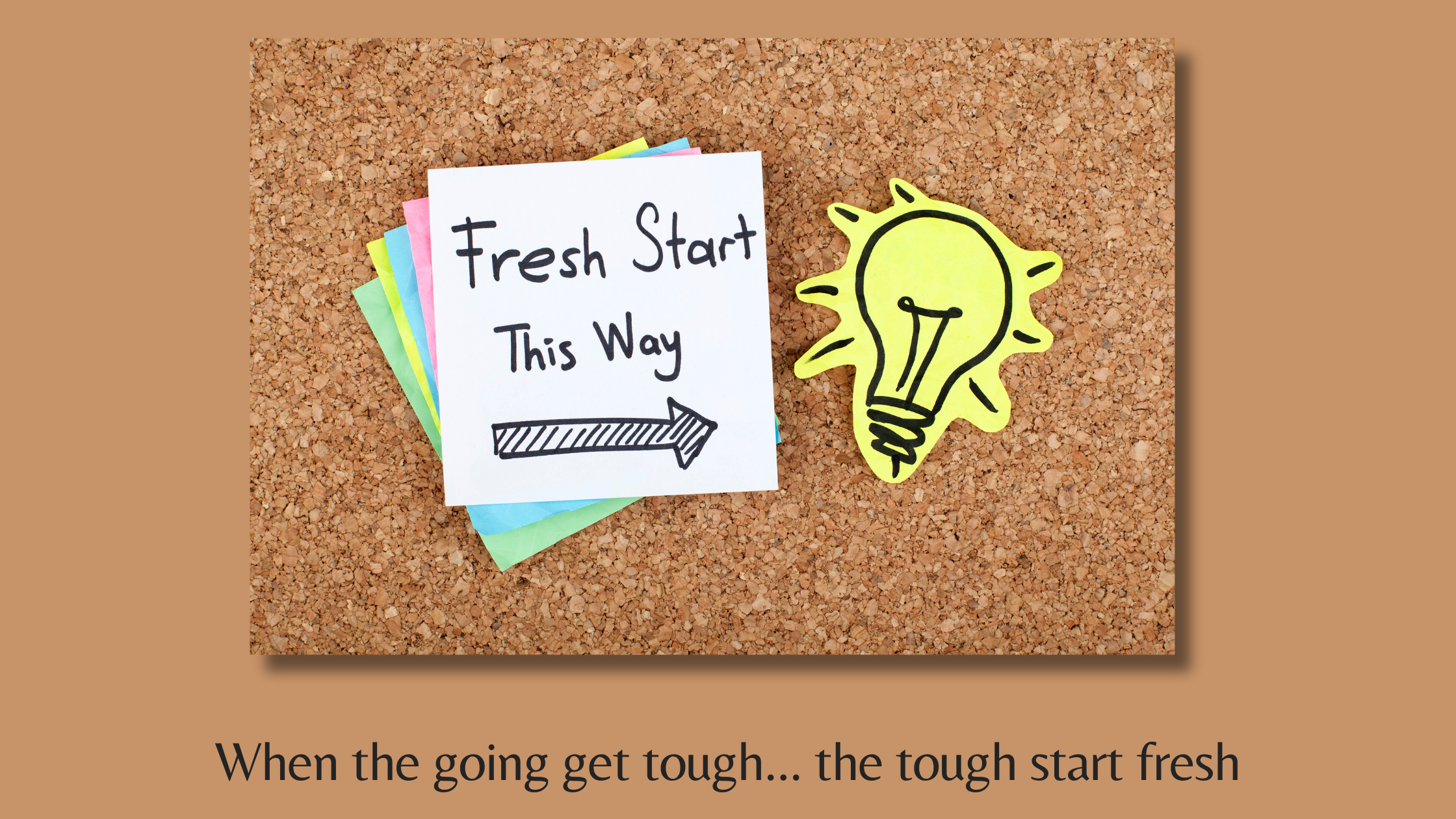
Is It Already Time for a New Beginning?

Has the school year already lost that new beginning luster with all the old and new challenges you are facing? There is so much going on in our lives as we pivot from vacation mode to work mode. Chances are you plunged right in without much thought especially since you know your job. But that means that even though the year is only a few weeks old, maybe you could already use a new beginning.

What would that mean? Probably a combination of things – looking at what can be started, what can be made new, what’s getting in your way, and how to get past those roadblocks. To help you get your motivation back, I recommend looking at the recommendations of Palena R. Neale Ph.D., PCC in her Psychology Today article, Harnessing the Fresh Start Effect : 6 steps to set you up for success with the fresh start effect. Neale notes that giving yourself a fresh start moves you away from any failures you perceive. This can help turn off those negative voices in your head that creep in with the “new” wears off.

Here are her steps and my usual comments on how it works for us in the education world:

1. Create Your Own Fresh Starts  – The first thing to consider is what would a fresh start include. Think about what would you like to accomplish. Do you have a goal or a plan you thought you put into action when the school year began and then it got lost in all the opening activities? Knowing what you hope to achieve can give you some focus.

2. Choose Your Peak Momentum – Now choose the day you want to begin your fresh start. Monday is usually a favorite time, but any day that works for you and your schedule is fine. New month, day after a long weekend. Nothing is off-limits. Accept and use what works best for you. Then, the night before, go through the focus you created in step one.

3. Connect to Your “Why” – What is your Vision for the library? Even though by definition it is not achievable, you are always working to bring it closer to reality. This is where your Mission comes in, what I call your “Perspiration” and “Motivation.” It defines how you operate through the day, how you deal with students, how you work with teachers, and how you communicate with your principal. Why do you want to accomplish what you focused on in step one.

4. Keep It Simple – There are likely to be lots of things you want to change, but it’s better if you focus on one or maybe two goals. Create a strategic plan. It doesn’t need to be complicated. You’ve got your Vision and Mission. Do an Environmental Scan. Do a SOAR analysis by identifying your Strengths, Opportunities, Aspirations, and Results. The first two are what currently exists. The second two are where you want to go. What Action Steps will get you started? Who will be involved? Remember to get approval where you need them. What costs are involved? What’s the timeline knowing it’s bound to need tweaking. Knowing where to start is the key to starting.

5. Change Your Environment – No, you don’t move outside the library. You need to remove the things that make you lose your focus. Clear clutter from your desk. Perhaps plan to save looking at emails until the end of the day or at lunch if you worry you may miss something important. Get things filed or tossed. Bring in something you love to look at. Frame your Vision Statement.

6. Sustain Success – Implementing a plan is important. Sustaining it is vital. Check in with your goal the steps you thought would get you there to see your progress. For my own strategic planning, I use “telescoping”, “microscoping,” and “periscoping”. At the beginning you telescope to see what the end results will look like. Before you get overwhelmed by the thought, microscope by focusing on what needs to be done now. Periscoping involves popping up now and then to check on what comes next. This ensures you won’t miss a deadline or key step.

As the well-known philosopher, Yogi Berra, said, “If you don’t know where you are going, you will end up someplace else.” Create your new beginning and get to where you want to go.

Thriving In Challenging Times

It feels like we have been living in challenging times for so long the phrase has become commonplace. Stress is so high, surviving might be the chief goal, making thriving seem like a fantasy. But we can’t afford that. If survival is the goal, we are likely to be swept away by the rising tide of our current political climate, and bad times don’t deserve our surrender.

Our students and teachers need more than our survival – and so do we.  Nina Snyder turns to a surprising role model to emulate in her blog post How to Run Your Business Like Taylor Swift. You are not running a business, but as my comments show, the five lessons work for us. And who couldn’t use a little more Taylor Swift in their lives:

Know your customer – Ours are the students, teachers, and the administrators. It’s also parents who are keeping an ever-watchful eye on school libraries, and the general public. What do they want?  What do they need? Students want to do well and not be bored or worried about grades. They need choice and voice. Teachers want relief. They need help as they are feeling overworked and overly scrutinized. Principals want to present a well-run, high achieving school. They need evidence that is happening.  Parents want their children to be successful. They need evidence to know the library is not harming them but rather preparing their children for today and tomorrow. The public wants a good school system because it makes for a desirable community that attracts people to the community.

 Pivot before it’s required – Times keep changing. New technologies emerge, as do new threats. In order to be ready to modify your strategy, you need to stay ahead of the game. Reading journals and articles you get as an ALA/AASL and AECT/ISTE member lets you know the latest in education, including what the administrators are thinking. Work with the public library. The youth services librarian may have a closer ear to the community than you do. Check in with your Professional Learning Network (PLN) for ideas and to learn what’s happening in other locations. It will give you a heads up. Reading the local newspaper or website for clues into what the community is thinking. Follow the towns social media. Shop occasionally in the town where you work so you can hear what customers are talking about.

Embrace authenticity – Be honest. Don’t abandon your core professional and personal values. That can be frightening today. Draw on the support offered by our professional associations. They offer resources to help in presenting what you stand for.  When you step away from what matters to you, you can’t be as confident about the work you do, and you don’t feel good about yourself.

Focus on your strengths – Most of you have strong tech skills. Use them to promote your program. Showcase student accomplishments, acknowledging the teachers involved on your library website. In addition to your regular reports to your principal, send photos and brief information after a successful project is completed. Consider writing a column for the local paper or school website on “Happenings in the School Library.”

Keep communicating – Most of the four ideas included communication. Misinformation abounds. We need to get in there first to share what is actually happening in the school library. Communication powers relationship. Relationship builds trust. Trust becomes advocacy. We need all the supporters we can get.

You can thrive even in challenging times. In fact, I believe this so much that my next book, (coming February 2026) https://www.routledge.com/The-Involved-School-Librarian-How-to-Increase-Your-Impact-and-Thrive/Weisburg/p/book/9781041088080, will support you in this endeavor. For now, some final advice from Taylor (the titles, not the lyrics): “You Need to Calm Down”, “Shake It Off” and be “Gorgeous!”

Tips for Managing the Library Classroom

As every school librarian knows, managing the library classroom is not the same as managing a typical classroom. Not only do students not come to the library on a daily or even a weekly basis, in some cases, but you have to add in the fact that the kids don’t see you as their real teacher. You can see where it becomes challenging. Plus, you have the ongoing possibility of drop-ins.

What is needed is a Classroom Management plan that encompasses all that happens in the library, ties into your Mission and Vision, and is cognizant of unforeseen circumstances cropping up. You need to keep yourself centered to manage it and make it a vital part of the school community. A tall order.

In Confident Classroom Management. A. Keith Young offers four tips for the traditional classroom. I have adapted to make them work for you.

  1. Let Each Day Start Fresh – Focus on today. Yesterday is over. Take time to review why something went off track yesterday or why it worked. Next, come up with a strategy to keep it from happening again or find a way to repeat it. Once you have your positive mindset in place—especially important after a tough day—move forward. Greet students with a smile and welcoming comments, even the ones who caused a conflict of some type on their last visit. Reset the tone for today.
  2. Maintain Relationships Separate from BehaviorThis is not easy. We have a tendency to be wary when a frequent troublemaker comes in. A focused positive comment is vital here. Choose an article of clothing, hairstyle or some other personal connection for your comment. It will signal to the student that you are not holding onto what happened last time. Talk to the person, not the action.
  3. Redirect with Calm, Neutral Phrases – When a student acts up, rather than telling them to stop, ask a question related to the topic at hand without indicating the student is off track and not behaving appropriately. Offer an approving comment when they respond positively. If the student continues to be disruptive you can hand them paper and pencil and suggest they write what is upsetting them. Or you can ask if they need time away from the group. Each of these give the student agency to resettle themselves and allows you to remain focused.
  4. Conduct Social Audits for Better InteractionsWhile much easier to do in a typical classroom, you can incorporate it into your strategy, particularly with students who repeatedly have problems in the library. Young suggests you “guide students through reviewing a situation that occurred, identifying missteps, and outlining future actions—(then) offers clear and precise empathetic direction.” You will likely not have time to do this while the class is in session. Instead, have step-by-step directions for them doing it. Tell them to ask you for help if they have difficulties answering the questions. Also, consult with the class teacher and the guidance counselor for advice on dealing with this student. Working together my have a much bigger impact

Incorporate these four steps into your personal lesson plans, different from what you might submit to your principal. The more frequently you put it this management into effect, the more natural it will become to you. As a leader and school librarian in difficult times, it’s more important than ever for your library not to become a problem for the administration or add to the challenges of teachers. Instead, demonstrate every day how the library contributes to the success of students and teachers.