Update Your Library for Little Cost – and Lots of Benefit

ALA once had a campaign entitled “Libraries Transform.” (retired in 2022). But what if it’s your library that needs a transformation? New displays and bulletin boards can’t distract from the somewhat dated appearance. You keep seeing beautiful school libraries on your various social media channels and you wish you could emulate them. But the school budget is tight so what are your options?

First, get clear on what you want and why you want it. Then, read Natalie Screen’s article for District Administration: 5 Budget-Friendly Ways To Revitalize School Libraries. Here are her recommendations:

  1. Start with stakeholders – There are more potential supporters than you might realize at first. Your stakeholders include students, teachers, parents, and community members. Screen points out that “Engaging stakeholders ensures the redesign meets diverse needs and fosters a sense of ownership and pride in the library, transforming it into a vibrant, well-used space.” You should start by scheduling a meeting with your principal. Let your administrators know what you are planning and what you hope to do so that it won’t be a budget buster.
  2.  Tap into student talent – There are so many wins here. Students have great ideas about what the library should have and look like. Asking for their input, and using it, gives them voice and ownership of the project. Not only can they offer creative ideas, but they also have talents such as art, carpentry, and design.
  3. Partner with a platform – Your resource management system may be as dated as the rest of your library. You want one that integrates digital tools, such as eBooks and online databases, and simplifies searching doing reserves. Use your PLN to get recommendations to help you make your choice. Then make sure your stakeholders (especially your principal) knows that “an updated system reduces reliance on costly manual processes and opens the door to digital resources that expand your library’s reach without taking up physical space” In other words, it can be a money saver in the long run. The cost is worth the improvement.
  4. Mix it up – Look for ways to make your space more flexible to meet different needs. How and where can furniture be moved. Screen suggests foldable tables and stackable chairs. Be creative in repurposing materials. Old furniture can be refurbished. Crates can be painted and used in various ways (pained by students?). Form areas for different activities and encourage people to see the library in new ways. Screen also recommends power strips and whiteboards to increase versatility.
  5. Connect with community – Another big win-win and a way to extend your connection to stakeholders. Look for ways to work with local businesses for funds, creating fund-raising events, and recruiting volunteers. A home renovation company might off pro-bono work by helping in the design process or doing the actual renovation. Parents may have skills they can and will contribute as well as doing some of the more physical aspects of the updating process. Look for the resources around you.

When you look at it from this perspective – there are so many amazing things that can come out of a low-budget renovation project. Not only does the library look and work better, but the different groups who contribute now have a deeper ownership of the library and are invested in its success. They have expanded their perspective on what the library does and can do. And you have created an army of advocates all while transforming your library.

Craft Your Leadership Statement

You have written a Mission and Vision Statement for your library. Hopefully, they are what energize you every day as you see them (they are in a prominent spot, right?). Your Mission, as I often say, is your perspiration, announcing what and why you do what you do. Your Vision serves as inspiration and aspiration, igniting ideas for future goals and plans. Today, I’m going to add another one: a Leadership Statement.

Like a Mission Statement, a Leadership Statement grounds you as you move out of your comfort zone. It defines you and how you present yourself to others. It is a place to take what you are best at, most known for, or enjoy the most, and use it to grow into the leader you want to be.

In her article, What Do You Stand For? The Power of a Leadership Statement, Elizabeth Hayes writes “A clear leadership statement not only builds trust and aligns expectations but also creates a more engaged and motivated team. When your team understands what you stand for, they are more confident, engaged and empowered to perform at their best.”

Writing the statement takes time and thought. To help you craft your statement, Hayes gives these four guiding steps:

  1. Define what matters most – Identify your core values. Where won’t you compromise? Do you stand for intellectual freedom? If so, what does that look like for you and your library? Perhaps it is that the library is a safe, welcoming space for all. You can combine values in your statement, but don’t overload it. Hayes says to reflect on how you want others to describe you.
  2. Draw inspiration from great leaders – The library profession provides a host of great leaders from whom to choose. You might go further and look at leaders in politics and those who led the way for significant change. Or authors who didn’t change what they wanted to write based on the biases around them. When you identify what inspires you in others, you’re likely to see that this is something you strive for —or already do.
  3. Learn from leadership missteps – No leader is perfect. We have learned from our mistakes; learn from where leaders took a wrong turn. There are always those who don’t recognize when it was time to leave, having become hooked on power and prestige. Some leaders stop listening to others, convinced their view or approach is the best possible route. Where did they falter?
  4. Pull it all together– This is the hard part. What do you write in your statement? Hayes says to, “Start by jotting down key ideas from your reflections…It must be authentic and reflect your true values, as any disconnect between your words and actions will erode trust.” To structure your statement, she gives the following frameworks:
  5. Values-based framework – A personal “I believe” statement followed by a goal.
  6. Commitment statement framework – Identify your core principles followed by daily commitment to it.
  7. Mantra style framework – Hayes says this is “A single sentence encapsulating your core leadership principles.”

If this is something that clicks for you, give it a try. Make notes, imagine what you want your leadership to be like. Like your Mission and Vision, it is likely something that will need a few iterations before you feel it’s finalized. When you feel comfortable, share it with others and see if they agree it’s a good fit. I built mine from my personal mission statement: “I seek daily opportunities to inspire school librarians to become the leaders they need to be.” The clearer you are about who you are, the more powerful and impactful your leadership will be.

It’s More Than Your Words

You are a relationship-builder. It’s one of your most important abilities. The relationships you create power and empower your program and the advocates who support it. To build relationships, you need to send clear messages. Unfortunately, there are many ways in which you can inadvertently garble it. Your communications are too important to the sustainability and growth of your program to chance them not being heard.

To avoid sending a mixed message, it’s helpful to be aware of ways in which it can go wrong and how to prevent that from happening. Wilson Luna in his article, Your Words Only Tell a Fraction of the Story — Here’s Why Tone and Body Language Actually Matter More, discusses a rule you probably don’t know and how to use it: Dr. Albert Mehrabian’s 7-38-55 Rule.

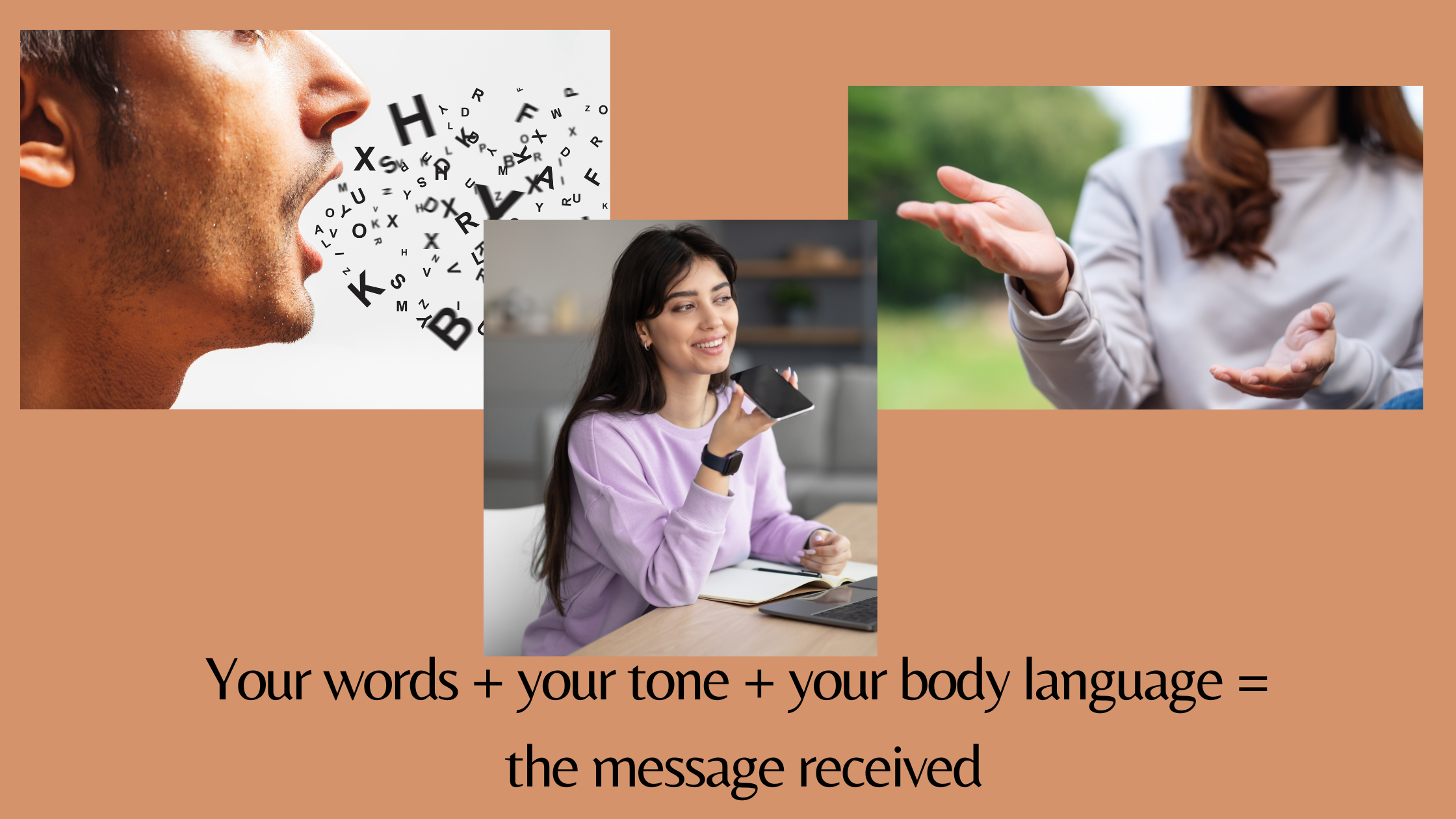
 Developed by psychology professor Albert Mehrabian in 1971, it states that “7 percent of meaning is communicated through spoken word, 38 percent through tone of voice, and 55 percent through body language.” It is astonishing to discover the words you use say only constitute 7% of what is taken in by the listener and more than half comes from your body language which involves your facial expressions, gestures, posture and eye contact.

Let’s try an exercise. Choose a sentence or two. Think of an emotion and then, saying the sentence out loud, convey that emotion using your vocal tone (pitch and pace). Repeat the sentence while thinking of another emotion. Let’s move on to body language by repeating the last exercise. Say the sentence with supporting body language. Now say it with contradictory body language. Can you hear the difference? Can you feel the difference?

Hopefully, most of the time, your voice and body language are aligned with your verbal message. The challenge is to be aware of times when the three or two of the three might not be in sync. To keep the communication channels clear, Luna offers these ways to ensure each of the ways you are sending the message you want:

Improving verbal communication: The practical ways

  • Clarity and brevity – Keeping it short and to the point is always safest. Everyone is pressed for time. Don’t clutter up your message. This is particularly important in speaking with your principal.
  • Intentional speaking – Think before you open your mouth. For important conversations, try mentally rehearsing your opening statement. Tell them what you most need them to know.
  • Eliminate filler words – “Uh’s, ” “umm’s,” and “you know’s” block the clarity you are trying to achieve. Rehearsing helps here, too.

The 38%: Using your voice effectively

  • Tone matching – Your tone of voice should match the message. The exercise you did with tone will help you keep them aligned. Don’t laugh off difficult news. Don’t assume good news will be met with more problems.
  • Pitch control – Speaking in a high pitch makes you sound nervous, which the listener may translate as unsure. Low pitches transmit confidence. Women’s pitches are naturally higher than men’s which give men an advantage here. See if you can modulate your tone lower. Also, ending your sentence with an up pitch sounds like you are asking a question, which is heard as insecurity with your message.
  • Controlled pacing – How fast or how slowly you speak can reduce the impact of what you are saying. Too fast and they may not hear every word. Too slowly and you might bore them, and they will tune out. Moderate is good for most things, with slightly faster speaking suggesting eagerness that pulls  listener in.

Strategies to improve nonverbal communication

  • Maintain eye contact – The expression “shifty-eyed” shows what happens when you don’t look someone in the eye. On the other hand, non-stop staring can make a person uncomfortable, too. Luna says “avoid doing it regularly. Instead, use eye contact as a gesture when speaking.”
  • Use facial expressions – Your face does most of your communication. A genuine smile goes a long way in getting your message heard. Do some mirror practice if you don’t feel confident with this. Head tilts also suggest interest, as does nodding when the other person responds.
  • Use purposeful gestures and open posture – You want your body to be loose and responsive to the content of what you are saying. When watching a program, see how the actors use gestures. Note how politicians use them in their speeches. Crossed arms say one thing. Hands in your pockets, another.

Save these suggestions, particularly the rehearsal ideas, for when you need your message to be as clear as possible. Whether it’s a meeting with your principal or a job interview, knowing how to communicate with clarity and confidence will have them hear and recognize you as leader you are.

Create the Culture to Make Your Library Thrive

How would you describe the culture of your library? It’s not a question we usually think about. Normally, we focus on purpose, Vision, and Mission, but this is a different way to look at what you are creating and how it is being received.

The Merriam-Webster online dictionary defines corporate culture as the set of shared attitudes, values, goals, and practices that characterizes an institution or organization.” Using this definition as a guide, you might say:

  •  The attitude of the library is that everyone is welcome here.
  • The values probably include intellectual freedom and a love of literacy and learning.
  • Your goal likely is to have students, teachers, and administrators view the library as a valuable part of their world.
  • Your practices seek to eliminate barriers to accessing the library.

If your answers closely matched the ones given above, are you certain this is an accurate analysis of your library culture? Manar Morales the author of THE FLEXIBILITY PARADIGM: Humanizing the Workplace for Productivity, Profitability, and Possibility (Georgetown University Press, 2025) collaborates with organizations to develop inclusive, flexible work cultures that cultivate diversity in leadership, foster a more humanized work experience and drive workplace well-being. In the business would, not being clear on the culture of your organization or having it misaligned leads to loss of engagement and productivity as well as higher turnover. How can we use this awareness to support our work?  

In her article “Work is Not a Place, Culture is Not a Location,” she recommends a process which can improve your culture, resulting in a flourishing, successful library. Morales starts by having you identify the following “4 ‘W’s that define culture:”

Who do you serve? – Your key stakeholders are your students and teachers. They are always primary, although there are others, including administrators, parents, and the outside community.

What do you stand for?- Your Mission Statement should drive your daily actions. What values do you hold and how can this be seen by others?

Why do you do what you do? – Beyond your library’s Mission Statement, this is your personal mission. Why are you a school librarian? What brings you back through the stress and challenges?

Where are you headed? – This is your Vision Statement. It is your inspiration and aspiration. It’s not fully realized, and may never be, but you should come closer and closer through your strategic planning.

By your answers to the 4 ‘W’s, you recognize that the library is just a room, a place, unless you can connect others to it. Relationship building is key to making the library thrive. How do you share those 4 ‘W’s with your key stakeholders in a way that connects them to the library and its value to them?

Let’s go back to the definition of culture.

What do you do daily to demonstrate the attitude that everyone is welcome in the library? On the simplest level, it starts with a welcoming smile. It also is shown by your connecting with classroom teachers and specials. Reach out to art, music, and physical education teachers. You will be amazed at what creative results you can produce together.

How are you sharing your values? Posters and displays send powerful messages. Visual images reinforce words. Are your Mission and Vision Statements posted where everyone entering the library can see them? And do your words (what’s posted) match your actions? If people feel a disconnect between what you say and what you do, they won’t feel connected to the library.

What barriers have you taken down? – Are your computers handicap-accessible? Have you eliminated fines? Does your collection include materials in languages spoken by your students? Have you taken surveys to find barriers you might not have identified?

One last step. How have you brought the library’s culture into the wider community? Have you created a way to keep parents informed about the library and students’ successes? Do they know about the accessibility? Are you and the public librarian working together on projects aimed at reaching students while informing the community? What contacts have you made with local businesses? Building connections and allies deepens and strengthens your culture.

Creating the culture that results in a thriving library is an ongoing practice. But isn’t this why you became a librarian? Look at where you are already succeeding and then take a first step to go either deeper, broader, or both. The results may embolden you!